

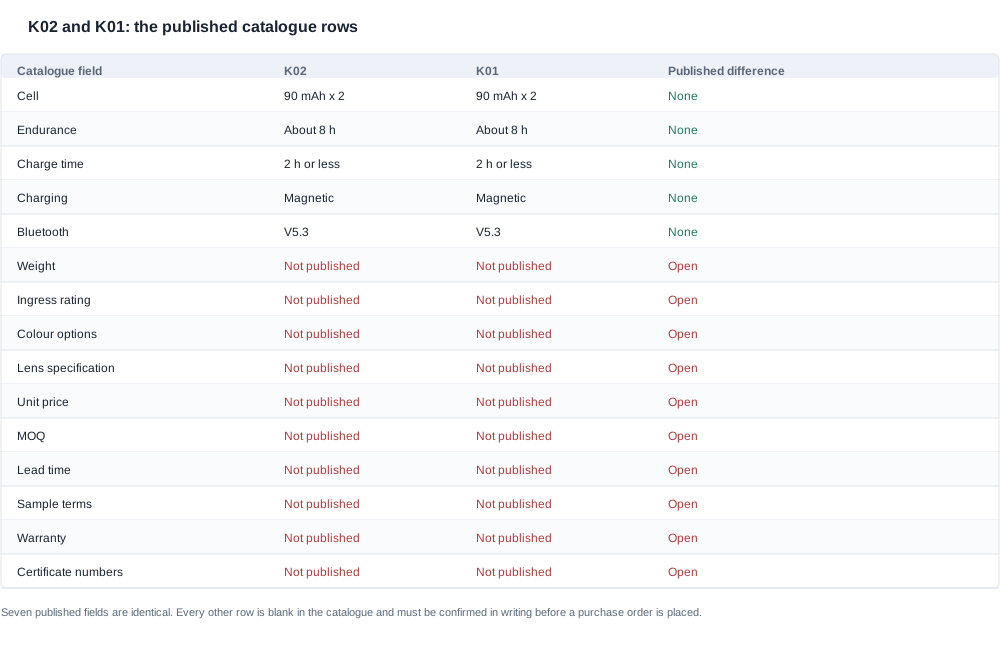
The K02 and the K01 sit in the same catalogue, two rows apart, and every published value in those two rows is the same. Same cell configuration, same stated endurance, same charge window, same magnetic charging method, same Bluetooth version. There is no column in the published data that separates them.
That absence is the finding, and it is more useful to a buyer than a list of differences nobody can verify. When two models publish identical specifications, the comparison is not finished; it has to be rebuilt from evidence. That evidence is a written answer from the supplier for the rows the catalogue leaves blank, a signed specification annex attached to the purchase order, a frozen packing list, and a change-control clause that stops the model being swapped after the order is placed.
This article is written for the person who signs that purchase order. It sets out the rows that are published, names the fields that are missing for both models, gives the exact wording to use when you request the missing information, and shows how to lay out a comparison sheet that a procurement file can defend line by line.
What the catalogue publishes for the K02 and the K01
Here is the published data for the two models, exactly as the catalogue prints it.
| Model | Catalogue name | Cell | Endurance | Charge time | Charging | Bluetooth |
|---|---|---|---|---|---|---|
| K02 | K02 AI Bluetooth Glasses | 90 mAh x 2 | About 8 h | 2 h or less | Magnetic | V5.3 |
| K01 | K01 AI Bluetooth Smart Glasses | 90 mAh x 2 | About 8 h | 2 h or less | Magnetic | V5.3 |
Seven columns, two rows, no difference. Before treating that as a defect in the comparison, it is worth reading each column as a procurement signal, because even an identical row tells a buyer something concrete about how the range has to be planned.
The cell configuration of 90 mAh x 2 is the same on both rows. Two cells per frame means a two-channel discharge path and a fixed contact arrangement, and it means the charging accessory, the dock and the carton specification can be planned once for both models. A buyer running a private label programme can size the charging accessory once and reuse it across the two SKUs, and the replacement parts stocking list that channel partners hold does not double. The same logic applies to tooling and packaging: a shared mechanical platform means one packaging design and one artwork master, not two.
The stated endurance of about 8 h is also identical, which says the two models are expected to sit in the same usage window and therefore belong in the same retail placement: same shelf, same demonstration unit, same charging point, same power budget at the counter. Two models with the same energy budget and the same radio are not two segments of a range. They are one segment with two names, and a buyer who treats them as two segments ends up splitting volume, inventory and marketing spend across two lines a customer cannot tell apart on the shelf.
The charge time of 2 h or less is an upper bound, not a measured cycle, and the catalogue does not print the condition behind it. Whether that figure describes a full discharge from empty to full, or a partial top-up between shifts, changes how you schedule charging stock in a store or a depot, and it changes what you may write in a listing without over promising. Ask for the test condition in writing and record the answer next to the number in your own technical file, rather than copying a catalogue figure into a purchase order without its context.
Magnetic charging on both rows fixes the docking method for the range. A magnetic contact arrangement drives the accessory tooling, the tolerance around the contact pads, the wear behaviour of the dock over repeated cycles, and the carton dimensions a logistics partner has to plan around. Because both rows publish the same method, one accessory plan covers the range.
Bluetooth V5.3 on both rows means the radio is identical, so the two models sit in the same device ecosystem. The same connection expectations, the same firmware and support policy, the same connectivity troubleshooting content for the retail channel, and the same level of effort if you ever need to run a firmware update across installed units. For a distributor that is good news: one support playbook covers both models, and a defect investigation on one model is a defect investigation on the other.
The two catalogue names are not identical, and it is worth being precise about what that does and does not mean. The K02 is listed as an AI Bluetooth glasses model and the K01 as an AI Bluetooth smart glasses model. The word AI appears in a name; the catalogue does not publish a feature list, a language set, an offline behaviour or a service term behind either name. Any supplier that attaches an AI label to a wearable has to answer a fixed set of questions about network dependence, subscription, data handling and supported languages before that label is safe for you to use in your own listing and advertising. Those questions are set out in the AI feature notes.
What the published rows support is a narrow conclusion, and it is worth stating it plainly: across the seven published fields a buyer cannot distinguish the K02 from the K01, and no published data justifies paying a premium for the higher model number. The published figures for the K02 on their own are set out in the K02 specification notes, and the wider entry level of the range is covered in the entry level audio glasses overview. The K01 buyer review checklist covers the questions that apply when you are comparing a single model against something outside this pairing.

Where the two rows are identical, and what that means for a purchase order
Read the two rows side by side and you reach a conclusion that is uncomfortable but genuinely useful: the K02 and the K01 are not separated by anything the published data prints. A comparison document that claims a difference on the basis of these rows would be making a claim the catalogue does not support, and in a procurement file that claim has to survive a supplier audit, an incoming inspection, and a customer who has read the same catalogue.
Three practical consequences follow from that.
The first is duplicate SKU cost. Two model names with one mechanical platform means two SKUs, two barcodes, two sets of packaging artwork, two listings to maintain, two sets of product documentation, and two lines of channel inventory, all competing for the same shelf space and the same demand. The cost of that duplication is rarely visible on a quotation because it lands in your operating cost instead of your unit price. If the difference between the two models turns out to be nothing at all, you are carrying freight, storage and administrative cost for a second SKU a customer cannot identify.
The second is specification mismatch risk. If the physical goods differ from the datasheet, the purchase order has no published row to point at. A purchase order that references a cell configuration, an endurance figure, a charge window and a radio version gives the factory something concrete to build against and gives your incoming quality control team something concrete to check. When those rows are identical for both models you need a second set of anchors, and those anchors have to come from written answers attached to the order.
The third is the assumption that a higher model number means a better platform. Buyers routinely assume the newer designation carries newer hardware. In this pairing the published data does not support that assumption at all, and it is precisely the kind of assumption that survives into a purchase order, into a price negotiation and into a margin calculation, where it quietly becomes the justification for paying more.
The position is a deliberately narrow one, and it is worth stating it here rather than leaving it to the end of the article. We will not present a specification difference the catalogue does not publish, so a buyer who needs to separate the K02 from the K01 should ask for the unpublished rows in writing rather than assume the higher model number carries an advantage. Where a difference genuinely exists it can be stated, and once it is stated it can be checked at incoming inspection against the specification annex. What we will not do is let a buyer pay a premium against a catalogue row identical to the row for the cheaper model.
There is also an entirely reasonable possibility that the two models are meant to differ in a way the catalogue does not express, such as a colourway, a packaging tier, a logo position or a channel specific bundle. A range built that way is legitimate and common. The difference is that when the separation is packaging or colour, the separation has to be visible in your own documentation, frozen in the packing list, and carried consistently through artwork, barcodes and the listing copy. A difference that exists only inside the factory and never reaches the paperwork is a difference your channel partners cannot see and your customer service team cannot explain.

The fields the catalogue does not publish for either model
The published rows cover the electrical core of the two models. Everything a buyer needs to price, place and defend an order sits outside them. The following fields are not printed for the K02 or the K01 in the catalogue, and each one has to be obtained before the purchase order is placed.
| Field not published | Why it changes the purchase decision | What to request |
|---|---|---|
| Frame weight | Decides comfort perception, shipping weight and the price band the model can carry | Net weight per unit and per shipped carton |
| Ingress protection rating | Decides the retail environment, the sports and outdoor channel, and the claims you may print | The rating, the standard used and the test report reference |
| Colour and finish options | Decides range depth and how many packaging and artwork variants you must fund | Available colour list per model and minimum per colour |
| Lens and optical specification | Decides whether a model belongs in the audio glasses band or in an optical band | Lens material, tint options and whether any display is present |
| Unit price and quantity break | Decides the margin you can build and the order size that works | A written quotation with price tiers by volume |
| Minimum order quantity | Decides whether a distributor or a small brand owner can enter the model at all | MOQ per model and per colour |
| Production capacity | Decides whether a large retail programme can be served without a shortfall | Monthly capacity and the current allocation position |
| Lead time | Decides the launch window, the launch date you can promise and the freight booking | Standard lead time, sample lead time and the peak season position |
| Sample cost and terms | Decides whether you can approve a sample before committing volume | Sample charge, refundable or not, and the courier arrangement |
| Warranty and returns policy | Decides the aftersales cost your channel carries and the defect allowance you hold | Warranty period, defect definition and the returns procedure |
| Certification and test documentation | Decides market access and whether you may claim compliance at all | Certificate numbers, test report references, issuing laboratory and date |
Two comments on that last row. First, no certificate number, no test report reference, no laboratory name and no report date are published for either model, so neither model may be described as certified, approved or compliant in your own product pages until the document is in your compliance file and its scope has been checked against the model number and against your market. The certification position for this family is handled separately in the certification status notes, and that note exists precisely because the catalogue rows cannot answer the question. Second, the same discipline applies to every other blank row: an unpublished field is not a permission to assume a good value. If the catalogue does not print the ingress rating, the rating is unknown, and an unknown is not a zero and not a pass.
The list of what this model does not publish is also collected in the K02 limitations analysis, which is the right companion document to keep open next to this comparison while you build the specification annex.
The questions to ask are short, and they are worth sending as a single written request rather than as a stream of informal messages. Ask each of them in a form that forces a specific answer, because a general question invites a general reply.
- For each model separately, what is the net frame weight in grams, and is the figure measured with or without the packaging?
- For each model separately, does an ingress protection rating exist, and if so which standard was applied and where is the test report?
- For each model separately, which colours are available, and is there a minimum order quantity per colour as well as per model?
- For each model separately, what lens material and tint options apply, and does the frame contain any display element?
- For each model separately, what is the unit price at your volume tiers, and what is the MOQ per tier?
- For each model separately, what is the production capacity per month and the standard lead time from deposit to shipment?
- For each model separately, what is the sample charge and the sample lead time, and what happens to the sample charge if the order converts?
- For each model separately, which certificate numbers and test report references cover that exact model, and may we use those documents in our own technical file?
Notice what the wording does. It asks per model, it asks for numbers rather than adjectives, and it asks for document references rather than assurances. A supplier who cannot answer a single one of those questions for a model is telling you something important about that model, and the answer belongs in the comparison sheet rather than in a verbal assurance nobody can audit later.

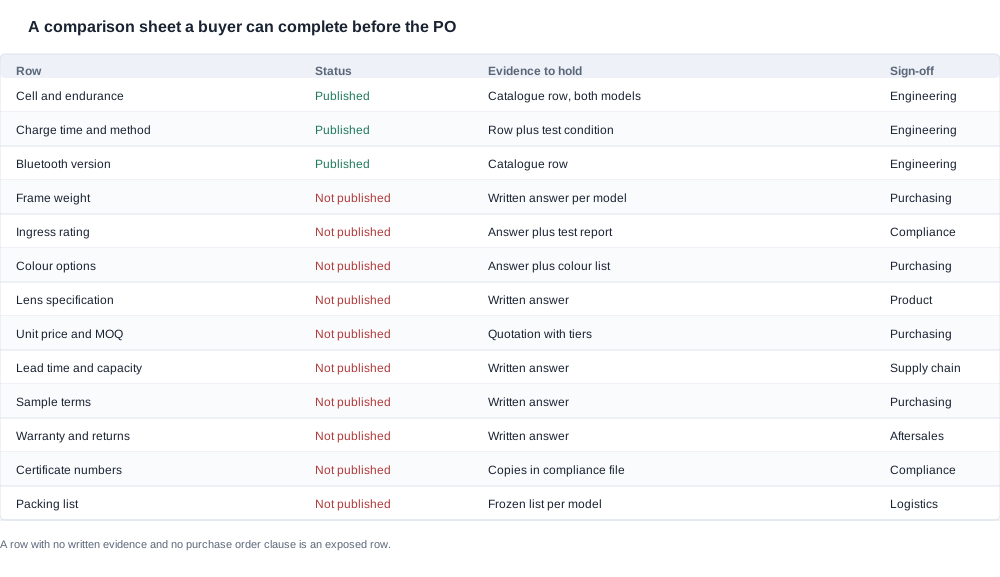
A comparison sheet a buyer can complete before the PO is placed
The purpose of the sheet below is not to look like a spec table. It is to separate three things that are routinely mixed together in a buying decision: what is already published, what is still an assumption, and what has been confirmed in writing and frozen.
| Row | Catalogue status | Evidence to hold | Clause to write into the PO | Sign-off |
|---|---|---|---|---|
| Cell configuration | Published, 90 mAh x 2, identical | Catalogue row, retained | Build to 90 mAh x 2 cells | Purchasing |
| Endurance | Published, about 8 h, identical | Catalogue row plus the test condition | Stated endurance with test condition | Engineering |
| Charge time | Published, 2 h or less, identical | Catalogue row plus the charge condition | Charge within 2 h or less | Engineering |
| Charging method | Published, magnetic, identical | Catalogue row | Magnetic charging, accessory listed | Engineering |
| Bluetooth version | Published, V5.3, identical | Catalogue row | V5.3 radio, firmware scope fixed | Engineering |
| Frame weight | Not published | Written answer per model | Net weight stated per model | Purchasing |
| Ingress rating | Not published | Written answer plus report reference | Rating and standard stated | Compliance |
| Colour options | Not published | Written answer plus colour list | Colour list, MOQ per colour | Purchasing |
| Lens specification | Not published | Written answer | Lens material and options stated | Product |
| Unit price | Not published | Written quotation with tiers | Price tier and currency stated | Purchasing |
| Minimum order quantity | Not published | Written answer | MOQ per model and per colour | Purchasing |
| Lead time | Not published | Written answer | Lead time in weeks, from deposit | Supply chain |
| Capacity | Not published | Written answer | Monthly capacity reserved | Supply chain |
| Sample terms | Not published | Written answer | Sample charge and refund terms | Purchasing |
| Warranty | Not published | Written answer | Warranty period and returns route | Aftersales |
| Certification documents | Not published | Copies held in the compliance file | Certificate numbers listed | Compliance |
| Packing list and carton data | Not published | Frozen packing list per model | Carton contents frozen | Logistics |
Read across that sheet and the criteria for a decision become obvious. A row that is published and identical needs no negotiation; it needs copying, and it needs the same copy on both models. A row that is not published needs an answer, and until that answer is in your file the row is an open risk that belongs in the same document as the price.
The sequence that makes the sheet work is straightforward.
- Freeze the published baseline. Copy the seven published fields into your own technical file for both models, exactly as the catalogue states them, and mark them as published rather than confirmed. This becomes the reference against which every later answer is checked.
- Issue one written request per model, covering every unpublished row, using the wording above. One request, two model blocks, so that an answer covering only one model is immediately visible.
- Convert the answers into a signed specification annex, attached to the purchase order and referenced by clause number. An email reply is a starting point; an annexed and signed sheet is the document your incoming quality control team can work from.
- Freeze the packing list, carton markings, accessory contents, languages on the packaging and the packaging artwork per model, and attach the frozen version to the order.
- Put change control in the purchase order. Any change to the model designation, the cell configuration, the radio, the firmware scope, the accessories or the packaging requires a written amendment and a re-approval before it is implemented. No substitution without a signed amendment.
- Log what is still open at the moment the purchase order is placed, name an owner for each open row, and set a date. An open row with a named owner is manageable; an open row that is only a concern is not.
The total cost comparison belongs at step 2 and not at step 1, because the unit price is not a published figure. The landed cost of each model has to be built from the quotation plus freight and duty plus packaging, artwork and certification amortisation, plus the aftersales allowance implied by the warranty and the returns policy. Two models with identical published specifications can still have different landed costs, and that difference, not the specification table, may be the only real separator between them. Payment terms, incoterms and the deposit structure belong in the same calculation, because a short lead time with a large deposit and a firm shipment commitment is a different commercial proposition from the same lead time with different terms.
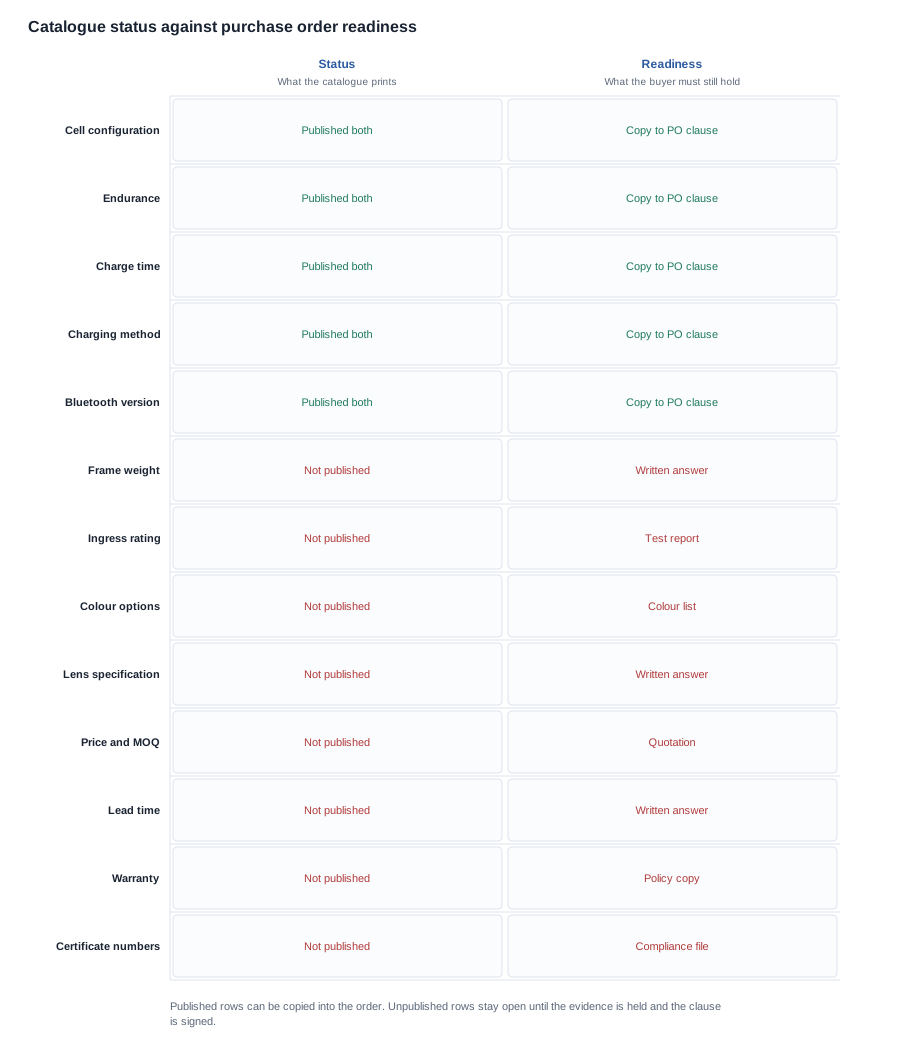
The matrix above is the same sheet reduced to three states, and it is a useful diagnostic. A row that is published but has no written evidence and no purchase order clause is a row that is exposed. If your comparison sheet has many rows in that state, the order is not yet ready, regardless of how attractive the quotation looks.
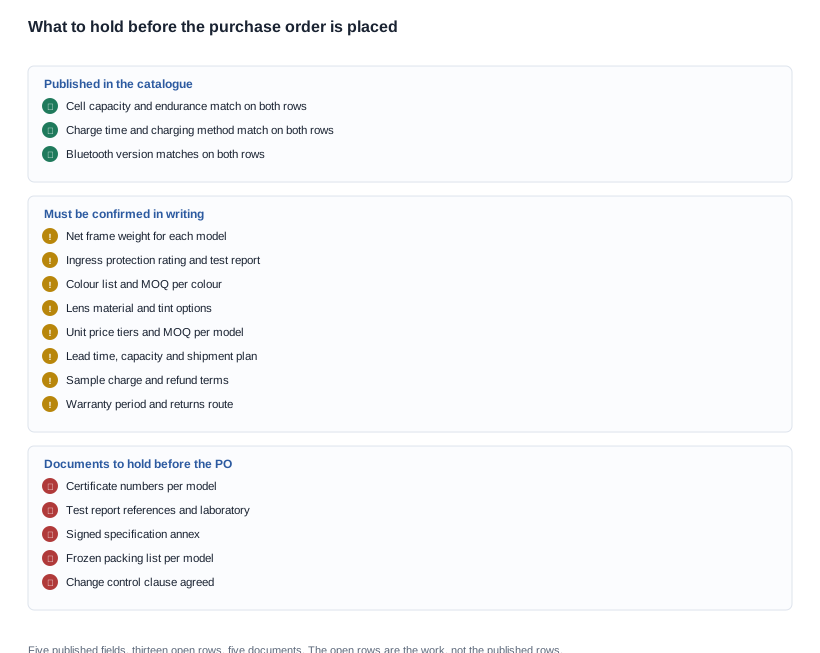
Three further points belong in the same file. First, a supplier who answers every question for one model and declines to answer for the other has effectively told you the two models differ, and the refusal is the evidence. Second, a supplier who answers that the two models are identical and then ships goods that differ in any physical respect has created a contract gap, which is why change control and the frozen packing list exist. Third, the commonest red flag in a comparison like this is a specification sheet that names one model and is presented as covering both; a document that names a model covers that model, and a test report for the K01 is not evidence about the K02.
A fourth point is about the paperwork you may need to satisfy a customer or a regulator rather than a supplier. When you offer a bulk order to a channel partner, they will ask for a technical file that matches what they are about to sell, and they will ask for a declaration of compliance that matches the model on the box. If the only document you can produce names the other model, that is a due diligence failure waiting to surface in a claim. Build the file for both models at the same time, even when the two SKUs are consolidated on one production line.
Choosing between the K02 and the K01 when the catalogue rows match
Once the sheet is complete, the decision resolves into one of three paths, and which one you are on is decided by the evidence rather than by the model number.
If the supplier confirms in writing that the two models differ in a way that matters to your channel, the comparison sheet becomes an ordinary shortlist exercise. You evaluate on the confirmed rows, add the landed cost calculation, and the higher model number earns its position only if the confirmed difference justifies the price difference. That is the honest version of this comparison.
If the difference turns out to be commercial rather than technical, meaning pricing tiers, minimum order quantities, colour depth, packaging tier or delivery timing, then the decision is a business decision and should be made on those grounds. In that case the range structure is fine, but the packaging, the artwork and the listing copy must make the difference visible, because that is the difference the customer will meet.
If the two models are confirmed as the same platform with no meaningful separation, the commercially sound move is to run one SKU, keep the second name as a variant behind it if your channel needs the naming, and spend the savings on artwork, certification and inventory depth rather than on a duplicate line.
What we will not do is publish a difference we cannot evidence, and we do not treat an unstated value as a favourable one. The published figures for this family are set out in the K02 specifications and features, the constraints are listed in the K02 limitations, and if the real question is which frame to put on a product page rather than how to name two lines in a range, the K01 against G07 form factor comparison is the more useful document.
Related reading
- Where the K01 sits against the rest of the audio range — K01 smart glasses buyer review checklist
- The published figures for the K02 — K02 smart glasses specifications and features
- Buying the range rather than a single model — Bluetooth audio glasses entry level options
- The full category this pair belongs to — Bluetooth Audio Glasses
Tell us the target market, the volume plan and the models you are weighing, and we will return the confirmed rows in writing so the comparison sheet can be completed before the purchase order is placed.


