

If you are looking for a d12 smart glasses vs k02 which one to choose answer, you will not find one in this article, and you should be suspicious of anyone who gives you one. These two models print almost the same specification sheet, and the two rows that do differ, the charging interface and the Bluetooth version, are decided by your supply chain rather than by the product. This piece is the selection method: the constraints to fix first, the rows that then answer them, the questions to put in writing, and the point at which this pairing stops being the right shortlist at all.
What the two models actually publish. The D12 states Bluetooth V5.4, a 100 mAh cell, a charge time of two hours or less, about seven hours of use and Type-C charging, and it carries no feature row at all. The K02 states Bluetooth V5.3, two 90 mAh cells, a charge time of two hours or less, about eight hours of use and magnetic charging, and it also carries no feature row. Two audio models, one cable interface against one dock interface, one hour apart on a use-time claim that neither model explains, and nothing else.
D12 and K02: a selection method, not a verdict
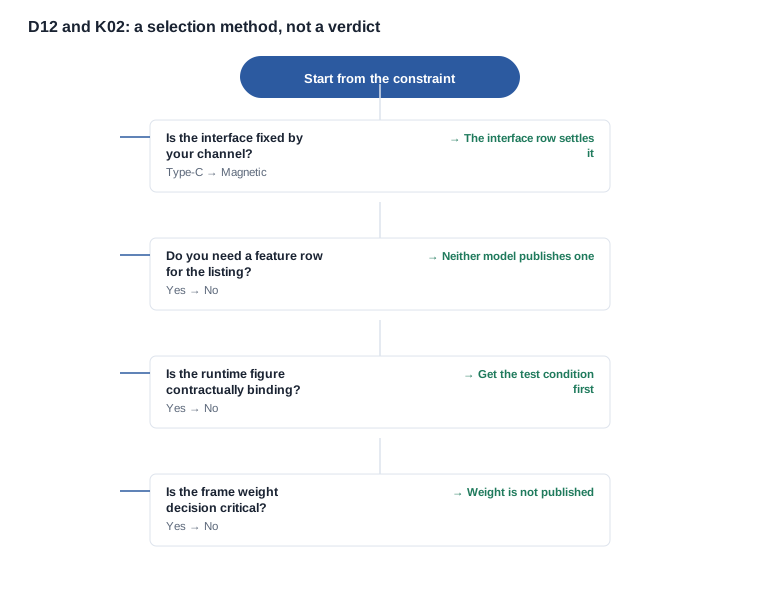
A selection method that ends in a model name is not a method, it is a preference with paperwork. What follows instead is an order of operations: fix the channel constraints, read the rows those constraints point at, collect the evidence for the rows that stay blank, and only then look at the two models side by side. When the method is followed honestly, a buyer often finds that the answer was decided in the first step and the model comparison was never the hard part.
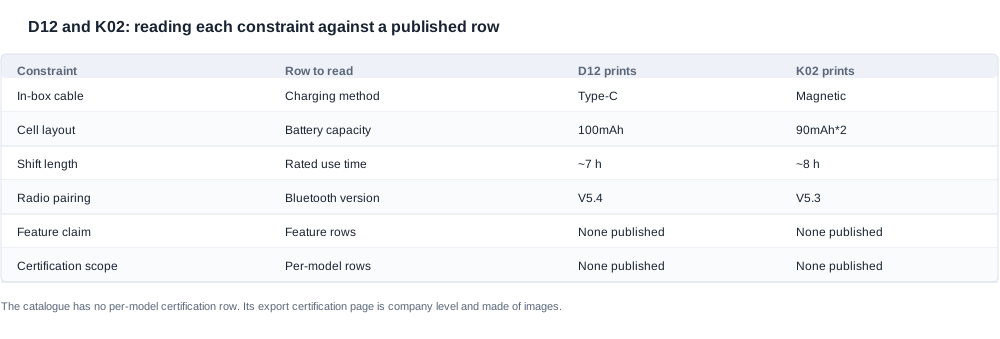
The table above is the whole method in one grid. Each row of it is a constraint a procurement team already knows the answer to, because a constraint comes from the channel: what is already in the box, how the product is charged in the field, what the packaging can carry, what the listing has to say. The second column is the catalogue row that speaks to that constraint. The third and fourth columns are what the two models print. Only one of those four constraints — the interface — produces a different published answer between the two models.
Why the two rows that differ are channel facts
Charging method. Type-C against magnetic. The D12 asks the customer to own a cable; the K02 asks the customer to own a dock. This is decided by what your channel already standardises on, by what your packing line can hold, by what your customer service team is prepared to explain, and by whether you want to ship a proprietary accessory in every unit. None of those four considerations is a property of the device.
Bluetooth version. V5.4 against V5.3. This is a one-generation gap, and the honest reading is that it will not decide a buying decision on its own. It will, however, decide a comparison sheet, because a competitor's listing will place the two figures next to each other, and a buyer who is asked to explain the difference has to have an answer ready. The Bluetooth connectivity page covers what a radio version does and does not establish, and it is worth reading before that conversation rather than after it.
What the method deliberately does not do
It does not rank the two models, and it does not treat the extra hour of published use time as a tiebreaker. Both models publish a use time without a stated condition, so the hour between them is a difference in two unpublished test procedures, not a measured advantage. Ranking on it would mean ranking on a figure that neither supplier has yet agreed to stand behind.
It also does not read across to the rest of the range. A buyer who works the method and arrives at an empty shortlist has not failed; the method has done its job by showing that this pair does not fit the channel, and the range is wider than two models.
The interface constraint and the pack it produces
Most channel decisions in this category are made at the packing line, and it is worth being blunt about that, because it is where the money is. The interface decision determines the bill of materials for the pack, the instructions, the support script and the return reasons.
What a Type-C model costs the channel
A Type-C product asks for one extra item in the box: the cable. That item has a length, a current rating, a connector standard and a unit cost, and each of those can be specified. It also produces a customer who can charge from a laptop, a power bank or a wall adapter they already own, which removes a whole category of support contact. Against that, a cable in the box is easily lost, and a customer who has lost it will buy another one from a third party, which is a small, silent cost to your accessory business and a slightly larger cost to your brand perception.
What a magnetic model costs the channel
A magnetic product asks for a dock. If the dock ships in every unit, it is a packing cost, a colour and finish decision, a logistics cost, and a second item that can be lost. If the dock does not ship in every unit, it becomes a separate line item with its own minimum order quantity, its own shipping profile and its own customer education problem, and it puts your buyer into a market where a dozen dock variations exist for one model. Buyers in this category regularly find that a model with no dock in the box generates a disproportionate share of first-month support contacts, because seating a magnetic contact is a skill and the customer does not know it is one.
The docking decision also has to be made at the same time as the quantity decision, because the dock and the device often have different order quantities, and the minimum order quantity page covers how that arithmetic is usually structured. The D12 charging options piece works through the cable-versus-dock argument in more depth, and the charging options for the range sits alongside the product pages.
The cell count question that follows from it
Whichever interface you settle on, the two models differ in how the mass is arranged, and neither page publishes a weight. The D12 carries a single 100 mAh cell; the K02 carries two 90 mAh cells, one per temple. Two cells spread the mass, and they also mean two contacts and two charging points, which changes how a dock is designed and how a fault is diagnosed. A single cell keeps the service path simple, because there is one cell to replace and one pair of contacts to inspect.
Because no frame weight is published for either model, this cannot be closed from documentation. It has to be closed on a sample, weighed, with the result written into the specification sheet. The materials and ergonomics page covers what a procurement team can check on a sample and what it has to ask for.
The order to run the checks in

The sequence matters more than it looks. If the interface constraint is settled last, a buyer will have already collected samples, sized the pack and briefed a designer around the wrong accessory model. If the constraint is settled first, the sample request itself becomes a sharper document, because the buyer knows exactly which questions the sample has to answer. The five steps in the chart above are the ones we would put in a sourcing request, and the fourth one, recording what the supplier confirmed in writing, is the step most often skipped and the one that decides whether the next order goes smoothly.
The same advice applies to the second sourcing round. Suppliers change, and a specification sheet signed eighteen months ago is a record of one conversation rather than a standing fact. Re-running the same short list of questions on every reorder, in the same format, is how a channel keeps its product page honest without rebuilding the file each time.

Runtime and Bluetooth version: the two rows to discount
Two of the four published differences between these models are the two a buyer is most tempted to lead with, and both are the weakest evidence available. Working through them is the most useful part of the method.
The runtime row, and why the intuitive reading fails
The K02 publishes about eight hours from two 90 mAh cells. The D12 publishes about seven hours from a single 100 mAh cell. The intuitive reading is that the larger total capacity produces the longer figure. The catalogue does not support that reading elsewhere: the LC-105 pair publishes the same 55 mAh × 2 configuration at about eight hours, while the G07 and the YK12 publish the same configuration at about six hours. Two models, same printed cell configuration, different published use times. The capacity number therefore does not predict the use-time number in this catalogue, and a buyer who quotes one as though it predicts the other will be wrong in a way nobody can audit.
What the row does tell you is that the K02's published claim is an hour longer. Whether that hour is real for your customer depends on conditions nobody has published: the start state of the cell, the volume the audio was played at, the content, whether the radio connection was held open, and the ambient temperature. Ask for the condition, and if the supplier will not give it, keep the word "about" in the copy and treat the figure as a catalogue description rather than a deliverable.
The Bluetooth row, and the question it does not answer
V5.4 against V5.3 tells a buyer which radio specification each model was built against. It does not tell the buyer how many device profiles the model stores, whether it reconnects automatically to a paired phone, what happens when a second device calls the same unit, or what the radio does to the use-time figure. Those four behaviours are the ones a customer notices and a support team explains, and none of them appears on either page.
The radio qualification question is separate again. A published Bluetooth version is not a statement that the radio is qualified for a given market, and the Bluetooth SIG material sets out the separate evidence trail a channel needs when a market asks for it.
The scenarios where this pairing is the wrong shortlist
There are three common situations where the D12 and the K02 are the wrong two models to be comparing, and recognising them early saves a sourcing cycle.
When the listing needs a named feature. Neither model prints a feature row. The D12 page carries no feature row at all, and the K02 page carries none either. In a range where other audio models do carry rows — the D11 with a surround-sound row, the G07 with a slim and detachable temple row, the YK12 with a surround-sound and slim-temple row — a channel that needs a differentiator in the copy cannot build it on this pair. The D12 against the D11 comparison is the usual first alternative because the D11 shares the D12's cell figure and interface and adds a feature row.
When the channel already carries a dock standard. If magnetic docks are already in the distribution channel for other products, the K02 is the one that slots into an existing line, and the D12 is the one that adds a new accessory. This is not a quality statement; it is an inventory statement, and it is often the heaviest one on the final landed cost.
When the customer needs a longer published use time as a headline. If the product page has to lead on the number of hours, the K02's published row is one hour longer. That is a legitimate commercial reason to prefer a model, and it is a reason about the copy rather than about the hardware. The D12 battery life page covers the condition question in the same way for the D12.
There is also a structural point worth making about the K02. The catalogue prints no row that distinguishes the K02 from the K01: both state V5.3, two 90 mAh cells, two hours or less, about eight hours, magnetic charging and no feature row. If a channel is choosing between the K01 and the K02 on published data alone, there is nothing to choose on, and the question becomes which supplier conversation is more likely to produce the missing rows. That comparison is covered in the D12 and K01 spec comparison.
What we will put in a quotation, and what we will not
On the D12 and the K02, our position is that this pair is decided by logistics and by evidence collection, and that the two rows buyers usually open with, runtime and Bluetooth version, are the two the documentation supports least. We would rather you choose on the interface your supply chain can carry and on the sample you have held, than on a number we have not been able to condition.
What we will quote. The published rows for either model, exactly as the catalogue prints them: cell values and cell counts, the charge-time ceiling of two hours or less, the published use-time figure with the word "about" attached, the charging method, and the Bluetooth version. We will also tell you, in writing, which rows we do not hold: frame weight, acoustic behaviour, ingress rating, colour options, control method, per-model certification scope, and the acoustic descriptor behind the surround-sound row that other models in the range carry.
What we will not quote. A ranking. A total capacity without the cell derivation beside it. A charge time described as a precise duration when the catalogue publishes a ceiling. A price tier, a value ranking or a recommendation, because the catalogue publishes no price and we do not publish one. We will not quote a certificate number, an issuing body or a test report reference that we do not hold, and we will not describe a catalogue marking as a certified result. The certification checklist is the right starting point for that conversation.
The questions to put in writing before a specification sheet is signed. Frame weight in grams, measured or declared, with the cell fitted. The use-time test condition, including start state, volume and radio state. The charge-time test condition, including the end criterion and the input current. The acoustic figures needed to write a defensible product page. The pack contents, including whether a dock ships and at what quantity. The minimum order quantity, the sample cost, the production capacity and the delivery plan, which we will treat as commercial terms to be negotiated rather than as published facts. The procurement guide on payment terms and the quality consistency page cover how those usually get written into an agreement.
How to close the gaps. Order samples of both models at the same time, run the same acceptance sequence on each, and record the results in the same format. The D12 buyer review checklist is written for that pass, and the sample procedure covers the order and inspection steps. Where the answer comes back as "typical", ask for the figure that will appear on the specification sheet instead.
The shortlist request, in the form it should be sent
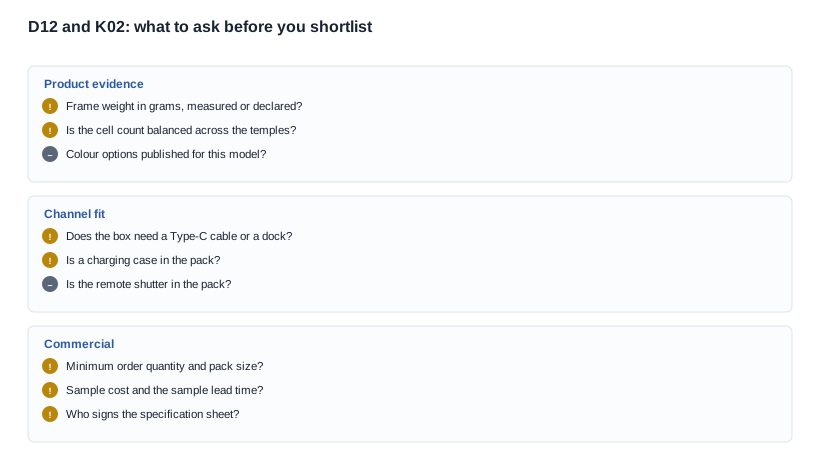
The checklist above is deliberately short, because a long questionnaire gets answered thinly. Every line is either a fact we do not publish, a fact we publish without the condition that makes it usable, or a commercial term that has to be negotiated rather than assumed. Sending it as a table, with the model name and the date in the header of each answer, produces a document that can be filed in the technical file and re-checked on the next order.
Two of those lines deserve a note. The case question, in the pack group, is not a trick: a magnetic interface is often assumed to imply a case, and the catalogue does not publish a case row for either of these models, so the buyer has to establish whether one exists before a product page can promise it. The certification line is broader than it looks, because the catalogue has no per-model certification row for any of the 28 models, which means the scope of any document the supplier offers has to be checked against the model name rather than against the family name.
Send us the interface your channel standardises on, the pack you intend to ship, the target market and the quantity, and we will tell you which of these two models the published rows keep in scope, and exactly which rows are still open on each.
Related reading
- The range both models belong to — Bluetooth audio glasses
- The two models as product pages — the D12 and the K02
- The alternative route when a feature row is needed — D12 against D11
- Where the blank rows are collected — certification checks
Send us the interface, the pack, the market and the quantity, and we will tell you which of the two models the published rows keep in scope.


