
This article starts with a disclosure, because everything after it depends on it. Our catalogue publishes no blue-light filtering parameter for any model. There is no wavelength range, no filter ratio, no transmittance figure, no lens substrate specification and no optical test result anywhere in the range, and there is no eye-care claim attached to the A05, the A06 or the A07. So this page cannot tell you what the filtering performance of a kids product is, and no sentence in it should be read as doing so. What it does is set out how claims of this kind reach a purchase file, what evidence would be needed to support one, and what a channel should write in the meantime.
That framing is not pedantry. A phrase such as "reduces blue light" or "protects eyesight" is the kind of wording the market uses loosely, and in a children's product the loose version and the evidenced version are not the same statement. We have no data on the loose version either, so the only honest position is to treat every instance of it as a claim that somebody has to evidence, and to say plainly which parts of it we can and cannot help with.
The second boundary is the one that decides the whole commercial conversation. A unit that detects a posture or a viewing distance and reminds is a prompt device, and the position we take on what that does and does not mean is written up in the age-band piece rather than restated here. The framework behind the question sits on the child product compliance page, and neither that page nor our own line on the boundary, which is on the claim boundary note, is a substitute for a test report on a lens.
Kids smart glasses blue light claims: what our catalogue does and does not contain
Here is the complete position, stated in the order a procurement team usually asks for it.
The optical parameters: none are published. Not for the A05, not for the A06, not for the A07, and not for any other model in the range. We do not publish a filter ratio, a wavelength range, a transmission curve, a substrate material, a coating description or a lens tint for the children's models.
The eye-care claim: none is made. Our published rows for the two protective models describe what the unit senses and reminds about, and the catalogue lists a fogging unit, a lens clarity line and a lens fogging line as feature rows. Those are descriptions of function. We do not convert them into a statement about eyesight, and we do not describe these units as clinical devices.
The only certification-type material in the catalogue is not optical material. Our export-certification page is made of images rather than text, and every one of them is a certificate of patent. A patent records novelty and nothing else; it establishes nothing about what passes through a lens, and it is not a conformity document. The conformity paperwork for these models has to be requested from the supplier.
The radio and the regulatory frame are separate questions. The audio model publishes a radio generation. The radio framework and the electromagnetic compatibility framework are two different instruments, with their own numbers and their own scope, and a file that covers one does not cover the other. Harmonised standards listed in a test report are the standards used, not certificates held, and they should never be presented as a certificate in a procurement pack.
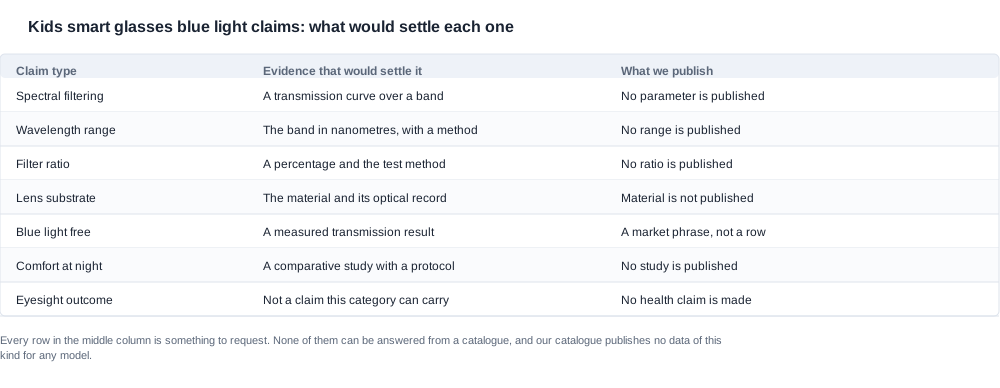
Read the middle column of that table as a shopping list. Every entry is something to request, and none of them can be answered by us.
The four-word test for a listing line
Any wording in a product listing that contains a verb or a noun from this list converts a description into a claim: reduce, block, filter, cut, shield, protect, ease, relieve, prevent, improve, correct, treat. The test is not about whether the sentence sounds reasonable to a reader. It is about whether a reviewer with a document in hand would be able to point at the line in that document that supports the sentence.
Applied honestly, the test clears a great deal of copy that is currently in circulation. "The unit detects posture and viewing distance and reminds" passes, because the catalogue publishes a row for it. "The unit reduces blue light during screen time" does not pass, because no such row exists in our documentation and no measurement accompanies it. "Designed for kids eye care" does not pass, for the same reason and for a second one: it describes a purpose rather than a function, and a purpose statement invites a reader to draw a conclusion the specification does not support.

Where the wording comes from before it reaches your specification sheet
Most blue-light wording in a children's product does not originate with the manufacturer. It arrives from one of four places, and knowing which one tells you what to do about it.
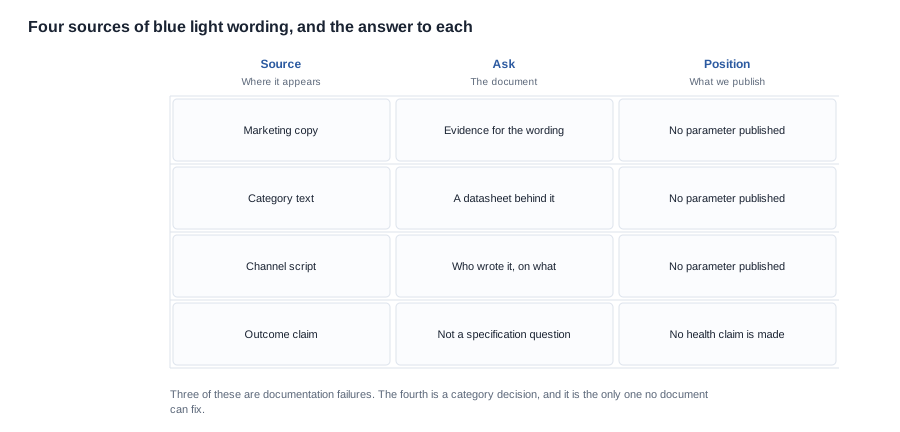
Marketing copy from an adult line, adapted. This is the most common and the most dangerous. An adult catalogue in the same range may well carry a lens description that was written to answer an adult retailer's question. The wording gets lifted into a children's listing because it reads well and because the product photograph is the same shape. The evidence, if it ever existed, was for a different model on a different form factor. Ask which model the supporting document names, and expect the answer to be a different designation.
Platform category text and attribute fields. Marketplaces and retailer portals carry category descriptions, searchable attribute values and short bullet lines that are usually written centrally rather than by the brand. Once a value is set in a portal, it propagates to every listing in the feed, including listings for a model that has no data behind it. These fields are frequently the hardest to correct and the easiest for a buyer to overlook, because they look like catalogue data rather than marketing copy.
A channel script, a training deck or a salesperson's line. This is where the phrase is most often used loosely, and where it does the most damage, because it is spoken rather than printed. A script is also the easiest thing to change: a one-page withdrawal notice to the channel team removes it in a way that no listing correction removes it from a sales conversation.
A comparison sheet assembled by somebody else. A buyer's own spreadsheet, built from a mixture of catalogue sheets, retailer pages and a competitor's marketing material, can contain a filtered-language column that no supplier ever asserted. A chart that arrives without a source column is a chart to treat as unverified until the sources are attached.
The practical consequence is that a procurement review that only reads the supplier's own listing will miss at least two of these four. A shortlist should be built by asking where each piece of wording came from, and by treating any wording that cannot be traced to a document as unverified — which is a different thing from false, and a much more common thing.
Why a claim inherited from an adult line is the worst case
An inherited claim is the case where the evidence, if there is any, points at a different product. That is the case a reviewer will find, and it is the case that turns a documentation gap into a recall discussion, because the same wording will already be on packaging in a market that has its own rules about what may be said about a lens.
Three questions close it quickly, and they are worth sending before anything else on this topic.
- Which model does the supporting document name? If the answer is not the ordered designation, the claim does not travel.
- Does the result vary by colourway or by size? A report that covers one variant of a lens does not cover the whole range, and a children's line with several colourways multiplies that gap.
- What is the scope of the result? A figure produced on a set of samples from one production run is a different statement from a figure that applies to every unit the supplier will ship.
If the supplier cannot answer the first question, the remaining two are moot, and the claim should come out of the listing until it can be answered. The decision is cheap at the specification stage and expensive after the artwork is on the shelf.

The evidence that would settle a claim of this kind
The request below is deliberately mechanical. It asks for things that can be produced and checked, rather than for assurances, because an assurance about a lens is worth very little to a reviewer and is impossible to verify later.

- The claim wording, verbatim. Ask for the sentence exactly as it appears on the packaging, in the language it will be printed in. The gap between a claim and its evidence is usually one or two adjectives, and those are the words that need a reference attached to them.
- The measurement method. The wavelength band over which transmission is reported, expressed in nanometres; the filter ratio as a percentage; the light source; the instrument; the sample count; and the conditions. A ratio with no method is not a measurement, it is a number.
- The correspondence between the report and the model. The report has to name the ordered designation. If the result depends on the variant, the report has to name the variant. If it depends on the production batch, the buyer needs to know that, because it changes the re-testing obligation.
- The issuer and the date. Who performed the work, under what accreditation, and when. A report with no date has no validity, and a report from a different supplier's component house is not a report on the finished product.
- The reference that maps to the wording. A number, a page or a clause, attached to each line of copy the channel intends to publish. Without a mapping, the copy and the document are two separate objects that happen to be in the same file.
- The exclusions. What the result does not cover. Batch, tolerance, storage, cleaning, and the effect of wear on the lens are all ordinary exclusions and all of them are live issues for a product in a school bag.
A seventh item sits outside the optics and is worth adding to the same request: the conformity documentation the manufacturer holds for the model. Whatever the lens turns out to be, the product still has to be documented for the market it is sold into, and the requirements that apply are the ones the buyer's own compliance party identifies for that market and for that band, and the frameworks it weighs are set out in the shipping-side piece.

How to rewrite an unsupported assertion into a question
A channel does not need to wait for a test report to begin selling. It needs to stop making the assertion and start asking for it, and that substitution is straightforward once the vocabulary is fixed.
Before: the unit reduces blue light and protects young eyes during screen time.
After: the unit detects posture and viewing distance and reminds; the supplier has been asked for the lens transmission data and the test method behind it, and the listing will carry that data only once it arrives in writing, named against the model.
The rewrite works because it does two things at once. It keeps the one function that is documented, and it converts the undocumented assertion into a tracked request with an owner. A buyer who has done the rewrite once can reuse the wording across every line in the feed, which is a considerable saving over editing copy one page at a time.
Three rules make the rewrite enforceable.
Never let a function and a conclusion share a sentence. Detection and reminder on one side, an outcome for the child on the other, and never in the same breath. The connective tissue that makes an outcome claim persuasive is exactly the connective tissue that has to be cut.
Do not let a product name carry a claim. If the channel's internal name, the listing title or the product family name contains an eye-care phrase, the phrase is part of the claim whether or not the description qualifies it. Names are the hardest thing to change after a listing goes live and the hardest thing for a reviewer to ignore.
Keep the requested evidence in the file even when the answer is no. A recorded refusal, or a recorded non-answer, is worth more to a later reviewer than a silent omission, because it shows the question was asked. It is also the basis for the clause that obliges the supplier to update the documentation pack when something changes.
The four questions to ask, in one message
The A05 specification piece sets out what the published rows for the protective models do and do not cover. The blue-light question is a separate request, and it is best sent on its own so that it is not answered in passing.
- Does any measured optical data exist for the ordered model, and if so will you provide the method, the issuer, the date and the model designation on the report?
- Which wording is currently used on your own packaging and in your own channel material, and which document supports each line?
- If a result is limited to a variant, a batch or a supplier component, what is the exact scope, and which other variants does it exclude?
- What will you state about the lens that is supportable today, in wording you will stand behind?
Question four is the productive one. A supplier who answers it honestly will often propose narrower copy that survives review, which is a better commercial outcome for the channel than the widest copy and a discovery later. The technical background on the range is at kids eye care.
The evidence request as a one-page checklist
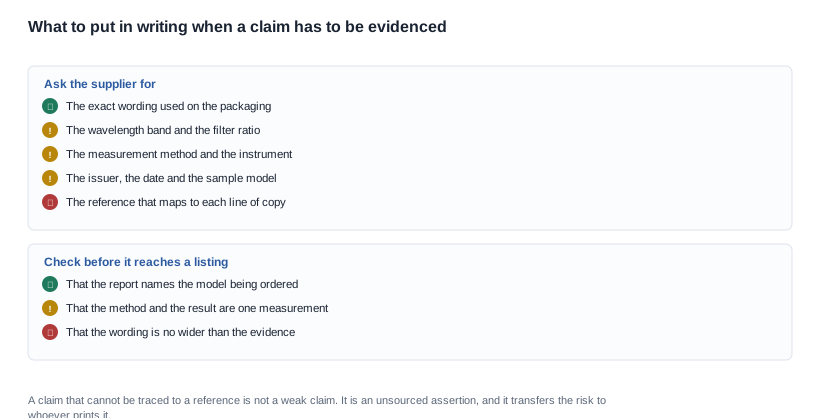
The checklist is built to be pasted into a request, and it is split the way a reviewer works rather than the way a supplier prefers to answer. The upper group is what a supplier is asked to produce; the lower group is what the channel checks on receipt, before the copy reaches a listing.
The order matters more than it looks. A supplier who sends a report first, without the claim wording in front of them, will send whatever report is to hand, and the channel then has to work out which line it was supposed to support. Putting the wording in the first message costs nothing and prevents most of that work. The second group is short on purpose, because it is the set of checks that a copy reviewer, a marketplace and a market surveillance officer will each perform independently.
What goes in the purchase order once the copy is clean
The commercial cost of a claims-clean listing is almost entirely rework, and rework is priced into the artwork round count and into the time a channel spends auditing listings it did not write. Two decisions reduce it.
Decide the scope of the claim review before the first artwork round. The number of copy lines in scope, the number of models the supplier reviews in one pass, and the number of destinations the approved wording covers are all negotiable, and all of them are much cheaper to change while the copy is still a document than after it is on a listing page. A channel that reviews its own catalogue copy twice and then asks the supplier to check only the lines it flagged will spend less than a channel that asks for a full copy review of every model, every variant and every language.
Fix the deadline for the optical data in writing, and let the copy travel without it. If the measurement arrives inside the deadline, the wider wording goes in. If it does not, the narrower wording goes in and the item stays open in the file. Writing that rule down before the deadline expires is worth more than the deadline itself, because it removes the temptation to approve the wider wording under time pressure.
What is not negotiable is the measurement itself, the elapsed time of an optical test, and the requirement set that the buyer's own compliance party determines for the destination market and the age band. Those are inputs to the programme rather than variables in it, and a commercial negotiation that appears to move one of them is moving something else.
Six clauses belong in the purchase order, and each one ties a line of copy to the document standing behind it: each designation tied to the document that covers it, listed against the order; the evidence reference recorded against each approved line of copy, so that the artwork and the document stay linked; a requirement to give notice before any change to the lens material, the coating or the supplier of that component; a standing duty to reissue the documentation pack whenever the applicable standard is revised; and a clear statement of who bears the cost when a lot ships against copy that was approved on a document that has since been withdrawn.
The red flags are worth naming, because each of them looks reasonable on the surface. A supplier who answers with an assurance instead of a document has declined the question politely. A report that names a different model has not been checked. A result with no date cannot be relied on. And a line of copy that is wider than the evidence behind it, however well it reads, is the one that a reviewer will find.
What a kids channel can state today, and what it has to defer
A channel can state, without any further evidence, that the two protective models sense a posture and a viewing distance and prompt the wearer, which is exactly what their catalogue entries record. It can state the electrical facts that are published, including the cell and the rated endurance, and it can state the ceiling on the charge time, the charging method and the radio generation on the one model that publishes a generation. It can state the absence of any published optical parameter, which is a factual statement about a catalogue rather than a performance statement.
Everything else is deferred. The filter ratio, the wavelength range, the substrate, the tint, the transmission curve, any comparison against a display, any statement about comfort at the end of a day, and any statement connecting the unit to a child's eyesight are all claims that require evidence we do not have and have not asked to be estimated.
That list is not a gap in our catalogue that a buyer should accept. It is a list of items a buyer should be willing to pay for, in the form of a documented measurement attached to the model, before the copy goes out. The kids smart glasses range is where the models sit, and we will tell you which of the questions above our documentation answers today and which have to go to the supplier with a date against them.


