

Exporting a children's line is less a question of documents than a question of answers, because the paperwork in a children's shipment is only ever a record of decisions that somebody already made. A border query, a retailer refusal or a hold on a consignment is not a documentation failure in the usual sense; it is a decision that was never taken, or was taken by a party that did not know it was theirs to take.
That is why the useful unit of analysis here is the obligation rather than the document. A buyer's due diligence for this category has one question at its centre: when a question is asked about these goods, who answers it, and does that party have the file to answer it? The answer changes from market to market, and it changes between the exporter and the importer, and it changes between the product side and the paperwork side in a way that surprises people who have shipped adult products before.
Three things about our own position belong at the front, because they shape everything else. Our catalogue publishes product specifications and a single page of images, and it does not constitute an export service, so a channel should not expect the obligations below to be carried by a catalogue. There is no per-model certification row for any of the three children's models. And the obligations described here are the buyer's, the importer's and the supplier's, distributed between them, rather than ours.
The health boundary is unchanged by any of this, and it is set out in full in the age-band article rather than repeated here. What changes with the mode of shipment is who answers for what, and the file that answers it is the importer's.
Kids smart glasses export considerations: a responsibility split, not a document list
Eight obligations travel with a consignment of these products, and only one of them sits with the manufacturer.
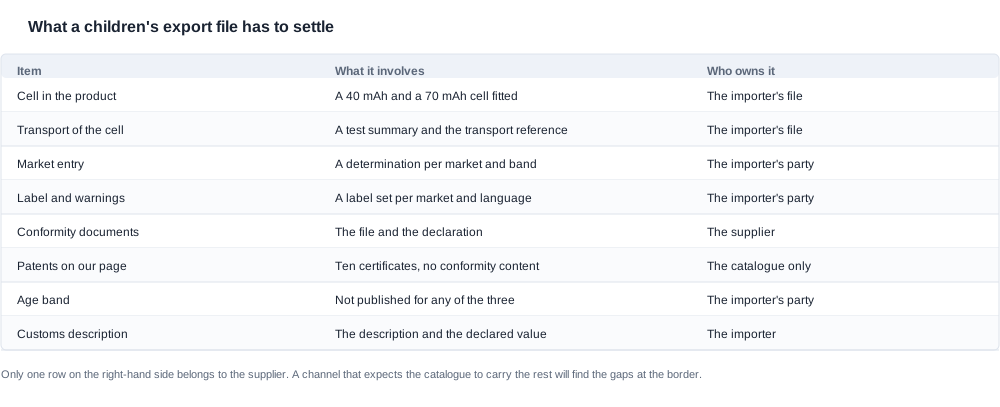
The distribution in the right-hand column is the whole argument of this article. A buyer who assumes that a supplier's catalogue answers the export question will be holding an incomplete file at the moment it is needed, and the incompleteness will not be visible until somebody asks.
Two features of the children's range make the split sharper than it is for the rest of the catalogue. The first is the cell: a battery fitted in the product means a transport document travels with the consignment, and that document is not a product specification, it is a dangerous-goods record with its own format. The second is the age band: a product sold to children attracts a market determination that adult products do not, and that determination belongs to the party who places the product on the market, which in a cross-border sale is the importer rather than the factory.
The three questions to ask before the first order
- Who is the importer of record for each destination market, and who is the party that makes the market determination? A brand that sells through a distributor in each market has a different answer in each one.
- Which of the eight obligations in the table above does the supplier actually take, and which stay with the importer? This is a question to put in writing before the first shipment, because the answer determines what has to be produced and when.
- What is the packed document set for a single consignment, and who assembles it? A file assembled per model rather than per consignment is the most common source of a delay at the border, and it is entirely avoidable.
The OEM export documentation piece covers the manufacturer-side file in more detail, and the private label options piece covers the case where the artwork and the label are the buyer's rather than the supplier's.

What travels with the goods, and who signs for it

A consignment of these products physically carries a short list of things, and the paperwork that matches them is short too.
The unit. Three published children's models: the protective pair with a forty milliampere-hour cell, and the audio model with a seventy milliampere-hour cell. Both are charged magnetically, so the box contains a charging contact and no cable, and that is worth stating plainly in the shipping description because a cable in the description and a contact in the box is a query waiting to happen.
The cell, and the document that follows it. A battery inside the goods is a regulated item on the transport side, and a record has to travel with it, obtained for the cell as fitted in the model rather than for a cell in the abstract. Our catalogue publishes a cell capacity and a charging method for all three and publishes nothing else about the cell at all, so the record that has to travel with the consignment can only be obtained from the supplier. The battery transport compliance checklist covers the format of that request in more depth.
The label. Whatever the destination market requires on the carton, the warnings and the instructions in the language of that market, and the determination of what goes on it is a determination made by the buyer's own compliance party against the destination market and the intended age band.
The document pack. Assembled for the consignment, not for the model, and packed with the goods. It holds the conformity documents the supplier has provided, the transport reference, the label artwork as released, and the record of the market determination.
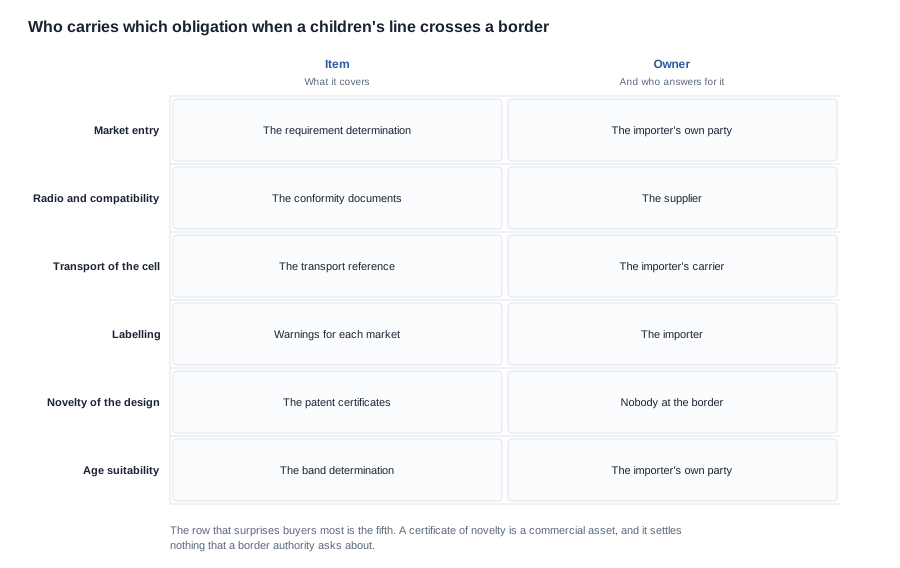
The matrix above sets out the obligations against the party that answers for them, and the row that surprises buyers most is the fifth. A certificate of novelty is a commercial asset: it establishes that a design is new. It settles nothing that a border authority or a retailer's technical team asks about, and treating it as though it did is a misunderstanding that has a long way to travel.
The questions a buyer asks the supplier about the paperwork
- Which documents does the supplier provide, and which does the importer have to produce?
- Does the supplied set cover every designation, and does it name the designation on each document?
- Which of the documents is per consignment, and which is a standing file?
- What notice does the buyer receive before the cell, the optics, the frame or the radio module is changed, and does the change affect the documents in the pack?
- What is the expected shelf life of the file, and what triggers a refresh?
The last two matter more than they appear. A consignment document pack is only as good as the version of the file it was cut from, and a change to the cell or to the frame material can invalidate parts of a set that a customs authority or a retailer has already seen once.

The market-by-market differences that change the paperwork
The reason a single export file does not work is that the requirements do not travel with the product. Three areas differ, and a buyer who treats them as one will find the difference at the worst moment.
The market determination. Which frameworks apply is settled, for each destination market and for the intended age band, by the buyer's own compliance party, against the finished item. In the European Union the frameworks that a compliance party weighs for a children's product include EN 71, alongside the General Product Safety Regulation (EU) 2023/988, and in the United States the determination is reached separately, with ASTM F963 and the consumer product safety rules run by the CPSC in scope. Which of them applies to a given unit is a classification decision, and it is not something a specification sheet can state.
The radio and the compatibility work. These are separate instruments with separate scopes, and the relevant directives are the Radio Equipment Directive (EU) 2014/53/EU and the electromagnetic compatibility directive (EU) 2014/32/EU. A file that answers one does not answer the other, and the standards named in a test report, such as the EN 301 489 series and EN 300 328, are the methods applied during testing rather than documents a border authority accepts. The audio model publishes a radio version; the protective pair publish none, so nothing about their radio can be asserted until the supplier confirms it.
The customs description and the valuation. The description of the goods on the commercial paperwork has to be consistent with what is in the box, and the valuation basis is a commercial decision with a legal consequence. Neither is a product specification, and neither can be supplied by a catalogue.
Two of the obligations in the table sit with the importer and cannot be delegated to the factory. The age band is the clearest: nothing is published for any of the three models, and the band is determined by the party placing the product on the market, for the market it is placed in. The age suitability piece covers how that determination is reached, and the safety requirements piece covers the framework side.

Where the exporter's risk ends and the importer's begins
The practical test for a cross-border sale is simple and it is worth stating before anything else: the party that signs is the party that answers. A declaration made by the importer, a valuation they have set, a label they have approved and a determination they have commissioned are four things they will each be asked to justify, and none of them can be justified by a supplier's catalogue.
That is why the importer's file is the important one, and why the exporter's contribution has to be specified rather than assumed. The exporter's part is the product and the documents the product is sold with: the specification, the conformity documents the supplier holds, the cell documentation and the transport reference. The importer's part is everything created by the act of placing the goods on a market: the market determination, the label and warning set, the customs description, the valuation and the record of the shipment.
Three questions settle the arrangement before the first order, and they belong in the purchase order rather than in a conversation.
- Which party is the importer of record in each destination market, and is the same party the one making the market determination? If they are different, somebody has to be responsible for the handover between them, and that is the handover that fails.
- Who prepares the packed document set for a consignment, and against what version of the file is it cut? A set assembled per model, or cut from a file whose currency nobody has checked, is a set that will be questioned.
- What happens to a consignment that is held, and who pays for the delay while the query is answered? A border query on a children's consignment is usually a documentation query, and a channel that has not assigned an owner to it will find the answer arrives after the sell-by date.
A fourth arrangement is worth settling at the same time, because it is the one that fails quietly: who briefs the carrier, who briefs the customs broker, and which of them is the party that receives the answer to a query. In practice three parties work from three different document sets, and the mismatch only becomes visible when a consignment is held and the wrong party has been asked for the answer. Naming the contact on each side of that handover costs nothing at the outset and shortens the longest part of any delay.
The privacy considerations piece covers a separate question a parent-facing prompt raises for an importer, and the A05 status write-up sets out the published position for one designation in the range.
The export file to assemble before the first kids shipment
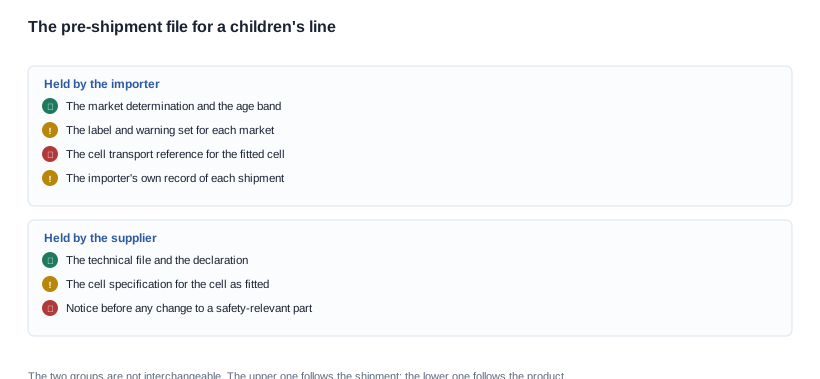
The checklist divides the file by the thing it follows. The upper group follows the shipment, so it is re-assembled and re-checked for every consignment. The lower group follows the product, so it is assembled once and carried forward, subject to the change-control obligation. A buyer who cannot say which group a document belongs to will end up re-cutting the file for every order, which is expensive and which nobody notices until the cost of it appears in the unit price.
The seven items to settle before the first shipment
- The market determination, per market and per intended band, issued by the buyer's own compliance party and held in the importer's file.
- The label and warning set, per market and per language, released as artwork with a version and a date, and packed against the consignment.
- The supplier's conformity documents, per designation, with the standards and editions that were applied recorded alongside them.
- The record that travels with the cell, obtained for the cell as fitted in each designation that is being shipped, together with the packaging and labelling requirements that the carrier applies.
- The customs description and the valuation basis, agreed with the importer and consistent with the contents of the box.
- The change-control obligation on the supplier, covering the cell, the lens material, the frame material, the radio module and the detection defaults, and a commitment to reissue the affected documents.
- The record-retention rule, so that the file is still available, and still matches what was shipped, for as long as the product is on sale in that market.
Four weaknesses a buyer's due diligence should look for in an export file
Most of these are administrative rather than technical, which is why they survive into the first shipment and why the first shipment is the expensive place to discover them.
- A pack assembled per model. The documents exist, but they were compiled once for the product rather than for the consignment, so the set in the box does not match the goods in the box. The remedy is a rule rather than a document, and the rule is that the pack is cut at the moment the shipment is booked.
- A description that the box does not support. A description written for the range rather than for the designation, or one that mentions a cable where the box contains a charging contact, generates a query every time it is used. It is worth comparing the description against the specification rows before it is ever printed on a commercial document.
- A file cut from an out-of-date version. Nothing in the pack records which version of the underlying file it came from, so a change to the cell or to the frame material in the intervening months goes unnoticed. A version number on the cover sheet is the cheapest defence available.
- A label set that was produced for a different band. A warning text approved for one age band, or for one market, being used for another because the artwork was convenient. The band is a determination rather than a preference, and the artwork follows it.
A buyer who can answer the four questions above has a file that a carrier, a customs authority and a retailer's technical team can each work with, and a buyer who cannot has a folder. The distinction is not visible in the folder, which is why it has to be tested against the questions rather than assumed from the presence of documents.
A shipment, worked through
The scenario below is set out to show how the steps fall into place rather than to describe a customer.
A brand places a first consignment of a children's line into two markets through two distributors. The first question it asks is not about the documents but about the importer of record in each market, and the answer turns out to be the distributor in one and the brand's own agent in the other. That answer alone splits the file in two, and it does so before anything has been produced.
The second question is which obligations the supplier takes. The answer is the conformity documents, the cell specification and the transport reference, with the market determination, the label set, the customs description and the valuation left with the importer. The brand then asks for the document pack to be assembled per consignment rather than per model, and for it to be cut from a file version that the brand's own compliance party has confirmed as current.
The consignment is held once, at the border, on a query about the description of the goods. The query is answered from the packed set, because the description, the cell reference and the market determination were all in it, and the goods are released without a re-papering exercise.
The second market's consignment then goes through with no query, because the label set and the determination had already been produced for the first, and the increment rather than the total had been priced when the market was added. The decisive actions were fixing the importer of record first, splitting the file by what it follows, and packing the documentation against the consignment. None of them was a formality, and none of them was a product specification.
What our documentation contributes to an export file
It contributes the product rows, and they are the rows a buyer needs in order to describe the goods accurately: the published rows for each designation, which are set out in the specification rows piece. It contributes one page of images in which every item is a certificate of patent, and a patent is a novelty record rather than a conformity record. It contributes no per-model certification row, no conformity marking statement, no cell safety or transport reference, no age band, and nothing that would amount to an export service.
The range itself is at our kids range, and the buying guide sets out how the three models sit against one another before any of them reaches a shipping document.
Tell us the destination markets, the importer of record in each, and the designations you intend to ship, and we will mark the eight rows above against what the three of you between you are each carrying, and flag the two of them that nobody has picked up yet.


