

Six questions account for most of the correspondence a channel receives about this category, and four of them are answered wrongly more often than they are answered right. The reason is not carelessness. It is that each of these questions has a short answer, and the short answer is either unavailable or misleading, so the temptation is to produce a confident sentence instead of an honest half-answer. The cost of that sentence arrives later, in a review, a return or a retraction.
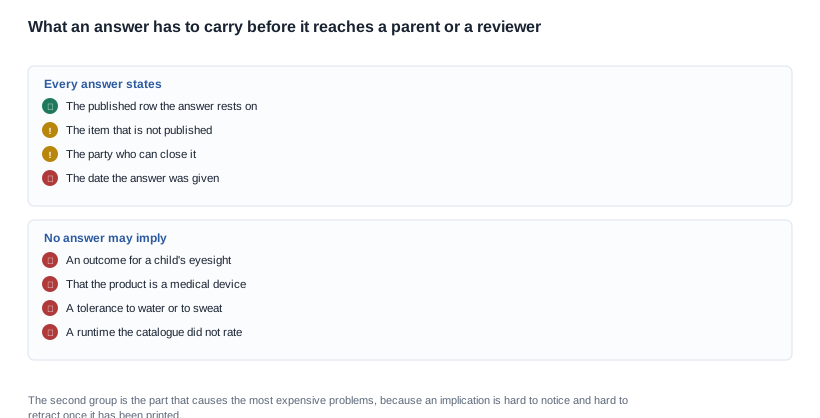
The fix is structural rather than a matter of tone. A useful answer to a question about these products has three parts: what the catalogue publishes, stated as a row rather than as a summary; what it does not publish, named explicitly so that nobody has to infer the gap; and the party who can close that gap, with the method the answer will be judged against. An answer with only the first part is a claim. An answer with the first two parts is a refusal to guess. An answer with all three is what a procurement team can file.
The questions themselves divide cleanly. A parent asks about the child in front of them, and wants a plain answer to a practical worry. A channel's technical reviewer asks about the product as an item that has to be documented and shipped, and wants a document. The two audiences want different things from the same product, and a single script aimed at both satisfies neither.
Nothing in this article is a health or eyesight claim, and none of these three models is presented as a clinical device. Where a question can only be answered by declining it, that is the answer, and the declining is worth doing early.
Kids smart glasses common questions: the ones that get answered wrongly
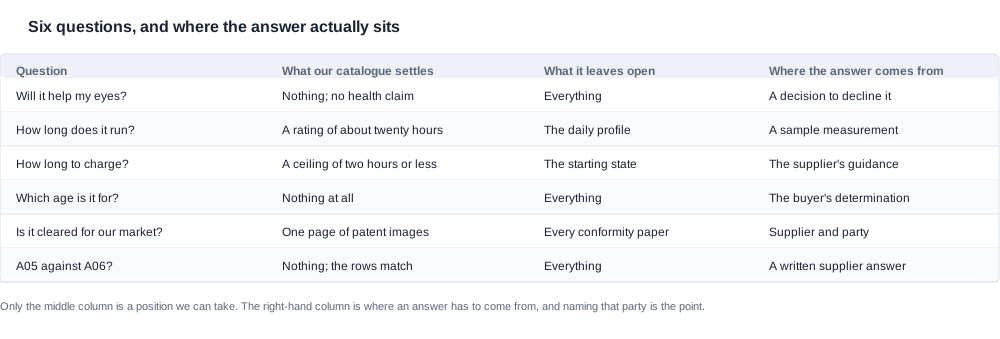
The table below is the short version of the whole article. Read the middle column as the only ground any channel is standing on, and read the right-hand column as the set of parties a channel has to talk to before it can say more.
The most common failure in the table is the first row, and it is worth being blunt about why. A product category whose name carries the word "protection" invites an outcome question that no technical file answers and that no supplier in this catalogue has published any data for. The honest answer is not a reassuring sentence; it is a statement of what the product does, a statement of what it does not do, and a clear signal that a channel whose proposition depends on the reassuring sentence should look at a different category.
How an answer gets assembled

The six steps are the same for every question, which is what makes an answer reproducible. The value of reproducibility is that it stops a channel from giving one answer in a sales call and a different one in a support reply, and it makes an answer reviewable: a colleague can check the answer against the row without reading the whole file.
The two steps that most answers skip are the fourth and the fifth. Naming the party who can close an open item turns an open question into a tracked request, and naming the method turns the eventual answer into something that can be compared against another supplier's answer. An answer that stops at "not published" has simply moved the problem.

What a parent asks first, and why the answer has to have two halves
"Will this do something for my child's eyesight?"
It is asked first because it is the reason the category is being considered at all, and it deserves a real answer rather than a deflection.
What is published: the two protective models list rows for a fogging unit, for prompts about correct and incorrect posture and distance, and for lens clarity and lens fogging. Those rows describe what the unit senses and what it prompts. What is not published: any optical parameter, any wavelength range, any filter ratio, any lens substrate, any study, and any age band.
The second half of the answer matters as much as the first, and the position we take on it is written up in the age-band question rather than restated here. A unit that senses a position and prompts a wearer is a prompt device, and a channel that markets it as though it were something else has created the problem rather than answered the question.
What to ask: the supplier's written claim position, and the requirement determination for the destination market and the age band the channel intends. Neither of those will produce an outcome claim, and a supplier that appears able to produce one is telling you something about its own file.
"How long will it run before it needs charging?"
What is published: a rated endurance of about twenty hours across the three models, a bound on the charge time of two hours or less, magnetic charging on all three, and a cell of forty milliampere-hours on the protective pair against seventy on the audio model. What is not published: the duty cycle behind the rating, the daily profile, the behaviour of a partial charge, and any ageing data for the cell.
The practical consequence is that the rating is a rating. A parent asking this question is really asking whether the unit will survive a school day, and the catalogue cannot answer that, so the answer has to point at the measurement: a log of the start and end of use, across a school week, at the prompt setting the channel intends to ship.
What to ask: the measurement method for the daily profile, the supplier's own guidance on a partial top-up, and the acceptance criterion the answer will be judged against.
"Does it need to come off for sport, and will it survive being knocked?"
What is published: nothing at all that rates these three models for water, sweat or rain, and no drop or impact data either. So there is no published basis for a liquid-related statement here, and the honest answer to a parent who asks is that the unit should come off before an activity session.
The honest answer has two halves in the opposite direction from the one a parent expects. The unit should come off for an activity session, and the reason to give is the absence of a published rating rather than a known weakness, because a supplier has not described a failure mode and nobody should invent one. The second half is that a knock test result is a question for the supplier, and a channel that wants to answer the parent with a number has to have a number of its own.
What to ask: whether any drop or exposure testing exists for these models, what the supplier's own guidance says about activity, and whether the answer can be given in the form of an instruction a household can follow.
"What age is it actually for?"
What is published: nothing. No recommended band, no frame geometry, no frame weight, no adjustment range. What is not published is everything, which makes this the clearest example in the category of a question whose answer is a determination rather than a specification.
What to ask: the size data measured with its method, the smallest removable part with its dimensions, and the requirement determination from the buyer's own compliance party for the destination market and the band. The order matters, because the band cannot be wider than the size supports, and the size is what the band is derived from.
"What happens if my child simply refuses to use it?"
This one is not in the catalogue and it is not a technical question, and it is the question that decides whether a unit is returned. A prompt that fires too often is a setting, not a fault, and the setting is not published. The answer a channel can give is about the disable path and about what the unit does when the prompting is switched off, and both of those are supplier questions.
What to ask: the disable path, the behaviour when prompting is off, and the alert format. The posture monitoring piece covers the published rows behind the prompting in more detail.

What a channel's technical reviewer asks second
"Is this product documented for children in our market?"
What is published: one page of images on our export-certification page, and the images are ten patent certificates: eight appearance-design patents, two utility-model patents. A patent establishes that a design is new. It says nothing about performance, nothing about testing and nothing about market access.
What is not published: any per-model certificate row, any reference to a conformity marking in the catalogue text, and any cell safety or transport reference for these three models. The technical file and the manufacturer's own declaration have to come from the supplier, and the requirement determination has to come from the buyer's compliance party.
What to ask: the file and the declaration, naming the designation and the market, and the standards and editions that were applied. The published position for the audio model is set out in the A07 status write-up, and the certification piece for kids products works through the request list.
"How do the A05 and the A06 differ?"
They do not differ in anything our documentation publishes. Both carry one identical set of published rows, running from the cell through the endurance rating, the ceiling on the charge time and the charging method to the feature rows, and no specification difference is recorded anywhere in our documentation.
That is a complete answer, and it is also a procurement problem, because a channel cannot choose between two designations on the basis of rows that are identical. What to ask: what each designation is for, whether one conformity file can cover both, and whether the feature behaviour is configured the same way on both. A written answer on the third point matters more than it appears to, because identical rows with different behaviour would mean two behavioural measurements rather than one.
"What does it take to get the file ready for a second market?"
It is asked by a buyer who has already cleared the first market and does not want to discover that the second one is a different exercise. The honest answer is that it usually is a different exercise, because the requirement determination, the label set, the declared marking and the warning text are all prepared per market, while the underlying test work may be shared.
The evaluation criterion a buyer should apply is the increment, not the total. Ask the supplier to state, per market, which documents are new and which are carried over from the first market, and to name the ones that are new because the requirement determination differs rather than because the paperwork is being re-typed. A buyer who receives that list can compare the second market's cost against the first market's and price it, which is a far more useful conversation than asking for a single number covering both markets.
What to ask, in short: the increment per market, the lead time attached to the documents that are genuinely new, the total cost of adding the market against the order, and whether the label artwork can be produced from a single source per language. All four of those have to be settled before you order the second market rather than after it, because the second market is usually the one that is on the critical path.
"Can we test a sample before committing to an order?"
Yes, and the request should carry a protocol, because a sample without a protocol produces a result that cannot be compared with anything. The protocol needs the dimensions and the mass and whether the cell is fitted, the prompt setting, the room and the week, and the pass condition. The samples page covers how a sample order is set up.

The questions whose honest answer is a request rather than a number
Six questions in this category cannot be closed by us or by anyone else inside a sales conversation. Each of them has an owner and a method, and the point of the list is that a channel can put all six on the same request instead of discovering them one at a time.
- The optical evidence behind any lens wording, if a channel intends to publish any. Owner: the supplier. Method: a transmission measurement with the band, the ratio and the instrument named, tied to the ordered designation.
- The geometry, the mass and the tolerance, because nothing is published for any of the three. Owner: the supplier, verified on a sample. Method: a stated measurement on a stated sample.
- The behaviour behind the prompting rows. Owner: the supplier, verified on a sample. Method: a written protocol with units, covering the trigger distance, the pause before a prompt appears, the rate of false alarms, the shape of the alert, and the way a parent switches it off.
- The paperwork for the cell as fitted, and the record that travels with it. Owner: the supplier and the cell source. Method: the report, naming the cell.
- The market entry question. Owner: the buyer's own compliance party. Method: a written list of the requirements that apply, with their standard names and editions.
- The claim position, in writing. Owner: the supplier and the channel. Method: a sentence that can be filed, confirming the absence of any eyesight, health or vision claim and describing the published rows as sensing and prompting.
The reason these six belong on one request rather than on six is scheduling. Each of them has an owner and a lead time, and a channel that collects them in sequence is simply collecting them in series.
How to keep an answer consistent across a sales and a support team
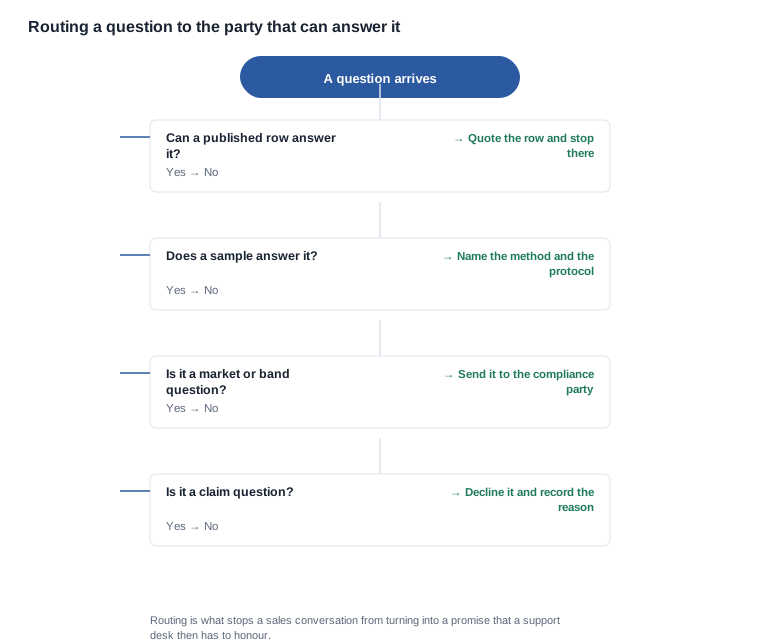
The routing chart above is the mechanism. A question arrives, and it is classified before anyone answers it: a published row answers it, a sample answers it, the compliance party answers it, or it is a claim question and the answer is a decline. Routing is what prevents a sales conversation from turning into a promise that a support desk then has to honour, and it is what allows a channel to answer quickly without answering badly.
Three practices keep the two teams consistent.
One source of answers, versioned. A single file holds the current answer to each of the six questions, with the date and the row it rests on. When a supplier answer changes, one file changes rather than a dozen conversations, and the support desk learns about it from the same place the sales team does.
A boundary on what may be said in the absence of an answer. The lower group in the checklist image is that boundary, and it should be enforced rather than preferred. An implication about eyesight, about the product being a medical device, about a tolerance to water or sweat, or about a runtime the catalogue did not rate is the kind of sentence that cannot be withdrawn once it has reached a printed carton.
A written escalation with a date. When an answer is not available, the channel says when it will be. A dated "we will confirm this by" is a commitment a support team can honour; an "as soon as we have it" is not, and it is the one that produces the follow-up complaint.
A worked exchange
The scenario is constructed to show the routing rather than to describe a customer.
A channel receives a question from a buyer's technical team, asking whether the product is documented for children in a particular market. The routing rule sends it: not a published row, because the catalogue has no per-model row, and not a sample either, because a sample cannot answer a market question. It goes to the compliance party, with a date attached to the channel's response, and the channel's interim answer names what our documentation does hold, which is the patent page and the product rows.
In parallel, a parent asks whether the unit will do something for their eyesight. The same routing rule sends this one to the claim branch, because there is no data and no document behind it that could produce an outcome claim. The answer given is the published rows for the two protective models, the statement that no eyesight claim is made, and a signal that a proposition built on the outcome belongs to a different category.
A third question arrives from a buyer's procurement team, asking how the A05 and the A06 differ. This one is answerable in part from our documentation, and the partial answer is that their published rows are identical, which is itself the finding. The open item goes onto the supplier request with a date, and the channel can proceed with a single designation in the meantime rather than waiting for an answer to a question that does not change the schedule for the first order.
Three questions, three different routes, and no sentence that anyone has to retract later. The decisive practice was classifying each question before answering it, and giving the unanswerable one a date rather than a sentence.
What we can answer today, and what we will not answer at all
Today, from our own records: what each of the three models does, the cell each one carries, the endurance it is rated at, the ceiling on its charge time, the charging method, and the radio generation of the single model that carries one. The models sit at kids smart glasses, and the published position on one designation is set out in the A05 specification piece.
We will not answer an eyesight question with anything except the absence of data, and we will not answer a market question with a document we do not hold. What we will do is take the six questions a channel is actually being asked, mark each one as answered, answerable by a supplier, answerable by a sample, answerable only by the compliance party, or not answerable, and give you the request list that goes with the third and fourth groups. Give us the markets, the channel's customer profile and the questions your own team is being asked, and we will mark them in a single pass.


