
The KY06 appears in our product catalogue as a single row, and that row does more work than it appears to. It states the cell capacity, the endurance range, the charge ceiling and the charging method, and it leaves the Bluetooth column with a dash rather than a version number. Buyers usually arrive with a long question list and find that the published record answers four of those questions and defers the rest. The purpose of this article is to separate the two groups, because a procurement file built on a published figure survives a supplier audit while a file built on an assumption does not. Every published value quoted below comes from the KY06 catalogue row. Where the row is silent, the article says so, sets out why the gap matters commercially, and describes what to request in writing before a purchase order is issued. It is not a product brochure and it is not a use guide; it is the brief a procurement team needs in order to decide whether the KY06 is a candidate model for a programme at all, and then to close the remaining rows before committing budget.
The questions the KY06 catalogue row actually answers
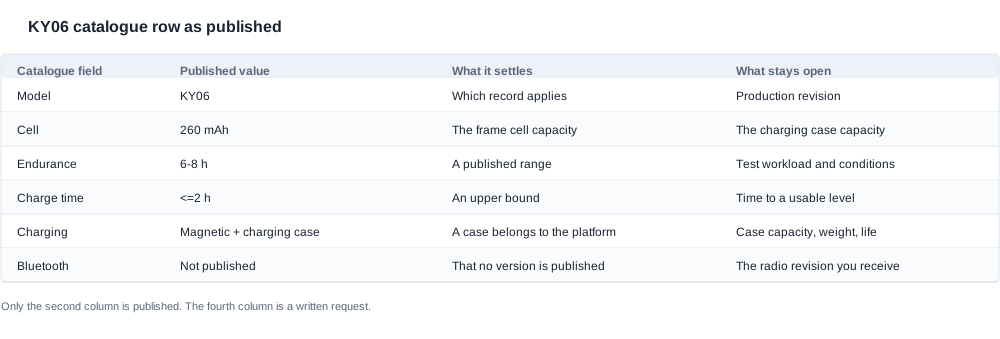
Here is the published KY06 row in full, with the reading a procurement team should attach to each field rather than a reading that assumes more than the record supports.
| Catalogue field | Published KY06 value | What it settles | What it leaves open |
|---|---|---|---|
| Model designation | KY06 | Which record applies to your file | The production revision behind that designation |
| Product name | KY06 AI Camera Sports Glasses | Family, camera function and sports positioning | The word sports is a name, not an ingress rating |
| Cell capacity | 260 mAh | The capacity of the cell inside the frame | The capacity of the charging case |
| Endurance | 6–8 h | A published range for the frame | The workload and test conditions behind the range |
| Charge time | ≤2 h | A published upper bound | Typical time to reach a usable level |
| Charging method | Magnetic + charging case | That a case belongs to the platform | Case capacity, case weight and case service life |
| Bluetooth version | Not published | That the catalogue publishes none | The radio revision of the unit you will receive |
Four of those fields carry a number, and each number carries a condition the catalogue does not spell out.
The 260 mAh is the frame cell, not the case. A camera frame that ships with a charging case carries two separate energy reserves: the 260 mAh cell inside the frame and whatever the case itself holds. The catalogue publishes the first and leaves the second open. This distinction is commercially expensive to get wrong, because "260 mAh battery" is a defensible phrase in a retail listing while "260 mAh plus a 1400 mAh case" is not, unless a separate row for this exact model states it. Buyers who need the case figure for a runtime story, a freight calculation or a return-rate projection have to request it in writing, and the charging options analysis for this model covers what that request should contain and how the case changes the packing list.
The 6 to 8 hours is a range with no stated test condition. A range is more honest than a single figure, but a range is not yet a specification. What was running during the measurement — whether the camera captured continuously or on a trigger, whether the radio was connected, whether a display was lit, the ambient temperature, the audio level — is the difference between the bottom of the range and the top of it. Read 6 to 8 hours as a band measured under conditions nobody has yet described, and ask for the workload behind it before you publish an endurance claim or build a shift pattern around it. The battery-life analysis for this model sets out the same measurement discipline from the test side.
The ≤2 h is a ceiling. The symbol carries the entire message: two hours is the longest the published record allows, not the time a buyer will normally wait. Real charge curves are also not linear, so two hours does not mean one hour and a partially usable frame. The row publishes a single charge figure and does not break it into a frame-to-case cycle and a case-to-frame cycle, so a programme whose operational plan depends on turnaround time needs to know which cycle the two-hour figure describes. Treat the ceiling as a commitment to plan against and an average to measure for yourself.
Magnetic charging with a charging case means a two-part accessory chain. The magnet is the electrical interface; the case is the charger, the storage object, the travel protection for the frame and the reason a buyer needs a spare-parts policy. That has consequences beyond the product page. The case adds a hardware line to the packing list, mass to the carton, a spare-parts line to the after-sales policy, a second unit to the defect allowance calculation and a second line to the landed cost model. A procurement team that treats "magnetic plus charging case" as a single word will under-count all five.
The Bluetooth column is a dash, and a dash is not a version. The KY06 sits in the camera series of the catalogue, and for this series the catalogue publishes no Bluetooth version at all. That is materially different from publishing "no Bluetooth radio", and it is materially different from the version number printed on a neighbouring audio row. Do not carry a version across from another model and do not let one enter your own documentation by accident, because radio declarations are written against a specific revision. The correct handling is to ask the factory which radio revision ships inside the unit you are buying, and to request the declaration and the test evidence that cover that revision specifically.
What the published row lets you claim, and what it does not
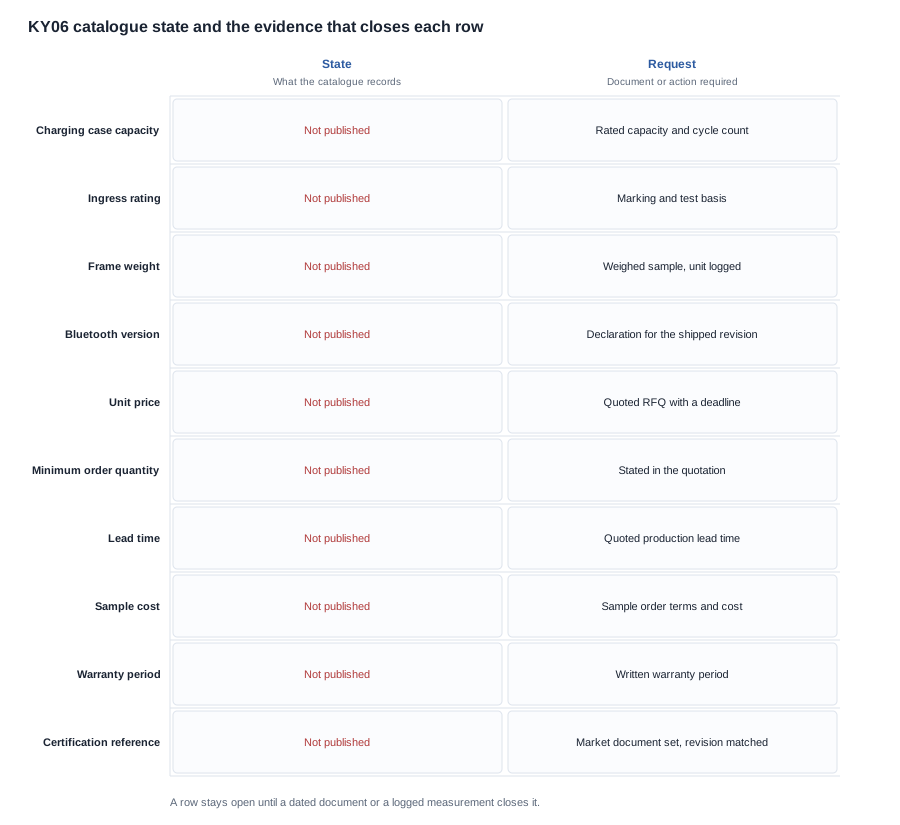
The published record supports a short and defensible list: a 260 mAh cell, a 6-to-8-hour endurance range, a charge time of no more than two hours, magnetic charging with a charging case, and a product name positioning the model as an AI camera sports glasses. Everything outside that list — charging-case capacity, frame weight, ingress rating, capture specification, certification status, unit price, minimum order quantity, lead time, sample policy and warranty — is open. Knowing the boundary of the record is what stops a team from publishing a claim that the factory cannot evidence in a document, which is the fastest route from a supplier conversation to a compliance problem in a market that checks.

The KY06 questions the catalogue leaves open
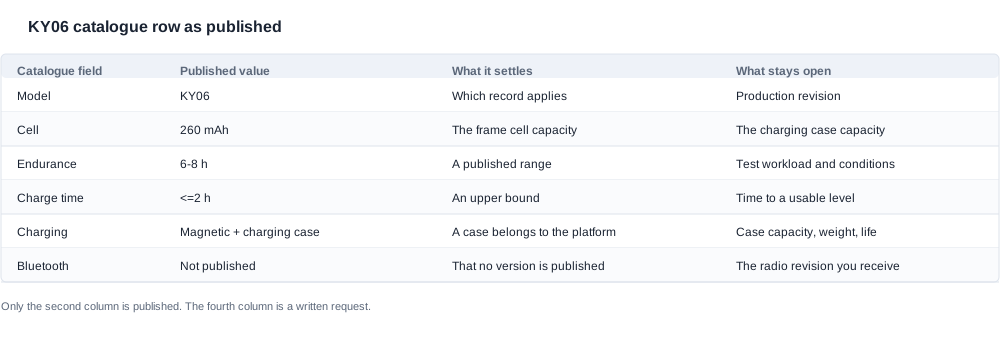
Six groups of questions arrive about this model more often than any others. Each is open in exactly the same way: the catalogue records nothing, so the answer has to arrive as a document with a date on it.
1. What is the capacity of the charging case?
The catalogue says the KY06 charges magnetically with a case. It does not say how large the case is. Ask for the case rated capacity in mAh, the case input rating, and whether the case ships in the retail box alongside the frame or appears as a separate line in the packing list. Then ask the harder question: how many complete frame charges one case delivers in a defined test. A case capacity without a cycle count is only a partial closure, because the endurance story a buyer publishes depends on the ratio between the two reserves rather than on either number in isolation.
2. Does the KY06 carry an ingress protection rating?
No ingress rating is published for the KY06. Two other models in this catalogue, the V06 and the S7, carry an ingress marking, and it is worth being precise about how that marking is read on those models: the second digit covers protection against splashing water, which is not rain, not immersion and not a shower. But a marking on a different model is not evidence about this one, and the sports framing inside the product name is a name rather than an ingress claim. For a camera sports glasses model this is a commercial question, not a technical footnote: outdoor and sports distribution carries sweat and rain exposure into the warranty conversation, and a model with no published rating has to be handled as a model with no rating. If the route to market demands a marking, that becomes a factory development request with a cost and a schedule attached, not a catalogue lookup.
3. How heavy is the frame?
Frame weight is not published for the KY06. The only weight figure that appears anywhere in this catalogue belongs to a different model, so it cannot be transferred across. This is a number a factory can produce in seconds by putting a finished unit on a scale, which is precisely why the absence is worth closing before the order. Weight drives three separate commercial lines: the comfort perception that becomes returns and reviews in a consumer channel, the freight and packaging cost in a wholesale shipment, and the classification decision on the packing list. Ask for the weight of the bare frame, the weight of the frame with the case, and the gross weight of the retail carton, and ask which variant was actually on the scale.
4. What does the camera capture?
The catalogue publishes a name, a cell and a charge method for this model, and it publishes no capture specification: no still resolution, no video container, no frame rate, no field of view, no storage destination, and no statement about whether capture runs continuously or on a trigger. The name tells a buyer that the product belongs to the camera family. It does not tell a buyer what the camera delivers, and a camera glasses programme cannot be planned, benchmarked against a competing platform or written up for a retail listing without that detail. Put the request in writing and be specific about the fields you need answered: still resolution, video resolution and frame rate, container format, storage medium and capacity, whether a capture indicator is present, and whether the unit can be set to record at intervals.
5. Which Bluetooth revision ships?
The catalogue publishes no Bluetooth version for the KY06, as set out above, because the model sits in the camera series where that row is not populated. Two consequences follow. A buyer must not fill the blank from another model's row, in any document, in any quotation. And a buyer planning to ship into a market with radio rules must request the radio evidence for the exact revision being purchased: the Bluetooth declaration, the RF test report reference, and the software or hardware revision that the report covers. A report written against a different revision is not a shortcut. It is the kind of shortcut that fails at the point of customs clearance rather than in the factory, which is the most expensive place for it to fail.
6. What is the certification and the commercial position?
The catalogue body does not print the words CE, FCC, RoHS or RED against any model, and the export certification page is an image page rather than a per-model certification row. There is therefore no published certification line for the KY06 that a buyer can quote in a listing or paste into a tender response, and no certificate number, test report number, laboratory name or report date exists in the record that we can supply. For a specific programme the action is the same as everywhere else: request the document set that applies to the destination market, confirm in writing which product revision those documents cover, and file them against the purchase order rather than against a folder on a laptop.
On the commercial side the catalogue is equally silent. No unit price, no minimum order quantity, no lead time, no sample cost or sample policy, no warranty period and no production capacity figure appear for this model. None of those should be guessed, because each of them changes the calculation that matters. A landed cost model built on an assumed lead time and an assumed minimum order quantity is not a cost model at all; it is a guess with a currency symbol attached, and it will be used to justify a volume that the factory has never committed to.

Buying the KY06 against a written configuration
Once the open rows have been answered, the buying task changes character. You are no longer collecting information; you are converting a set of answers into a configuration that a factory can build, a logistics team can ship, a compliance team can defend and a finance team can cost. The sequence below is the one a serious programme follows, and each step carries a specific buyer action rather than a general intention.
- Build the open-row list and send it as a request for quotation. Collect every gap identified above into a single document with a response deadline and a named recipient on the supplier side. The list should name the fields you need and the format you want them in. A buyer who asks for a catalogue receives a catalogue; a buyer who sends a field list receives answers.
- Convert the answers into a configuration sheet. One page per programme version, showing the published values and the confirmed values side by side, a revision number, the date each answer was received, and the name of the person who gave it. This sheet becomes the object every later step refers to, so it has to be versioned rather than edited in place.
- Evaluate a sample against the configuration sheet, line by line. The sample evaluation process describes the stages of that review, from unboxing through a weight check to a capture and charge test. The point of a structured evaluation is that it produces evidence rather than an impression, and that the evidence can be compared against the sheet line by line instead of against a vague memory of the last call.
- Freeze the packing list and the packaging artwork before the order is placed. With a magnetic case in the box, the packing list carries two hardware lines and the carton has to carry both. Packaging artwork approval is a long-lead item, and it is the point at which a configuration change usually surfaces at the lowest possible cost.
- Attach the configuration sheet to the purchase order as an annex. The annex should carry the model name and revision, the published values, the confirmed values, the packing list, the packaging artwork version, the certification document set with its reference numbers, the warranty period, the agreed lead time and the defect allowance. A purchase order that does not carry the configuration as an annex will be fulfilled against whatever the factory considers the default configuration.
- Set change control before the first shipment. Any change to the cell, the charging interface, the camera module, the case, the packaging or the artwork should require a written change request and a re-approval of the affected annex lines. This is not a trust issue; it is the mechanism that keeps the goods arriving matching the goods that were ordered, and it is the mechanism that lets a factory audit pass.
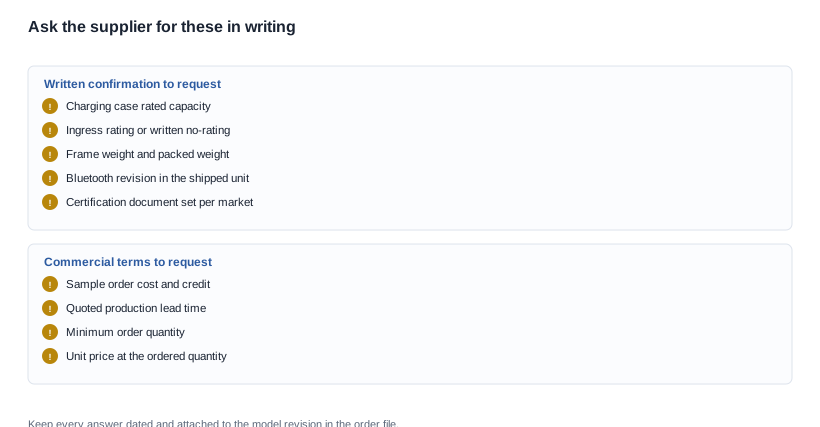
The commercial evaluation belongs inside this process rather than after it. The unit price is one line in a total cost calculation: the case, the packaging, freight and insurance, the compliance testing you carry as the importer, the payment terms and deposit structure, the defect and returns allowance, and the working capital sitting in production and in transit all sit alongside it. A buyer comparing the KY06 with another model on unit price alone is comparing an undefined configuration against a defined one. That is why the specification comparison against the V03 and the form-factor comparison against the L2 Utral are the right tools for deciding which model to develop, while the configuration sheet is the right tool for pricing the model you have already chosen.
Two negotiating points are worth raising early rather than late. The first is the sample. Ask what the sample order costs, what it is credited against, and what the sample order does to the production lead time that follows it, because those three answers together decide whether your evaluation schedule and your delivery schedule can coexist at all. The second is the documentation set. Ask for the document list and the delivery date of that document set in the same exchange as the commercial terms, because a compliance file that arrives after the first production run is worth very little to the business that ordered it.
Answering the KY06 questions we cannot answer from the catalogue
A published row and a confirmed row are not interchangeable, and any buyer should be able to see which of the two they are holding. For the KY06 the published record gives a name, a 260 mAh cell, a 6-to-8-hour endurance range, a charge ceiling of two hours, magnetic charging with a charging case, and no Bluetooth version at all. Everything else set out in this article is open. We will not fill a gap in the catalogue with an assumption, so a buyer who needs the charging-case capacity or the ingress rating should ask for both in writing before the sample is approved.
We do not publish a charging-case capacity, an ingress rating, a frame weight, a capture specification, a certification reference, a unit price or a lead time for this model, because we do not hold those figures in a form we can defend in a document. What we will do is narrower and more useful. Send the model, the destination market, the quantity band and the claims your listing needs to make, and we will go back to production and tell you which of the open rows can be closed for that programme with a document, which can only be closed by evaluating a sample, and which cannot be closed on the current hardware. Where a buyer needs to compare the KY06 against another platform before spending that effort, the specification comparison, the form-factor comparison and the value-for-money analysis are the internal documents that already exist, and the sample evaluation process is where the physical evidence comes from.
One practical note for a sourcing team: ask for the answers in a single exchange rather than one at a time. A factory that receives six separate questions usually returns six partial replies, and a partially answered open row is still an open row. A single dated request that names the model, lists every field and sets a response deadline produces a document you can attach to the order file, and it gives the supplier a reason to answer properly because the answer is going somewhere specific.
Related reading
- Certification position for this model — KY06 certification status
- Commercial positioning — KY06 value for money
- Model-to-model comparison — KY06 versus V03 specification comparison
- Form-factor alternative — KY06 versus L2 Utral form factor
- Charging and case configuration — KY06 charging options
- Physical evaluation — sample evaluation
- Product family — AI camera glasses
Send the target market, the quantity band and the claims your listing needs to make, and we will come back with what is documented and what is not.


