
A form factor comparison is the easiest kind of comparison to fake and the hardest kind to run honestly. The KY06 and the L2 Utral are both camera frames in the same catalogue, both ship with a charging case, and both are sold to the same buyers, so a comparison between them sounds like it should be a short table with a weight and a size in it. It is not, and the reason is not a gap in the analysis. The catalogue publishes no weight, no dimension, no lens material and no colour list for either model, so there is no table to write. What a buyer holds instead is a published set of electrical and charging rows, and a question those rows cannot answer.
This article is about handling that honestly. It sets out what the catalogue does publish for the KY06 and for the L2 Utral, identifies precisely which fields a form factor comparison needs and which of them are absent, and then gives the method that actually resolves the question: a sample order, a measurement protocol that produces numbers you can defend, and the commercial terms that decide whether the shape you measured is a shape you can afford to ship.
We will not describe a frame the catalogue does not publish, so a buyer comparing the KY06 and the L2 Utral on shape should commission a sample and measure it rather than read a difference into the model names.
What the catalogue publishes for the KY06 and the L2 Utral
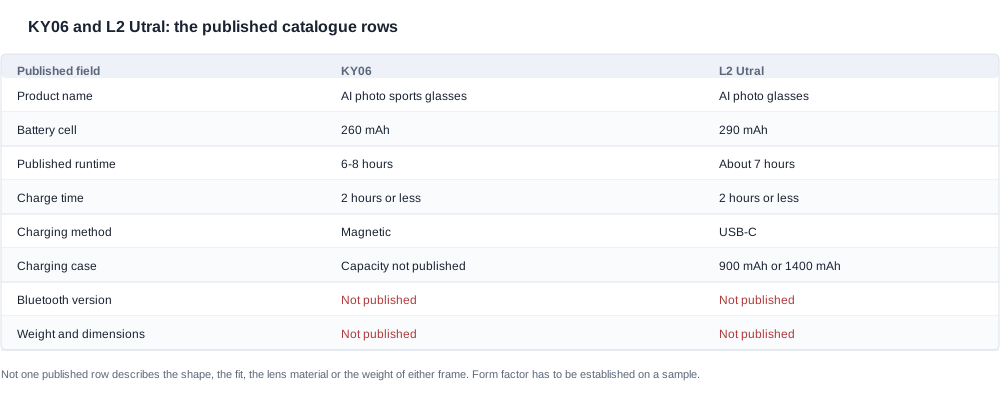
Both models appear in the catalogue in the same format, with the same short list of fields. The KY06 is listed as an AI photo sports glasses model and the L2 Utral as an AI photo glasses model. Here are the published values for the two of them, including the fields where the catalogue is silent.
| Published field | KY06 | L2 Utral |
|---|---|---|
| Product name | AI photo sports glasses | AI photo glasses |
| Battery cell | 260 mAh | 290 mAh |
| Published runtime | 6-8 hours | About 7 hours |
| Charge time | 2 hours or less | 2 hours or less |
| Charging method | Magnetic | USB-C |
| Charging case | Included, capacity not published | 900 mAh or 1400 mAh |
| Bluetooth version | Not published | Not published |
| Weight and dimensions | Not published | Not published |
| Water and dust rating | Not published | Not published |
| Price, MOQ, lead time | Not published | Not published |
Two published differences do real work here, and only two.
The charging method. The KY06 charges magnetically into its case. The L2 Utral charges over USB-C. That is a packaging and logistics difference rather than a shape difference, and it is a bigger operational difference than it looks: a magnetic charging dock is a proprietary accessory that has to travel with the product, while a USB-C cable can be bought anywhere a device is used. For a brand that sells into field service, hospitality or travel, that difference decides what happens when a cable is lost between shifts. The L2 Utral battery life piece covers the charging side of the same model in more detail.
The charging case. The L2 Utral is published with two case capacities, 900 mAh and 1400 mAh, which makes it the only model here whose parcel can be planned and whose days-away-from-a-socket proposition can be written down. The KY06 has a charging case, and the capacity of that case is not published. The difference is not cosmetic: a case is weight in the pocket, volume in the parcel and freight on the shipment, and an unknown capacity is an unknown on all three.
The two L2 Utral case options are worth separating before a sample order, because they answer different briefs. The 900 mAh case is the lighter parcel and the smaller packed unit, and it suits a buyer who recharges overnight or travels with a power bank. The 1400 mAh case is the option that supports a working day away from a socket, and it is the one that adds packed weight and packed volume. Neither number tells you what the frame weighs, and neither tells you how large the case sits in a pocket, which is exactly why the sample still has to be weighed before a bulk order.
Everything else that is published is close. The cells are 260 mAh and 290 mAh. The runtime is published as a range of 6-8 hours on the KY06 and as an approximation of about 7 hours on the L2 Utral, and neither figure states the test condition, so they cannot be ranked against each other. The charge time is an upper bound of 2 hours or less on both. No Bluetooth version is published for either camera frame in this range, so no protocol version is claimed here. No camera specification appears in the published rows for either model. No price, MOQ, lead time or warranty term is published for either one, and the export certification page in the catalogue is an image page without a per-model line, so no certification or compliance claim attaches to either model from the documentation alone.
Each model's published rows are set out in full in KY06 specifications and features and in L2 Utral specifications and features. What follows is the part that matters for this comparison: the fields a shape decision needs, and the fact that none of them are in either row.
Where the published rows say nothing about shape or fit
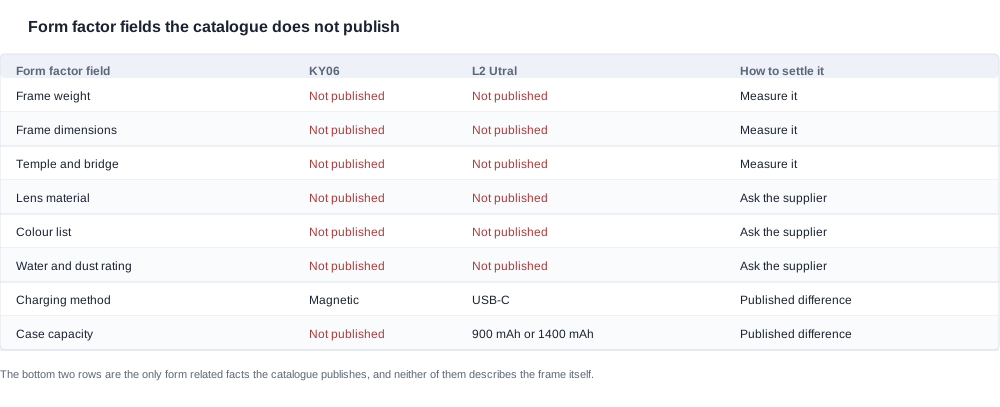
A form factor comparison for eyewear needs a specific list of numbers, and the list is short enough to write down. Frame weight, so that comfort over a full day can be assessed. Temple length and hinge position, so that the frame holds its place on different head sizes. Bridge geometry and nose pad contact, because that is where a frame presses. Lens height and lens width, because that is where the camera sits relative to the wearer's eye line and therefore where the recording lands in the frame of view. Frame material and colour list, because those are what a private label programme commits tooling and artwork to. And a water and dust rating, because it decides whether the frame can be sold for outdoor and active use.
For the KY06, none of those values are published. For the L2 Utral, none of those values are published. The catalogue publishes a battery, a runtime, a charge time, a charging method, a case and a Bluetooth column that stays empty. That is the whole evidence base for a comparison whose subject is the shape of the object.
Absence of data in a catalogue is not the same as absence of information at the factory. The catalogue is a sales document, and the engineering detail for a model that is in production normally exists in a specification sheet, a drawing or a technical file that the manufacturer holds. The right request to a supplier is therefore not a question about the catalogue but a document request: ask for the specification sheet for the KY06 and for the L2 Utral, with the frame weight, the dimensions and the material stated on it. Ask for the same document for both models in the same format, so the two sheets can be laid side by side. If a supplier cannot produce that document, the buyer has learned something important about what sits behind the model name, and that knowledge is worth more than a guessed dimension.
This is where most published comparisons of these two models go wrong, and the failure is not usually a fabrication. It is an inference. A model name containing a word associated with slimness gets read as slim, a model whose catalogue entry carries a sport positioning gets read as light or athletic, and a model with a smaller cell gets read as a lighter frame. Each of those readings is plausible and none of them is documented. The smaller cell is the clearest example: a 260 mAh cell sits in a smaller volume than a 290 mAh cell, but the cell is not the frame, and the weight of the frame, the hinges, the temple tips, the camera housing and the battery is what a wearer actually feels. No weight is published for either model, so no weight can be claimed for either model, and no parcel weight can be computed for either configuration.
The commercial cost of guessing wrong is not abstract. A brand that commits a private label programme to the wrong frame ends up with artwork, tooling and packaging for a shape it cannot reorder. A channel that fitted a case to one model finds that the other model does not seat in it. A buyer who specified a frame for a smaller head finds out at the review stage, after the bulk order, that the temple tips do not hold position. Each of those failures is discovered late, which is exactly what a form factor comparison is supposed to prevent.
The published charging rows are the only form-adjacent facts available, and they point at packaging rather than at the frame itself. That is a real signal about how the two products are meant to be carried and recharged, and it is a legitimate thing to compare. It is simply not a substitute for the frame data a buyer would use to judge fit, and treating it as one is how a comparison of two unreadable objects ends up looking like a comparison of two read objects.
Comparing frames when the specification sheet is silent
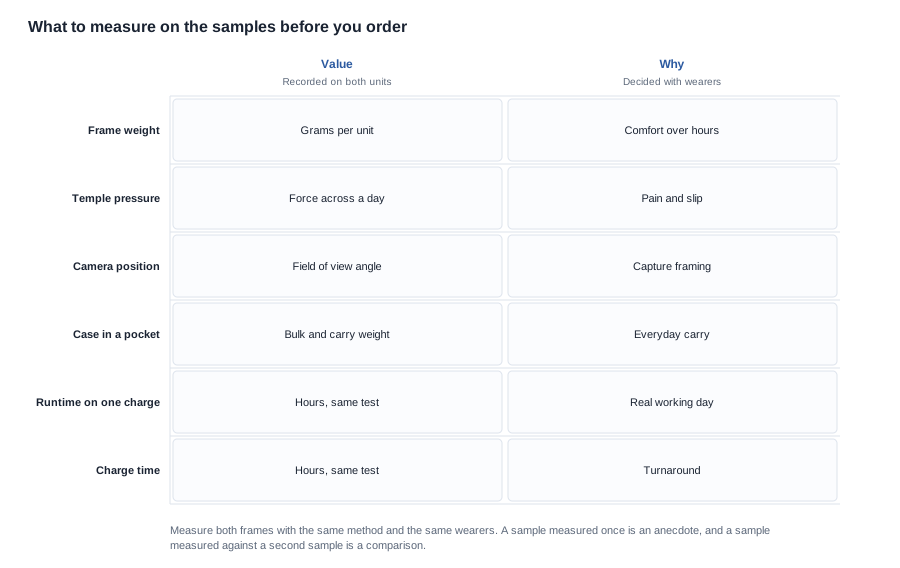
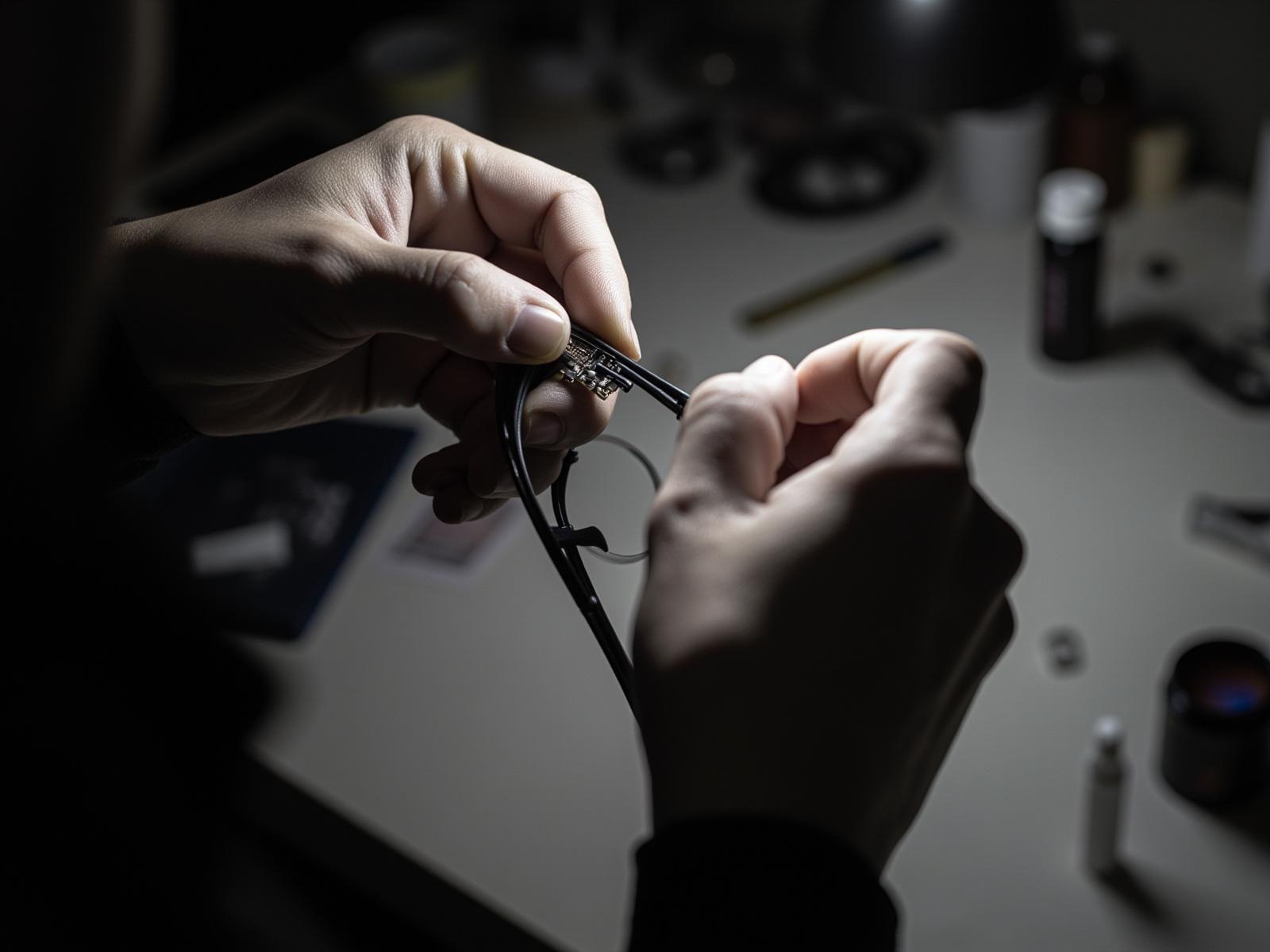
When the documentation cannot answer a question, the answer has to be produced. For form factor, the production method is a sample order plus a protocol, and the protocol matters more than the samples themselves, because two people wearing two different frames for ten minutes will produce two opinions and no data. This is also the only honest way to evaluate two samples that arrive with no published frame data behind them.
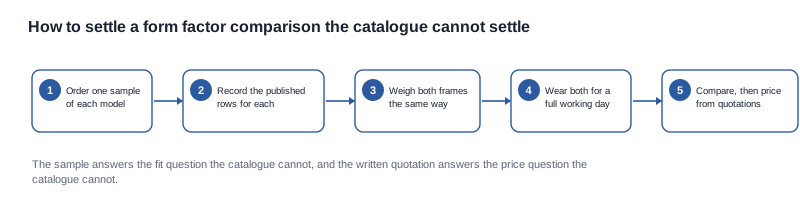
Set the criteria for the comparison before the samples arrive, and use the same list for both models. Then work through the measurement half in this order.
- Order one sample of each model from the same supplier, in the same configuration you would actually buy, so that the samples are the product and not a showroom variant.
- Record the published rows for each model next to the samples, so that every measurement is later attached to a published fact rather than to a memory.
- Weigh both frames on the same scale, with the accessories separated, and record the frame weight and the case weight separately.
- Measure temple length, lens width, lens height and bridge width with the same instrument, and write down the method used so the numbers can be repeated by someone else.
- Wear both frames for a full working day, and note where the pressure lands, whether the temple tips hold position, and whether the frame slips when the wearer looks down.
- Check the camera position on both, by eye line and by recording a scene and reviewing where the capture lands.
- Run the same runtime and charge test on both, with the same screen brightness, the same record pattern and the same ambient conditions, so that a published range and a published approximation become numbers you generated yourself.
- Record the case in the pocket and in the bag, and weigh the packed unit, because the case is part of the form factor a wearer carries every day.
That is the measurement half. The commercial half decides whether the shape you liked can be bought at all, and it is where the questions to ask are concentrated:
- What to ask about the sample order itself: the cost, whether it is credited against the first bulk order, and how long it takes to arrive.
- MOQ per model, and whether the MOQ is higher for one of them because of how the case or the packaging is sourced.
- Lead time in weeks, and whether it runs from order or from artwork approval.
- Payment terms and the deposit percentage, and the balance trigger on shipment.
- Incoterms, and who carries the risk between the factory and the destination.
- Warranty period and what it covers, including the case and the charging accessories.
- Whether the tooling, the artwork and the colour list are held for the brand, and what happens to them if the brand changes supplier.
- Whether an audit of the production line is possible, and whether a third-party pre-shipment inspection is accepted.
Those answers, taken together with the measurements, are what a buyer should negotiate with. A supplier who answers all of them in writing is a supplier whose quotation can be compared with a competitor's. A supplier who answers none of them is quoting a configuration that exists only inside the quotation.
One sample is one unit, and one unit is not a production run. That limitation belongs in the evaluation rather than in a footnote, because a single unit can be an unusually good or unusually poor example of a frame. Two things reduce the risk. The first is to ask the supplier to retain the evaluated sample as the reference unit against which the production batch is checked, which turns the sample into a golden sample and gives the quality control argument a physical reference instead of a written one. The second is to specify a pre-shipment inspection against that reference, so that a bulk order is measured against the shape that was approved. Both steps cost very little and both guard against the most expensive form factor failure, which is a batch that is acceptable in every respect except that it does not look like the sample the buyer approved.
The measurements also change what a buyer can reasonably negotiate. A quotation is usually negotiated on unit price, MOQ and lead time, and a measured form factor adds a third axis. If the measured frame turns out to be awkward for the intended use, the negotiation is not about a better price but about a different specification, a different model or a different quantity, and the buyer should know which of those conversations is available before the quotation is accepted. A quotation that was compared against measured alternatives is a stronger document than one compared against catalogue rows, because the risk it carries has been priced rather than assumed.
There is a risk to name here, because it is the one that damages a programme most often. The risk is not that the frames turn out to be uncomfortable. It is that the shape is discovered late, after the private label artwork is approved, after the tooling is cut, after the packaging is printed and after the deposit has been paid. Once that has happened, a change becomes a new tooling charge and a new lead time, and the trade-off collapses into whether the new shape is worth more than the sunk cost. A sample order is cheap compared with that sequence, and the due diligence value of two measured samples sits well above their cost.
The order of the work also matters. Measure before committing, price before signing, and put the written terms into the purchase order rather than into a message thread. The technical file, the declaration of conformity and the certification and compliance documents for the destination market belong to the order as well, and a quality control standard agreed before production costs far less than an inspection after a rejected batch.
A checklist is worth writing down at this stage, because the questions to ask are numerous and they are spread across several weeks of correspondence. This is the list to work through before you order in volume:
- Sample order confirmed, in the same configuration as the intended bulk order.
- Measurement sheet completed for both models, with the method recorded.
- MOQ, lead time, payment terms, deposit and incoterms written down per model.
- Warranty period and what it covers recorded per model.
- Tooling, artwork and colour ownership recorded.
- Certification and compliance scope confirmed in writing for the destination market.
- Quality control standard and acceptable defect rate agreed.
- Contract terms matching the assumptions in the quotation.
Where CYNRIN places the KY06 and the L2 Utral in a camera range
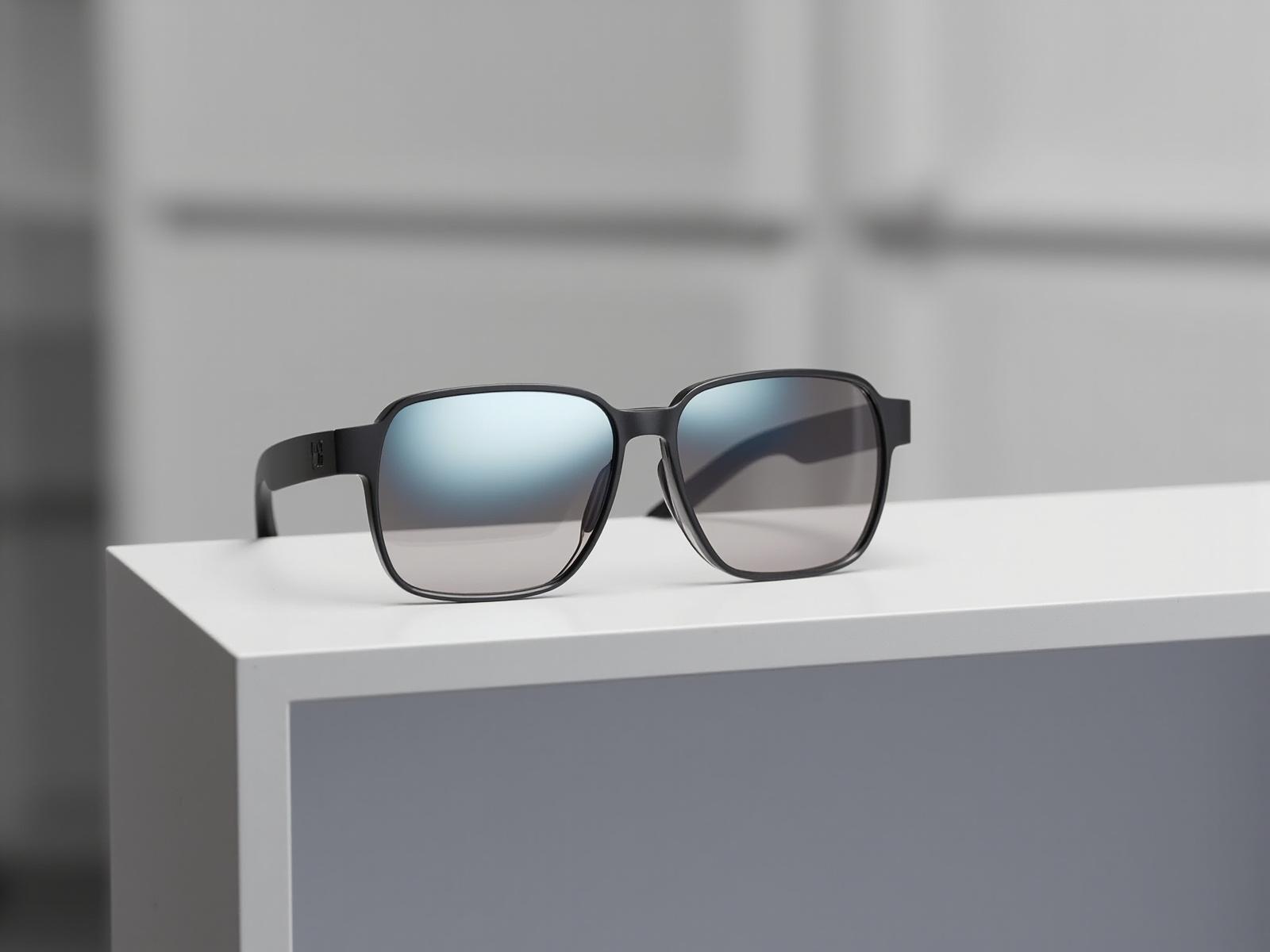
Both models sit in the camera glasses range and both are sold to buyers who need to record and to recharge on the move. The published rows place them at different points, and the honest description of those points is short. The KY06 is the smaller-cell model at 260 mAh, published with a 6-8 hour runtime range, magnetic charging and a case whose capacity is not published, and it carries a sport positioning in its name. The L2 Utral is a 290 mAh model published at about 7 hours, charging over USB-C, and offered with two documented case capacities at 900 mAh and 1400 mAh.
On the evidence that exists, the L2 Utral is the lower-risk model for a channel that ships in volume and reorders. A documented case capacity means the parcel, the pocket bulk and the days-away-from-a-socket claim can all be planned, and USB-C removes the proprietary accessory from the after-sales story. The KY06 is the model to choose when the sport positioning is the point of the brief, when the smaller cell is useful, and when the buyer is willing to confirm the case capacity before committing, because an unknown capacity cannot be planned around.
What neither position gives you is a weight, a size or a fit. Both models are published without those figures, so neither can be called lighter, slimmer or more comfortable on the basis of this catalogue. The CY03 versus KY06 form factor comparison covers the same question across a neighbouring pair of models, and the KY06 versus V03 specification comparison covers the entry end of the same range. Both reach the same place: the documented rows decide the electrical and packaging decisions, and the sample decides the shape decision.
The two models also behave differently after they reach the wearer. The L2 Utral, with a standard cable and a documented case capacity, can be supported by a generic charging routine: a spare cable from any supplier, a known recharge ceiling of 2 hours or less, and a case that can be reordered against a published specification. The KY06, with magnetic charging into a case of unpublished capacity, needs the case itself to be managed as a spare part, which turns it into a stock item a buyer has to track and a specification that has to be established before that stock can be ordered. For a brand with a service model rather than a one-off sale, that difference in after-sales handling is often larger than the difference in the box.
None of this describes how either frame feels, and that is the point of the article rather than a gap in it. A form factor comparison built on measurements is a comparison a buyer can act on. A form factor comparison built on adjectives is a comparison a buyer can only repeat.
So the recommendation is a method rather than a verdict. Commission one sample of each model, measure both with the protocol above, and let the measured frame decide the fit question. Then price both from written quotations against the same configuration, because the price of either model is a per-order figure rather than a published one. The sample evaluation process is where to start, and the AI camera glasses range is where the rest of the models sit.


