

KY06 smart glasses value for money is a question we cannot answer with a number, because we publish no price for any model in the range. That is a deliberate constraint on what a catalogue is for. A catalogue publishes the rows that describe the product — cell capacity, rated endurance, charge time, charging method, charging case, camera resolution class — and leaves the commercial terms to a quotation. The consequence is that the value question has to be rebuilt by the buyer, using the published rows as the verifiable baseline and the quotation as the variable that moves. The mistake most buyers make is treating that rebuild as a price search. It is not a price search. It is a documentation exercise that happens to end in a price.
Three myths sit underneath most poor value assessments in this category, and each of them produces a specific and recognisable failure. The first is that the cheapest quotation is automatically the best value. The second is that a larger battery cell is automatically the better buy. The third is that a longer rated range means a longer working day. All three are wrong in ways that only become visible after the first shipment arrives, which is precisely why they are worth correcting before the order rather than after it. This article takes the published row for this model apart, shows what it can and cannot carry in a value assessment, gives you a test for any quotation you receive, and lists the commercial terms that decide whether a margin survives the programme.
The reader we have in mind is one of three people. A brand buyer needs to defend the margin on a product line and wants to know which parts of the bill are real and which are assumptions. A channel partner needs to know what can be claimed to a customer and what has to be avoided, because an unsupported claim becomes a return under their name. A sourcing manager needs to know which questions belong in the specification annex so that the factory and the buyer are reading the same document. All three need the same thing first: a baseline they can verify without asking us anything.
KY06 smart glasses value for money: the question the catalogue cannot answer
Before the three myths, it is worth being precise about what is missing and why the gap is not the problem it appears to be.
What a published price would have settled, and what it would not have settled
A published price settles one comparison and only one: the ratio of cash to capability. It does not tell you whether the capability claim is verifiable, whether the shipment will be complete, or whether the accessory set matches the model on the quotation. A published price attached to an unverifiable specification is the worst possible combination, because it converts a missing fact into an apparent fact. Two parties then argue about a number that was never measured.
The published row with no published price is a better position than that. The row tells you which claims you may make to a customer today, and by omission it tells you which claims you may not. The quotation then tells you what the product costs. Keeping those two things separate is the whole method behind this article: the catalogue answers "what is it", the supplier answers "what does it cost", and your value assessment is the disciplined comparison of the two.
What the catalogue publishes for this model
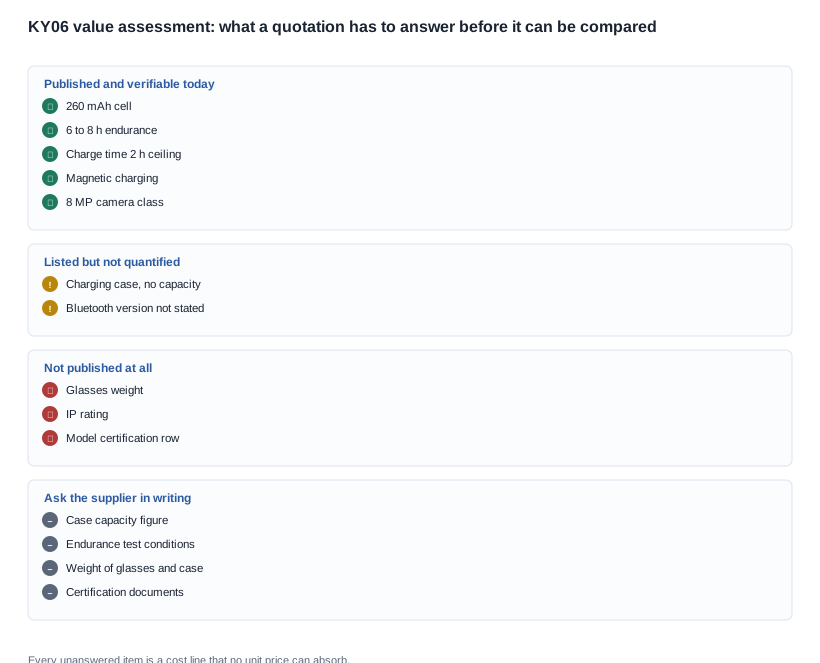
Six figures form the verifiable baseline. The cell is 260 mAh. The rated endurance is six to eight hours. The charge time is two hours or less. The charging method is magnetic, and a charging case is listed with no capacity published for it. The camera is recorded in the eight megapixel resolution class.
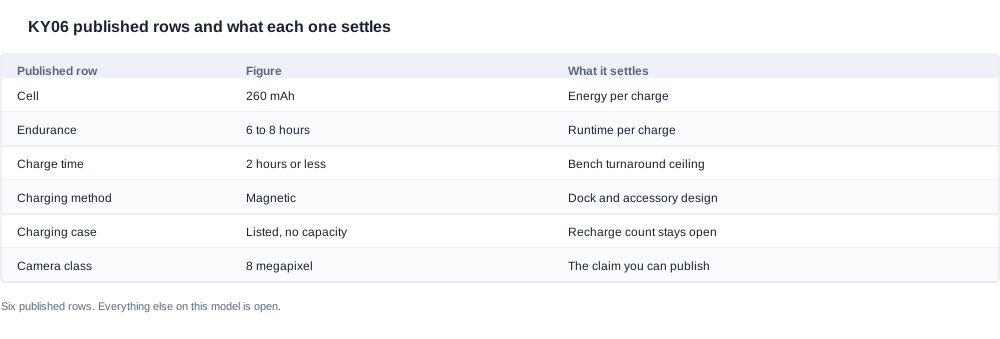
Alongside those six, the absences matter just as much. No weight is published for this model, and the catalogue publishes a weight for only one camera model in the whole section, so there is no derived figure available either. The camera section publishes no sensor model, field of view, frame rate, video format, storage configuration or stabilisation note for any of its eleven models, so this model is no more exposed on those points than its neighbours. The camera section publishes no radio version row for any of its models. No model in the catalogue publishes a touch row, and only the AR product publishes an indicator light and a button control line. And the catalogue carries no per-model certification row anywhere.
That last point is the one most likely to be misread, so it is worth stating in full: the export certification page in our catalogue sits at company level and is made of pictures, not of typed content, carrying ten patent certificates: eight of them for appearance designs, two for utility models. Not one conformity framework appears in the catalogue text. For any model, including this one, the certification position is a document request, not a claim you can repeat in a customer file.

Three myths that make this evaluation go wrong
The myths are worth separating because each one changes what you ask a supplier, and asking the wrong question wastes a quotation cycle.
Myth one: the lowest quotation is the highest value
The lowest quotation in a camera range is frequently the model with the smallest published cell, or the shortest published endurance, or the charging method that nobody will put in writing. That is not a criticism of the quote; it is a description of what a buyer is being offered and what cannot be claimed on its behalf.
The published rows let you tell a price difference from a capability difference. If two quotations cover the same model, then the published row is identical on both sides and the entire difference sits in the commercial terms: order size, lead time, what is included, what is billed separately. That is a negotiation, not a selection decision. If two quotations cover different models, the published rows tell you exactly which capability differences the money is buying, because the six published figures per model are directly comparable. Either way the comparison is decidable. What is not decidable is a quotation for the same model where one side has answered the annex questions and the other has not, because the unanswered side carries an unbounded documentation risk that no price discount can price.
Myth two: a larger cell is automatically a better buy
Cell capacity is the number buyers reach for first, and it is the number that misleads most often. Four camera models publish 290 mAh, three publish 260 mAh, three publish 220 mAh and one publishes 265 mAh. The ordering of those four groups says very little about value, because cell size is only an input to a duty cycle the catalogue does not publish.
The clearest demonstration sits one row away from this model. The MT6 publishes 265 mAh, which is more than this model and less than the 290 mAh group, yet it is also the only camera model in the section with a published weight — 158 grams for the glasses themselves, excluding its folding charging case — and the only one with a folding case of a stated capacity, 1200 mAh. Ranked on cell capacity alone, it would be treated as a compromise between two tiers. Ranked on the full published row, it is the best-documented model in the group, and documentation is what protects a margin.
Myth three: a longer rated range means a longer working day
A rated range is a rating under conditions the catalogue does not state, and the catalogue uses three different shapes of figure across the camera section: about seven hours for five models, six to eight hours for two, and five to eight hours for four. Reading six to eight hours as a working-day claim imports conditions that were never printed.
The discipline that follows is short: plan on the lower bound of the band, write the lower bound into anything a customer or a channel partner will read, and treat the upper bound as the good case rather than as the promise. A team that writes eight hours into customer-facing material on the strength of a six-to-eight-hour range has converted a published range into an unpublished claim, and that claim becomes a return the first time conditions push the unit to the bottom of the band. The method for comparing endurance figures across the range is set out in the battery comparison guide.
What the published rows are actually worth in a value assessment
Once the myths are out of the way, the published rows become usable. Each one supports a different part of the assessment.
The cell and the rated range, held side by side
Two of the six published figures describe energy, and they answer different questions. The cell figure tells a buyer what is available per charge, which determines how often the bench has to run and how the spare-unit policy is set. The endurance figure tells a buyer how long the unit works per charge, which determines staffing and how many units the kit needs. Together, and only together, they let you reason about energy per working hour — the number that a shift plan actually consumes.
The reason this is worth doing carefully is that a single-figure endorsement and a range-based endorsement do not carry the same risk. A model publishing about seven hours invites a straightforward promise. A model publishing six to eight hours invites a promise with a band around it, and a band has to be explained to whoever is receiving the product. The battery life reference covers the arithmetic that sits underneath both forms, and the endurance note for this model covers the specific behaviour behind the published range.
The charging method and the case question
Magnetic charging is a published fact about this model, and it has direct commercial consequences that a buyer should price into the programme rather than discover later. Magnetic means a dock rather than a cable and socket, which fixes the accessory list, the spare-parts plan, the packing design for a set, and the consumables budget for a channel partner who stocks spares.
The case is a separate line and a separate problem. The catalogue lists a charging case for this model and publishes no capacity for it. That makes the one calculation most field-kit buyers need — how many extra charges a single case carries — unavailable. The comparison across the camera section is instructive: the CY05 and the L1 Pro, and the CY03 each publish a 1400 mAh case, the L2 Utral publishes two options at 900 mAh and 1400 mAh, and the MT6 publishes a 1200 mAh folding case. The full survey of how case options work across the range is in the charging case options note.
Across the eleven camera models the case question has three distinct answers, and only one of them is a yes with a number attached. Five models publish a capacity. Two list a case with no capacity published, and this model is one of the two. Four publish no case row at all, which is silence rather than a negative answer. A buyer who treats all three as the same state will over-order spare units for the first group and under-order them for the second. The four models in the third group are the V03 and the V06, and the S7 and the V03 Pro, and their case position is an open item rather than a constraint.
The camera class and what it buys you in product copy
The eight megapixel class is the only camera figure published for this model, and its commercial value is that it defines what you may write in a listing without qualification. It is also where the cost of a wrong decision hides. Anything a customer needs that sits outside the resolution class — a particular field of view, a particular frame rate, a particular file format, a particular low-light behaviour — cannot be established from the catalogue at all, for this model or for any of the other ten in the section. That gap is closed by a sample programme, and a sample programme is a real cost line that belongs in the assessment rather than in the contingency.

How to test a quotation for this model against published evidence
When a quotation arrives, the value question becomes mechanical. Four checks, in order, and they take an afternoon rather than a week.
The four checks before you compare two quotations
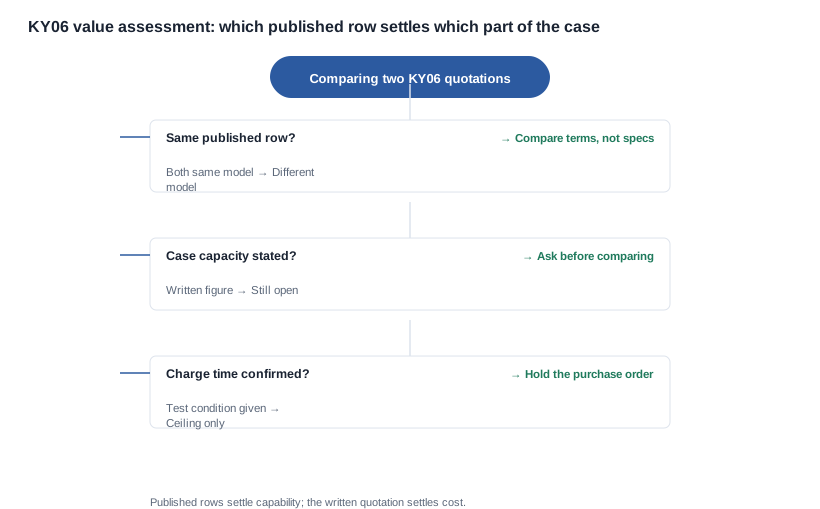
First, confirm the model and the published row. The published row is the fingerprint: cell, endurance band, charge ceiling, charging method, case state, resolution class. If two quotations do not produce the same fingerprint, you are not comparing the same product, and no arithmetic will fix that.
Second, ask the quotation to itemise the charging method and the case. For this model the charging method is published, so a quotation that leaves the charging interface ambiguous is an avoidable ambiguity. The case capacity is not published, so a quotation that states it in writing has done something genuinely useful, and that number should be the first thing you ask for when comparing otherwise similar quotations.
Third, ask what is not included. Samples, sample freight, tooling, NRE for any private tooling, certification documentation, inspection, packaging development, accessory sets, warranty administration — each of these sits outside the unit price and each of them lands on your margin. A quotation that includes everything is easier to evaluate than a cheaper quotation with a long list of exclusions, and the comparison only becomes honest when both sides of the list are visible.
Fourth, check that the annex questions are answered in the document rather than in a conversation. A quoted answer that exists only in a meeting has no contractual weight, and the questions that matter most are technical: the weight of the glasses and of the case, the case capacity, the charge and endurance test conditions, the sensor, field of view, frame rate and file format, the storage configuration, the radio version, and the control surface. The limitations summary for this model and the model-to-model notes are useful starting points for that annex.
The arithmetic the published row makes possible
Once a quotation is in hand, the published figures turn into denominators. Landed cost per unit is the unit price plus freight, duty, inspection, packaging and any accessory set that ships in the box. Energy per operating hour uses the lower bound of the published endurance band, not the upper bound and not an average. Cost per field recharge uses the case capacity once it arrives in writing, and stays provisional until then. Cost per claim is the one most buyers skip: every product claim you make that the documentation does not support is a claim you may have to fund through a return, and the published rows tell you in advance which claims are supported today and which are not.
None of the price-side inputs are published by us, and we are not going to invent them. The arithmetic is yours to run; the published figures are the part you can check without asking anyone. A useful discipline is to keep the two in separate columns of the same sheet, so that no assumption migrates from one side to the other by accident.

The total cost questions behind the headline number
The unit price is the part everyone looks at and the smallest part of what decides whether the programme works.
Where the real cost hides
Sampling is the first hidden cost, and it is larger than buyers expect, because a sample programme for a camera product is not a single unit — it is a test of the thing the customer actually wants, under conditions the customer actually works in. Tooling and NRE come next, and for a private programme they are usually a fixed amount that only the order volume amortises, which means the effective unit cost depends on a forecast that has not happened yet. Packaging and accessory design are real engineering tasks against a charging method you now know is magnetic.
Certification documentation is a third hidden cost, and it is the one most often left out of a spreadsheet because it is filed as administration rather than as cost. It takes supplier time, it takes your time, and for some destination markets it is a gating item rather than a formality. A company-level certification page with ten patent certificates on it does not substitute for a model-level document.
The fourth is the cost of an unsupported claim, and it is the only one that arrives after the product is in the market. If a customer-facing document promises a runtime the published band does not support, or a camera capability the catalogue never published, the cost arrives as returns, as replacement shipments, and as a discount request that you cannot refuse because the claim was yours.
The commercial terms that decide the margin
Minimum order quantity, production lead time, unit price and the tier it belongs to, warranty period and its remedy, quality control and defect terms, production capacity, tooling and NRE, sample order and sample fee, payment terms, contract and agreement terms — this is the commercial set, and none of it appears in the catalogue. We publish no price, no minimum order quantity, no lead time, no warranty term and no capacity figure for any model, including this one, so any of those numbers quoted without a source is an invention rather than an estimate.
That limit is worth stating plainly rather than leaving a buyer to infer it. We will not publish a unit price the catalogue does not state, so a buyer pricing a KY06 run should cost it from the configuration sheet and the written supplier quotation rather than from a published figure. Before you order, ask the supplier to quote against the configuration you actually intend to ship — cell, charging case, accessory set, packaging — so the tooling, NRE, bulk order and sample order lines appear as a trade-off you can negotiate rather than as a surprise at the second quotation round. Hold the purchase order until the charge-time confirmation arrives in writing, because the ≤2 h figure is a ceiling and not a tested value. Put the accessory cost into the comparison sheet before you negotiate, and let MOQ, lead time, incoterms, payment terms, deposit, warranty, quality control, contract and technical file sit in the supplier's own quotation and your due diligence checklist, where a declaration, an audit and a written confirmation can be checked. The trade-off is yours to make; the arithmetic we can publish is not.
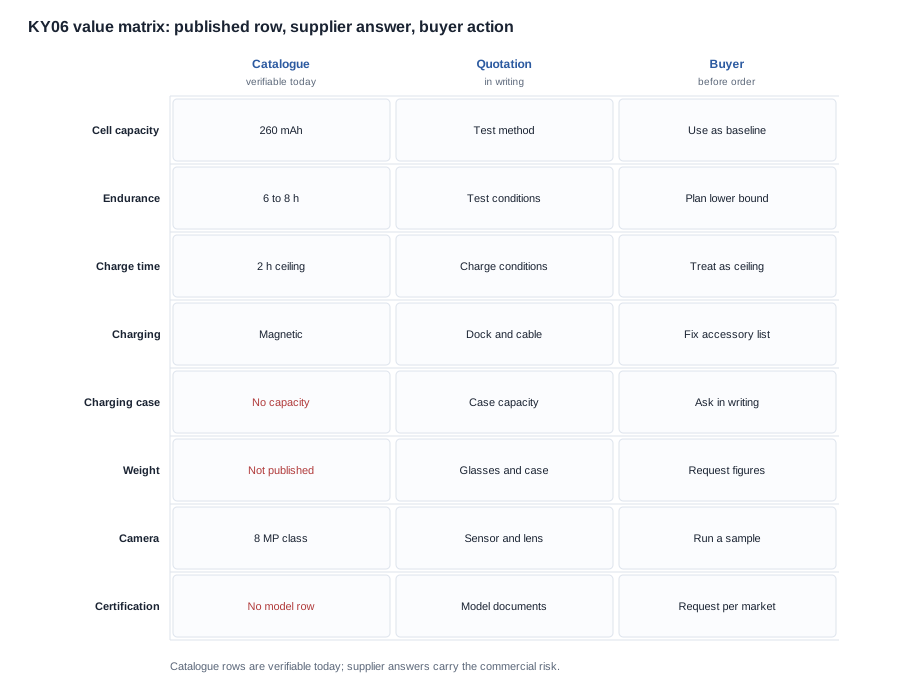
The practical version of this is a written list of the questions to ask the supplier before the comparison begins, each one tied to a field the row leaves open. The acceptance criteria are simple: what to ask for, and what a usable answer looks like. The case capacity as a number, the weight of the glasses and of the case as two measured figures, the test conditions behind the endurance band, the radio version, the certification and compliance documents for each destination market, and the private label and packaging scope. Knowing how to evaluate the answers is simpler than knowing how to evaluate the price, because a written answer either matches the published row or it does not, and the ones that do not match are the ones to price as risk.
Two pieces of our own material help here. The OEM-ready product line covers how models in this range group for private programmes, and the sample request path is the fastest route from an open question to evidence. The AI camera glasses collection is where the model sits among the eleven camera models, and the model pick note compares them from a sourcing point of view rather than a price one.
What to put in the specification annex so the value survives the shipment
A value assessment that lives only in a spreadsheet fails at the shipment boundary. The last step is to write the result into a document that both parties sign.
A hypothetical sourcing scenario
The following is a hypothetical scenario rather than a client project, and it is written to show the sequence rather than to describe a deal.
A distributor compares two quotations for the same model. The lower one is materially cheaper. The published row is identical on both, because it is the same model, so the difference is entirely in the commercial terms: one quotation includes the accessory set and the certification documentation, and states the case capacity; the other excludes both and leaves the case capacity open. On a pure unit-price comparison the second wins. On the assessment built in this article it does not, because the excluded items have to be bought somewhere else, and the open case capacity means the field-kit arithmetic cannot be finished.
The procedure that follows is short. Confirm the fingerprint. Ask both sides the same annex questions in writing. Ask for the case capacity explicitly, because it is the single most useful number nobody has published for this model. Run a sample under a realistic scenario and record the output, because the camera class cannot settle the application on its own. Write the published figures and the supplier-provided figures in two separate columns of the annex, and mark which claims are supported today. Then let the quotations be compared on total cost per working unit, with the endurance lower bound in the denominator, which is the only denominator in this calculation that the buyer controls.
The short version
- Six published figures are the verifiable baseline for this model: 260 mAh, six to eight hours, a charge ceiling of two hours, magnetic charging, a charging case of unpublished capacity, and the eight megapixel camera class. Everything else is open.
- Drop the three myths. The cheapest quotation is not automatically the best value, a larger cell is not automatically a better buy, and a rated range is not a working day.
- Plan and publish on the lower bound of the endurance band, and treat the charge ceiling as a ceiling until the test conditions arrive.
- Put the missing case capacity at the top of the written request, because it changes the kit arithmetic and it is cheap to ask.
- Treat certification as a model-level document request for your destination market, not as something the catalogue page settles.
- Put the commercial set in the quotation in writing: minimum order quantity, lead time, unit price and tier, warranty, quality control, capacity, tooling, NRE, samples, and what is excluded.
- Keep unverified claims out of the product copy, because that is where the last of the margin goes.
The full published row for this model is set out in the specification note for the same product, and the comparison against a neighbouring model in the same section is in the use-case note on the CY05. How the models group for private programmes is covered in the OEM-ready platform note.
Value for money, on this model or any other, is not a number the supplier prints and the buyer accepts. It is the distance between what you can verify from published evidence and what you have actually committed to pay for — and a buyer who closes that distance in writing before the order is signed keeps the margin that a buyer who compares unit prices loses.


