
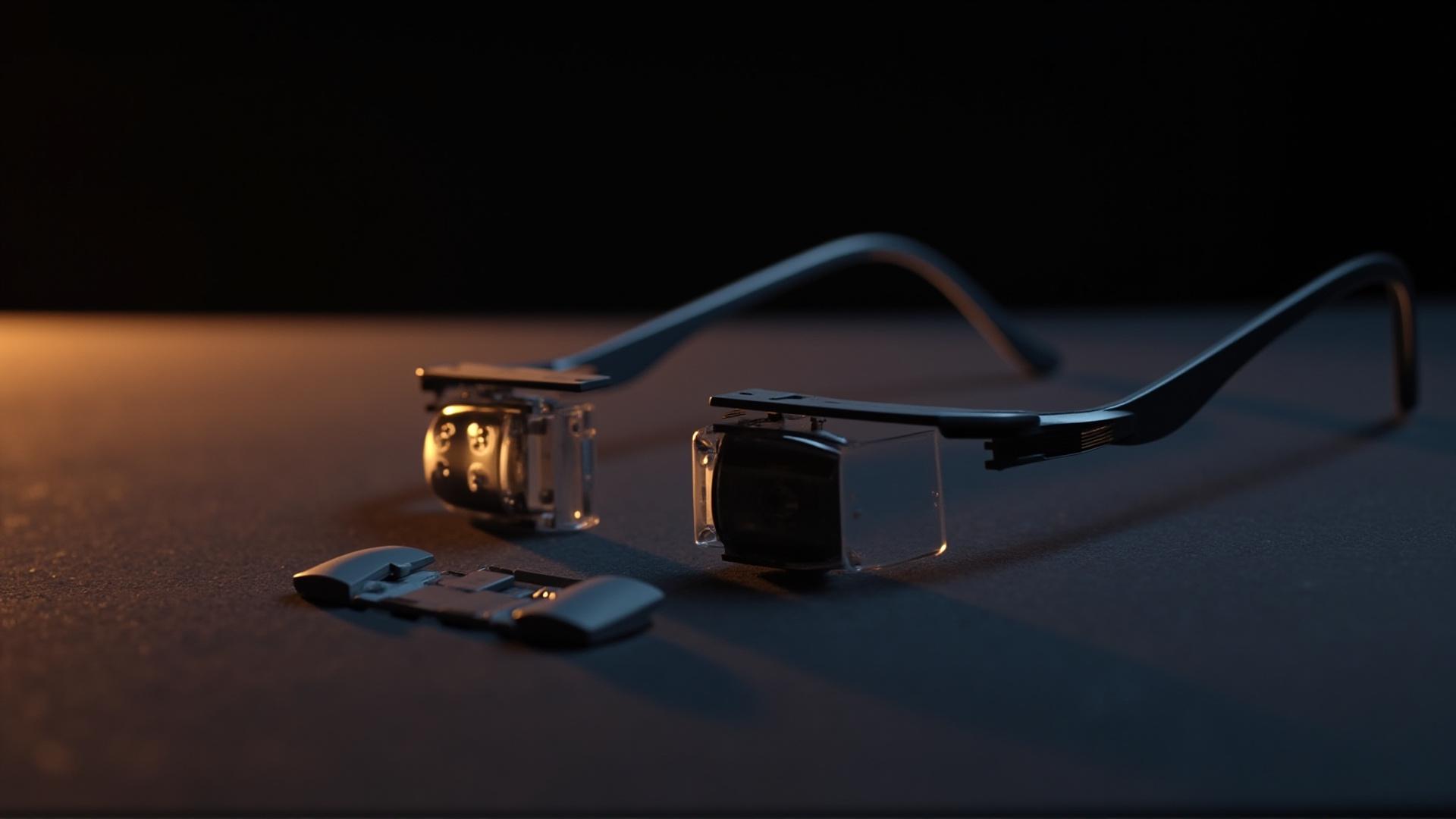
The KY06 AI photo sports glasses sit in a catalogue where most of the published numbers are close together, and where the differences that matter to a buyer are often the ones that were never published at all. This is a range-level comparison, not a single-product pitch. It takes the KY06 and places it next to the other camera glasses we list, then separates the rows that genuinely tell you something apart from the rows that only look like they do.
Everything below comes from the current product catalogue, and the KY06 specification and feature notes are the reference for the individual rows quoted here. Where a figure is not published, it is marked as not published, because a clean table with blanks in it is more useful than a complete-looking table with invented numbers in it.
On the sport description, our position is worth stating at the top. We will not present a specification difference the catalogue does not publish, so a buyer comparing the KY06 against the rest of the camera group should ask for the unpublished rows in writing rather than assume the sport-labelled model carries an advantage.
KY06 smart glasses compared on the published catalogue rows
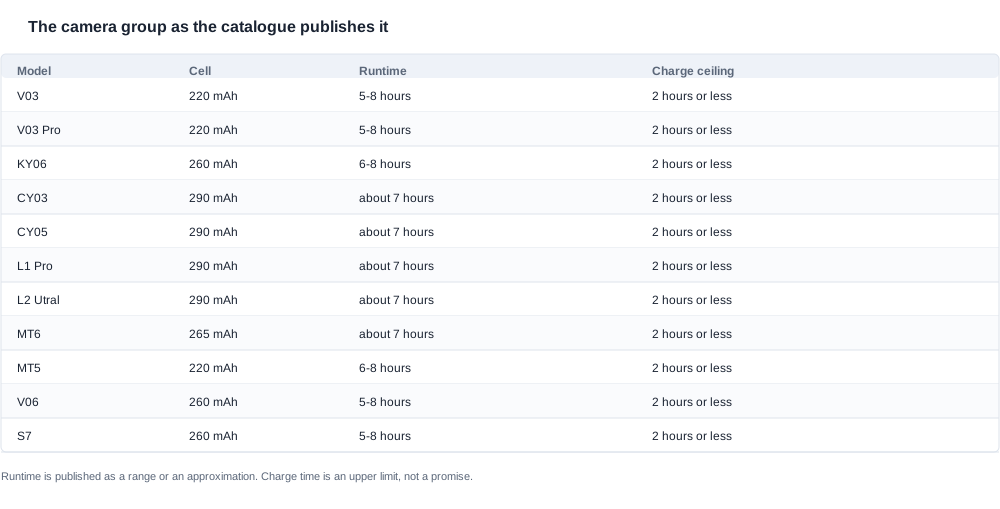
Every camera glasses product in our range publishes a battery capacity, a runtime figure and a charging time. Those three rows exist for all of them, and they are the first place to look when you are trying to work out whether the KY06 belongs in a programme alongside the rest of the range. The imaging side of the comparison is covered separately in our camera imaging technical notes, so this article stays on the specification and commercial rows.
The KY06 lists a 260 mAh cell. The L2 Utral and the L1 Pro, and the CY03 and the CY05 each list 290 mAh. The MT6 lists 265 mAh. The MT5 and the V03 Pro, and the V03 each list 220 mAh, and the V06 and the S7 list 260 mAh — the same cell as the KY06. That is the whole of the capacity comparison, and it is worth being precise about what it means. A 30 mAh difference between the KY06 and the CY-series models is real but small, and on its own it does not tell you which product will run longer in a working day. The capacity row is the one number on the datasheet, and runtime is the one number that depends on what the wearer is actually doing.
On runtime, the catalogue uses ranges and approximations rather than single points. The KY06 publishes 6~8 hours, and the MT5 publishes the same band. The CY05 and the CY03, and the L2 Utral and the L1 Pro, and the MT6 each publish approximately 7 hours. The V03 and the V06, and the V03 Pro and the S7 publish 5~8 hours. Read the way a procurement lead should read it: the KY06 sits inside the same band as the others, with a lower bound above the five-to-eight-hour group and an upper bound at the same eight hours. Nobody can tell you from the catalogue that the KY06 will outlast the CY03, and nobody should claim otherwise on your behalf. The wider battery comparison across the range is set out in our camera glasses battery comparison, where the same bands appear for every model that publishes one.
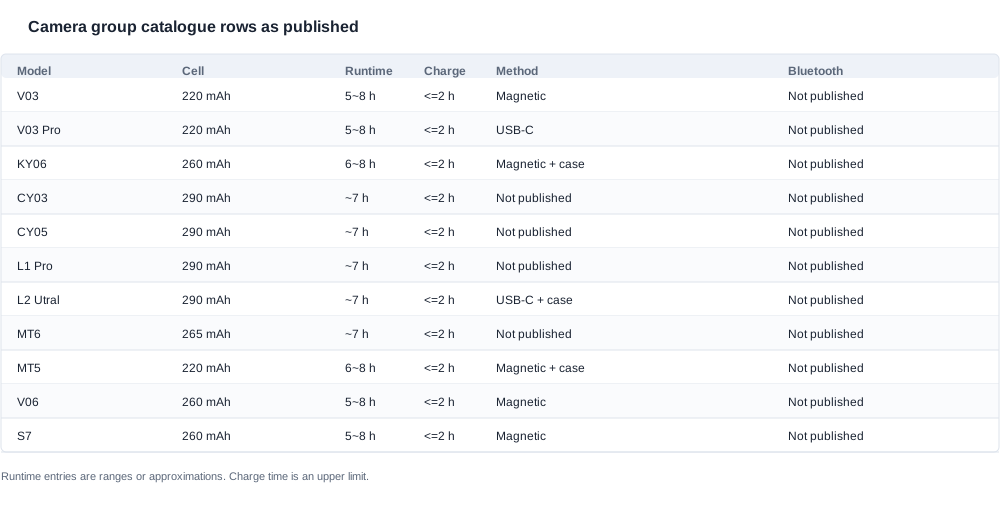
Charging time is the most uniform row in the range. All eleven camera glasses models publish a charging time of no more than two hours — the V03 and the CY05, the CY03 and the MT5, the L2 Utral and the MT6, the KY06 and the L1 Pro, the V03 Pro and the V06, and the S7. Because every model is capped at the same upper limit, this row does not separate any of these products. It tells you that a two-hour charge window is the assumption you should plan around across the whole range, and it tells you nothing about which model is faster. Treat it as a ceiling in your own planning, not as a measured figure, and ask the supplier for the measured charge time under the load your application actually applies.
Charging method is where the catalogue is genuinely inconsistent, and inconsistency is information. Five models publish magnetic charging — the V06 and the MT5, and the KY06 and the V03, and the S7 — and two of them, the KY06 and the MT5, pair it with a charging case. Two models publish Type C: the V03 Pro, published without a case, and the L2 Utral, published with one. For the CY05 and the L1 Pro, and the CY03 and the MT6, the charging method is not published; the catalogue records only that a charging case is available, with a capacity of 1400 mAh for the first three and a 1200 mAh folding case for the MT6. Our KY06 charging options breakdown works through what each of these rows does and does not let a buyer conclude.
That last point deserves care because it is the detail most likely to be misquoted. The KY06 does have a charging case, and the charging method for the KY06 is magnetic, which is published. What is not published is the capacity of the KY06 charging case. It would be wrong to describe the KY06 charging method as unannounced, and it would equally be wrong to quote a 1400 mAh figure for the KY06 case, because that figure belongs to the CY03 and the CY05, and the L1 Pro. The L2 Utral carries its own case capacity line as well, listing 900 mAh or 1400 mAh depending on the configuration.
Where the difference is real
Three things genuinely distinguish the KY06 within the camera glasses group. The first is the cell capacity, sitting at 260 mAh rather than 290 mAh or 220 mAh. The second is the shape of the runtime figure: a published 6~8 hour band where the models carrying the larger cells publish an approximate single figure instead, and a band that is narrower than the five-to-eight hours published on the S7 and the V03 Pro, and the V03 and the V06. The third is the charging architecture: magnetic charging published together with a case, the same pairing the MT5 publishes, while the V06 and the S7, and the V03 publish magnetic charging with no case row at all.
None of those three is dramatic. On the published rows the KY06 does not carry the largest cell — four models list 290 mAh — and the charge-time row does not separate it from any of them, because all eleven are capped at the same ceiling. What it is, on the published evidence, is a mid-position camera glasses product that has a defined charging method, a case in the box, and a runtime band whose six-hour floor sits above the five-to-eight-hour group's. If your programme needs a product that can hold a full working day of intermittent use without an overnight charge and without a proprietary cable, that is a coherent reason to shortlist it. If your programme screens on capacity per unit, the cell capacity row is where the work happens: four models list 290 mAh, and two of them — the CY03 and the CY05 — share the KY06's 8 MP tier, so the decision between them turns on the cell row and the case row rather than on the runtime row. Our KY06 against the CY05 use case fit comparison takes those two rows apart.
Where the difference is not there
It is equally important to record the rows that do not separate anything, because a comparison sheet that pads itself with non-differences misleads the reader who is trying to build a shortlist.
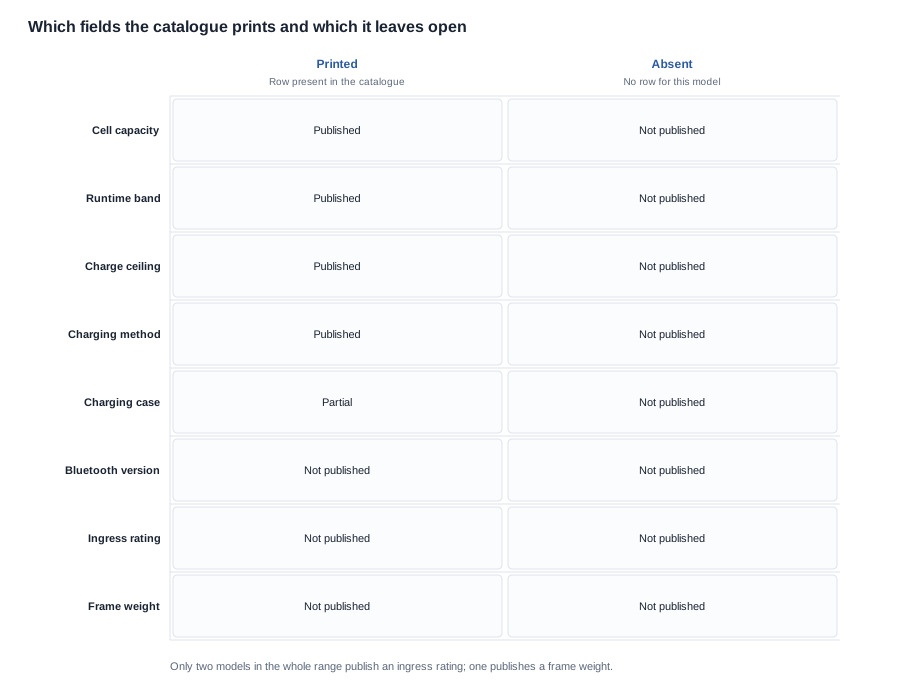
Bluetooth is not published as a version for any camera glasses model in the range, including the KY06. Every row in that column reads as unannounced. A buyer who wants a specific Bluetooth version to interface with an existing product ecosystem cannot resolve that question from the catalogue at all, for any model, and must put it in writing to the supplier before the sample order is placed.
Ingress protection is published for only two products in the range, the V06 and the S7. The KY06 carries no published IP rating, and neither do the CY03 and the MT5, the CY05 and the V03, and the MT6 and the L1 Pro, and the L2 Utral or the V03 Pro. The correct entry for the KY06 in that column is not published, and any supplier sheet asserting a rating for it needs to be traced back to a test report before it goes into your documentation. Our sport smart glasses water resistance options page sets out what the published IP54 marking covers and how to read an ingress row that is genuinely absent, and our IP ratings reference explains the marking system itself.
Weight is published for exactly one product across the whole range, the MT6, at 158 g for the glasses themselves, excluding a 1200 mAh folding case. That single data point says nothing about the weight of the KY06 or of any other camera glasses product in the range. Weight is the number that buyers in eyewear, logistics and retail presentation care about, and it is the number most often quietly assumed rather than confirmed. Treat it as an open question in every conversation you have about the KY06.
Certification is the biggest gap of all, and it needs to be handled correctly. The catalogue body contains no mention of FCC, CE, RoHS or RED for any of these products. The export certification page is an image page, and it does not carry a per-model certification row. So the accurate position is that no certification claim can be made for the KY06 or for any other model in this comparison, and no certificate number, test report number, laboratory name or report date exists for us to quote. This is not a statement that the products lack certification. It is a statement that certification is not published in the material available, which is a completely different thing and the difference matters enormously when you are building a compliance file. The KY06 limitations and open documentation items page works through this distinction at greater length, including what to request per model.
Price, MOQ, lead time, sample order terms, warranty, factory capacity, packing detail and shipment arrangements are also absent from the catalogue. All of them are legitimately negotiable and most of them are legitimately variable between suppliers, so their absence is normal. What is not normal is to fill them in with placeholder numbers that later have to be unwound. Every one of these is a question to ask, and the section below is the list of questions to ask.
A range-level comparison sheet for a camera glasses programme
The practical output of a range comparison is a single sheet with one column per candidate model and one row per decision criterion, populated with published values where they exist and with an explicit not-published marker where they do not. The criteria below are the ones that actually separate the camera glasses products in this range, in the order they tend to matter.
- Published cell capacity in mAh, with the exact source line recorded so the comparison can be re-checked rather than trusted.
- Published runtime as a range or an approximation, copied exactly as written and never converted into a single hour figure for internal modelling.
- Charging method as published, including magnetic, Type C, or an unannounced method, and whether a case is included.
- Charging case inclusion and its published capacity, kept in a separate cell so a blank is never read as a zero.
- Charge time as a published upper limit, with confirmation of whether the limit applies with a case or without one.
- Ingress protection rating, with not published as the default entry for every camera glasses model in the group.
- Published weight with the scope of the measurement stated, since the only published weight in the range excludes the case.
Build the sheet with a fifth column labelled not published rather than leaving cells blank. A blank cell is ambiguous between zero, unknown and not applicable, and ambiguity is what causes procurement to argue with the factory three weeks before a bulk order lands. Where a column applies to no model at all, such as Bluetooth version, write that fact in the column header so a reader does not read the empty column as an oversight.
What to ask a supplier before you order
Before you order anything from this range, put the following in writing and get the answers back in writing, tied to the specific model rather than to the range. A supplier who answers these cleanly is telling you what their due diligence actually covers.
- The cell capacity for the exact model, plus the cell model and whether it is a supplier-specified or customer-specified part.
- The runtime test conditions behind the published figure, including whether the estimate was measured with the camera idle, recording, or streaming.
- The charging method, the charge time under load, and whether the published charge time assumes the case or the device alone.
- The charging case capacity for the KY06 specifically, and the number of full device charges the case is expected to deliver.
- The ingress protection rating, with the test standard and the report reference, or a clear statement that no rating has been tested.
- The weight of the glasses in the shipping configuration you intend to sell, and whether the case is included in that number.
- The Bluetooth version and chipset platform, together with the firmware version and any regional firmware constraints.
- The certification scope for that model, including which test reports exist, which laboratory produced them, and their validity dates.
- Whether the product is produced in-house or by a subcontractor, and whether the supplier runs its own quality control or relies on third-party inspection.
- The warranty period, the defect definition, the replacement process and whether warranty applies to the charging case separately.
- The MOQ per model and per colourway, the lead time from order to shipment, and the sample order process including sample cost and sample lead time.
- The incoterms and payment terms that will apply, and what documentation accompanies the shipment on delivery.
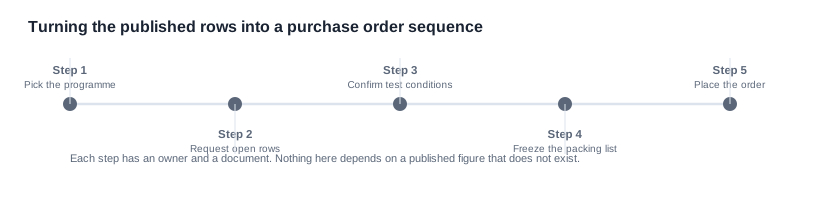
Turning the comparison into a purchase order
A comparison sheet is an input, not a decision. The decision becomes real when the specification moves into a purchase order and into the technical file that supports it.
Start with the configuration line on the purchase order. Write the model designation, the exact cell capacity, the charging method, whether a case is included, and the firmware version, in the order line itself rather than in an attachment that can be replaced without trace. Where the catalogue says not published, the purchase order should say what the agreed value is, with the date and the person who confirmed it. A purchase order that repeats a catalogue figure is only as good as the catalogue; a purchase order that records a confirmed value is a contract document, and it is the version that survives a dispute with the factory.
Then freeze the configuration for the bulk order. Once the sample order is approved, the configuration should be locked, with any change requiring a written change request, an impact assessment on tooling and certification, and a sign-off from both sides. Uncontrolled configuration drift between the approved sample and the bulk order is the single most common cause of a shipment arriving that does not match what was approved, and it is entirely preventable through change control.
Freeze the packing list as well. Carton quantity, inner box configuration, the accessory set that ships in the box, the cable set, the case, printed materials and the labelling requirements should all be stated and agreed before the first bulk order is produced. A packing list that changes quietly between the first order and the repeat order creates landed costs that nobody budgeted for and warehouse errors that land on the customer. The same discipline applies to the quotation that starts the sequence: model, quantity, configuration, packaging, incoterms, payment terms and lead time all belong in one document that can be referenced by number in every later step.
Build the technical file as you go. It should hold the confirmed specification sheet, the samples and the approvals they record, the certification and compliance documents that exist for that model, the packaging artwork and version, the quality control inspection records, and the correspondence that records each confirmed value with a date and a name against it. When a buyer, a customer or an auditor asks where a figure came from, the answer should be a document reference rather than a recollection.
Run a due diligence check on the factory before the bulk order, not after it. Ask to see the production line, ask which steps are in-house and which are subcontracted, ask to see the inspection records for a previous shipment, and ask what the quality control process is at each stage: incoming component inspection, in-process checks, final functional test, and the pre-shipment inspection that belongs to the purchase order. Audit the paperwork against the physical process. A supplier with good documents and an inconsistent line, or a supplier with a disciplined line and thin documents, is a different risk, and you want to know which one you are dealing with before the money moves.
Treat the trade-offs explicitly rather than assuming they are resolved. Capacity against case size, runtime against feature set, certification scope against cost and lead time, customisation against the risk of a bespoke bill of materials with a single source for every part. Each of these is a genuine negotiation, and each one ends up in the contract. Negotiate the terms where they are negotiable, and state clearly which ones are fixed by the hardware, because a negotiation that starts without knowing which points can move wastes time and produces a weaker agreement.
Matching the model to the application
The comparison only becomes a decision once it is matched to what you are actually selling. The KY06, with its 260 mAh cell, its 6~8 hour published runtime band and its magnetic charging with a case, is a sensible fit for applications where the wearer uses the camera intermittently through a working day, where the case matters because the device goes back into a pocket or a bag between uses, and where a proprietary charging cable is an operational nuisance worth avoiding.
If your application is a long continuous recording session, the runtime band matters more than the case and you should ask for tested continuous recording figures rather than catalogue runtime figures. If your application is a sports or outdoor programme where the device will be exposed to handling, rain and dust, then the absent ingress protection rating moves from a footnote to a blocking item, and no amount of catalogue confidence substitutes for a test report. The two models in the range that do publish an ingress marking, the V06 and the S7, are worth reading against the same criteria in our V06 range comparison if a published IP row is a hard requirement for your programme.
If your application depends on a specific phone, a specific app ecosystem or a specific Bluetooth profile, note that no Bluetooth version is published for any model in this range, and treat the integration dependency as something you resolve with the supplier before committing volume rather than after. The same applies to the whole AI camera glasses platform if you plan to run more than one model under one brand: the range shares a platform, but it does not share a published radio specification, so each model needs its own written confirmation.
The practical summary
Three rows in the published catalogue do the work of separating the camera glasses products in this range: battery capacity, the runtime figure as written, and the charging method including case inclusion. On those rows the KY06 is a mid-position product with 260 mAh, a published 6~8 hour band, and magnetic charging with a case whose capacity has not been published.
Everything else you might hope to read from a comparison sheet is currently unannounced across this range. Bluetooth version, ingress protection for every camera glasses model except the two that publish it, weight for every model except the one that publishes it, and per-model certification rows are all open. So are price, MOQ, lead time, sample terms, warranty and quality control arrangements.
That is a normal state for a catalogue, and it is also a well-defined shopping list. The comparison tells you where the KY06 sits in the range, and the comparison tells you exactly which questions to ask a supplier before you order, which is where the actual specification gets locked down. Take the published rows as fixed, take the unannounced rows as items on your due diligence checklist, and put every confirmed value into the technical file with a date and a name attached to it.


