
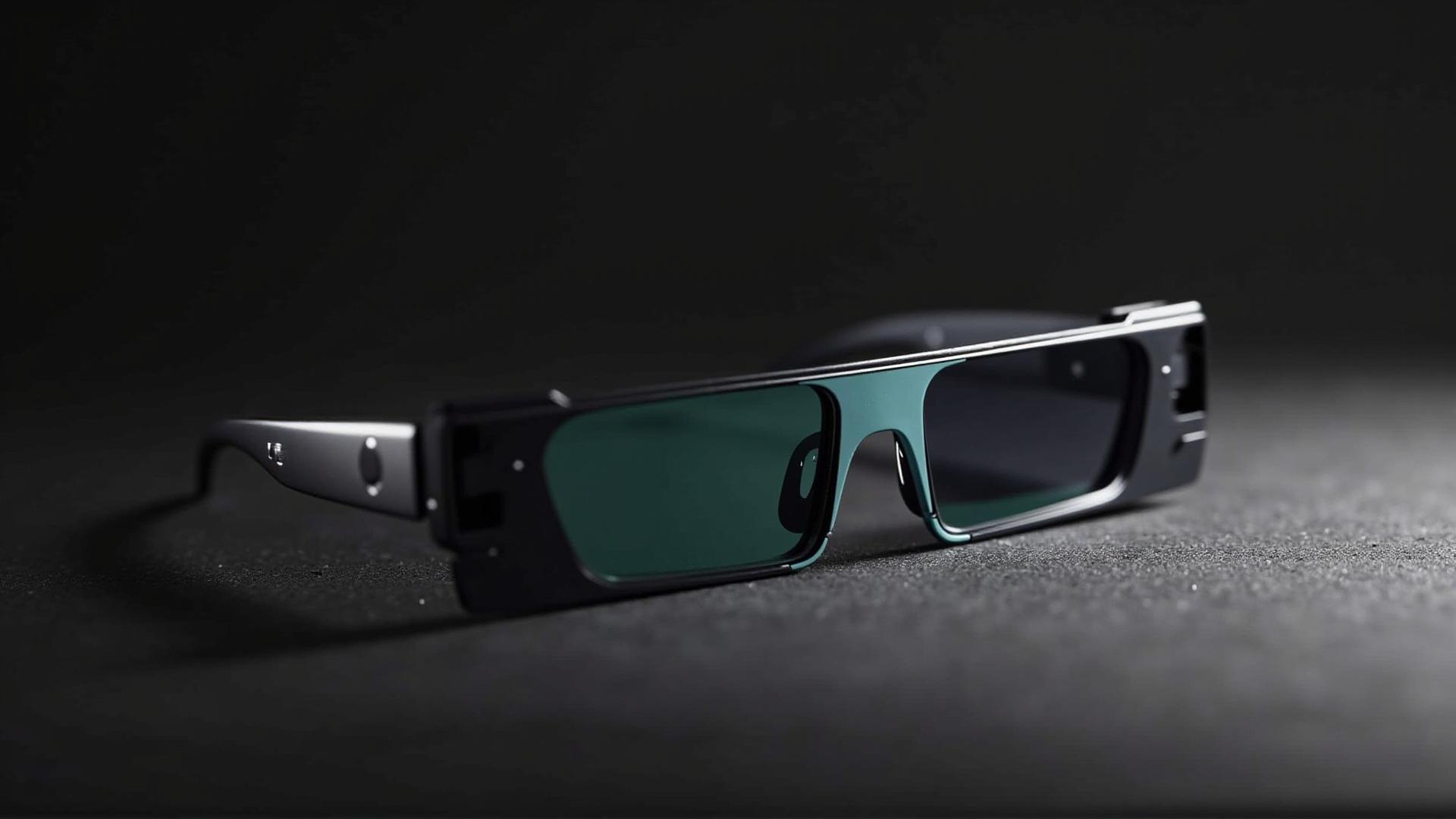
Two camera platforms, a set of rows that both of them publish, and one gap on each side that behaves in a completely different way. The gap on one side can be closed with a single email. The gap on the other side cannot be closed at all, because the figure has already been published in its final form and the honest way to use it is to measure it yourself or to promise less than its upper end.
That asymmetry is the whole answer to the question this page is about, and it is why a buyer who treats both gaps as items on one request list ends up with a product they cannot describe. The rows that decide the choice are the case, the interface and the form each runtime figure takes — not the camera tier, which is the row most comparison copy leads with.
What follows is a decision rather than a verdict. Each step below either settles the next one or makes it irrelevant, and none of the steps requires a specification this catalogue has not published. Where a value is missing, the missing value is treated as a task with an owner rather than as a gap to be papered over, and the file you end up with is a shortlist you can defend rather than a preference you cannot explain.
L1 Pro vs V03 Pro: what actually differs
Five rows separate this pair, and the order in which they are worth reading is not the order they appear on a product page. The camera class comes first on paper and last in practice. The cell capacity looks like a specification and behaves like a family resemblance. The charging case is the row that changes what physically ships. The charging interface decides whether your accessory chain can be drawn at all. The runtime is the row where one page gives you a number and the other gives you a range.
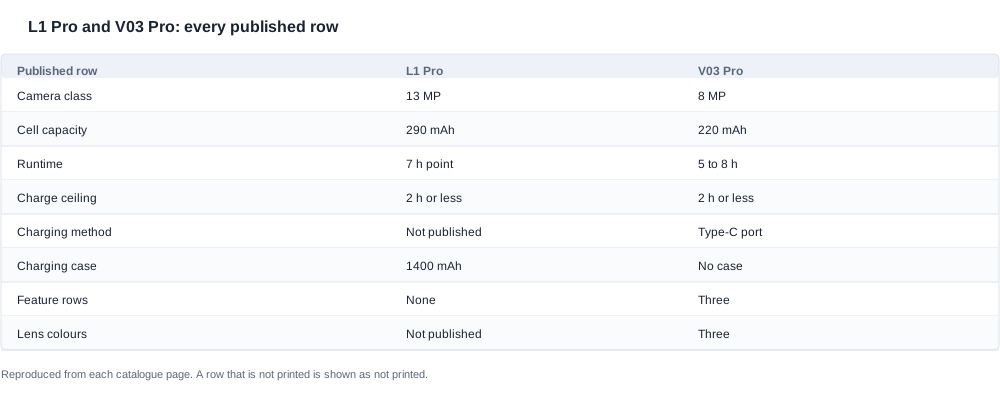
The chart above is the complete published comparison. Read it as five rows that differ, one that coincides, and two rows that only one side prints — and note that most of what differs concerns hardware and packaging rather than what the camera produces.
The camera class is a real separator and the smallest one commercially. One page publishes 13 megapixels, the other 8, and those two figures place the models in different blocks of a group that holds eleven camera models in total — from the V03 and the V03 Pro at one end of the group, through the MT6 and the L2 Utral, and the KY06 and the CY05, and the MT5 and the CY03, and on to the V06 and the S7. Eight of that group publish the lower class; three publish the higher one, and this pair straddles the line. What the class cannot do is describe an image. Neither page identifies the imaging sensor or the angle the camera looks through, and neither states a recording format or a frame rate, so the megapixel figure is a tier label and a positioning decision rather than a picture-quality claim.
The cell difference is real and it is not decisive on its own. The larger cell belongs to the higher class model, and it is the top of the published camera range. But the two pages state their endurance in different forms — a single figure of roughly seven hours on one side, a five-to-eight-hour range on the other — so a capacity comparison alone does not produce a runtime comparison. The bigger cell buys headroom; what that headroom is worth in hours depends on a duty cycle that neither page publishes, and a larger cell with an unstated workload is not a promise of a longer working day.
The charging case is the difference closest to a functional one. The higher class model publishes a 1400 mAh case. The Pro configuration is recorded in the catalogue as shipping without any charging case at all — a stated exclusion, not an absence of information. That distinction is worth being precise about, because a published negative can be planned around: there is no case to wait for and no case specification to request. The absence to plan around is the case itself, and whatever the customer is offered in place of it has to be designed rather than inherited.
And the charging method splits the pair in the way that decides an accessory chain. The Pro configuration publishes a Type-C port, so the frame takes the cable the customer already owns. The higher class model publishes no charging method whatsoever — nothing in the catalogue says magnetic, nothing says Type-C, and the difference between those two states is the difference between a known accessory set and an open one. The camera group splits on this row too: magnetic charging on five models, a Type-C port on two, and no method named on four.
One row is worth checking before anything else, because it is cheap. The higher class page carries no feature rows, while the Pro page carries three: a flexible temple, a photochromic lens and the Type-C port, alongside three published lens colours in orange, beige-white and black. Those two pages are the only ones in the whole camera group that carry a colour set, which means the colour decision in this pair belongs to one side alone and does not need to be negotiated between two offerings.
Those three published lines are worth reading as promises and not as performance figures. A lens that darkens with light is a usable answer for outdoor and daytime channels, and it is the one published feature in this pair that changes what the product can be sold as — but the catalogue prints the lens type and nothing about how fast the transition happens, how dark the lens goes, or the temperature range over which it holds. A temple that flexes is a fit and durability statement published as a word rather than as a figure, which is a legitimate basis for a listing line and a poor basis for an acceptance criterion. The how to evaluate question for each of them is the same: what would you have to measure to turn the published word into a number you can put on a purchase order? For the lens that is a transition time and a darkness reading; for the temple it is a movement measured in millimetres and a cycle count.

Two kinds of unknown, and the work each one creates
This is the part of the comparison that decides how you run the programme, and this pair states the point better than any framework would. There are more than two states here, and keeping them apart is the whole skill.
The unpublished charging method is a request. The supplier holds the answer; it simply is not on the record. A request with the right wording — the interface, the port or the contact arrangement, the model designation it applies to — normally returns a line rather than a paragraph. Unpublished does not mean unavailable, and the cost of closing this one is a single message that can go out on the same morning as the sample order.
The published range is not a request at all. The five-to-eight-hour figure has already been stated in the form the catalogue chose, and no amount of asking turns a range into a point. There are exactly two honest ways to deal with it: measure it on a sample unit under your own conditions, or design the commitment around the conservative end of it. What cannot be done is quote the top of the range and hope, because the model being quoted is precisely the one whose published figure has a shape.
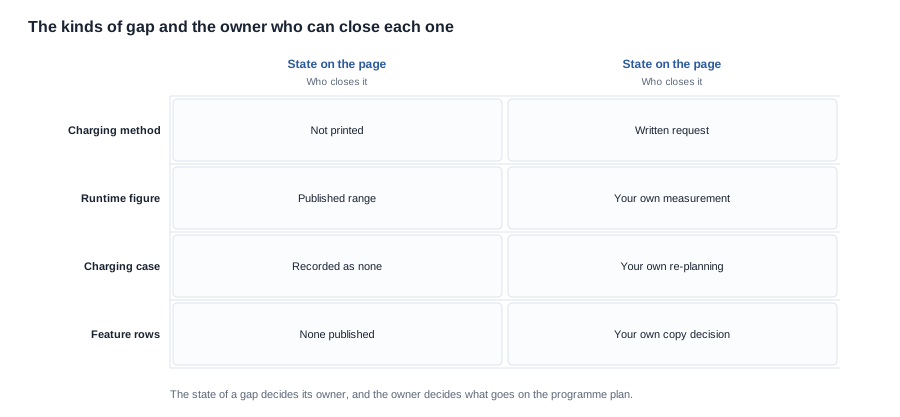
The matrix above sorts each gap by the state it is in and by the party who can close it. That column is the one that should drive your schedule: a request has an owner in the supplier's inbox, a measurement has an owner on your bench, and a re-planning exercise has an owner in your own product brief.
What to ask is therefore decided by the state, not by the topic. The unpublished interface is a request about a port and it takes one message. The range is not a request about anything at all; it is a measurement you arrange on your own bench. The signs that a reply has done its job are simple — a model designation, a named interface, a figure with a method attached — and a reply without any of the three has to be asked again rather than written into the file.
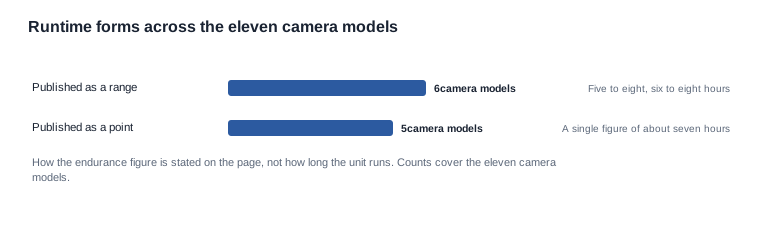
And the shape of the published runtime is not unusual. Of the eleven camera models in this group, six state their endurance as a range — five to eight hours, or six to eight hours — and five state a single figure of about seven hours. The higher class model sits in the second group, the Pro model in the first. A comparison that places a point value next to a range without saying so has already made its mistake before the reader reaches the bottom of the page.
A third state exists and it is the one most often mishandled. The Pro model's missing case is neither unpublished nor imprecise: the catalogue records that the configuration has no charging case. Nothing has to be requested and nothing can be. A buyer who treats it as a gap will spend a fortnight chasing a specification that was never going to exist, and a buyer who treats it as a feature will promise a dock that was never on the plan.
So keep four states apart, because each one creates different work. A published value is a fact you can build on. An unpublished value is a request with a deadline attached. A published range is a measurement you have to arrange, or a commitment you have to write conservatively. A published negative is a fact as well, and the only thing it costs is the re-planning.
The difference between them shows up in what you are able to promise. The interface is a promise you can make once the answer arrives, because a supplier can state a port in one line. The range is a promise you have to make now, with nothing arriving: you promise the conservative end of it, or you promise nothing and design the charging cycle into how the product is used. One of those two answers comes back within a week, and the other has to be arranged in a laboratory, and that asymmetry is why the two gaps belong in different places on the programme plan rather than in the same box of open items.

The rows the L1 Pro and V03 Pro have in common
Both models charge within two hours or less, and that is the only power figure they print identically. Both belong to the camera group, and every model in that group publishes a camera class, so neither of these two can be described as a model whose camera specification is missing. Neither identifies the sensor behind the lens or the angle it looks through, and neither gives a recording format or a frame rate. Neither publishes a frame weight. Neither publishes an ingress marking. Neither publishes a Bluetooth version, and eleven camera models in this catalogue are in the same position on that row.
What the shared rows settle is very little, and that is the point. Two hours or less on both sides is a turnaround figure, and it is the same number, so it cannot decide anything between them. The identical gaps cannot decide anything either, because a gap shared by two models is a gap you will have to close twice rather than once.
And that is where a comparison can go wrong quietly. Evaluate these two models on the published rows and you conclude they are nearly the same product with a different camera tier and a different box. Evaluate them on what you still need to learn and you conclude you cannot choose at all. Both readings are correct, and the second is the more useful one, because the first quietly converts an open question into a confident answer that nobody has verified.
The two are not close relatives in the way the shared charge ceiling suggests. The higher class model shares its 290 mAh cell with three other camera models and its 13-megapixel class with two others, while the Pro model shares its 220 mAh cell with two and its camera class with eight. The common charging ceiling is a category default rather than a shared platform, and the L1 Pro versus L2 Utral battery comparison is a useful reminder of how different two models sharing one cell can look once the interface and the case are included in the picture.
The label on the charging row differs between the two pages as well. On one page the charging figure is printed as a charge duration, on the other as a charge time, and the endurance row is labelled differently on each. The values coincide, so nothing changes for the buyer — but a specification file that transcribes the labels verbatim will look inconsistent to the person who reads it next, and that confusion costs more than the transcription saves.
Two catalogue-wide silences are worth stating so that nobody plans around them. The twenty-eight-model range contains no capacitive touch row at all, so a gesture-controlled feature cannot be promised on the strength of what these pages say, and no model carries a translation row, so neither side of this pair can claim one. And on compliance the position is the same for both: the catalogue's certification page carries images of ten patent certificates — eight design patents and two utility models — while its text names no CE, FCC or RoHS marking at all. Company-level declarations exist; per-model certificate numbers do not appear anywhere and have to be requested for the model you are actually buying.
How to run the decision, in order
The decision is not a preference between two cameras. It is a short sequence of questions about your own programme, each of which a published row either answers or leaves open. Run it in the order below and every step either settles the next one or makes it irrelevant.
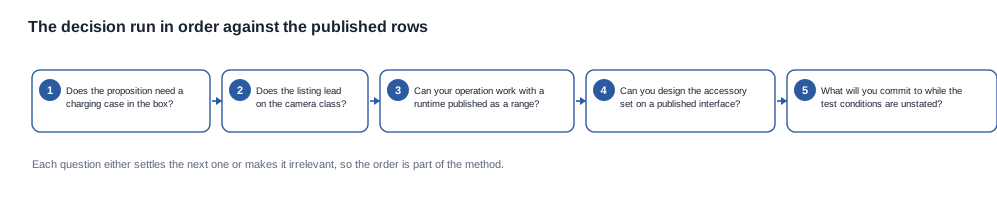
The flow above is the decision itself: five questions, and the order matters because question three is pointless if question one has already excluded a model.
- Does the proposition need a charging case in the box? One model publishes a 1400 mAh case, the other is recorded as having none. If the case is part of the proposition, this row settles the question, and if it is not, this row stops mattering immediately.
- Does the listing lead on the camera class? If the copy leads on the 13-megapixel class, that is the model that carries it. If it leads on the lens, the temple or the colour set, that is the Pro model's published row, and the camera class stops mattering.
- Can your operation work with a runtime published as a range? If it can, the five-to-eight-hour figure is usable as a range and you plan charging coverage against the top of it. If your procurement policy requires one committed number, then the row to work on is the point estimate of roughly seven hours with a stated condition attached — and a range cannot be given a condition that a point value can.
- Can you design the accessory set on a published interface? The Pro model publishes Type-C, so the cable, the packaging and the support script can be written now. The other model publishes nothing, so the interface is a request with a date on it, and the packaging cannot be finalised until it comes back.
- What will you commit to while the test conditions are still unstated? Both pages print a runtime without a condition. Where your own quality policy insists on a stated condition before a runtime reaches a purchase order, that condition has to be requested for both models — and it is a request rather than a comparison, because neither side carries it today.
Two of those steps are requests and one is a measurement, and keeping them apart is what makes the programme run. The interface request and the runtime-condition request belong in one message, addressed by model designation so that a family-level answer cannot be mistaken for a model-level one. The runtime measurement belongs to the sample unit and to your own script. The camera class, the case and the colours are facts you can write down today, and they are the only three rows that need no follow-up at all.
And record the outcome as the row that decided it. A plan that says the case carried the decision and the lens and the colours carried the next one is a plan a colleague can read and act on. A plan that says one model was better is not, and that is the version that gets relitigated the next time a listing has to change. The criteria for judging a reply are the same as the criteria for asking the question: an answer tied to a model designation can go on a specification sheet, a figure without a method cannot, and a range returned where a point was needed is a red flag rather than an answer.
Before you order, run the shortlist through one more filter: what will you promise the customer? Write the sentence you would put on the product page for each model, using only the published values, and see which sentence survives a customer reading it. That is the fastest way to find out whether the model with the open interface is a problem you have solved or a problem you have deferred.
A short checklist at this stage costs less than a discrepancy later. Confirm three things before the purchase order leaves: that the runtime figure on your copy is the conservative end of what is published, that the accessory list matches the interface you have actually been given, and that the parcel description in the packing list matches the case row as it was printed. When to run that checklist is before the artwork is released rather than after the first container is booked, because at that point the only remaining option is a reprint and a relabelling charge that lands in the total cost of the shipment.
Where CYNRIN stands on the L1 Pro and V03 Pro choice
This is a packaging and channel decision rather than a technology decision. The imaging difference is a tier label; the differences that actually affect your business are the charging case and the charging interface. We do not rank the two models, and we will not tell you that 13 megapixels is the deciding factor, because that is reading the marketing row rather than the product.
What we will not do is pretend the two unknowns are the same kind of unknown. The charging method can be requested and will be answered in writing. The runtime precision cannot be requested, because the range is the published form; the only honest way to use it is to measure it or to commit to the conservative end of it. Folding both into one line on a request list is the fastest route to a programme that ends with a model nobody can describe.
What we will not do either is publish a value the catalogue does not carry. Nothing is published for either model on frame weight, ingress protection, the imaging sensor, the viewing angle, certificate numbers, unit price, minimum order quantity, lead time or warranty cover, and none of those appears on any product page we publish. The certification position for both is a regulatory frame that a file can be built against, not a document you can put in a folder.
And what we can do is narrow the choice quickly. Send one request covering the charging interface and the runtime condition, put a sample unit of each on your own scales and your own camera script, and the decision that remains is a short one about the case, the colours and the tier — all of which are already on the record. The V03 Pro behaviour notes, the V03 Pro limitations and the use-case split between the two platforms are the next documents worth reading, and the camera range overview shows where the other nine sit. The row-by-row comparison is the document to keep open beside this one.
Related reading
- The same pair laid out as published rows — L1 Pro versus V03 Pro specification comparison
- What the Pro configuration is worth inside the range — V03 Pro value for money
- The Pro model against a different platform — V03 Pro versus KY06 form factor
Tell us which row your programme actually turns on — the parcel, the cable or the tier — and we will tell you which of the open items still belongs in your request list.


