
A spec comparison is worth writing only when the two pages answer the same questions, and this pair does — with one trap that most comparisons of these two models walk straight into. Six rows are printed across the two pages: a camera class, a cell capacity, a charging figure, a runtime figure, a charging method and a charging case. Four of those rows carry different values on the two sides, one carries the same value on both, and two exist on one page only. The trap sits in the labels. The two pages name the same two concepts differently, so a table that copies one page's wording onto the other looks tidy and means nothing.
The 13-megapixel model in this pair prints a 1400 mAh charging case and a charging ceiling of two hours or less, and prints no charging interface at all. The 8-megapixel model prints magnetic charging, prints no case row, and publishes its runtime as a five-to-eight-hour range. So the L1 Pro and the V03 are separated less by the camera than by what each page declines to print, and that is where a buying decision is really made.
This comparison reproduces the six rows as they stand, quotes each page in its own vocabulary, and turns every blank into a question you can put in writing before a quotation goes out. Nothing has been carried across from a neighbouring model to fill a gap, because a blank filled by inference is the fastest way to build a specification file that cannot survive due diligence. Where a row is missing, the row stays missing and the cost of closing it is named.
L1 Pro vs V03 spec comparison: the rows side by side
Both models sit inside the camera group of this catalogue, and that group gives the comparison a solid base: eleven camera models in total — the CY05 and the S7, the KY06 and the V03 Pro, the L2 Utral and the MT6, the L1 Pro and the MT5, the CY03 and the V03, and the V06 — and every one of them prints a camera class, a cell capacity, a charging figure and a runtime figure. Nothing in this pair has to be inferred from a neighbouring model, which is why a row-by-row reading is worth more here than a feature pitch.
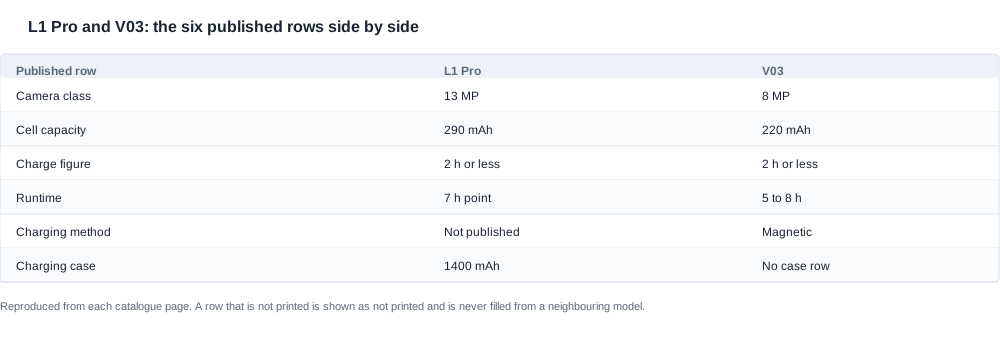
The chart above is the whole documented comparison, and the shape of it matters more than the individual numbers. Four rows carry different values on the two sides, one row carries the same value on both, and two rows exist on one page only. That last group is where a buyer has to work hardest, because a printed row can be quoted today while a missing row has to be requested, dated and followed up.
The one row the two pages share is the charging ceiling, and it settles nothing. Both print two hours or less. Across the whole catalogue that same ceiling appears on twenty-six of the twenty-eight models, and only the D17 and the ZH12 publish a shorter figure of roughly one hour. A ceiling that nearly every model shares is a category default rather than an advantage, and a procurement that treats it as the deciding row is reading a house value as a product difference. If your accessory plan depends on turnaround time, then this is the number to plan against — but it cannot separate these two models from each other.
The label mismatch is the real trap, and it changes how every other number reads. On the page of the higher camera class, the charging figure sits under a charge-duration label and the runtime sits under an endurance label. On the page of the lower camera class, the charging figure sits under a charge-time label and the runtime sits under a charge-duration label — the same word the first page uses for charging. Put plainly: on one page two hours or less is how long the unit takes to charge and about seven hours is how long it runs; on the other page two hours or less is how long the unit takes to charge and five to eight hours is how long it runs. Carry the first page's wording into the second page's column and the runtime of one model ends up filed under the charging time of the other. The comparison below therefore quotes each page with the label that page uses, and compares like with like.
| Published row | L1 Pro page | V03 page | What the row changes for a buyer |
|---|---|---|---|
| Camera class | 13 megapixels | 8 megapixels | The tier your listing copy can carry |
| Cell capacity | 290 mAh | 220 mAh | The power headroom you plan against |
| Charging figure | Two hours or less | Two hours or less | No difference between the two |
| Runtime | About seven hours | Five to eight hours | A point figure against a range |
| Charging method | No row printed | Magnetic charging | One open request against a settled chain |
| Charging case | 1400 mAh | No row printed | Two different parcels, two different in-box lists |
| Ingress marking | No row printed | No row printed | No protection claim available to either |
| Camera models in that class | 3 | 8 | The sourcing depth behind each tier |
The how to compare rule for this pair is short. Take the four differing rows, drop the one shared row out of the decision, and treat the two one-sided rows as the work item. The two common pitfalls in a comparison like this are the errors this section has just described: reading a shared category ceiling as a difference, and borrowing one page's labels for the other. That is a comparison you can complete inside a week, and it produces a document you can defend in front of a colleague who has not seen either catalogue page. The V03 specification list is the published reference for the lower class model, and the camera range overview shows where both of these sit against the other nine.
Resolution, cell and runtime on both pages
Resolution is the cleanest axis this catalogue offers for camera models, and it separates these two before any other argument starts. Thirteen megapixels is held by three of the eleven camera models — the L2 Utral and the S7, and the L1 Pro — while the remaining eight publish the 8-megapixel class, including the V03. One model sits in a block of three and the other in a block of eight, and that is the whole of what the published tier tells you.
A camera class is a tier label, not an image claim. No camera model in this catalogue names the sensor, gives an angle of view, states a recording format or prints a frame rate, so the megapixel figure cannot be turned into a statement about sharpness, low-light behaviour or the length of usable recording. If image quality drives the programme, the honest reading of the class row is a positioning decision, and the evidence has to come from units on your own desk under the same shooting script. The camera imaging notes set out what a like-for-like comparison needs to include.
Cell capacity places each model inside a band rather than outside it. The 290 mAh cell is printed on four camera models — the L2 Utral, the L1 Pro and the CY05, and the CY03 — and the 220 mAh cell on three — the V03 and the V03 Pro, and the MT5. The remaining models sit at 260 mAh on three units and at 265 mAh on the MT6 alone.
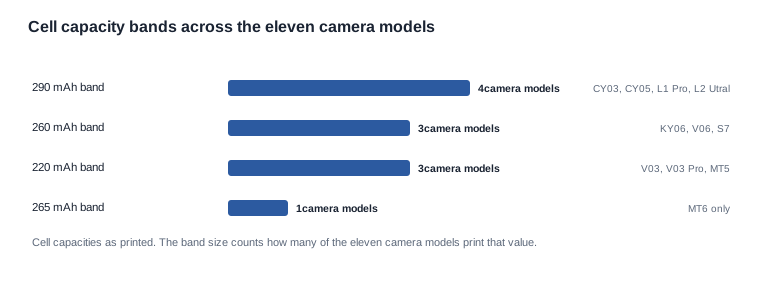
The distribution above is worth reading before anyone treats a cell figure as a model signature. The higher of the two cells in this pair is the top of the published camera range, and it is shared by three other camera models; the lower cell is shared with two. Neither figure marks a model out on its own, and neither is rare in a range of twenty-eight products.
Runtime is where the two pages differ in kind rather than in degree. The higher class page prints a point estimate of about seven hours. The lower class page prints a range of five to eight hours. Neither page publishes the test condition behind its figure, so the two numbers were not produced under a method a reader can see, and a larger cell cannot be used to argue that one model lasts longer than the other — the published forms are simply not commensurable.
What survives that is still useful. A point estimate can be republished on a product page as a single figure, provided it is republished as the estimate it is. A range has to stay a range, because a range in a product description reads to buyers as a figure that moves with use rather than as a weaker claim, and a range that gets flattened into a single number becomes a claim nobody has tested. If your own quality policy requires a stated condition before a runtime goes on a purchase order, then that condition has to be requested for both models, and it belongs in the same written request as the interface question in the next section. The evaluation criteria for a runtime row are simple: the figure, the condition it was measured under, and whether your programme can operate the worst case. The trade-off in front of you here is not capacity against capacity — it is a committed number against a published range. The battery life guide covers the question of how a runtime figure should be written once you have one.

The charging interface, and the row one model does not print
Nothing else in this pair separates the two models as sharply as the charging method row, because one page prints a method and the other page prints nothing in that row at all. The 8-megapixel page prints magnetic charging. The 13-megapixel page has no charging method line and no charging interface line — the row is absent, not filled with a value.
Across the eleven camera models that column splits three ways. Five of them name magnetic charging, two name a Type-C port, and four name nothing at all — the L1 Pro and the CY03, and the CY05 and the MT6. Across the whole catalogue the same split reads seventeen magnetic, seven Type-C and four unpublished. The row is therefore well documented across most of the range, which makes the four blanks a property of those four models rather than a silence of the catalogue.
What a printed method settles, and what a blank does not. A published method settles the accessory chain before a sample arrives: the charging cable or the contact arrangement, the spare stock you hold, the line on the packaging, the replacement part a support agent can offer, and the scope of the technical file that has to describe the accessory alongside the product. A blank settles none of it. Everything downstream of the interface has to be treated as open until a written answer arrives, which is an entirely manageable state as long as the programme knows it is in one.
There is a specific question raised by the magnetic-charging row on the lower class page. Magnetic charging implies a contact arrangement, and that page prints no case row at all, so the catalogue does not show what the magnetic charging attaches to. That is a legitimate question to ask, not a defect to allege: a dock or a charging case may be sold as a separate item, or the contacts may work with a cradle that is described elsewhere. Ask it in writing and let the answer decide the accessory list.

The sequence above is the whole method, and it is worth naming because it keeps a cheap request separate from an expensive one. Steps one and two cost nothing and finish in a morning. Step three is one email. Step four is the sample. Step five is the file.
The questions to ask are narrower than they look, because four of them close most of what is open and each is answerable in a single line:
- Which connector or contact arrangement does the 13-megapixel model use for charging, and is the same lead used to charge the 1400 mAh case?
- Is the two-hour ceiling on that page measured for the glasses alone, or for the glasses and the case together, and from empty to full?
- Under what conditions was the five-to-eight-hour runtime measured on the lower class page, and what was recording during that test?
- What does the magnetic charging on that page attach to, and is that item part of the standard configuration?
The red flags in a reply are the signs that the experience has been described rather than the interface named. A supplier that answers with a paragraph about convenient charging has not answered the question, and the row has to stay open in the file. An answer tied to a specific model designation, quoted back in your own document, is what closes it. Asking the right way to ask is half of due diligence; the other half is refusing to write an answer that was never given.
The charging case row and what it changes
The charging case is the row where this pair diverges most sharply in commercial terms, because it changes what physically leaves your factory rather than what appears on a datasheet. The higher class page prints a 1400 mAh charging case. The lower class page prints no case row at all.
That distinction is worth stating carefully, because it is different from the one the catalogue draws elsewhere. One model in this camera group is recorded explicitly as shipping without a charging case, and two publish a case with no capacity figure. Three print no case row at all — and the lower class model in this pair is one of them. A published exclusion is a fact you can plan around. A blank row is an open question, and it needs a request rather than a re-planning exercise. The practical difference is that you will not waste a fortnight chasing a specification that was deliberately excluded.
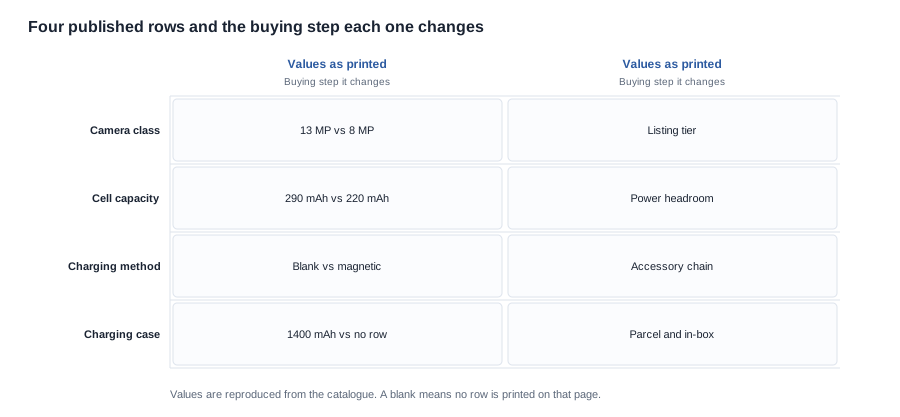
The matrix above pairs each differing row with the buying step it unblocks, which is the only way a spec table becomes useful rather than decorative. A row that changes a step is worth an afternoon of attention; a row that changes nothing is not worth a line in the file.
The four states of the case row across the camera group are worth knowing before you ask. Five camera models publish a capacity. Three of them print 1400 mAh — the CY05 and the CY03, and the L1 Pro — one prints 900 or 1400 mAh, and one prints 1200 mAh in a folding case. Two publish a case with no capacity — the KY06 and the MT5. Three print no case row, and one is recorded explicitly as shipping without one. So the higher class model in this pair is not in an unusual position; it shares its 1400 mAh figure with two other camera models, and it sits on the opposite side of the only distinction the catalogue draws here from the lower class model.
What a published capacity does not tell you is almost everything about the object. There is no case dimension, no case weight, no case charging time, no case input voltage and no published number of charges a case can deliver before the frame needs a wall supply. Those are the numbers that decide whether a configuration is workable on an air shipment or inside a battery-compliance carton, and every one of them sits outside the catalogue.
The how to evaluate rule for the case row is that it is a total cost question, not a number question. Take the parcel with the case and the parcel without it, add the freight difference, the packaging difference, the labour at the packing line and the spare stock you would hold, and compare the two totals. Then ask whether the retail proposition you intend depends on a case being in the box. If it does, the case is a requirement rather than a feature and the comparison is not between two similar products but between two different products. The question of when to ask is not the question of how long the answer takes — the case row becomes expensive to change after the packaging artwork is released, and cheap to change the day before. The IP ratings note and the sample request route both belong on the same page of the programme plan as this row, because the questions they answer are asked against the same physical unit.
Where CYNRIN stands on the L1 Pro and V03 comparison
The position is a narrow one and we will state it plainly: these two pages support different programmes, and neither of them is the better product. The higher class model publishes a charging case and a larger cell but leaves the interface open. The lower class model publishes a charging method and a runtime range but leaves the case open. We will not rank them, because the rows that would decide the ranking are the ones the catalogue does not print.
What we will not do is fill a gap from a neighbouring model. The charging method that the L1 Pro does not print is not magnetic because four camera models share that silence, and it is not Type-C because two other models print it. The weight published for a different model is not a weight for this one. The IP54 marking carried by two camera models elsewhere in the range is not a marking for either model here. Each of those would be a claim nobody has verified on the product you are buying, and an unverified claim in a specification sheet is a defect waiting for a customer to find it.
What we will not do is quote a figure the catalogue does not publish. No weight, no ingress marking, no sensor model, no field of view, no certificate number, no unit price, no minimum order quantity, no lead time and no warranty period is printed for either model, and none of them appears on any product page we write. The certification position is worth stating precisely: the export-certification page of this catalogue is a page of images carrying ten patent certificates, eight of them design patents and two of them utility models, and the catalogue text refers nowhere to CE, FCC or RoHS. What a file can be built against is a company-level compliance declaration plus a model-level certificate number that has to be requested, and the certification checklist is the right instrument for that request.
Two other catalogue silences are worth naming so that nobody plans around them. Not one of the twenty-eight models in the catalogue carries a capacitive touch row, so gesture control cannot be promised on the strength of any comparison drawn here, and no model carries a translation row either — which means a translation capability is not something either side of this pair can claim.
What we can do is narrow the choice quickly and honestly. Send one request that names the model and asks for the charging method, the runtime test condition, the in-box list and the case contents; put one sample unit of each on your own scales and your own shooting script; and what remains is a short decision about the parcel, the tier and the accessory chain, all of which are facts already on the record. The how to choose question that survives all of that is a shortlist question rather than a technical one, and it is the last thing left for a buyer to answer before you order. How to verify whatever answer comes back is simple: read it back against the model designation printed on your own file. The V03 limitations page and the L1 Pro versus V03 Pro comparison cover the neighbouring models in the same group, and the battery and charging note on the L1 Pro sets out what the 290 mAh band contains.
Related reading
- The published rows of the lower class model — V03 specifications and features
- Where the lower class model stops — V03 limitations
- The same pair against a third platform — L1 Pro versus KY06 form factor
Send us the row that decides your programme — the parcel, the interface or the tier — and we will tell you which of the open rows still has to be closed before a quotation goes out.


