

Most specification pages for smart glasses are written as sales sheets. They list the headline numbers, skip the caveats, and leave a table that looks complete but is not. The V03 row in the CYNRIN catalogue is smaller than that, and smaller in a way that is useful to a buyer configuring a product rather than browsing one. Reading V03 smart glasses specifications and features means treating that row as a confirmed baseline and everything around it as a structured question list, not as a gap to fill with borrowed numbers.
This page works from the published row and nothing else. Every number below comes from the catalogue row for the V03 AI smart camera glasses. Where the catalogue prints nothing, this page says so, and it gives the questions to put to a supplier so the gap is closed before artwork, tooling, or a purchase order is signed. Our position is that a catalogue row is a starting point rather than a finished specification, and we will not print a figure the catalogue does not carry.
V03 smart glasses specifications: reading the published row
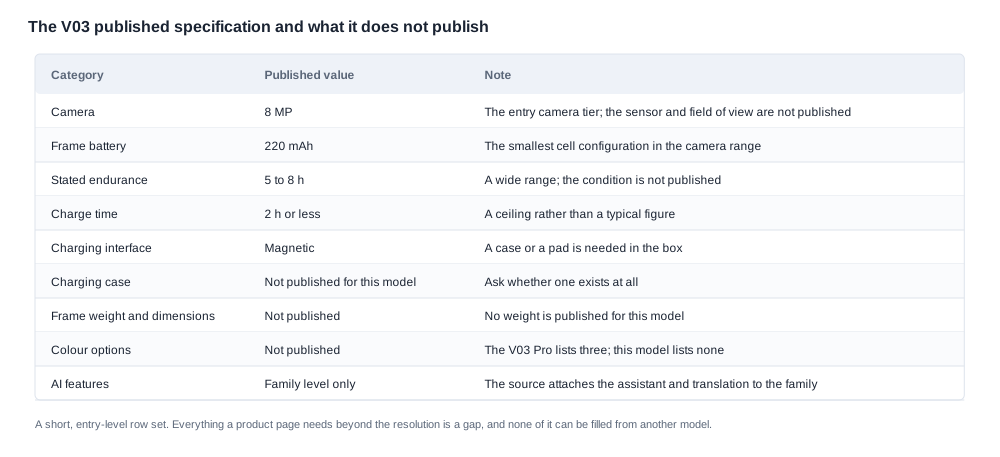
The catalogue publishes one row for the V03, and the shape of that row tells you what kind of device it is and what kind of device it is not. The published fields are these.
Model. The row is labelled V03, and the name field reads V03 AI smart camera glasses. The V03 Pro is a separate row whose name field adds a parenthetical note about a colour-changing lens configuration. The two are catalogue entries in their own right, not one entry with options attached.
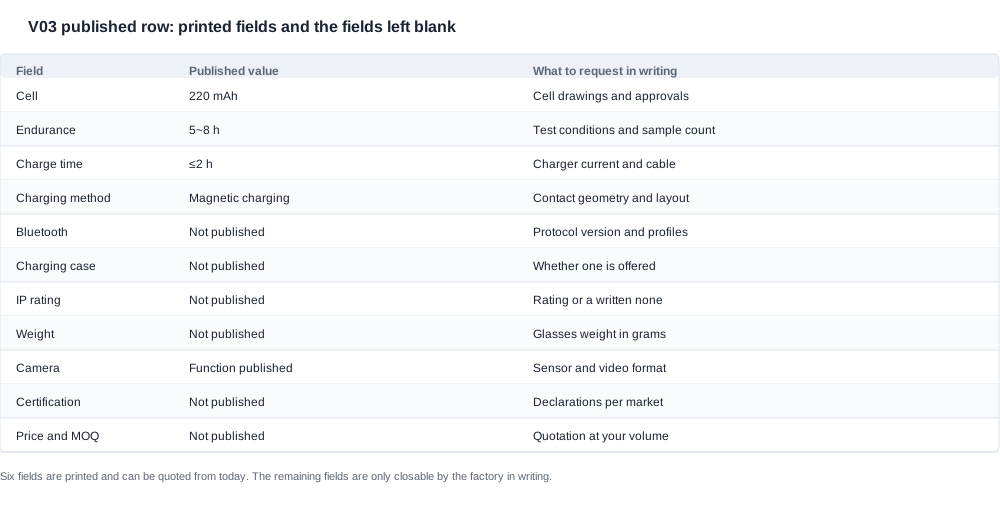
Cell capacity. The battery cell is printed as 220 mAh. That is the only battery figure the row carries, and it is not a range.
Endurance. The runtime is published as 5~8 h, written with a tilde rather than as two separate claims. A band means the outcome depends on which settings are active and how much the camera is doing, so it should be planned as a band rather than quoted as one number. The method for reading an endurance band against other models is in the battery comparison guide.
Charging time. The figure is ≤2 h. That is an upper bound, not a typical value and not an average, and the catalogue does not publish the current the two hours refer to.
Charging method. The row reads magnetic charging, and it appears with no charging case field at all. The V03 Pro row reads Type C and also appears with no case field. The consequences of an absent case row are covered in the charging case options breakdown.
Bluetooth. The field is blank, carrying an em dash rather than a version number. This catalogue does not publish a Bluetooth version for the V03, and this page will not substitute a familiar-sounding number for the empty field.
Four shapes of published value
Almost every sourcing dispute in this category comes from reading a bounded value as an open one. A row contains four kinds of statement, and each licenses a different claim.
A fixed figure can be quoted as printed. A cell capacity of 220 mAh is a number the catalogue stands behind, and a later mismatch is a supply chain failure rather than a documentation nuance.
A band is a statement about variation. Use the upper bound of 5~8 h in a customer-facing claim and the lower bound in a shift-planning assumption; using one for both is how a true specification becomes commercially misleading.
A ceiling supports exactly one sentence: the device reaches full charge within two hours. It does not support "charges in two hours", a dock-throughput assumption, or a typical charge time, none of which is published.
A method constrains physical design rather than performance. Magnetic charging fixes the accessory kit, the packaging and the instructions, and says nothing about charge duration.
What the row deliberately does not carry
There is no charging case field on the V03 row. That is not the same as a case being unavailable; the catalogue's case discussion sits on other rows, and the KY06 row pairs magnetic charging with a case whose capacity is not published.
There is no IP rating. The published ratings attach to specific models, and the V03 is not among them. The correct entry in a comparison sheet is "not published", which differs both from a low rating and from no protection at all.
There is no weight. This catalogue does publish weight figures, so the absence is a real gap, and any number attached to the V03 in a third-party listing came from somewhere other than this catalogue.
There is also no price, no MOQ, no lead time and no warranty term on any row. Those are supplier and programme questions, and the right place to settle them is a quotation.
Why a partial row is a strength for a configurator
A configuration is a decision about what to ask for, not about what to announce. A complete table invites you to publish it and stop. A partial row pushes you into the work that determines whether the project lands: converting a published baseline into written requirements a factory can quote against, a quality control plan can be written against, and a contract can be signed against.
For the V03 that conversion is short. The baseline is a 220 mAh cell, a 5~8 h band, a ≤2 h ceiling, magnetic charging, and a camera. The open items are the ones any camera glasses programme raises: lens and sensor configuration, ingress rating, unit weight, case availability, Bluetooth implementation, certification position, and commercial terms at your volume. All of them are answerable in writing, and a buyer who treats the row as confirmed and the rest as a question list is working correctly. A buyer who wants completeness before anything happens will wait forever, because completeness is a property of a signed technical file, not of a catalogue row. If the model itself is still open, the model picking guide comes first; once the V03 is settled, the work below is what remains.
The published row and what a buyer can build from it
What can be built from the row divides into three layers: fixed by the catalogue, open but answerable, and closed only in writing.
Layer one: the fixed baseline
- Model identity. A project specifying "the V03" specifies the magnetic-charging row with no lens-colour note, not the Pro.
- Cell capacity. 220 mAh is the published cell. Changing it changes the product and moves the runtime band and charge ceiling with it.
- Endurance band. 5~8 h is the figure to use in product copy and in sizing a working day.
- Charge ceiling. ≤2 h supports "fully charged within two hours" and does not support "charges in two hours".
- Charging method. Magnetic charging propagates into the accessory kit, packaging, instructions and after-sales replacement logic.
- Camera function. The name field establishes it, and it is why this row is a separate catalogue entry. Platform detail is in the AI features notes.
Each fixed field propagates further than its own table row suggests. Magnetic charging also decides the cable inventory, the carton contents list and the instruction artwork, while the camera function drives the declaration set and the privacy wording any market with a recording notice requires. A fixed field may be used as a fixed field but never extended: the catalogue publishes a capacity, not a cell chemistry, and a runtime band, not a cycle count.
Layer two: open but answerable
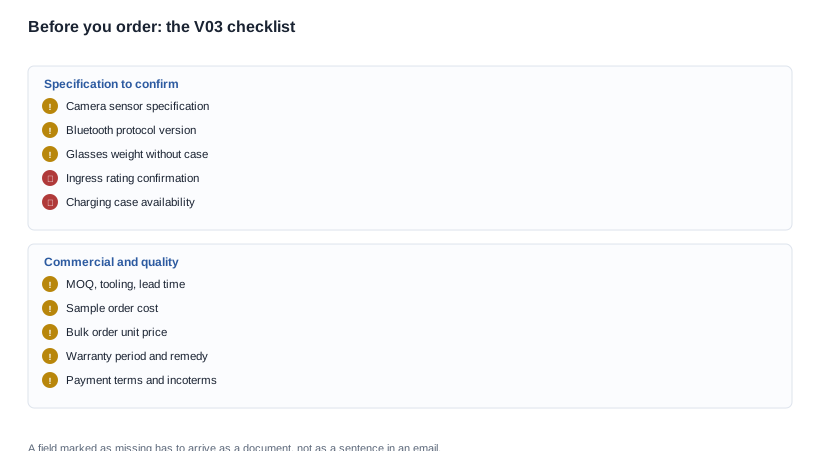
Ingress protection, unit weight excluding any accessory, lens and sensor configuration, Bluetooth protocol version and profiles, charging case availability and its cell, and frame and lens materials with available colourways are all fields a supplier can answer in a technical file without the catalogue changing.
Ask for fields rather than for information. A supplier can return ten named fields in one reply because ten fields is a form; a general request returns a brochure, and a brochure cannot be filed or audited. Name the destination market and the date by which the answer is needed, and prefer answers from the factory itself over an intermediary's summary.
Layer three: closed before an order
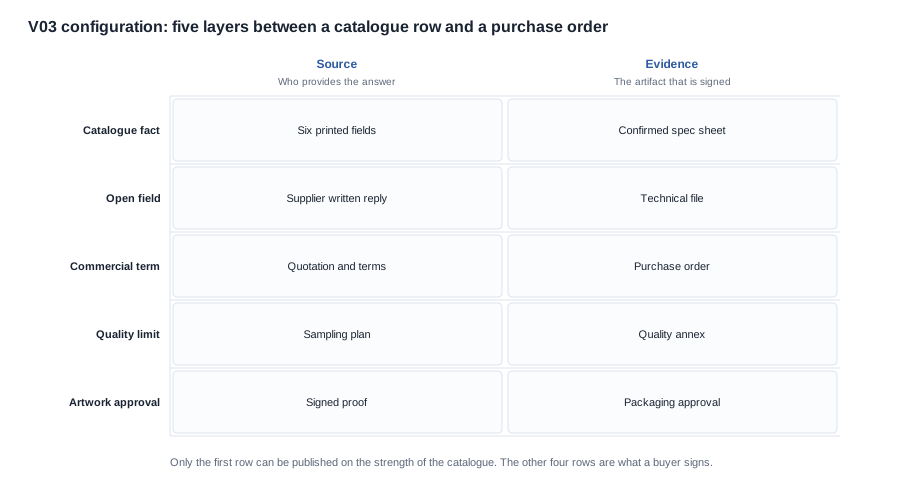
- Certification and compliance. Which regulatory regimes apply to the destination market, which declarations are needed, and what evidence supports each one, with scope and issuing body named.
- Quality control. Inspection points, sampling method, defect classification and the agreed acceptance threshold, in the purchase order or its quality annex.
- Commercial terms. Unit price at your volume, MOQ, tooling cost and ownership, lead time, sample order cost and lead time, warranty period and remedy, payment terms, deposit percentage, incoterms, and bulk order pricing tiers.
- Private label and packaging. Named owner and date for branding, labelling and packaging approvals, because artwork locks the configuration.
- Technical file. The assembled evidence set: confirmed specification, drawings, test reports, declarations, approved artwork.
That ordering is not cosmetic. Artwork before the technical file is the classic way a camera glasses programme loses a month, because artwork locks the printed claims and those claims cannot change without re-approval and new logistics for stock that already exists.
The trade-off this row creates is between speed and certainty. Publishing a small row lets a factory ship sooner because there are fewer claims to substantiate, and it hands the diligence work to the buyer. For a buyer who needs a fixed number on a retail carton without a matching technical file it is not fair at all, and the right response is to make the file a condition of the order.

The features that are not in the published row
A partial row is a specification with a shape. What follows is what a V03 feature page cannot claim on the catalogue alone, and what must come back from the factory in writing first.
No charging case feature. No case field means no bundled case can be promised. If the programme depends on a case, ask on day one, because it changes the accessory, the packaging, the carton copy and the runtime story together.
No ingress protection claim. An IP figure on a V03 listing has to come from a declaration naming the V03 configuration, not from a neighbouring model in the same family.
No weight figure. The catalogue's published weight belongs to a different model and covers that model's body only, excluding its folding case. Measure the V03 on a sample order. The weight comparison across the sport models shows how much the accessory changes the answer.
No camera specification beyond the function. No resolution, sensor model, field of view, video format, frame rate, stabilisation claim or storage arrangement is printed for the V03. A resolution number on a V03 page is imported from elsewhere.
No touch-control claim. There is no capacitive-touch row anywhere in this catalogue. If a sample demonstrates touch input, that is a specification to be written down and evidenced.
No translation row and no audio claim. The catalogue publishes neither for the V03, and exactly one model carries a surround-sound annotation.
No Bluetooth version. The protocol version must be confirmed in the technical file before it appears on a specification sheet or a store listing.
No certification statement. No model carries a per-model certification line, so nothing in the catalogue lets a buyer state that a V03 holds a given certification. Request the applicable declarations and test reports for the destination market, check that the product designation on each document matches the ordered model, and make the production order conditional on that evidence. A general compliance statement instead of documents is a risk to record, not a claim to publish.
No commercial terms whatsoever. No price, MOQ, lead time, sample policy, warranty period, capacity figure, deposit, payment terms or incoterms. All of it comes from a quotation, and all of it is negotiable.
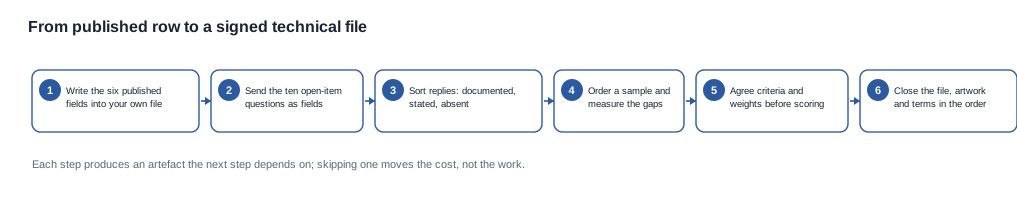
Two consequences follow, pointing in opposite directions. The first is marketing discipline: everything on a V03 page, carton or listing must be traceable either to the published row or to the signed technical file. The V03 common questions page answers most of what buyers arrive with in exactly these terms. The second is sequencing: published row first, written specification second, sample order third, technical file fourth, purchase order last. A programme that locks artwork first discovers the missing fields one at a time, usually in an artwork approval meeting, which is the most expensive place to discover them.
Build a claim ledger before you commit
The tool that enforces this is a two-column claim ledger: every claim your page, carton, insert and listing intends to make on the left, and its authorising source on the right. A claim is authorised by the catalogue row, by a document in the technical file, or by nothing at all. Run it before artwork exists and again the week before printing; the first pass removes unsourced claims cheaply, the second catches claims authorised for a slightly different configuration.
Three entries deserve attention. A charge claim is authorised by the ceiling only. A runtime claim is authorised by the band, so retailer copy stating one number needs a source. A camera claim is authorised by the name field only, so resolution, sensor and storage are unauthorised until the file arrives. Red flags are a claim with no source, a source naming a different model, a source older than the current production revision, and a claim only one supplier in the shortlist can evidence.

Turning the published row into a configuration you can order
This is a sequence rather than a document, written to be handed to a supplier as the opening of a technical file rather than as a complaint.
Step 1: write the confirmed row into your own file
Record the six published fields as facts attributed to the catalogue and keep everything else out until it returns in writing. This prevents the most common failure in camera-glasses sourcing, where an unverified number enters a listing and becomes impossible to retract without a redesign. Attribution matters more than it seems: "220 mAh, catalogue row V03" is evidence, while "220 mAh" is an assertion that starts a dispute whenever a channel partner compares it with a competitor's carton.
Step 2: send the open-items question set
Ask for the missing fields as a structured set, because a supplier can answer a list of specific fields in a single reply while a general request produces a brochure.
- Unit weight of the glasses alone, in grams, excluding any accessory.
- Lens and sensor configuration, including resolution and field of view.
- Ingress protection rating for the V03, or a written statement that none is declared.
- Bluetooth protocol version and the profiles exposed.
- Whether a charging case is offered, and its cell capacity if so.
- Applicable regulatory regime for the destination market, and the supporting reports.
- MOQ, tooling requirement and cost, and lead time for the quoted configuration.
- Sample order availability, cost, and sample-to-production lead time.
- Warranty period, defect definition, and the remedy offered.
- Payment terms, deposit percentage, and incoterms for the quoted route.
Sort the reply into three piles: confirmed with a document, confirmed without one, and not available. Only the first enters the technical file. The second is a supplier position, useful for planning and useless for a claim. The third is a permanent gap to design around, and a gap designed around is a decision rather than a disappointment.
Step 3: agree the criteria before the comparison
Write down what you are evaluating before you compare anyone: confirmed specification match, document availability, sample quality, defect rate, lead time consistency, payment terms, warranty responsiveness, and willingness to put the specification in the contract. Score the evidence, not the brochure: a supplier who answers all ten questions in one written reply, attaches documents naming the V03, and states plainly which fields are unavailable has given you more than one who returns a glossy page and a stock certificate for a different model. Fix the weights before scoring, because weights chosen after the scores are visible are an argument rather than a method.
Step 4: negotiate on terms that can be traded
Specification, certifications and quality thresholds are close to non-negotiable, because changing them later costs a redesign and a new compliance cycle. Commercial terms move differently: unit price at volume, tooling cost and amortisation, payment terms, deposit percentage, incoterms, warranty length and the bulk order schedule can often be traded for forecast volume, a longer commitment or a faster first payment.
Settle the incoterm before negotiating anything else, because it decides who carries risk at each point of the shipment. A lower unit price combined with inherited shipping risk is not a saving, and the result of a good negotiation is not the lowest price but a documented configuration a factory can repeat. For platform-based programmes, the OEM ready platform comparison sets out what "ready" should mean first.
Step 5: audit the evidence, then put it in writing
A factory need not have every document on day one, but it must be able to produce the evidence for its claims by the time the order is placed. Check that the model on each document matches the model you are buying; a report for a similar model is not evidence for the V03, and a certificate naming a different legal entity is not evidence for your supplier. This due diligence step is where a factory audit beats any reference call, because it verifies the line that produces your units rather than the line that assembles samples.
The technical file, approved artwork, quality thresholds, delivery date, incoterm and payment terms then belong in a purchase order and its annexes, signed on both sides. Anything not written is not part of the configuration, however it was phrased in a meeting. Two clauses earn their place: a specification annex reproducing the confirmed fields and attaching documents by name, and a change-control clause requiring written approval before any change to specification, firmware branch or packaging.
What this means for the V03 specifically
The buying decision is unusually clean because the row does not try to be more than it is. A 220 mAh cell, a 5~8 h band, a ≤2 h ceiling, magnetic charging and a camera function, with no case in the row and no Bluetooth version printed, describe a product with a clear use case and a clear set of unknowns. The unknowns are ordinary and answerable, and the right response is a technical file, a sample order and a checklist rather than a search for a more flattering specification page.
If your programme needs a case in the box, the row will not confirm one, so establish it early. If it needs a colour-changing lens, the V03 Pro is the entry carrying that note, and it charges over Type C rather than magnetically, which belongs in the unboxing and the instruction sheet. The V03 Pro use case notes cover that branch, and the V03 and L2 Utral charging comparison shows how a magnetic row and a Type C row behave against the same criteria. Both are branches where the row forces an early conversation, which is cheaper than having it during artwork approval.


