

The L2 Utral and the CY03 sit on the same 290 mAh frame cell and publish the same rated endurance, so on two of the rows a buyer would use to compare them the two pages are identical. On three other rows they are not, and the three differences are the whole of the positioning. The camera row reads 13 MP on one page and 8 MP on the other. The case row reads two values on one page and one on the other. And the charging row is named on one page and absent on the other.
That last one is the difference most often got wrong in both directions, so it is worth stating plainly at the top: the CY03 page carries no charging-method row, and in the camera range four models are in that position. That is missing information, not a different method, and it cannot be read as a method of its own.
Nothing about price can be settled from any of this, because no price, order minimum, lead time or warranty period is published for any model in the range. What can be settled is the structure, and the structure is what a positioning note should be built from: three differing rows, four matching rows, and a list of the items that have to be requested before either model can be described in a quotation.
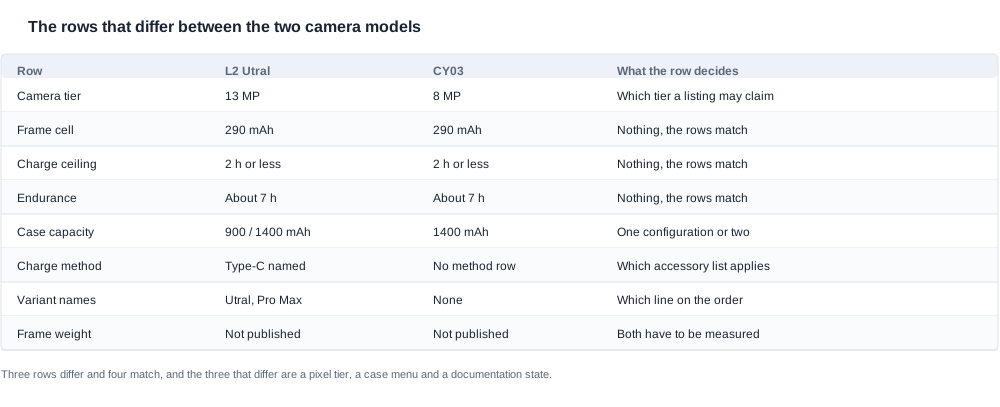
L2 Utral smart glasses vs CY03 price positioning: the three rows that differ
Four rows that match, and why matching rows do not help
Both pages publish a 290 mAh frame cell, a charge time of two hours or less, and a rated endurance of about seven hours. Those three rows are identical, and the fourth row worth naming is the case capacity, where they are not.
Identical rows settle nothing in a comparison, and they do something else as well: they remove the hardware as an explanation. A buyer who wants to know why two quotations for these two models differ has already learned that the cell, the charge ceiling and the endurance rating will not answer it, because those three numbers are the same on both pages. The remaining candidates are the three rows that do differ, and each one has a different commercial consequence.
Across the camera range the 290 mAh figure is shared by four models — the L2 Utral and the CY05, and the CY03 and the L1 Pro — and the cell sizes elsewhere fall into other groups: 265 mAh on one model, 260 mAh on three, and 220 mAh on three. So a buyer working across the range has to be careful with a cell figure as an identifier, because it identifies a group rather than a product.
What a matching row can and cannot settle
Matching rows are still worth reading carefully, because they tell a buyer which questions do not need to be asked twice. The endurance rating carries no condition on either page, so one question asked identically to both suppliers closes it for both. The charge ceiling is a ceiling on both pages, so the start state and end condition are one question rather than two. And the camera rows are what make this comparison a comparison at all.
The rows that carry the positioning
The three rows that differ are the camera tier, the case menu and the state of the charging documentation. In practice they separate the two models in three independent ways, and a buyer who plans a range needs to know which of the three matters to which channel. The camera tier decides which listings can be written. The case menu decides how many production configurations and stock lines exist. And the charging row decides whether the accessory list can be built at all before a supplier answers.
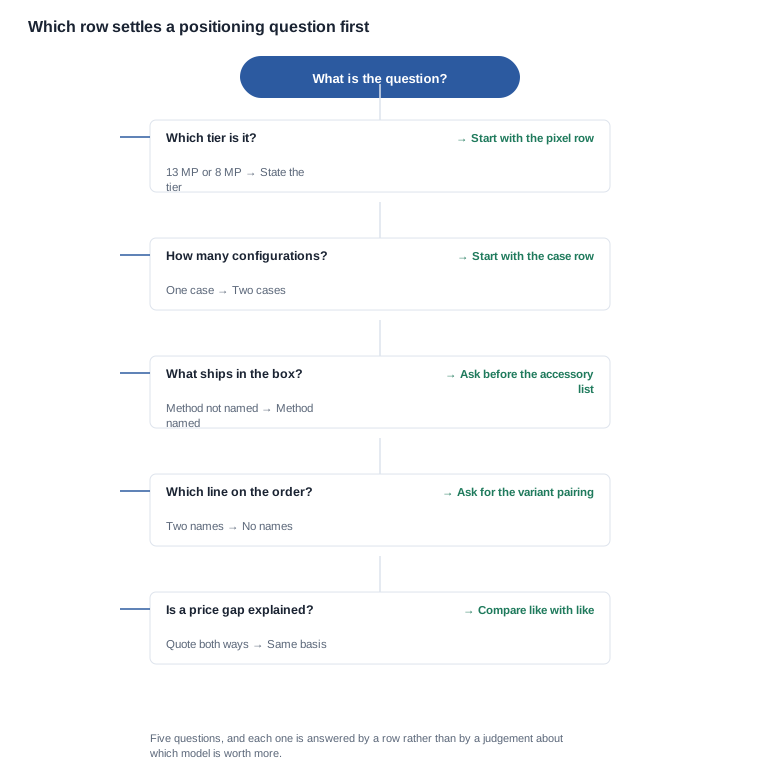
The pixel tier is the first difference, and it is a tier
Thirteen megapixels against eight
The camera row is where the two pages part company. The L2 Utral publishes 13 MP. The CY03 publishes 8 MP. In the camera range, eight models publish 8 MP and three publish 13 MP, and the two models in this comparison sit on opposite sides of that split.
What that difference supports is a tier statement, and only a tier statement. A listing may say that the camera is in the higher published tier or in the lower one. It may not say that the image is better, because the sensor model, the field of view, the video format and the frame rate are not published for this model or for any other camera model in the range, and a pixel count without a sensor model cannot be converted into a picture. The camera and imaging page covers why the resolution row is an input to an imaging chain rather than a result from it, and the CY03 specification list sets out the rows on that page in full.
There is a second reason the tier matters commercially, and it is not a quality claim. A brand that builds a range needs the tiers to be distinguishable on a shelf and in a listing, and two models in the same tier cannot be differentiated on the camera row at all. That is a reason to check the tiers against the range before placing a model, and it is a structural question rather than a judgement.
What to do with a tier difference in a range plan
A tier difference is useful to a brand precisely because it is legible on a shelf, in a listing and in a catalogue without a single supporting document. That makes it the cheapest of the three differences to act on, and it also makes it the easiest to overstate. The criteria for using it are narrow: state the tier, do not describe the picture, and keep the two tiers in separate claims.
What a tier difference does not do is narrow the shortlist on its own. Two models in different tiers can both be right for the same channel, and a model in the higher tier is not a substitute for a model in the lower one unless the tier is the only requirement in the brief. How to evaluate a range against a brief is a question about which rows the brief actually depends on, and the honest answer is that most briefs depend on rows the catalogue does not publish: the imaging behaviour, the protection, the weight and the channel terms.
That is the practical reason why the three differing rows have to be taken together rather than separately. The tier is the visible one, the case menu is the structural one, and the charging row is the documentary one. A range plan built on the visible row alone will leave the other two unpriced.
What a higher tier does not settle
The tier does not settle the use case either, because the fields that decide whether a camera platform suits a deployment are the unpublished ones. Whether it records video, for how long, at what format, and what happens when the storage fills are all unstated for both of these models. A buyer whose brief depends on any of them has the same task on both models, and the task is a document request rather than a comparison.
The CY03 versus L2 Utral battery and charging comparison covers the rows that are the same on both pages in more detail, and the limitations analysis for the CY03 sets out the gaps on that model alone.
The case row: one published value against two
What each page actually prints
The CY03 prints a case capacity of 1400 mAh. The L2 Utral prints two values in one row, 900 mAh and 1400 mAh. Across the camera range, five models publish a case capacity, two more name a charging case without publishing its size, and four carry no case row at all.
The important point about the CY03 row is what it does not say. A page that prints one value has not published that only one value exists, so the statement "the CY03 comes with a 1400 mAh case" is a statement about what the catalogue prints, and the statement "the CY03 has only a 1400 mAh case" is an inference that has to be requested. The difference matters because the inference is the one that would end up on a packing list.
Two values against one, and what that does to a range
The L2 Utral's two values are the only published case choice in the camera range, and they come with two variant names printed beside them without a published correspondence. The commercial consequence is a set of decisions rather than a number: two carton specifications, two accessory lists, two configurations to stock and two configurations of spare part to hold.
The CY03 side of the same comparison has one published capacity and one published configuration. That is simpler, and it is also the configuration a buyer can write down today without asking anybody anything. Which of those two positions suits a programme depends on volume, channel mix and packaging design, and those three are not published for either model — so the comparison produces a decision to be made rather than a conclusion to be reported.

The charging row: one page names a method and one page does not
What the two pages say
The L2 Utral page carries a feature line naming a Type C charging interface. The CY03 page carries five rows — camera, cell, charge time, endurance and case capacity — and no charging-method row at all. In the camera range, five models publish magnetic charging, two publish a Type-C interface, this model and the V03 Pro among them, and four publish no method: the L1 Pro and the CY03, and the MT6 and the CY05.
So the two pages differ in a way that is easy to summarise wrongly. The L2 Utral publishes a method; the CY03 does not publish one. The CY03 is not thereby a magnetic-charging model, and it is not thereby a different method either. It is a model whose charging method has to be obtained as a document item.
There is a second limit on the L2 Utral row itself. The page names the interface but does not say where it sits: on the frame, on the case, or on both. Nor does it say whether the case is a power source or a cradle, and it publishes no case weight, no case interface and no case charge time.
What the difference does to a channel
The practical consequence is on the accessory list, and it falls on the CY03 first. A channel that ships without accessories needs to know what the customer has to have on day one, and for the CY03 that cannot be answered from the catalogue at all. The accessory list, the carton, the instructions and the support content for that model are all waiting on a single reply.
For the L2 Utral the same list has a different problem: the interface is named, so the cable question is closed, but the port location and the role of the case are not, so the box contents are still open. The charging case options analysis works through what each of those two configurations means for the accessory economics, and the OEM pricing tiers sheet sets out the commercial terms that have to appear on the same page as the configuration.
The two problems that one reply closes
Two of the gaps on these two pages are closed by a single sentence in a supplier's reply, and both are worth writing out precisely, because they are the items most often left open by accident.
The first is the CY03's charging method. It is not a complicated question and it does not require a document: one sentence naming the interface, and whether a cable or a case is the charging path. The trade-off of leaving it open is that the accessory list, the carton, the day-one instructions and the support content for that model all wait behind it, which is an expensive thing to leave open for a row that takes one line to answer.
The second is the pairing between the L2 Utral's two variant names and its two case capacities. One sentence, confirmed in writing, closes the ambiguity that otherwise has to be carried through the artwork, the purchase order and the packing list. What to ask for is the mapping itself, per capacity, plus a note of which of the two names is the base build — and what not to accept is an inference from the sound of the names, because the catalogue does not publish that either.
Both of these belong in the same message, because a buyer who sends them separately gets them separately, and a comparison built on two partial replies is not a comparison.
The two questions that only one model raises
Each model also raises one question that the other does not, and a positioning note has to keep them apart rather than merging them into a single list. The L2 Utral raises the configuration count: two published capacities mean two carton specifications, two accessory lists and two configurations of spare part, and the criteria for carrying two rather than one are volume, channel mix and whether the packaging artwork can hold two box sizes. The CY03 raises the opposite question: whether a single published capacity is genuinely the only one, which is a question about the range rather than about the product.
How to build a positioning note without a price
Four fields, and nothing else
A positioning note for these two models can be built from four fields, and none of them is a number the catalogue does not publish. Which pixel tier the model sits in. Whether the case menu is one published value or two. Whether the charging method is named on the page or is an open item. And how many variant names the page carries. Each field is a published fact or an explicitly stated blank, and a note built from those four fields can be shown to a customer, a distributor and an auditor without a single unsupported claim.
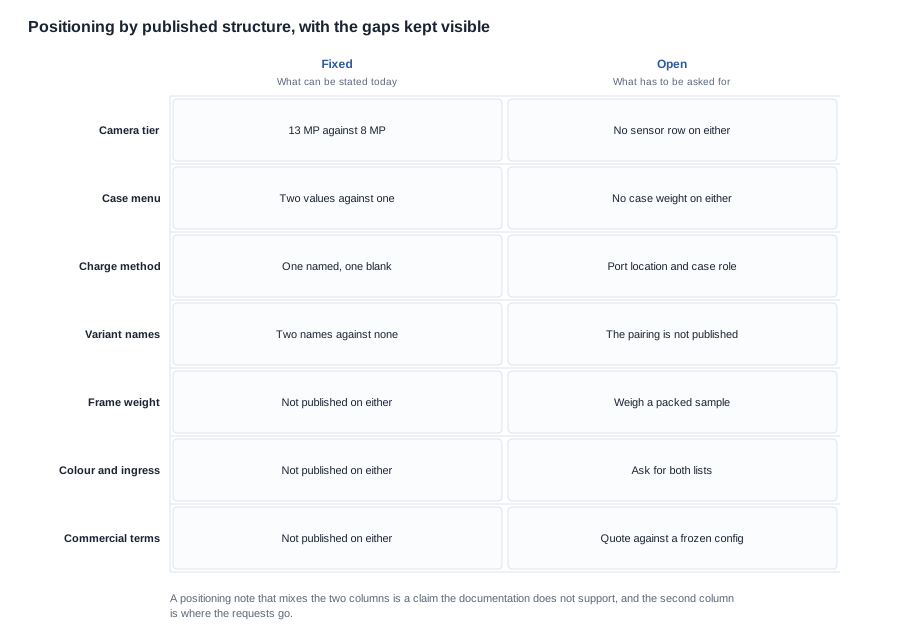
What the note cannot contain is a merged row. A note that says one model has a charging advantage describes a documentation state as though it were a product difference, and that is the specific error that turns a comparison sheet into a claim nobody can support. The discipline is simple: put every published row in one column and every open item in the other, and never let a reader of the note mix the two.
The questions, and which model each one belongs to
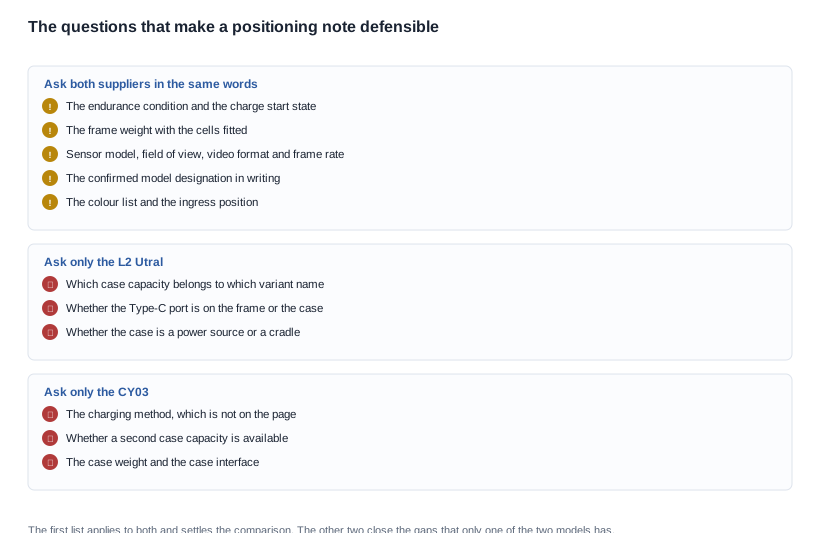
Five questions apply to both models and should be sent with identical wording, because a comparison is only worth the effort if the answers can be placed next to each other. The endurance test condition and the state it was taken in. The charge start state and the end condition behind the two-hour ceiling. The frame weight with the cells fitted. The sensor model, the field of view, the video format and the frame rate. And the confirmed model designation in writing.
Three questions belong to the L2 Utral alone: which case capacity belongs to which variant name, whether the Type-C port is on the frame or on the case, and whether the case is a power source or a cradle. Three belong to the CY03 alone: the charging method, which is not on its page, whether a second case capacity is available, and the case weight and interface.
How to compare two quotations without a published price
No price is published for either model, so the only honest comparison between two quotations is a comparison of what each of them commits to. The criteria are four. The same configuration is being quoted, which means the case capacity and the variant name are both on the line. The commercial terms are complete, which means the order minimum, the lead time and its starting point, the payment terms, the warranty period and the defect allowance are all present rather than implied. The delivered cost is on the same basis, which means the freight term and the incoterm are the same on both sides. And the configuration count is understood, which means a quotation covering two configurations is compared with a quotation covering two configurations rather than with a single-line quotation.
That last one is where the two models differ in a way that has nothing to do with their specifications. The L2 Utral's two published capacities can arrive as two lines on one quotation, and the CY03's single published capacity can arrive as one. A buyer comparing a two-line quotation with a one-line quotation line by line is comparing two programmes rather than two products, and the difference between the two is packaging, stock and spares.
The note as a document that travels
A positioning note is worth writing down, because the people who need it later are rarely the people who wrote it: a distributor, a compliance reviewer, a customer service lead and the person who finally places the order. That gives it four requirements. Every line has a source, so that a reader can tell which rows came from the catalogue and which came from a reply. Every blank stays visible, so that an unanswered question does not quietly become an assumption in the next document. Every figure carries its state, so that a number quoted from a reply does not lose the condition it was measured under. And every open item has an owner and a date, so that it is tracked rather than remembered.
The fourth requirement is what keeps the note honest. A positioning note that records an open item is a working document; a positioning note that omits one is a claim. Before you commit a range to a customer or to a shelf, the criteria for the note are therefore the same four, and the last one is the one that decides whether the note can be sent at all.
What we will and will not state
A positioning note for these two models can be built entirely from published rows, and the three differing rows are the whole of it. We will state that the two models publish different camera tiers, that one page carries two case capacities and the other one, and that one page names a charging interface while the other names none. We will not state a charging method for the model whose page does not publish one, we will not describe the single published case capacity as the only capacity available, and we will not turn a pixel tier into an image quality claim.
We will also not quote a price, an order minimum, a lead time, a warranty period or a certificate number, because the catalogue publishes none of them for either model, and a comparison that needs one of those is a comparison that has to be made against a written quotation rather than against a catalogue page.
If you give us the quantity, the destination market and the configuration you need, we will tell you which rows are settled on each of the two models, which are open, and which of the open ones a single reply closes. Send the L2 Utral and CY03 questions together, and we will tell you which of them the two pages already answer.
Related reading
- The endurance and case comparison — CY03 versus L2 Utral on battery and charging
- The CY03 in full — CY03 specifications and features
- Pricing structure — OEM pricing tiers


