
LC-105-1 smart glasses battery life is published as roughly eight hours on two 55 mAh cells with magnetic charging, and that combination is the most interesting row in the audio range because it does not obviously add up. Every other model in this catalogue that publishes a figure of around eight hours carries more capacity — the K01 and the K02 publish two 90 mAh cells, the D11 and the D12 publish a 100 mAh cell — and the models in this catalogue that publish a charging case with real capacity behind it are camera models, not audio models. The LC-105-1 reaches the top of the range's published endurance ladder on the smallest cell configuration any audio product carries. That is not impossible and it is not proof of anything. It is a reason to ask a specific question rather than to accept the number or to dismiss it. What follows breaks the row down into the parts a buyer can actually check, sets out what the eight hours will and will not license on a listing page, and gives the acceptance condition that turns a rating into a term. No price, order quantity or lead time is published for this model, and nothing below should be read as a ranking of it against another model.
LC-105-1 smart glasses battery life: what the published rows actually say
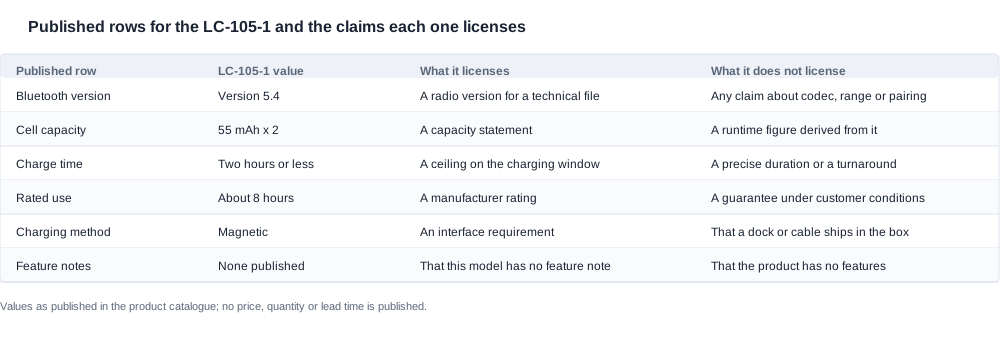
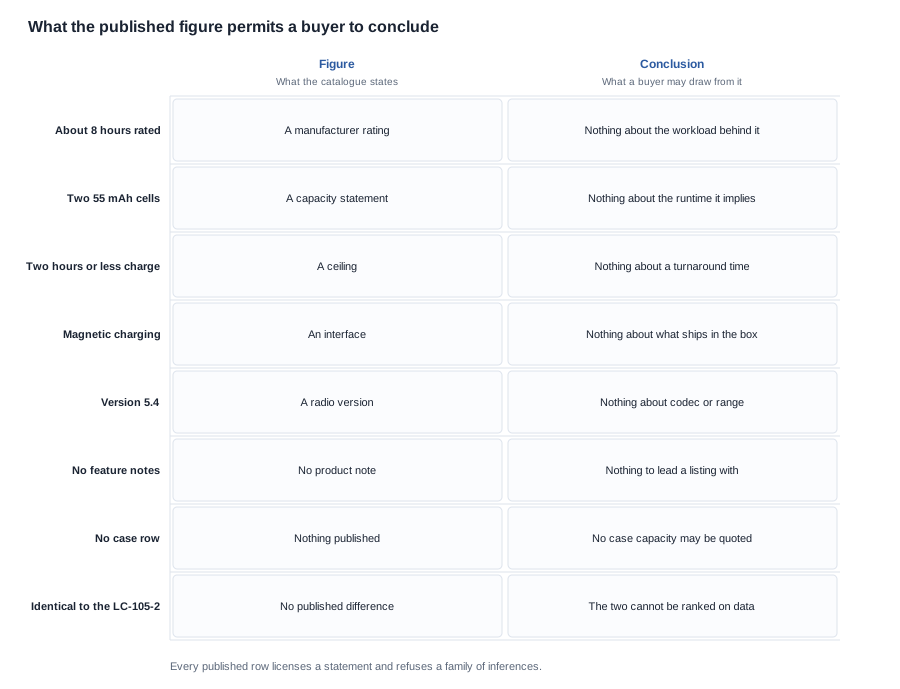
The published configuration for this model is five specification rows and no feature rows at all. The specification rows are Bluetooth version 5.4, a battery capacity of 55 mAh × 2, a charge ceiling of two hours, a rated use of about eight hours, and magnetic charging. There is no surround-sound note, no driver or amplifier figure, no leakage figure, no microphone pickup distance, no temple or hinge descriptor, no touch row of any kind, no ingress rating, no frame weight, no colour list, no charging-case row and no per-model certification reference. For an audio product that is a thin but unusually honest sheet, and it is worth reading it as a set of permissions rather than as a set of features: everything a listing says about this model has to come from these five rows, because there is no feature note to lean on.
The capacity line reads 55 mAh × 2, which the catalogue publishes as a cell value and a cell count. Adding those two published numbers gives a derived total of 110 mAh, and it is worth being precise about the status of that total: it is arithmetic performed by the reader, not a figure the catalogue states. The distinction matters because the derived total is the only way to compare this model with the single-cell models, and a buyer who puts 110 mAh into a comparison table without marking it as derived is presenting a number the supplier never published. The same applies in reverse to a 90 mAh × 2 model, which derives to 180 mAh, and to the 100 mAh single-cell models, which need no derivation at all. The battery specification guidance covers why a capacity row is not a runtime row and how to keep the two apart in a comparison sheet.
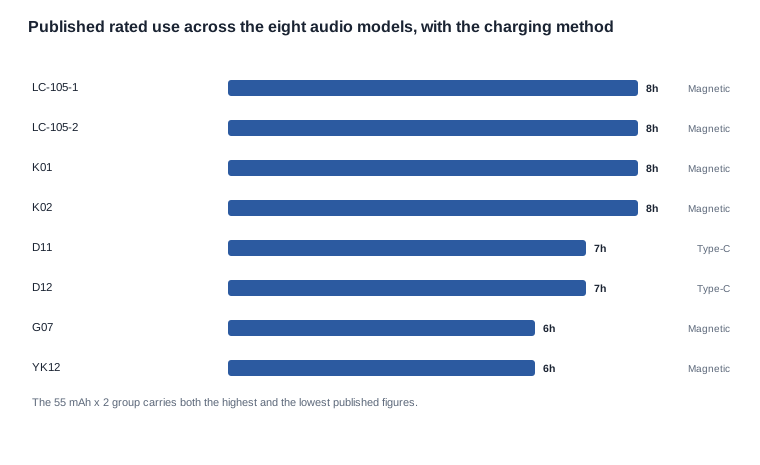
The published endurance figure then does something that is easy to miss when the models are read one at a time. Sort the eight audio models by their published rated use and they fall into three groups: the K01, the K02, the LC-105-1 and the LC-105-2 publish roughly eight hours; the D11 and the D12 publish roughly seven hours; the G07 and the YK12 publish roughly six hours. So the LC-105-1 shares the highest published figure in the range with three other models, two of which carry a larger cell configuration and one of which is its own twin. Meanwhile the two models carrying exactly the same 55 mAh × 2 configuration publish the lowest figure. Capacity therefore does not explain the ordering in either direction, and neither does cell count: the 55 mAh × 2 group contains both the highest and the lowest published figures in the range. That is a fact about the published data, not an accusation about the engineering, and it is the reason the eight-hour figure has to be treated as a rating whose method is unknown rather than as a derived outcome.
There is a second feature of this model's catalogue entry that a buyer has to handle, and it is specific enough that it is often missed. The LC-105-2 publishes exactly the same five rows: the same 55 mAh × 2 configuration, the same charge ceiling of two hours or less, the same rated use of roughly eight hours, the same magnetic charging method, the same Bluetooth version, and the same absence of any feature note. The catalogue publishes no difference between the two models. Not a different cell, not a different interface, not a different feature descriptor, not a different charging case — nothing at all is published to distinguish them. That has three consequences a buyer should write down. First, a comparison between the LC-105-1 and the LC-105-2 cannot be made on published data, so no listing or sales document may treat them as distinguishable products. Second, an order for "an LC-105" is not an order for a specific model until the model identifier is written onto the purchase order, the packing list, the carton and the product marking. Third, a price difference between the two, in either direction, cannot be justified from anything the catalogue publishes, so any such difference has to be justified by something else — a configuration, a lead time, a quantity term — and that justification has to be obtained in writing.
| Published row | LC-105-1 value | What it licenses | What it does not license |
|---|---|---|---|
| Bluetooth version | Version 5.4 | A radio version for a technical file | Any claim about codec, range or pairing |
| Cell capacity | 55 mAh × 2 | A capacity statement | A runtime figure derived from it |
| Charge time | Two hours or less | A ceiling on the charging window | A precise duration or a turnaround time |
| Rated use | About 8 hours | A manufacturer rating | A guarantee under the customer's conditions |
| Charging method | Magnetic | An interface requirement | That a dock or a cable ships in the box |
| Feature notes | None published | That this model has no feature note | That the product has no features at all |
What the eight-hour figure licenses, and what it does not
The charge row is the one that gets transcribed incorrectly most often, and the rule for it is simple enough to apply without any judgement at all. The catalogue publishes "two hours or less" for this model, and that is a ceiling. Writing that the LC-105-1 charges in under two hours overstates the published figure, because exactly two hours falls inside what the catalogue permits and "under" excludes it. The wording that survives review is two hours or less, at or under two hours, or the notational form. Twenty-six of the twenty-eight models in this catalogue publish this same ceiling; only the two sport models publish a different figure of roughly one hour. Because the row carries no published start state and no published end criterion, it also cannot be read as an operational interruption window in a distribution flow, and it cannot be read as a case turnaround time either. A buyer who plans a shift around a charging window built on that row is planning around a ceiling as though it were a schedule.
The rated-use row is the one that carries the most risk, because eight hours is a large-sounding number and it appears in a lot of listing copy. What the catalogue licenses is a rating: a manufacturer figure of roughly eight hours of use. What it does not license is "up to eight hours", which converts a rating into a guarantee; it does not license a duration under the customer's own conditions, because no workload, volume level, ambient temperature, start state or end criterion is published; and it does not license a comparison against a competitor's figure, because two figures are only comparable when they were produced the same way and neither side has published a method here.
The charging row then raises an accessory question that the catalogue leaves completely open. Magnetic charging means the product needs a magnetic interface to charge on — a pad, a cradle or a case. The LC-105-1 publishes no charging-case row at all, which is a statement that nothing is published rather than a statement that no case exists. The distinction has to be held carefully, because five models elsewhere in this catalogue do publish a case capacity: the L1 Pro and the CY05, and the CY03 each publish 1400 mAh, the L2 Utral publishes 900 or 1400 mAh, and the MT6 publishes a 1200 mAh folding case. Two further models, the KY06 and the MT5, publish the existence of a case without publishing its capacity. None of those is this model, and none of those capacities may be imported onto an audio listing. What a buyer can state is simply that magnetic charging appears in the catalogue, while no case capacity appears for this model; what a buyer has to ask for is whether a dock, a pad or a case is part of the box, what it weighs, and what it does to the freight rate.
The weight question belongs in the same paragraph, because it is the number buyers ask for next and the number the catalogue cannot supply. Not one audio model in our catalogue prints a frame weight. The only weight published anywhere in it belongs to the MT6, and that is the weight of the MT6's own frame body at 158 g — a camera model, not an audio model, and not a number that can be borrowed as a proxy for the LC-105-1. The same discipline applies to the acoustic rows. This model publishes no sound descriptor at all, so a listing for the LC-105-1 cannot carry a surround-sound line, a driver claim, a leak rate or a microphone figure, and it cannot carry a touch, gesture, translation or noise-cancelling claim either, because the catalogue publishes no such row for any model in the range. The specification rows support a functional product page. They do not support a performance one. The Bluetooth audio glasses range is where the rest of the family sits, and the accessory economics across it are in Bluetooth audio glasses charging options.
Why capacity does not explain the figure, and what that changes for a shortlist
The argument so far has been descriptive, and it is worth stating the conclusion it forces. Because the same published figure appears at two different cell configurations, and because two models with an identical cell configuration publish different figures, the published endurance figure cannot be a simple consequence of the published capacity. Whatever produces the eight-hour number on the LC-105-1 — a workload definition, a firmware behaviour, a lower-power component, a measurement profile — is not visible in the catalogue. And a figure whose determining variables are invisible is not something a technical shortlist can be built on, however attractive the number looks.
That does not make the figure useless, and it is worth resisting the temptation to treat it as either proven or worthless. It makes it a specific kind of object: a manufacturer rating that a buyer can accept, publish and enforce, provided the buyer converts it into a condition. The work of a procurement team is not to decide whether the eight hours are true — nobody outside the factory can decide that without a method — but to decide what evidence will make the eight hours enforceable, and then to require that evidence. That reframing is the difference between a spec-sheet buyer and a supply-chain buyer, and it is the whole content of the next section.
The first practical consequence is that a cross-supplier comparison on endurance is invalid as published. A buyer with one quote showing eight hours and another showing six has two numbers and no way to rank them, because the workload behind each is unknown and the two suppliers have no reason to be measuring the same thing. The honest protocol is to ask every supplier for the same set of parameters — workload, start state, end criterion, volume level, ambient temperature, and whether the measured unit was the production configuration — and then to mark any row as non-comparable when a supplier declines to answer. Marking a row non-comparable is a legitimate result and it is far better than a ranking built on incomparable inputs. A spreadsheet column headed "battery life" that mixes two suppliers' figures with no method is a document that will be relied on long after the person who built it has left.
The second consequence is specific to this model and is the one most likely to cost money if it is ignored. The LC-105-1 and the LC-105-2 publish identical rows, so the catalogue cannot tell a buyer which one to order, cannot support a price difference between them, and cannot support a listing that presents them as different products. In practice that means three things have to be true before the first shipment: the model identifier appears on the purchase order, on the packing list and on the carton; the product marking carries the same identifier; and the packaging artwork is built around one identifier rather than a family name. A buyer who orders "the LC-105 pair" and receives an assortment of both will not be able to resolve a customer complaint against a listing that named only one of them.
The third consequence is a positioning point that a range planner needs and that the raw specification does not give. Within the eight audio models the LC-105-1 is tied for the highest published endurance, but it publishes no feature note, so its listing has to lead on specification — on the cell configuration, the interface and the charge ceiling — while a competitor inside the same family, the G07, publishes a detachable temple and a lower rated figure of roughly six hours on the same cell configuration. The G07's own endurance analysis covers that comparison in detail, and the point to take from it is that the published endurance ladder is not the same as a ladder of published differentiators. A model can sit at the top of one and at the bottom of the other, and a buyer who builds a range on either axis alone will build it wrong.
So the shortlist criteria that actually work for this model are the ones that do not depend on the unknown method:
- The published row set, which is known, citable and checkable against the catalogue.
- The identity of the model being ordered, established in writing before the first shipment, because the catalogue sets down no distinguishing row between the LC-105-1 and the LC-105-2.
- The evidence the supplier is required to produce, which is negotiable in the sense that the buyer can demand it, even though the content of the evidence is not.
- The acceptance condition, written as a workload, a start state, an end criterion and a tolerance, and attached to the order.
- The commercial terms, which are discussed only after the first four are settled, because they are the only terms that are actually variable.
Turning the rating into an acceptance condition a supplier will sign
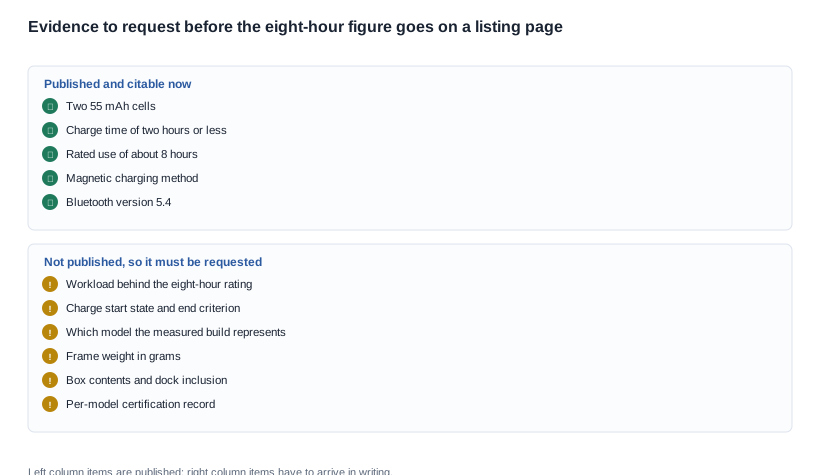
The request to the supplier is short, and the reason it is short is that the catalogue is silent on exactly six things. Ask for all six in one message, in writing, and the answer becomes the acceptance condition.
- The workload. What is the product doing during the eight hours — continuous audio, intermittent audio, calls, or a defined mix, and at what volume level.
- The start state. What charge level the test begins from, and whether the figure assumes a full or a partial charge.
- The end criterion. What counts as the end of the run, and at what point the product is treated as discharged.
- The ambient condition. The temperature the test was run at, and whether the product was connected to a paired device throughout.
- The build of the measured sample. Whether the measured unit was the production configuration, and which model identifier it carried — the LC-105-1 or the LC-105-2, since the catalogue publishes no difference between them.
- The number of samples and the tolerance. How many units were measured and what spread was seen, so that the condition can be applied to a batch rather than to one unit.
The verification step is the part that separates a procurement process from a purchase, and it happens on a sample rather than on paperwork. The sample evaluation page covers the mechanics of ordering and judging a sample order, and for this model the protocol is straightforward: run the workload the supplier has described, on the sample, and record the result against the same six parameters. A supplier who answers all six questions has given a buyer a protocol that can be repeated; a supplier who answers none has given a number, and the right response to a number is to treat it as a rating and say so on the page. The sample evaluation is also where the shipping figures get established, because a packed unit on a scale is the only route to the packed weight and the parcel dimensions that the freight rate is calculated on — and this model publishes neither.

The documentary side runs in parallel with the sample work, and it follows the same rule: every document must name the model it covers. Nothing in our catalogue text mentions CE, FCC or RoHS for any model, there is no per-model certification row, and the company-level export-certification page is made of pictures rather than text, showing ten certificates — eight of them appearance-design filings and two of them utility-model filings — which are intellectual-property documents and not conformity assessments. A buyer therefore asks the supplier for the conformity file, the signed declaration, the test reports carrying their issuing body and expiry dates, and the Bluetooth SIG listing identifiers, and checks that each one names this model rather than a platform or a family. For a radio product placed on the European market the instrument that applies is the Radio Equipment Directive (EU) 2014/53/EU, while electromagnetic compatibility is handled under the EMC Directive 2014/32/EU; the two are routinely written as one in compliance files, and a declaration citing the wrong instrument is a defect in the file rather than a formatting preference.
The commercial sequence follows from all of this, and it is the same sequence that applies across the range. The cost of conformity testing and the time it takes are not commercial variables — they are set by the testing laboratory and by the authority, and the only things a buyer controls are whether the supplier commits to producing the documents and on what timetable. Everything else — quantity breaks, packaging, payment nodes, warranty term, defect allowance, production lead time — is negotiable, and it is negotiable more easily once the evidence risk has been taken off the table, because a supplier with a model-named document set and an agreed acceptance condition has fewer reasons to concede on price. A buyer who negotiates money first and evidence afterwards ends up paying for the evidence in the price.
The failure modes this published row produces
Most of the damage that comes from an endurance row happens in the document, not in the product. The five patterns below are the ones this model produces reliably, and each is listed with what it looks like on the page, what caused it, and what prevents it. All five are preventable at the drafting stage, which is the cheapest place to prevent them.
The rating written as a guarantee. The symptom is "up to 8 hours" in a specification block or in a product title. The cause is that "about 8 hours" is a rating and "up to 8 hours" is a promise, and the two were treated as the same claim. The prevention is to write the figure the way the catalogue writes it, as a rated figure, and to attach the workload and the tolerance to it as soon as the supplier has confirmed them. If the workload is not yet confirmed, the honest version of the line is that the model is rated for about eight hours of use and the measurement condition is stated on request.
The ceiling inverted. The symptom is "charges in under two hours". The cause is a natural but incorrect reading of "two hours or less", which excludes exactly the value the catalogue permits. The prevention is not a proofreading step but a rule: the ceiling wording is copied verbatim from the catalogue and never rephrased, because every model in this range publishes that same ceiling except the two sport models, and a rephrased ceiling on one listing creates a comparison problem across the whole set.
Capacity used to explain endurance. The symptom is a comparison chart that puts a derived 110 mAh next to a derived 180 mAh and lets the reader conclude that the larger model runs longer. The cause is that capacity looks like an explanation and the published data says it is not, since two models with the same 55 mAh × 2 configuration publish different figures and two models with different configurations publish the same one. The prevention is to mark derived totals as derived, to keep capacity and endurance on separate lines of the sheet, and to refuse the conclusion the chart invites.
A case capacity imported from another category. The symptom is a charging case figure on an audio listing. The cause is that five models in this catalogue do publish a case capacity — 1400 mAh on the CY05 and the CY03, and the L1 Pro, 900 or 1400 mAh on the L2 Utral, and a 1200 mAh folding case on the MT6 — and the LC-105-1 publishes none, so the number was borrowed from a neighbouring row. The prevention is to check the category before the number: every one of those is a camera model. The correct line for this model is that magnetic charging is published and no case capacity is published for it.
A weight borrowed from a camera model. The symptom is a frame weight on the page. The cause is that a single weight figure appears anywhere in the catalogue — 158 g, on the MT6's frame body — and it is tempting to treat a published number as a general one. The prevention is to keep the category attached to every figure, and to state plainly that not one audio model in our catalogue carries a published weight, so this model publishes none.
Two models presented as one product. The symptom is a listing that contrasts the LC-105-1 with the LC-105-2, or an order that requests "the LC-105" and receives both. The cause is that the two appear in different places in a range list and look like different products, while the catalogue publishes no difference between them at all. The prevention is naming one identifier on the order, the packing list, the carton and the artwork, and refusing to write a comparison the published rows cannot support.
A five-minute check before publication catches all six. Read every number on the page against the catalogue and confirm the model, the category and the ceiling wording; read every feature line and confirm it comes from a published feature row rather than from a neighbouring model; read every claim that rests on a comparison and confirm the two sides were measured the same way. That check is the reason this model's specification, sparse as it is, is safer to publish than the specification of a model with more rows and fewer habits behind them.
The LC-105-1 battery position, and what to send in the RFQ
The eight-hour figure is the most valuable row on this model's catalogue page and the one we would least like a buyer to publish without conditions attached. It puts the LC-105-1 at the top of the range's published endurance ladder on the smallest cell configuration any audio product carries, and that combination is a genuine selling point in a listing — provided it is presented as a manufacturer rating and provided the workload behind it is on file. We publish the five specification rows for this model and nothing further: no feature note, no test method, no frame weight, no charging-case capacity, no per-model certification reference, no price, no minimum order quantity, no lead time and no warranty term. We would rather tell a buyer that than quote a typical figure that nobody measured, and we will not rank the LC-105-1 against the LC-105-2 on any basis, because the published rows are identical and the difference between them is not in the catalogue.
For the wider range, the comparison against the Type-C models is set out in LC-105-1 smart glasses versus D11 price positioning and LC-105-1 smart glasses versus D12 use case fit, the selection logic across all eight audio models is in Bluetooth audio glasses which model to pick, and the same cell configuration carrying a different published figure is covered in G07 smart glasses battery life.
If the LC-105-1 is on your shortlist, send us the quantity band, the target market, the workload your customers will actually put the product through, and the listing copy you intend to publish. We will tell you which of your lines are supported by a published row, which have to be obtained from the supplier in writing before they appear, and which should be cut rather than hedged. Send the workload and the copy first, because those two documents are where the six failure modes above actually live, and they are the cheapest ones to fix.


