

Price positioning between two audio models is not a feature comparison. It is a comparison of cost structures, and the LC-105-1 and the D11 are a good pair to practise on because the published data between them is unusually narrow. Both sit in the eight-model audio group of this catalogue. Both publish Bluetooth 5.4. Both publish a charge time of two hours or less. What separates them is three rows: the cell arrangement, about one hour of rated use, and the charging connector.
Thin published data is an advantage for a procurement team, not a disadvantage. When there is little published, the commercial decision cannot be made by reading a product page — it has to be constructed, and the construction is visible. What you can read off this catalogue is the skeleton of the comparison: three published differences, two identical rows, one documentation asymmetry, and a list of cost elements that nobody has published for either model.
We do not publish prices for any model in this catalogue. Nothing below is a price band, a value judgement, or a recommendation of one model over the other. What follows is a method for building a position between the LC-105-1 and the D11 that you can defend in a quotation, and the specific questions to ask once the method is on the table.
LC-105-1 smart glasses vs D11: what the catalogue actually publishes
Both models sit in the audio group of eight: the G07 and the K02, the LC-105-2 and the LC-105-1, the K01 and the D11, and the D12 and the YK12. The two other groups in this catalogue are the three sport models and the eleven camera models, and neither of the models in this comparison belongs to either of them. That matters commercially, because the camera group publishes rows — resolution class, charging case capacity, ingress marking on two of them — that the audio group simply does not have. A buyer reading a camera model's specification sheet and then an audio model's specification sheet is looking at two different document types.
Here is the complete published comparison between these two models.
| Published row | LC-105-1 | D11 | What it means for a commercial decision |
|---|---|---|---|
| Model name in the catalogue | LC-105-1 AI Bluetooth audio glasses | D11 AI Bluetooth glasses | Different product names, different documentation |
| Bluetooth version | 5.4 | 5.4 | Identical radio, identical conformity route question |
| Cell | 55 mAh x 2 | 100 mAh, single cell | Two cells against one; a shipped-unit difference |
| Rated use | about 8 h | about 7 h | One hour, on figures taken under different conditions |
| Charge time | two hours or less | two hours or less | Identical ceiling; neither publishes the test condition |
| Charging method | Magnetic | Type C | Different accessory and cable requirements |
| Published feature rows | None | Surround sound, long endurance | A documentation difference, not an acoustic specification |
| Charging case capacity | Not published | Not published | The largest unknown in the comparison |
| Frame weight | Not published | Not published | Packed weight cannot be planned from the catalogue |
| Per-model certification row | None | None | Conformity is a document request, not a catalogue lookup |
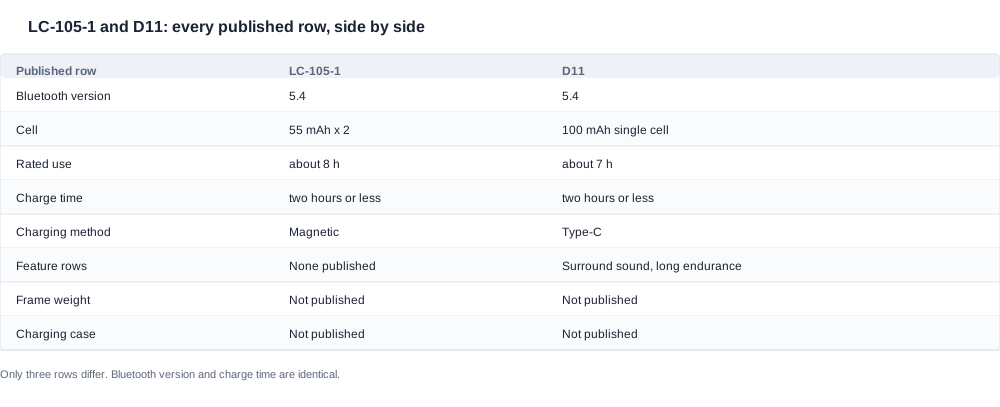
Read that table twice, because its shape is the whole argument. Two rows are identical, three rows differ, one row exists on only one side, and four rows are empty on both sides. The empty rows are where the money is, and they are empty in exactly the places a buyer needs numbers to build a delivered-cost model.
Two points about the identical rows deserve emphasis because buyers routinely try to mine them for a difference.
The charge time is a ceiling, not a duration. Two hours or less is an upper bound, and it stays an upper bound for both models. The catalogue publishes no starting state for the cell and no termination criterion — the point at which a charge counts as complete — so the figure cannot be turned into a shift-recovery time, an opportunity-cost number, or a promise about how long a frame sits on a dock. It tells you the worst case and nothing about the likely case.
The radio row settles the conformity framework, not the conformity outcome. Both publish Bluetooth 5.4, so both sit inside the same regulatory question: the Radio Equipment Directive (EU) 2014/53/EU for the radio element, and the EMC framework of Directive 2014/32/EU for the electromagnetic behaviour, with the harmonised standards cited separately by the conformity assessor rather than by a supplier's product page. What the catalogue does not contain is any reference to CE, FCC or RoHS in its text, and it publishes no per-model certification row at all. So the two models carry the same conformity question, and neither model can be cleared by looking anything up.
The three rows that differ, and the two that do not
The cell arrangement is the only difference that is physically visible in the shipped unit. The LC-105-1 carries two 55 mAh cells, and the D11 carries a single 100 mAh cell. The 55 mAh x 2 configuration is shared with the LC-105-2, the G07 and the YK12; the single 100 mAh is used by the D11 and the D12, and by the sport-positioned ZH12. Two cells means two cells to pack, two cells to document for transport, and two cells whose states of charge will diverge over the life of the unit — which is a supplier-quality question before it is a product question. One cell means a smaller bill of materials and a simpler replacement path, and it also means the port and the cell are on the same side of the frame. Neither model publishes a frame weight, so the balance consequences of that geometry cannot be quantified from the catalogue; they have to be measured on samples.
The charging connector is the difference with the largest commercial footprint. A Type-C port charges from a cable the buyer may already own. A magnetic interface needs a mating accessory to be useful. The catalogue publishes no charging-case row for either model, so the honest position is that the size and cost of the charge path for the LC-105-1 is unpublished, and whether the D11 ships with any accessory at all is equally unpublished. That single gap sits at the centre of this comparison: two models whose published specification rows differ by one cell arrangement and one hour, and whose delivered-cost structures could differ by an accessory that the catalogue does not describe. This is where the charging options analysis and the shipping weight breakdown become the relevant reading rather than a feature comparison.
The rated-use gap is the smallest difference and the easiest to over-read. About eight hours against about seven is a one-hour gap on numbers whose measurement conditions are not published for either model. The next section explains why that one hour carries less commercial weight than it appears to.
The runtime figures were not taken under one protocol
The most useful single observation available in this comparison comes from a cell configuration rather than from a model.
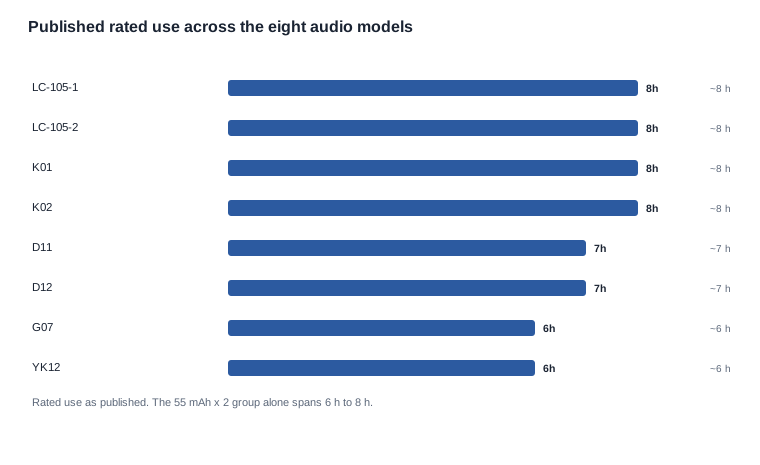
Four models in this catalogue publish the same 55 mAh x 2 arrangement: the YK12 and the LC-105-2, and the G07 and the LC-105-1. The first two publish about eight hours of rated use. The other two publish about six hours. Same cell count, same cell capacity, same magnetic charging method, same Bluetooth version — and a two-hour spread inside one configuration.
That spread establishes something a buyer can rely on: the published rated-use figures are model-specific outputs, not a function of the cell configuration. Whatever protocol was used, it was not applied identically across models. The catalogue publishes no runtime test condition for any model in the audio group, so there is no way to normalise the two numbers from the outside.
The consequence for a price position is direct. The one-hour gap between the LC-105-1 and the D11 sits inside a two-hour gap that exists between two models sharing an identical cell configuration. A procurement team cannot build a price step on the published runtime difference, because the same published methodology produces a larger spread between models that are not even being compared here.
There is a second asymmetry in the documentation that a buyer should hold separately from the numbers. The D11 publishes a long-endurance feature row alongside its surround-sound row, and it publishes about seven hours of rated use. The LC-105-1 publishes about eight hours and publishes no feature row describing endurance at all. Descriptors and published figures are not on one scale. The G07 and the YK12 show the mirror case: they carry the published thin-temple and removable-temple feature rows, and they carry the shorter six-hour figure. The useful discipline is to read every descriptor and every number as a separate piece of evidence and never to let one stand in for the other.
The question that closes this section is a single one, asked in identical words for both models: what is the runtime test condition behind the published figure, and what does the same protocol produce on the other model? The how to compare battery life method and the audio range battery picture cover the wider version of the same investigation.

The cost structure the catalogue leaves open
A delivered-cost model for these two models can be assembled from published facts plus a short list of documents that have to be requested. Listing the gaps is more useful than pretending around them, because each gap is a line item a buyer can price once it has an answer.
Frame weight and packed weight. Neither model publishes a frame weight, and the catalogue publishes one weight anywhere: 158 g, which belongs to the MT6 glasses body, a camera model, measured without its folding charging case. It cannot be used to compare an LC-105-1 with a D11, or to stand in for either of them. What you can compare today is the cell count in the shipped unit, which is published, and the weight of that unit, which is not. The weight comparison across the audio range covers the measurement method to use once samples arrive.
Transport and freight. A unit carrying two lithium cells is a different shipment from a unit carrying one, and that difference is published even though its mass is not. The transport test for lithium cells, UN38.3, applies to the cells in either configuration, and the number of cells, the packaging and the declared configuration all belong in the document set. Freight class, carton dimensions and the declared unit configuration are commercial terms to fix in the agreement, not assumptions to carry into a quote.
Ingress and environment. Neither model publishes an ingress rating. The IP54 marking in this catalogue belongs to two other models, the V06 and the S7, both in the camera group, and it cannot be borrowed for an audio range claim. Any environmental requirement in a brief therefore has to become a written question about the model as it will ship, and the answer belongs to the supplier.
Conformity. The catalogue text contains no reference to CE, FCC or RoHS, publishes no per-model certification row, and carries a company-level export certification page with image content instead of text content. For both models the conformity question is identical: request the technical file and the declaration for the model, in the configuration, for the destination market. A buyer who expects a catalogue line to settle this will find nothing there, for either model.
Features the catalogue does not publish. No model in this catalogue publishes a touch row, a gesture row, an audio-processing row or a translation row. That means the LC-105-1 has no published acoustic descriptor of any kind, and it means neither model can be compared on noise handling, because there is no published row to compare. The D11's surround-sound row is the only published audio descriptor on either side of this comparison, and it is a descriptor, not a specification: it tells you the model has a documented surround-sound feature and nothing about its output.
After-sales and commercial terms. Warranty term, defect responsibility, replacement policy, MOQ, lead time, payment terms and capacity are all absent from the catalogue for both models. They are ordinary negotiation items, but they are negotiation items rather than catalogue facts, and they are where a price position is usually settled.
The practical result is a structure that is simple to describe and hard to fill. The published side gives you the cell count, the cell capacity, the rated-use figure, the charging method, the Bluetooth version and the charge-time ceiling. The unpublished side gives you the weight, the accessory, the case capacity if any, the conformity documents, the freight configuration and every commercial term. The first set lets you describe the product. The second set decides its price.
Building the comparison brief: what to ask before shortlisting
The order of these questions matters less than getting them all answered in the same vocabulary for both models. Asking the same question in different words produces answers that cannot be compared, which is the most common way a comparison like this goes wrong in practice.
- The runtime test condition behind each published rated-use figure, asked in identical words, and what the same protocol produces on the other model.
- The cell arrangement inside each frame, and where the cells sit relative to the temple and the charging interface.
- Frame weight and dimensions for each model, measured on samples, not estimated.
- Packed weight and the declared unit configuration for each, for the freight quotation.
- The charging path for each: whether a magnetic dock, a magnetic case or a cable is the intended route, and whether any accessory is in the box.
- The charging case capacity for each model, and whether a case exists for the D11 at all.
- The acoustic and microphone specification for each, given that the LC-105-1 publishes no acoustic descriptor.
- The confirmation that the published feature rows still apply to the configuration you are ordering.
- The conformity document for each model, in your destination market, covering the Radio Equipment Directive (EU) 2014/53/EU and the EMC framework of Directive 2014/32/EU.
- The warranty position and defect responsibility split for each, and whether the terms differ between the two models.
- The MOQ, the lead time and the production capacity behind each, in the same units.
- Whether the two models share a platform for firmware and accessories, and what that means for the version count you would maintain.
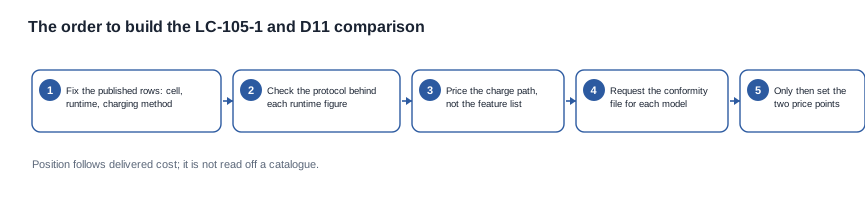
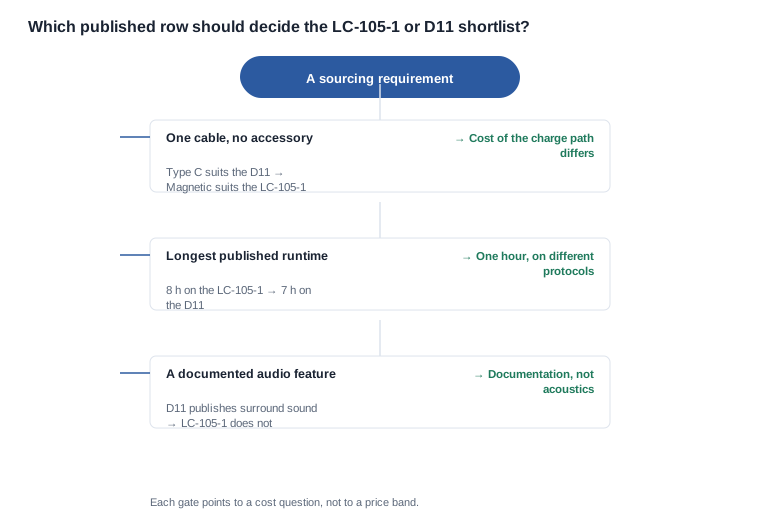
Four of those twelve questions — one, two, five and eight — are the ones that change the outcome of the comparison. The runtime protocol decides whether the one-hour gap means anything. The cell arrangement decides how the shipped unit is built and documented. The charging path decides what the unit costs to deliver. The feature-row confirmation decides what you are allowed to write on the product page.
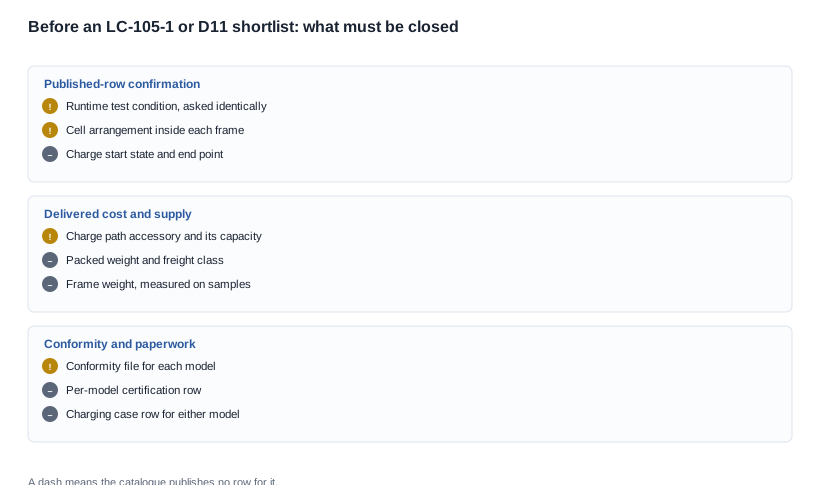
There is a sequencing discipline behind this list, and it is the discipline that keeps a comparison from turning into a price argument. Fix the published rows first, because they are the only facts you own today. Then check the protocol behind the runtime figures, because that determines whether a published gap is a real gap. Then price the charge path, because the accessory and the freight configuration are the two largest cost items that the catalogue leaves open. Then request the conformity file. Only after those four steps do the two price points mean anything, because only then does each point sit over a known cost base rather than over an assumed one.
Two things this list deliberately does not contain. It contains no comparison of sound quality, because the catalogue publishes no acoustic specification for either model and there is nothing to compare. And it contains no comparison of scenario fit, because a scenario argument needs a published capability set, and these two models publish two rows of features between them.
What we will and will not state about this comparison
The position is narrow and deliberate. We will tell you the three rows on which the LC-105-1 and the D11 differ, the two rows on which they are identical, and the feature row the D11 publishes that the LC-105-1 does not. We will tell you that the published runtime figures were not taken under one protocol, because four models sharing the 55 mAh x 2 configuration publish two different figures. We will tell you that the catalogue publishes no price, no case capacity, no frame weight and no per-model certification row for either model.
We will not present the surround-sound descriptor as an acoustic specification, we will not present the one-hour runtime gap as a usable performance difference, we will not present the charge-time ceiling as a measured duration, and we will not quote a weight, a case capacity, a certificate number, a production capacity or a lead time that the documentation does not contain. We will not name one of these two models as the better value, because that conclusion requires a price comparison the catalogue cannot support.
What we can do is take the twelve questions above, put them to the factory in one set, and return the answers with the same vocabulary on both sides. The model readiness overview sets out where the sharing between platforms is documented, and the OEM ready pricing structure covers how the commercial terms around a range are usually framed.
Related reading
- The published rows for the D11 — D11 smart glasses specifications and features
- The published rows for the LC-105-1 — LC-105-1 smart glasses specifications and features
- The money side of the accessories — Bluetooth audio glasses charging options
- Where the D11 sits against its nearest sibling — D12 smart glasses best-for analysis
- The sibling platform's customisation path — customising the LC-105-2
Send us the channel, the two target positions and the destination markets, and we will tell you which published row each of those positions should be built on and which ones have to be answered by document first.


