

Comparing the LC-105-1 and the D12 is usually framed as a feature question: which one belongs in a retail floor, in a warehouse, in a promotional programme, in a corporate deployment. That framing does not survive the published data, because neither of these two models publishes a feature row of any kind. The LC-105-1 publishes two 55 mAh cells, magnetic charging, about eight hours of rated use, a charge time of two hours or less and Bluetooth 5.4 — and nothing else. The D12 publishes a single 100 mAh cell, Type-C charging, about seven hours of rated use, the same charge-time ceiling and the same Bluetooth version — and nothing else. There is no acoustic descriptor, no touch surface, no microphone figure, no ingress rating, no colour and no frame weight on either side.
So the match between these two models and a channel is not settled by what they can do. It is settled by how each one gets recharged, how each one ships, and what you are able to write on the product page once the order is placed. That is a real question, and it has real answers, but the answers come from evidence you have to collect rather than from rows you can read.
This article is a method for answering it. We do not publish prices for any model, nothing here recommends one of these two models over the other, and every difference claimed below is one the catalogue actually publishes.
LC-105-1 smart glasses vs D12 use case fit: the feature layer is empty
Start with the structure of the audio group, because it explains why this particular comparison is harder than it appears. The catalogue carries eight audio models: the G07 and the LC-105-1, the K02 and the K01, the D11 and the YK12, and the LC-105-2 and the D12. Five of those eight publish no feature row at all — the D12 and the K02, the LC-105-1 and the K01, and the LC-105-2. Only three publish one: the D11, with surround sound and long endurance; the G07, with an extra-thin temple and a removable temple; and the YK12, with surround sound and a slim temple.
Two consequences follow, and both of them matter for a procurement team.
The first is that the emptiness is normal, not a warning. A blank row is not evidence that a model is weak; it is evidence that the catalogue does not describe that model. When two thirds of the audio group is in this state, the absence of a descriptor carries no signal at all. A buyer who treats a missing row as a defect is reading the catalogue's coverage as the product's quality.
The second is that the D12 in particular must be handled carefully. The audio models in this catalogue that publish a surround sound feature row are the D11 and the YK12, and in the sport group the YKC02 and the D17 publish Surround Sound while the ZH12 publishes it under a Chinese wording. The D12 publishes no such row. Its page carries five standard specification rows and nothing further. Any comparison that credits the D12 with a surround sound feature has invented it, and any argument that trades that feature off against the LC-105-1 is a comparison between two things the catalogue does not say.
The same discipline applies to the features the catalogue never publishes for any model. There is no touch row, no gesture row, no translation row and no audio-processing row anywhere in the range. A buyer who wants to deploy a model with noise handling or voice translation cannot find a published row to justify it on either of these two models — and cannot reject one of them for lacking it either. That symmetry is worth stating plainly, because product comparisons in this category routinely import features from elsewhere and attach them to whichever model is convenient.
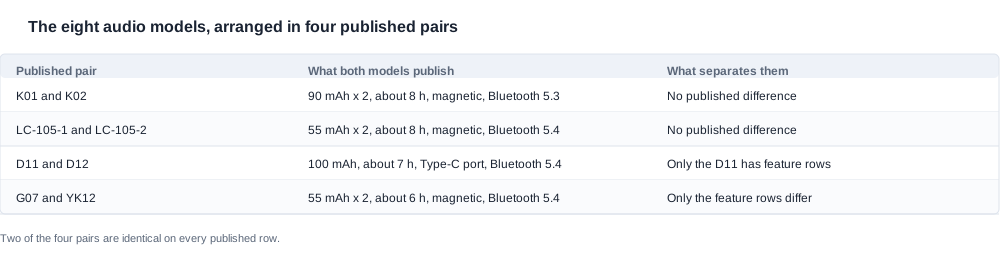
The catalogue is built out of twins
There is a second structural fact here that most buyers never notice, and it is the reason the comparison below has to be built from delivery rather than from features.
The eight audio models fall into four published pairs, and inside each pair the published specification rows are identical:
- The K01 and the K02 both publish 90 mAh x 2, about eight hours of rated use, magnetic charging and Bluetooth 5.3, and neither publishes a feature row. Nothing in the catalogue separates them.
- The LC-105-1 and the LC-105-2 both publish 55 mAh x 2, about eight hours of rated use, magnetic charging and Bluetooth 5.4, and neither publishes a feature row. Nothing in the catalogue separates them either.
- The D11 and the D12 both publish 100 mAh, about seven hours of rated use, Type-C charging and Bluetooth 5.4. The only published difference is that the D11 carries the two feature rows and the D12 carries none.
- The G07 and the YK12 both publish 55 mAh x 2, about six hours of rated use, magnetic charging and Bluetooth 5.4. The only published difference is the feature rows, which are not the same on either model.
That is the whole group. Four pairs, and in two of them the rows are identical down to the absence of a descriptor. So when a buyer asks which of the LC-105-1 or the D12 suits their channel, the catalogue has already told them something uncomfortable: this product line is published at a granularity where whole models are interchangeable on paper. That is not a defect of the comparison; it is the fact the comparison has to be built on.

What both models publish, and how far it can carry a deployment
Here is everything the catalogue says about these two models.
| Published row | LC-105-1 | D12 | What a buyer can do with it |
|---|---|---|---|
| Bluetooth version | 5.4 | 5.4 | Identical radio, identical conformity question |
| Cell | 55 mAh x 2 | 100 mAh, single cell | Different shipped unit, different cell count |
| Rated use | about 8 h | about 7 h | One hour, and not on a comparable protocol |
| Charge time | two hours or less | two hours or less | Identical ceiling, no test condition published |
| Charging method | Magnetic | Type C | Different accessory requirement |
| Published feature rows | None | None | No capability claim is available on either |
| Frame weight | Not published | Not published | Packed weight cannot be planned |
| Charging case capacity | Not published | Not published | No audio model publishes a case row |
| Ingress rating | Not published | Not published | The IP54 marking belongs to two camera models |
| Per-model certification row | None | None | Conformity is a document request |
Only three of those rows differ. Bluetooth version and charge time are the same on both sides, and every row below the charging method is empty on both sides.
The charge time is a ceiling and not a duration. Two hours or less is an upper bound, and the catalogue publishes no starting state for the cell and no termination criterion, so the figure cannot become a shift-recovery time or an opportunity-cost number. It tells you the worst case and nothing about the likely case. Both models publish it, so it does not separate them — but a buyer who builds a deployment schedule on it is building on an upper bound.
What identical rows mean for a range architecture. Channels that carry two audio models usually expect the published rows to differ somewhere, because that difference is what justifies the second SKU to a customer and to a distributor. Between these two models the published difference amounts to a cell arrangement, an hour of rated use and a connector, while the Bluetooth row and the charge-time row are identical and four further rows are empty on both sides. If a range strategy needs a documented reason for the second model to exist, that reason has to be created and written down rather than inherited from the catalogue. It is usually a delivery or commercial reason — an accessory, a charging standard, a packaging tier — rather than a capability one, and the sooner that is recognised the less likely it is to be faked in the listing copy later.
The cell topology is published and its mass is not. The 55 mAh x 2 arrangement is shared with the LC-105-2, the G07 and the YK12; the single 100 mAh is used by the D11, the D12 and, in the sport group, the ZH12. A pair of cells and a single cell distribute mass differently across a frame, and the LC-105-1's cells would sit one per temple. Neither model publishes a frame weight. The catalogue publishes one weight anywhere, and it is 158 g for the MT6 glasses body — a camera model, measured without its folding charging case, so it cannot be used for either of these two models or as a proxy for them.
The runtime row is not the argument it appears to be
The LC-105-1 publishes about eight hours and the D12 publishes about seven, and the intuitive reading is that the larger single cell produces the longer figure. The published data does not support that reading.
Four models in the catalogue use the 55 mAh x 2 arrangement: the LC-105-1 and the YK12, and the LC-105-2 and the G07. The first two publish about eight hours of rated use; the other two publish about six. Identical cell count, identical cell capacity, identical charging method, identical Bluetooth version — and a two-hour spread inside one configuration.
That spread establishes that the published rated-use figures are model-specific outputs rather than a function of the cell configuration, and that no common test protocol was applied across the group. The catalogue publishes no runtime test condition for any of these models, so the numbers cannot be normalised from outside.
The consequence for a deployment decision is direct. The one-hour gap between these two models sits inside a two-hour gap between two models that are not even the subject of this comparison. A buyer cannot use the published runtime difference to justify a channel decision, because the same published methodology produces a larger spread elsewhere in the group.
The D11 and the D12 make the same point from a different direction. The D11 publishes a long-endurance feature row alongside about seven hours of rated use; the D12 publishes about seven hours and publishes no descriptor at all. Descriptors and figures are separate pieces of evidence and never stand in for one another. The audio range battery comparison sets out the wider grid, and the Bluetooth audio charging options covers the accessory side of the same question.

The delivery model is what separates them in practice
With the feature layer empty, three things remain that a channel actually experiences, and each of them can be handled.
The charge path. The D12 publishes Type-C charging, so a unit can charge from a cable the channel already owns. The LC-105-1 publishes magnetic charging, which needs a mating accessory to be useful. That is the single largest published difference in the delivered-cost structure between these two models, and it is the one most often glossed over. The glossing happens because the catalogue publishes no charging-case row for any audio model, so neither the LC-105-1's accessory nor the D12's in-box contents are described. A channel that wants a case, or a channel that wants no case, cannot resolve that from the catalogue for either model — it has to come back as a question, with the answer written into the quotation.
The shipped unit. Two cells against one is a published difference and it has consequences that do not require a weight figure. A unit carrying two lithium cells is a different shipment from a unit carrying one: the declared configuration, the transport test documentation for lithium cells under UN38.3, the carton, the pallet arrangement and the freight class all follow from the cell count that is published, even though the mass is not. For a distributor or an e-commerce operation, this is a packaging and logistics question rather than a product question, and it is the one where the two models genuinely diverge in a way a buyer can plan for.
The product page. Neither model publishes a feature row, so a listing can carry the specification rows and nothing more. This constrains both models identically, which means it does not separate them — but it does constrain them, and for a channel whose listing template expects a capability line it is a genuine commercial fact to plan around. The right move is to write the listing against what is published: Bluetooth 5.4, the cell configuration, the rated-use figure as published, the charging method and the charge-time ceiling. A performance claim requires a document that does not yet exist, and it will stay unavailable until someone requests it.
The twin question sits underneath the whole comparison
If the channel is being served by the LC-105 platform, there is one question that has to be answered before the LC-105-1 is even a candidate: what separates the LC-105-1 from the LC-105-2?
On the published rows, nothing does. Both publish 55 mAh x 2, about eight hours of rated use, magnetic charging, a charge time of two hours or less and Bluetooth 5.4, and neither publishes a feature row. The catalogue gives a buyer no basis for choosing one over the other, and it publishes no per-model certification row for either.
That has a practical consequence for a channel that expects to reorder, extend or phase out a platform. If the two models are indistinguishable on paper, then the record that distinguishes them — the configuration identifier, the firmware branch, the approval sample, the conformity file — is not something you can build from the catalogue. You have to create it, and you have to be able to reproduce it on the next order. Asking whether the two models share a firmware branch, and whether the distinction survives a repeat order, is a due-diligence question with real cost attached if the answer turns out to be unclear.
This is also the point at which the cost of the comparison itself becomes visible. If the separation between the two LC-105 models is not documented, then the entire selection effort has been spent on a choice the catalogue cannot arbitrate. Confirming that separation is therefore the first gate, not the last one, and it is cheap to ask.
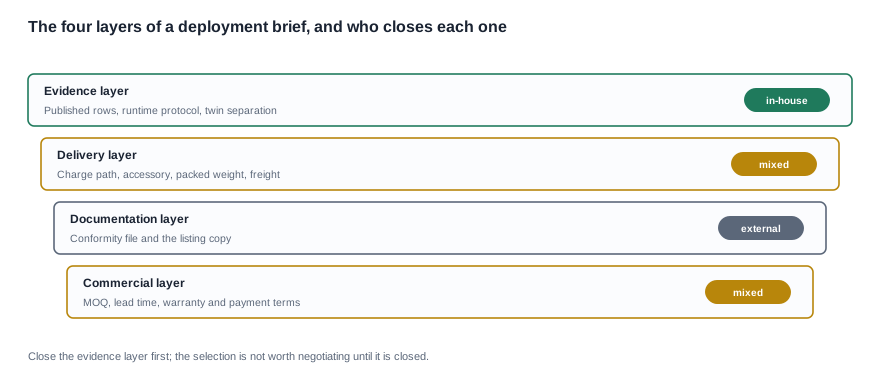

Matching a channel to a model: the questions to close first
These are the questions that decide this comparison. Ask them of both models in the same vocabulary, because answers collected in different words cannot be compared afterwards.
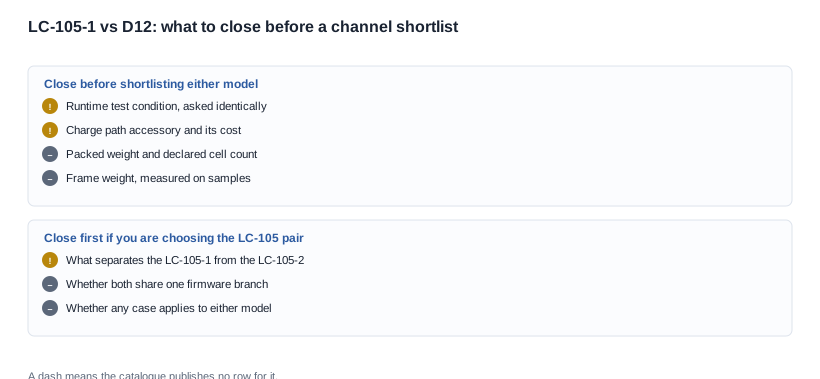
- The runtime test condition behind each published rated-use figure, asked in identical words, and what the same protocol produces on the other model.
- The cell arrangement inside each frame, and where the cells sit relative to the temples and the charging interface.
- Frame weight and dimensions for each model, measured on samples rather than estimated.
- Packed weight and the declared cell configuration for each, for the freight and transport documentation.
- The charge path for each: whether a magnetic dock, a magnetic case or a cable is the intended route, and what is in the box.
- The charging case capacity for each, and whether a case is offered for the D12 at all.
- The acoustic and microphone specification for each, given that neither model publishes an acoustic descriptor.
- What separates the LC-105-1 from the LC-105-2, and whether that distinction survives a repeat order.
- Whether the two models share one firmware branch, and what a customised build would mean for platform updates.
- The conformity file for each model in the destination market, covering the Radio Equipment Directive (EU) 2014/53/EU and the EMC framework of Directive 2014/32/EU.
- The warranty position, defect responsibility and replacement terms for each, and whether they differ between the two models.
- The MOQ, the lead time, the production capacity and the payment terms for each, in the same units.
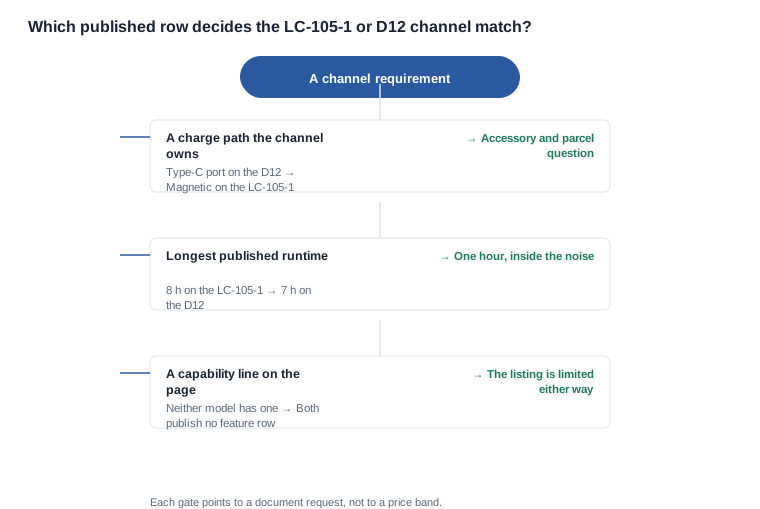
The four questions that change the outcome are one, five, eight and ten. The runtime protocol decides whether the one-hour gap means anything. The charge path decides what lands in the parcel and what it costs to ship. The twin separation decides whether the LC-105-1 is a selection at all. The conformity file decides what you are permitted to claim and to sell.
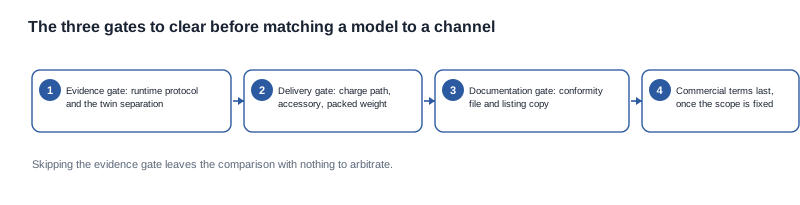
Read the list as three gates rather than twelve items, because the order matters more than the counting.
- The evidence gate. Close the published rows first, starting with the runtime protocol and the twin separation. Nothing downstream is worth negotiating until this gate closes, because the two models are published at a granularity where whole models are interchangeable.
- The delivery gate. Settle the charge path, the accessory, the packed weight and the declared unit configuration. This is where the two models actually diverge in a way a channel can plan and price.
- The documentation gate. Request the conformity files, confirm what the product page can claim, and take the commercial terms. Only here does the model choice become a priceable position.
Turn the evidence gate into a record. The most useful artefact a buyer can produce for this pair is a written specification sheet per model that reproduces the published rows verbatim and then adds the unpublished fields as answered values, each one dated and attributed to the person who supplied it. It is a modest document and it does three things at once. It fixes the exact configuration that the conformity file, the approval sample and the freight declaration all refer to. It gives the factory a single reference instead of a conversation history that gets reconstructed differently on each order. And it gives the next order a starting point instead of a blank page — which matters more than usual here, because if the two LC-105 models cannot be separated on paper, that sheet is where the separation gets written, dated and checked again the next time.
A buyer who jumps from the evidence gate straight to the commercial gate has skipped the part that decides the comparison. The two models differ by one hour of unverified runtime, one cell arrangement and one charging connector. Everything else that separates them commercially is currently unpublished, and unpublished means it has to be asked for, in writing, before it can be relied on.
What we will and will not say about LC-105-1 and D12
This pair is not a feature comparison, because the catalogue does not support one. We will tell you that the LC-105-1 and the D12 differ on exactly three published rows — the cell arrangement, the rated-use figure and the charging method — and that they are identical on Bluetooth version and on the charge-time ceiling. We will tell you that neither publishes a feature row, that the eight audio models fall into four published pairs, and that the runtime figures were not taken under one protocol, because four models sharing the 55 mAh x 2 configuration publish two different figures.
We will not credit the D12 with a surround sound feature, an ingress rating, a frame weight, a case capacity or a certification row, because the catalogue publishes none of them for that model. We will not turn the one-hour runtime gap into a performance difference, and we will not read the charge-time ceiling as a measured duration. We will not name one of these two models as the better option for your channel, because a decision that requires a price, a lead time or a capability the catalogue does not publish cannot be made from this document.
What we can do is put the twelve questions above to the factory as one set, return the answers with identical vocabulary on both sides, and tell you plainly which of the three published differences actually survive the evidence gate. The published rows for the LC-105-1 and the published rows for the D12 set out the same facts model by model, and the audio platform overview places both inside the wider group.
Related reading
- Where this pair sits against another audio model — D11 versus D12 price positioning
- The radio and conformity question on this platform — Bluetooth audio glasses certification
- How a first order is evaluated — sample evaluation
- What to request in writing before an order — certification checklist
Send the charge path your channel can absorb, the markets you sell into, and the document set you need answered, and we will tell you which of the three published differences survives the evidence gate on both models.


