

MT5 smart glasses value for money is not a number that exists, and any article that gives you one is inventing it. No price, unit price, price tier or landed cost is published for any model in this catalogue, and this one is no exception. What can be settled from the documentation is the structure of the cost: which parts of the delivered unit are determined by published rows, which are determined by the accessory, and which are determined by how much brand identity the buyer supplies. That structure is what decides whether the MT5 is a good purchase for a particular channel, and it is what this article sets out.
The short answer, for the record: the MT5 has almost no published differentiator of its own, so it rewards a buyer who brings their own. A reseller selling on specification will find it thin. A brand building a private label line will find it workable and unusually cheap to differentiate.
MT5 smart glasses value for money: what the published rows can and cannot settle
The MT5's published rows are a 220 mAh cell, an eight-megapixel resolution class, a charge time of two hours or less, a rated runtime of six to eight hours, magnetic charging, and a charging case whose capacity is not published. Read carefully, every one of those rows is shared with at least one other model in the camera group. The 220 mAh cell is shared with the V03 and the V03 Pro. The eight-megapixel class is shared with eight camera models in total. The charge ceiling and the magnetic charging method are shared with most of the catalogue.
That is the central fact for any value discussion. The MT5 is not a model with a feature advantage; it is a model whose published identity is entirely structural. Whatever makes it worth buying has to come from somewhere other than its specification sheet.
The rows that are not shared are just as important. The six-to-eight-hour runtime range is published by the MT5 and the KY06, and no other camera model publishes a range in that band. And the case row is shared only with the KY06, as one of two camera models documented with a case and no stated capacity. Those two rows are the closest thing this model has to a distinct position, and neither of them is a performance claim.
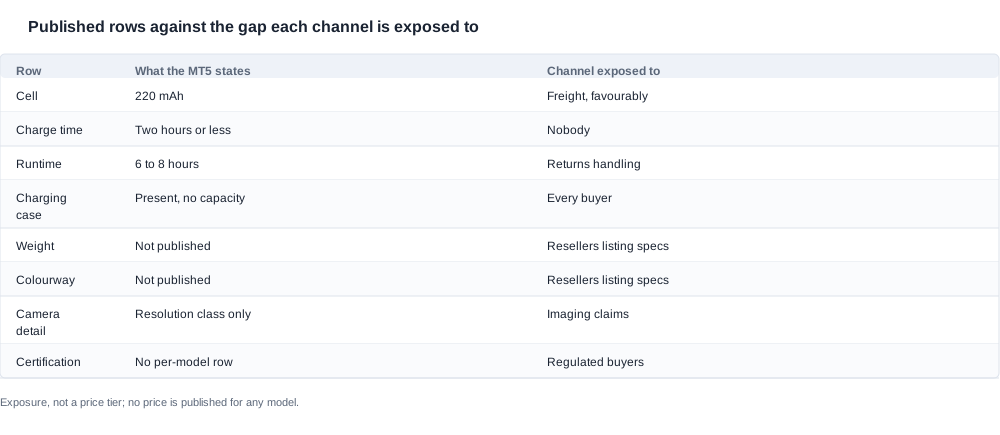
The gap between what is published and what is not is wider than the sheet suggests. No weight is published for the MT5. No colourway is published. No feature line describing the frame, the temple or the lens appears on its page. No Bluetooth version is published, which is true of all eleven camera models and false of every audio model. No sensor model, field of view, frame rate or video format is published. No certification row exists for any model, and the catalogue text contains no reference to CE, FCC or RoHS anywhere.
So the value question has a precise form: which of these absences is your business model exposed to? A channel that lists specifications will be exposed to nearly all of them. A channel that sells a brand will be exposed to almost none of them, because the specification sheet is not what the customer is buying.

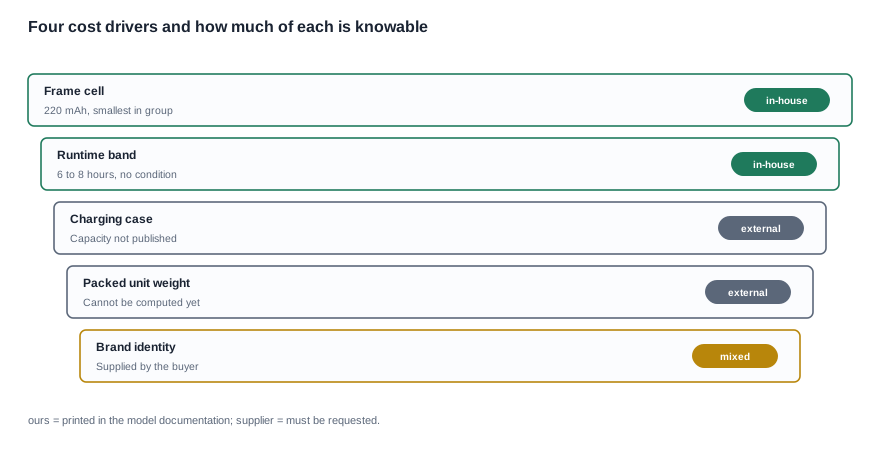
Four cost drivers a buyer can read from the documentation
No price is published, so a buyer cannot compute a margin. What a buyer can do is identify the four components that actually move the delivered cost, and rank them by how much of each is knowable today.
The frame cell is the smallest in the camera group. 220 mAh contributes in the customer's favour to packed unit weight, and therefore to freight and to the parcel a courier handles. The effect is real but modest, and it is entirely offset by the accessory below. The shipping weight breakdown covers how that arithmetic resolves once a packed unit has been weighed, which is the only figure worth putting into a freight model.
The charging case is the component that cannot be sized. The MT5 ships with a case and the case capacity is not published, which means the accessory weight, the accessory cost and the carton dimensions are all unknown. This is the single largest planning gap on this model, and it is the reason the MT5's value cannot be settled from the catalogue even approximately. A buyer who wants the small-cell advantage to reach the customer has to close this gap before the advantage reaches a freight calculator.
The magnetically charging interface determines the accessory in the box. Because the charging method is magnetic, some form of dock, pad or case is expected to be included. The MT5's case satisfies that, but whether a pad is also supplied is not published, and two accessories in one carton is a different proposition from one.
The runtime range determines the returns exposure. Six to eight hours is a wide band with no stated condition. A channel whose customers work long shifts will generate returns faster on a wide, undocumented band than on a narrow documented one, and the questions those customers ask will be answered by whoever wrote the product page — which is you.

The decision tree: which channel the MT5 actually serves
Rather than rank this model against its neighbours on an axis nobody can measure, walk the decision. The question at each step is about the buyer's business, not about the product.
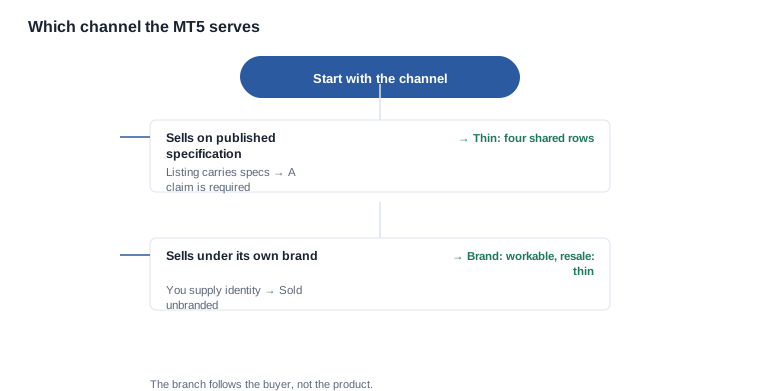
Does your channel compete on published specification? If yes, the MT5 is a poor candidate, and the reason is structural rather than a matter of degree. It publishes no weight, no colourway, no feature line and no imaging detail, so a specification-led product page for this model would have to be built from four rows that its rivals also publish. The MT5 how it compares piece sets the model against the wider camera range so the shared rows are visible.
Does your channel compete on brand recognition instead? If yes, this model becomes materially more attractive, because every published row it has is available to you to build on and none of them locks the customer to the supplier's identity. A private label line built on the MT5 looks like a private label line; the same product sold unbranded looks like the catalogue.
Is your channel reselling rather than rebranding? Then the value calculation runs the other way. Without a brand of your own, you have nothing to add to the specification sheet, and the customer's price comparison collapses onto the one or two rows that are actually different — the case, and the runtime band. On that basis the MT5 is a thin proposition, and the honest response is to source a model that publishes something you can put on the front of the listing.
Is your decision a range decision rather than a model decision? This is the branch most buyers arrive at late. Building a line on the 220 mAh platform means choosing between two carton configurations of the same cell tier: this model with a case of unpublished size, or the V03 Pro with no case and a Type-C interface. Both are legitimate; they are not substitutes, because one includes an accessory you cannot yet size and the other includes a lens and three published colourways. The trade-off is packaging complexity against visible product difference, and it should be made deliberately.

Where private label work substitutes for a published differentiator
A brand that buys the MT5 is buying a platform and supplying the difference. That is not a defect in the model; it is a different kind of purchase, and it comes with a different checklist.
The customisation surface is where this model's value is actually created. The AI camera glasses customisation options piece sets out the axes available on this platform, and the readiness overview maps which models carry a documented surface. What the supplier does not publish — minimum order quantity, tooling charges, private label fees, packaging minimums, artwork lead times — is exactly the material a brand needs to quote its own project, and all of it has to be obtained in writing before you order. No fee, minimum or turnaround for any of these is published, so any figure quoted back to you is a quotation term rather than a catalogue fact, and should be written into the purchase order with a remedy attached.
There is a second-order effect worth naming. A brand that has invested in its own identity on a shared platform gains something from the platform's simplicity: there is less to describe, so less can be described wrongly. On a model with four published rows and no feature line, the failure mode of an inaccurate product page is small. That is a genuine, if unglamorous, argument for this model in a brand portfolio.
It also carries the reverse risk. If the platform is thin on documentation, a brand's own marketing claims become the only claims on the page, and every one of them is then exposed to a challenge from a competitor who can read the same catalogue. That is an argument for private label work that stays inside the published rows, and for a request list that closes the gaps before the claims are written.
One further trade-off deserves naming before a brand commits. Private label work on this platform concentrates risk in the accessory rather than in the frame, because the case capacity is the one published row that cannot be checked before an order. The criteria for deciding whether that is acceptable are straightforward: if your channel can absorb an in-box description that stops short of an endurance claim, the gap is manageable; if your channel cannot, close the gap before you order or choose a model whose case capacity is published. Deciding this once, in writing, is cheaper than discovering it through a returns pattern six months later, and it is the single question a brand buyer should be able to answer without opening a supplier email.
What to ask before you order, and what to refuse as an answer
The checklist below is ordered by how much each answer changes the commercial position. It is a due diligence list, not a preference list.
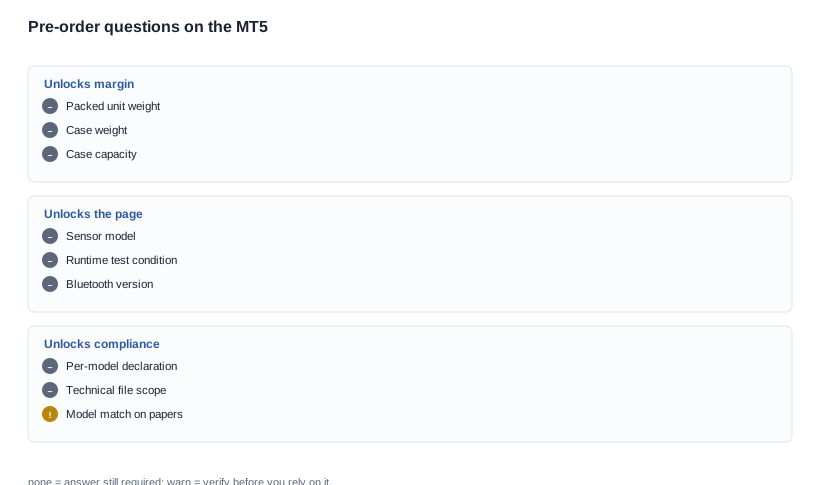
What unlocks freight and margin. The packed unit weight with the case in the carton. The case weight and external dimensions on their own. The case capacity. Whether a charging pad ships in addition to the case. These four answers determine whether you can quote a delivered cost at all, and they are the reason a value conversation about this model cannot be completed from the catalogue.
What unlocks the product page. Whether the eight-megapixel row can be supported by a sensor model, a field of view and a video format. Whether the six-to-eight-hour range has a stated test condition. Whether the Bluetooth version can be supplied for device-management purposes. If the answers are no, the page is written from the four published rows and nothing more, and that is a legitimate page as long as it claims nothing beyond them.
What unlocks the compliance file. A per-model declaration with verifiable references, a technical file covering the radio and safety scope for this model, and shipment documentation that matches the model designation. The catalogue carries a company-level export certification page holding ten patent certificates — eight appearance-design patents and two utility-model patents — and nothing per model. For a buyer in the European Union the relevant buyer-side reference for radio equipment is the Radio Equipment Directive (EU) 2014/53/EU; the electromagnetic compatibility directive is (EU) 2014/32/EU and is a different instrument. Ask for the model-specific scope rather than accepting a company-level statement, and check that the reference on any document matches the model in your purchase order.
What refuses to be an answer. A restated question, a distributor listing, a figure with no unit, a guarantee with no test condition behind it, or a certificate whose model designation does not match what you are buying. Each of these looks like progress on a specification sheet and is not.
Turning the answers into a specification annex
A request list is only useful if the responses end up somewhere a contract can point at. The sequence below is the one that keeps the specification sheet and the purchase order from drifting apart, and it is deliberately ordered so that each step depends on the one before it.
- Request the current model datasheet. Not a distributor listing and not a web page — the supplier's own document for this model designation, with its revision date on it. Everything that follows is checked against this copy rather than against a summary of it.
- Confirm the four published rows. The eight-megapixel resolution class, the 220 mAh cell, the two-hour-or-less charge ceiling and the six-to-eight-hour runtime band. If the datasheet disagrees with the catalogue on any of these, stop there and resolve the discrepancy before asking anything else; a mismatch at this step invalidates every later answer.
- Request the accessory numbers. Case capacity, case charge time, case weight, case external dimensions, and whether any further accessory ships in the carton. These five answers decide the freight model and the in-box description, and they are the ones most often answered with an estimate.
- Ask for a weighed packed unit. Not a computed figure and not a rounded one — a unit on a calibrated scale, with the case in the carton as it will ship. This single measurement settles more downstream work than any other item in the list.
- Request the runtime test condition. Whether the camera was recording, the audio and radio states, the starting and ending battery state, and the sample size. A supplier who cannot supply these has told you that the band cannot be defended, and your product page should say less as a result.
- Request the radio and camera detail. Bluetooth version for the model, sensor model, field of view, video format and frame rate. Some of these may genuinely not exist as published figures; the point of asking is to find out which category they fall into.
- Request the compliance file for this model. A declaration with verifiable references, a technical file covering the radio and safety scope, and shipment documentation whose model designation matches your purchase order. Check the model line on each document before you file it.
- Write the answers into the annex. Every number with its unit and its condition, every non-answer marked as a non-answer, and every remainder carried forward as an open item with an owner and a date. Then attach the annex to the purchase order so the specification and the commercial terms cannot diverge.
Steps three and four are the ones to protect when time is short, because they are the answers that change the delivered cost. Steps six and seven are the ones to protect when a regulated market is involved. Steps one and two take minutes and prevent everything downstream from being built on a wrong premise.
Failure modes worth planning for
Four things go wrong with this model in practice, and all four are preventable at the stage described above.
Shared-row drift. A product page is written from the catalogue, then corrected by a distributor's listing, then amended by a customer question, and ends up claiming rows that belong to a neighbouring model. The criteria for catching this are simple: every claim on the page must be traceable to one printed row, and no row may be used to imply a performance property the row does not state. An eight-megapixel row is a resolution class; it is not a sharpness claim, a low-light claim or a video quality claim.
The case that arrives unsized. The quotation assumes a carton the supplier has never weighed, and the first shipment lands with a parcel that is heavier and larger than modelled. The remedy is the weighed unit in step four, taken before the master carton is signed off rather than after.
The certificate that belongs to another model. A technical file assembled for a neighbouring product on the same platform arrives with a model designation that does not match the purchase order. It is a frequent outcome precisely because the platform is shared, and it is caught by reading one line. What to ask is simple: which documents in the file are specific to this model, and which are platform-level.
The runtime promise that outruns the evidence. A wide band with no stated condition becomes a single confident number on a listing somewhere, usually under competitive pressure from a channel that wants a clean claim. The trade-off to negotiate is a narrower published claim in exchange for a documented one, and it is worth taking that trade-off explicitly rather than losing it silently.
Each of these is a process failure rather than a hardware failure. None of them can be detected from the catalogue, and all of them are closed by the same discipline: write down what is known, write down what is not, and make the supplier fill the second list in writing before you order.
The decision this model asks of you is narrow enough to state plainly. If you have a brand to sell, the MT5 is a workable platform whose value comes from your own work and whose gaps are closeable with a written request. If you do not, its published rows are the whole offer, and there are models in the same catalogue that publish more of what a reseller needs to list. The MT5 smart glasses best for analysis works through that buyer-fit question from the other side, and the published MT5 baseline is the honest starting sheet.
What we will not do is publish a price, a price tier or a value ranking for this or any other model, because none is documented and a fabricated one would be worse than silence. What we will do is tell you exactly which numbers exist, which do not, and in which order to close them.


