

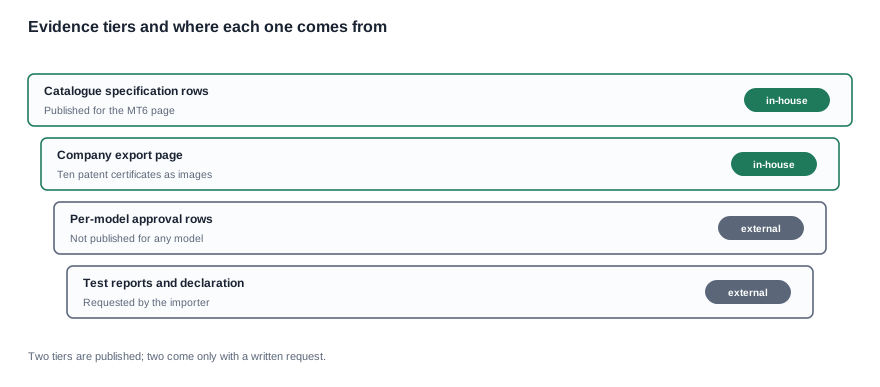
The MT6 smart glasses certification status cannot be answered from the catalogue, and the reason is specific enough to be useful. The catalogue's export certification page sits at company level, and its content is ten patent certificate images rather than typed text. The catalogue text names no CE, FCC or RoHS anywhere, there is no per-model certification row on any page, and there is no record of an approval that is pending confirmation for any model. So the status is not "certified" and it is not "uncertified" — it is unpublished at the model level, which places the entire evidence burden on documents the importer must request in writing.
That distinction is the whole of this article. An importer who treats a supplier's silence as a pass will discover the gap at customs or at a channel audit. An importer who treats it as a fail has no basis either. The workable position is to know exactly which documents close the gap, in what order to ask for them, and which numbers to check so that a report for the wrong directive does not get filed as evidence.
MT6 smart glasses certification status: what the catalogue publishes, and what that does not license
Three things are true at once on this model, and importers routinely collapse them into one. First, an export certification page exists at company level in the catalogue, and it is a page of images: ten patent certificates, of which eight cover appearance designs and two cover utility models. Second, those patent documents are not market-access approvals — a design patent protects an appearance, not radio compliance, not electrical safety and not electromagnetic behaviour. Third, because the page sits at company level, it says nothing about which approvals, if any, apply to the MT6 as a model.
The practical consequence is that no line in the catalogue links the MT6 to CE, to FCC, to RoHS or to anything else. There is no row to read, and there is no footnote to interpret. An importer who writes "supplier states CE and FCC" into a compliance file has recorded a conversation, not a document, and that file will not survive review. The same applies to the phrase "claimed at company level", which circulates widely in this category and which nothing in this catalogue supports.
Two further absences matter for planning. The catalogue carries no Bluetooth version for any of the eleven camera models, so the MT6 sits outside the Bluetooth qualification path until a supplier document says otherwise — the SIG route is covered separately in Bluetooth SIG certification. And the catalogue publishes no charge method row for the MT6, which means the accessory and cable decisions an importer makes for this model are provisional until the method is documented.

Why a company-level page cannot answer a model-level question
Compliance scope attaches to a product configuration, not to a company. A supplier holding approvals for one model, or for one factory line, or for one earlier product generation has told you nothing about a different model with a different battery, a different enclosure and a different radio.
The failure mode is well documented in buyer-side due diligence: a supplier attaches a photograph of a certificate wall, the importer files it against the model under order, and eighteen months later a market surveillance authority asks which test report supports that specific model, at which point nobody can produce it. The photograph was never evidence; it was decoration.
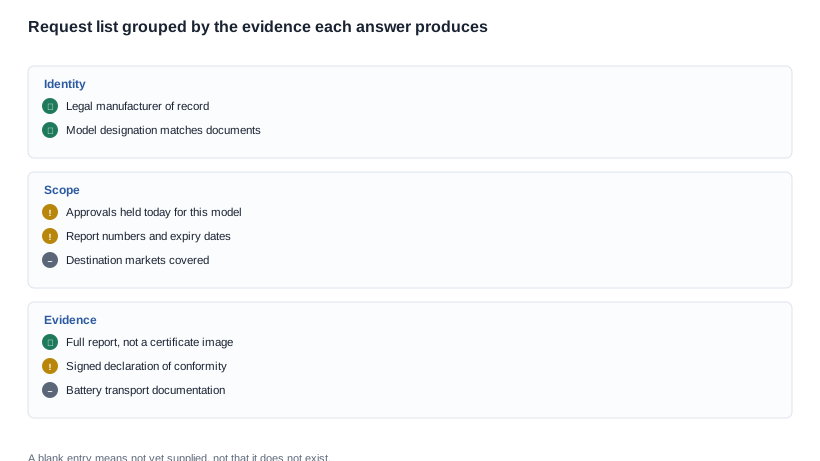
Ask a narrower question instead, and it is much easier for a supplier to answer: which approval, held by which legal entity, covers which model number, issued by which laboratory, on which date, with which report number, and valid until when. Six fields. A supplier who cannot complete those six fields for the MT6 has told you that the approval does not exist in a form you can file, and you should price that accordingly rather than assume it is coming.
The battery adds its own documentation stream. A 265 mAh cell in the body and a 1200 mAh folding case mean two power sources to describe in transport paperwork, and lithium battery declarations are checked before most other documents. The transport side is set out in battery transport compliance, and the dimensional side in AI camera glasses shipping weight.

The document request list, in the order importers ask for it
Order matters here for a simple reason: the cheapest answers come first, and a supplier who answers the first three questions is telling you whether the rest will be forthcoming. Asking for test reports before asking which approvals apply invites a supplier to send you whatever is on the shelf.
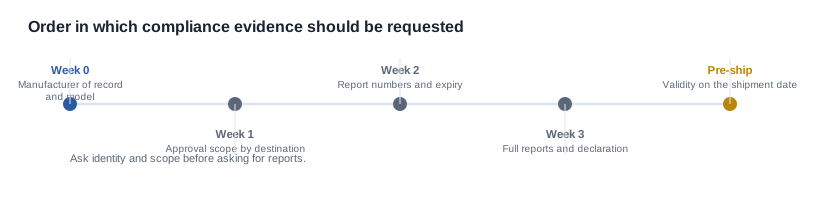
Start with identity. Which legal entity is the manufacturer of record, and does the model designation on the model match the designation on every document. Then scope: which market destinations is the configuration intended for, because the answer set differs by destination and asking one question resolves a whole branch of follow-ups. Then approvals: which of the applicable approvals are held today for the MT6, with report numbers and validity dates.
Only after those three should you ask for the underlying reports — the full test report rather than a certificate image, because a certificate names the standard and the report shows the measurements, and only the second one tells you whether the configuration was the one that was tested. Then the declaration of conformity, signed and dated, naming the model. Then the battery documentation: cell specification, transport classification, and the UN38.3 test summary where lithium transport applies.
Ask for all of it in writing against the purchase order number. Email is evidence; a verbal assurance relayed by a salesperson three months later is not, and the distinction matters most at the moment it is needed.

Directive numbers and standard families, stated precisely
Most of the avoidable risk in this category comes from a document that names the right family and the wrong number. Precision costs nothing, so it is worth being exact about the references that come up most often.
Where radio equipment is in scope, the reference is the Radio Equipment Directive (EU) 2014/53/EU. It is not 2014/32/EU — that number belongs to the electromagnetic compatibility directive, a different instrument covering different obligations. Conflating them is a common and entirely avoidable error, and it undermines the credibility of an otherwise careful file.
Where electromagnetic compatibility is the concern, EN 301 489 is the relevant harmonised standard family. A standard family and a directive number are not interchangeable, and a report that cites a directive as though it were a standard should be queried rather than filed. Where battery transport documentation is required for lithium cells, UN38.3 is the test summary reference. Where a model carries Bluetooth, the Bluetooth SIG qualification route is separate again, and it is separate from both.
None of these references establishes that the MT6 holds any of them. They tell you what a correct answer would look like, which is exactly what an importer needs in order to recognise a wrong one.
The unpublished gaps that shape the request
Three MT6 facts shape what you must ask for. The charge method is not published, so the power-supply and accessory documentation cannot be scoped until a supplier answers. The ingress protection rating is not published for this model, so no durability claim can be written into your own channel material. The camera detail beyond the eight megapixel resolution class is not published, which affects nothing in the compliance file but does affect what your own product page may legitimately say.
None of these are red flags on their own. They are simply the boundary of what the catalogue supports, and stating that boundary in writing to your supplier is a more professional position than filling it in yourself.
Building the technical file as you go
The requests above produce a technical file, and the value of that file depends entirely on whether it was assembled as you went or reconstructed afterwards. Keep one folder per purchase order, and keep it flat: the request as sent, the answer as received, the report itself, and a one-page index naming the legal entity, the model designation, the report numbers and the dates. That index is what a compliance reviewer, a channel partner's due diligence team or your own quality control function will actually ask for.
Four questions to ask at the point of receipt, rather than later. Does the report name the same model designation that appears on the product? Was the tested configuration the production configuration, or an engineering sample? What is the report date, and is anything in it superseded by a later report? And does the declaration of conformity name the same entity as the purchase order. Any one of those four mismatches invalidates the file, and each is far cheaper to catch in the week the documents arrive than in the month a regulator asks.
Keep the file alive after the shipment too. Approvals expire, configurations change, and suppliers reorganise. A file that records an expiry date and a named contact is a live document; one that records a single PDF is an artefact that will quietly stop being true.
What to do when the answers conflict
Conflicting answers are more common than missing ones, and they are harder to resolve, because both answers came from the same supplier. The pattern to watch for is a document that names a standard from a different directive family, or a report whose model designation differs from the one on the purchase order by a suffix. In both cases the document may be perfectly valid for a different product, which makes it useless for yours without making it obviously wrong.
The correct response is a narrow question rather than an accusation. Ask which configuration the report was issued for, and ask for the page that shows it. Most conflicts resolve into one of three categories: the report covers a sibling model, the report covers an earlier configuration, or the report was issued under a superseded standard version. Each has a different remedy, and only the third requires anything from a laboratory. Buyers who open with the accusation spend the relationship on a problem that a single page would have answered.
There is a fourth category worth naming explicitly because it is the one that catches people: a supplier who has sent a document that genuinely does apply, but cannot produce the corresponding declaration of conformity because the legal entity on the report is a trading company rather than the manufacturer. That is a solvable problem, usually through a simple document chain, and it is far cheaper than the alternative of a channel that cannot restock.
A shortlist for a first-time importer in this category
If you are entering this category for the first time, resist the urge to start with the model that interests you. Start with the destination market instead, because it determines the evidence set, and the evidence set determines which questions are worth asking of every candidate.
Work in four passes. Pass one is regulatory scoping: establish which approval families apply to the product type and the destination, in plain language, before any supplier conversation. Getting this wrong early is expensive, because it invalidates documents you have already paid for. Pass two is supplier selection: shortlist on the completeness of the technical file rather than on the headline specification, since a supplier who cannot produce a document for one model will struggle with the next one too. Pass three is the sample, with the questions answered in writing and the answers filed. Pass four is the order, with the evidence set attached as a condition rather than as an aspiration.
For a private label or distributor arrangement, add a fifth pass that has no equivalent in a direct purchase: confirm who becomes the holder of record. A distributor reselling under its own brand is frequently treated by the market as the party responsible for the product in that territory, and may find itself asked for documents it never received. The way to avoid that is contractual and cheap — specify in the supply agreement exactly which party holds which approvals, and which party obtains and files which declarations. Getting this right at the outset costs one clause. Getting it wrong costs a channel.
Questions to ask that suppliers consistently answer well
These are the questions worth asking, because they have determinate answers and a supplier who answers all of them is giving you a usable technical file. Which legal entity is the manufacturer of record. Which approvals are held today for this model designation. What are the report numbers and their expiry dates. Was the tested configuration the production configuration. Which laboratory issued each report. Which document in the set is the declaration of conformity, and who signed it. What is the date of the most recent production run covered by the approvals. And is anything in the file superseded.
Then two questions that matter commercially rather than technically. What happens to the approval position if the configuration changes, and at what point in that change must we be told. And what lead time applies if a destination market later requires an approval not held today. Both convert an open compliance risk into a costed option, which is the only form in which it can be compared against a competing quotation.
Red flags worth naming early
Four patterns show up repeatedly in this category, and each is worth naming before you meet it rather than after. A supplier who offers a certification page rather than a report — that is decoration, not evidence. A supplier who asks which standard you need before telling you what they hold, which inverts the order and transfers the scoping work to you. A document set whose model designation does not match the purchase order exactly, which is usually a suffix difference and occasionally a different product. And a supplier who treats validity dates as administrative detail rather than as a condition.
None of these is evidence of bad faith. All four are evidence of a documentation process that will not support a compliance conversation six months from now, which for a buyer is the only question that matters.
Turning the answers into an acceptance condition
A document request that is not attached to a commercial consequence produces a partial answer. Attach it: make the scope of approvals, with report numbers and validity dates, a stated condition in the purchase agreement, and attach a holdback or a warranty period long enough that a later gap still costs the supplier something.
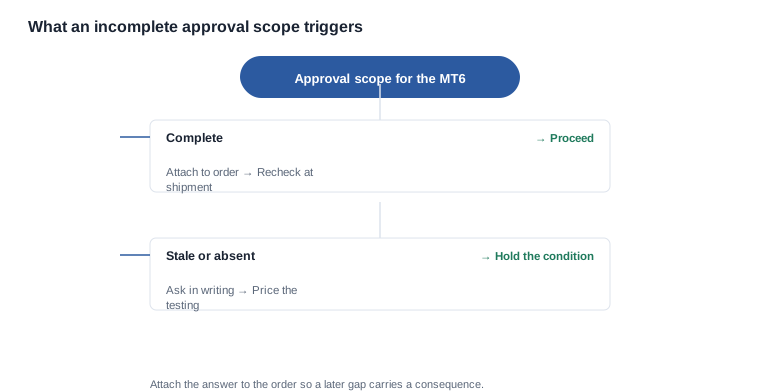
Two structures work well. The first ties approval scope to pre-shipment documents: the set must be complete and valid on the date of shipment, not merely at the date of the sample. The second ties it to the warranty period, so that an approval withdrawn mid-contract has a defined consequence. Buyers who take the second route generally find the conversation easier, because it frames the request as risk allocation rather than suspicion.
Where a supplier genuinely does not hold approvals for the destination market — which happens, and which is not a failure of character — the correct response is commercial, not moral: get the configuration routed through a testing pathway with a named laboratory, a cost line in the quotation, and a date. A quotation that carries the testing cost and the timeline as visible lines is a document you can evaluate. A supplier who intends to absorb it silently is making a promise that will surface later as a claim.
The boundary we can state
We can tell you what this catalogue publishes: five specification rows on the MT6 page, one export page at company level carrying ten patent certificates as images, and no per-model approval record of any kind. We cannot tell you that the MT6 holds CE, FCC or RoHS, and we will not infer it from a company-level page that contains patent images. That question belongs in your document request, and the answer belongs in your file.
The criteria for judging whether a supplier's file is good enough
Four criteria, applied to the file rather than to the supplier. Coverage: does the set name a holder, a model, a report number and an expiry date for every approval claimed. Currency: is the most recent production run inside the validity window. Consistency: does the same model designation appear on the report, on the declaration and on the purchase order. Traceability: can the supplier point to the laboratory record behind each report without needing to search for it.
A supplier meeting all four is a supplier you can place a repeat order with, because the file will still be usable when the second run ships. A supplier meeting two is a supplier whose file has to be rebuilt on every order, which is a cost that appears on no quotation and is paid in your team's time. Judge the file rather than the intent: a supplier who is willing to produce a complete set when the request is specific is in a different position from one who cannot, and the difference shows up only when you ask precisely.
How the evidence request changes the rest of the purchase
The document request is not an administrative side issue; it decides several terms that would otherwise be negotiated later at the buyer's expense. Scope of approvals fixed at order time becomes a condition, so it can carry a remedy. Configuration change notification fixed at order time becomes a trigger, so a change can be priced rather than discovered. Destination markets named at order time become a boundary, so an approval for one territory is not assumed to cover another.
Each of those is worth more before the order than after it. A condition agreed while the quantity is still negotiable costs a supplier nothing to accept. The same condition requested after the run is built is a dispute. This is the ordinary commercial pattern — risk is cheap to allocate before commitment and expensive afterwards — applied to a technical subject, which is exactly why the technical question should be settled first rather than last.
Related reading
- Certification scope across the camera group — AI camera glasses certification for camera glasses
- Specification rows this certification view depends on — MT6 smart glasses specifications and features
- Battery transport documentation — battery transport compliance
- Bluetooth qualification route — Bluetooth SIG certification
- Export paperwork beyond approvals — OEM-ready export documentation
- This note as a standalone reference — MT6 smart glasses certification status


