
These are the MT6 smart glasses common questions a buyer asks most often, answered in a fixed order every time. First what the catalogue publishes, quoted as published. Second what it does not publish, named explicitly so nobody fills the gap by assumption. Third what to put to the supplier. The reason for the fixed order is simple: a question answered without that structure tends to produce a confident answer that merges published fact with inference, and that merged sentence then travels into a purchase order, a product listing and a warranty claim.
The model itself is easy to summarise. It is a camera model in a range of twenty-eight, with a 265 mAh cell, a runtime of about seven hours, a charge time of two hours or less, an eight megapixel resolution class, a folding case of 1200 mAh, and a body weight of 158 grams that is the only published mass figure in the entire catalogue. Everything below is an elaboration on that list, and on the honest boundary around it.
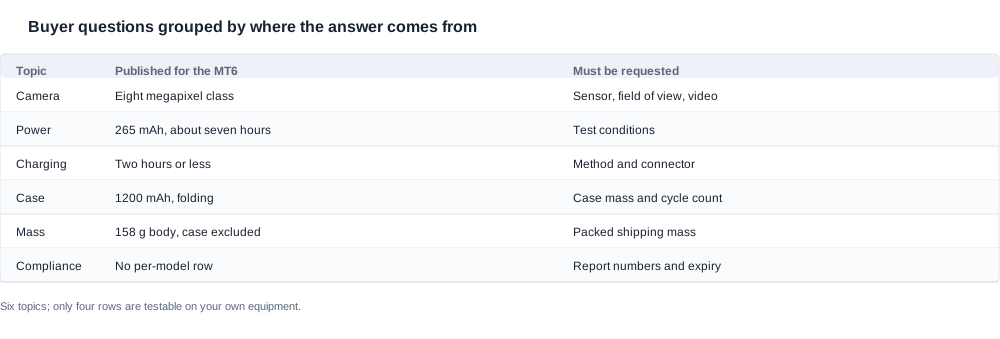
MT6 smart glasses common questions: the five rows and what sits next to them
The published record for this model is short enough to state completely, which is itself unusual and useful. There is a cell capacity, a runtime, a charge time, a case capacity, a camera resolution class, a body weight, and three short descriptors reading portable, ultra-light and foldable case. There is no row for the charge method, no row for ingress protection, no camera detail beyond the resolution class, no colour row, and no certification row.
Note what is missing rather than merely what is present, because the absences are where procurement time is actually spent. Colour is published for only two models in the whole camera group, and this is not one of them. Ingress protection is published for only two, and this is not one of them. Bluetooth version is published for the audio models but for none of the eleven camera models, including this one.
That pattern is worth internalising before you read the answers, because it tells you what kind of question to ask. For a model with fewer rows, the questions are not about the specification — they are about the evidence.
Questions buyers ask about the camera
What resolution is the MT6 camera? Published: the eight megapixel resolution class. That places it in the eight-model group of camera models rather than the three-model group published at thirteen megapixels. Not published: sensor model, field of view, frame rate, video format, stabilisation, low-light performance, storage capacity and file format. What to ask: which sensor is fitted to this configuration, what the horizontal and vertical field of view is, and what the maximum supported recording resolution and frame rate are. Treat the answer as a specification you want written into the order, because it determines what your own listing may claim. See AI camera glasses imaging for why an unpublished sensor limits what a camera evaluation can conclude.
Can it record video? Not published. There is no video row on this page, and the absence of a video row is not a statement that video is unsupported — it is a statement that the catalogue does not address it. What to ask: what modes the device records in, at what resolution and frame rate, where files are stored, whether storage is fixed or expandable, and whether recording continues while connected to the case. Until that is answered, do not describe recording behaviour in your channel material.
Does it have a remote shutter? Published for two sport models, and not for this one. What to ask: whether a physical or remote trigger exists in this configuration, and if so whether it is a catalogue feature or an option. This is a small question that is expensive to discover after a listing has been built around it.
Is it water resistant? Not published for this model. Two camera models publish an IP54 row and this is not one of them. What to ask: whether any ingress rating applies to this configuration, and if so which letters and digits, tested by which laboratory. The background on why a rating must be tested rather than inferred is in IP ratings. Until answered, no durability claim belongs in your copy.


Questions buyers ask about power, case and charging
How long does the battery last? Published: about seven hours. Not published: the workload, the camera state, the ambient conditions, the battery age, or any definition of "use" behind the figure. What to ask: the test condition behind the seven hours, and what the figure becomes with the camera recording continuously. Five camera models publish roughly the same seven-hour row, so a comparison across them is meaningful only if you hold the condition constant. The wider picture is in battery life.
How long does it take to charge? Published: two hours or less. Two points matter here. It is a ceiling, so a unit taking exactly two hours meets it, and describing it as under two hours would overstate what is published. And it carries no start state and no completion criterion. What to ask: whether the cell starts empty, what charge level counts as complete, and whether the figure applies to the body alone or to the case as well.
How does it charge? Not published. The MT6 is one of four camera models that publish a case capacity without publishing a charge method — the CY05 and the L1 Pro, and the CY03 are the other three, and all four publish their case capacity. What to ask: the physical connector or contact arrangement, its position on the body, whether the case charges the body directly, whether the case has its own input, and whether one case charges more than one model. The full treatment of that gap is in charging solutions.
How many times does the case recharge the glasses? Not published. What is published is a 1200 mAh case and a 265 mAh cell. Any ratio you derive is your arithmetic, not the supplier's claim, because conversion losses and cut-off thresholds are unpublished. What to ask, or better, what to measure: run the case down on identical sample units to a stated end condition and count the cycles.
How much does it weigh? Published: 158 grams, for the glasses body including its fitted battery and camera, excluding the case. This is the only published mass figure anywhere in the catalogue. Case mass is not published. What to ask, or measure: the case mass, and the packed shipping mass per unit, since the case is what consumes volume.
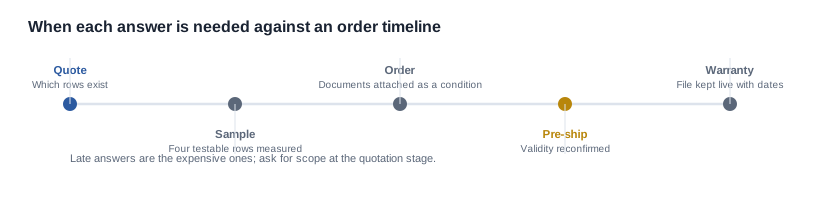

Questions buyers ask about documents and compliance
Is it certified? Not published, and the answer is more specific than it first appears. The catalogue carries a company-level export certification page whose content is images rather than text, carrying ten patent certificates — eight appearance-design and two utility-model. The catalogue text contains no reference to CE, FCC or RoHS anywhere, and there is no per-model certification row on any page. A company-level page of patent images cannot establish a model-level approval, and nothing in the catalogue should be read as doing so. What to ask: which approvals are held today for this model designation, with report numbers, issuing laboratories and expiry dates. The document side is set out in the certification checklist.
Does it come with a warranty? Not published in the catalogue. Warranty terms are a commercial term rather than a specification, and they are negotiated per contract rather than per model. What to ask: the warranty period, what it covers, what it excludes, the claim procedure, and whether it transfers if the goods are resold under a private label. The longer structural discussion sits in OEM-ready warranty setup.
What is the minimum order quantity and lead time? Not published, and deliberately so — these are quotation terms that vary with configuration, quantity and market. What to ask: MOQ per model and per colourway, lead time from deposit to shipment, and whether tooling or setup is required for a private label. Any figure you receive should arrive as a line on a quotation rather than as a statement in conversation. See MOQ for private label.
Is the supplier a factory? Not something a catalogue can answer. What to ask for due diligence: the manufacturing entity's registration details, whether the model is produced in-house or through a subcontract route, whether the camera and battery are sourced components, and whether a factory audit is permitted before the first bulk order. Model-level answers to none of these appear in any product documentation.
The questions worth asking rather than answering
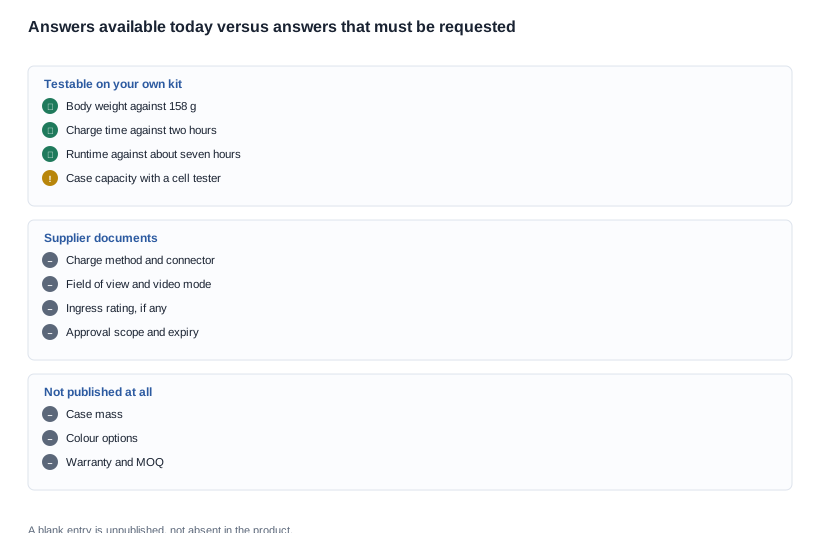
The pattern across all of the above is consistent. Four rows are testable on your own equipment: the body mass, the charge time against its ceiling, the runtime against its figure, and the case capacity with a cell tester. Everything else is either a supplier document or a sample measurement. Nothing about this model is answered by inference from a neighbouring model, and nothing should be.
Two closing cautions for anyone building a product listing from this record. First, the eight megapixel class, the seven-hour runtime, the two-hour ceiling, the 1200 mAh case and the 158 gram body may all be stated, because all five are published. Second, the connector type, the ingress rating, the field of view, the video mode and the certification status may not be stated at all, because none of them is published for this model. That boundary is not a limitation of the product; it is simply where the evidence stops, and knowing where it stops is what lets a buyer negotiate for the rest.
The boundary of what we will and will not answer
We will answer with what the catalogue publishes, and we will name the gaps rather than filling them. That is a deliberate position rather than a limitation of effort, and it has a commercial reason behind it. A supplier who describes a connector type, an ingress rating or an approval scope that the record does not contain is making a commitment the record cannot support, and the buyer who relies on it inherits a dispute later with no document to point at.
So the position is this. The cell capacity, the runtime, the charge-time ceiling, the case capacity, the resolution class and the body mass are published, and we will state them exactly as published — including the fact that the charge time is a ceiling and the mass figure excludes the case. The charge method, the sensor, the field of view, the video mode, the ingress rating, the colour options, the warranty terms, the MOQ and the approval status are not published for this model, and we will not supply them from inference or from what a neighbouring model happens to publish.
That boundary is also the most useful thing on this page, because it tells a buyer exactly where to spend due diligence effort. Where a row exists, the work is measurement. Where it does not, the work is a written request and a supplier who can answer it. A buyer who understands that split before the first quotation will spend their time on the questions that actually move the decision.
Coverage, precision and currency, and the criteria behind them
Answers arrive in a range of quality, and the quality determines whether the file is worth anything six months later. Three criteria decide it. Coverage: does the answer name the configuration, or only the model family. Precision: does it give a value with its test condition, or a value alone. Currency: does it correspond to the production run you are about to receive, or to an earlier one.
Apply those criteria to a simple case. A supplier answers the charge method question with "it charges over USB type C". Coverage fails if the case capacity is supplied as a separate accessory, because the answer may describe the case input rather than the body connection. Precision fails because there is no test condition attached. Currency is untestable without asking. None of those failures is serious on its own, but each one leaves a gap in a purchase order, and three gaps in one order is a pattern worth escalating before you commit.
The evaluation habit that catches most problems is simple: write the answer down in the same words the supplier used, with the date and the purchase order number, and read it back against the question you asked. If the two do not match, the answer is not yet an answer, and it costs nothing to ask again while the supplier is still thinking about the first question.
The questions only a sample can settle
Some questions never close on paper, and it is worth knowing which so that you stop asking suppliers for things only a unit can show. Charge method is one: a supplier can document it, but confirming that the documented method is the fitted method requires plugging the device in. Case recharge count is another, because it depends on conversion losses and cut-off thresholds that no specification states. Case mass is a third, and it is a direct function of the folded dimensions, which are not published for any model.
The practical sequence is to close every documentary question first, because those answers shape what you ask the supplier to demonstrate. Once the documents are in, the sample order becomes a short and specific list: confirm the documented charge method against the unit, measure the case recharge count to a stated end condition, weigh the case, weigh the body against the published figure, time a charge cycle against the ceiling, and run a runtime test under conditions you will state in advance so the result is comparable with a second run later.
The value of doing it in that order is that a sample test never asks a question the paperwork could have answered. Testing first and documenting afterwards is how a buyer ends up paying for a measurement that a supplier could have confirmed in an email.
Closing the loop on repeat orders
The first order produces a technical file, and the second order is where that file pays for itself. Before placing a repeat order, check three things: whether any document you relied on has passed its expiry date, whether the supplier has changed the configuration without notice, and whether the measured figures from the first run still hold on a new sample. Each check is quick, and each catches a category of problem that is otherwise discovered by a customer.
Buyers who maintain that discipline report fewer surprises on repeat runs than those who treat a second order as a formality, and the difference in effort is measured in hours rather than in rework. That is the whole argument for keeping the file alive.
What the published rows mean for a quotation
A quotation is a set of assumptions written down, and the published rows tell you which of your assumptions the supplier has actually confirmed. On this model, a supplier who quotes against the seven-hour runtime and the two-hour ceiling has confirmed two things and is silent on the rest. The silence is not deception, but it is worth pricing: an unstated charge method and an unstated ingress rating are both items a competitor may have resolved, and both are items you will carry if you proceed.
So before you accept a quotation, mark every line that rests on a supplier statement rather than on a published row, and ask for those lines in writing. The charge method, the case configuration, the ingress position, the approval scope and the warranty terms are the usual ones. Any of them that arrives as a conversation rather than as a line on the order form is a line that will be renegotiated at the worst possible moment, which is usually after the goods have shipped.
The same discipline applies to the reverse direction. Where the catalogue does publish a row, a quotation that contradicts it is not a negotiation point; it is an error, and correcting it early costs nothing. The body mass, the cell capacity and the case capacity are the figures most often transposed between models in a range this size, and a quotation carrying another model's figure is the single easiest mistake to catch and the most expensive to discover at goods-in.
One closing habit worth building in. When a supplier answers a question, log it against the purchase order number on the day it arrives rather than at the end of the month. Technical files fail quietly: an answer received in week three is filed under a folder nobody opens again until the next audit, and by then the question has been re-asked twice. Logging on arrival costs a line and preserves the sequence of your own due diligence, which is often the thing a reviewer asks to see.
A useful discipline for repeat orders is to keep the questions themselves, not only the answers. A one-page list of the open items, dated, attached to the purchase order, tells you at a glance what has closed and what is still outstanding when the next order is being negotiated. It also makes the pattern visible: when the same question has been asked three times across three orders and never answered, that is a supplier characteristic worth acting on, rather than a piece of bad luck to absorb again.
Related reading
- The camera range this model belongs to — AI camera glasses
- Every published row on this page — MT6 smart glasses specifications and features
- Certification evidence — MT6 smart glasses certification status
- The charge method gap — MT6 smart glasses charging options


