

A warranty arrangement agreed after the first thousand units have shipped is a negotiation from a weak position, and the first thing that gets argued about is what counts as a defect. That definition is the whole arrangement, and it is a document rather than a conversation. Building it before the first order is harder in this category than it is elsewhere, for a specific reason: the record provides no baseline to measure against. The product record for this catalogue covers twenty-eight models and states for every one of them that no product photographs, no video and no detection reports have been supplied, and the catalogue pages publish specification rows with no test condition attached to any of them. So a warranty for these models cannot be written by pointing at a published performance figure, because there is none that carries a condition. It has to be written by agreeing the conditions first and then naming the rows.
Where a failure list can legitimately come from
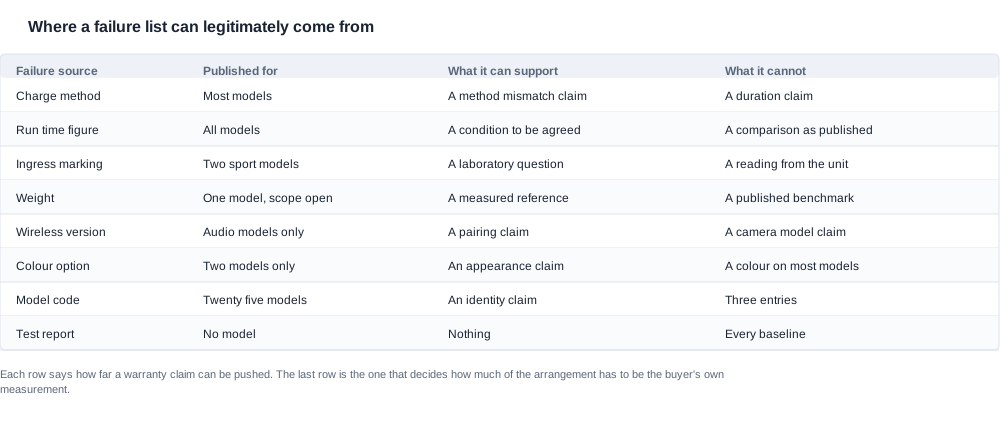
The table below is the starting point for a failure list, and it is built from what the documentation can actually support rather than from an inventory of components.
| Failure source | Published for | What it can support | What it cannot |
|---|---|---|---|
| Charge method | Most models | A method mismatch claim | A duration claim |
| Run time figure | All models | A condition to be agreed | A comparison as published |
| Ingress marking | Two sport models | A laboratory question | A reading from the unit |
| Weight | One model, scope open | A measured reference | A published benchmark |
| Wireless version | Audio models only | A pairing claim | A camera model claim |
| Colour option | Two models only | An appearance claim | A colour on most models |
| Model code | Twenty five models | An identity claim | Three entries |
| Test report | No model | Nothing | Every baseline |
The last row is the one that governs everything else. Because no model in this range has a test report behind it, a warranty cannot be built as a comparison against a documented performance. Every claim it covers has to be either anchored to a published row that happens to exist, or defined against a condition the two parties agree in advance.
Three rows in that table need particular care, and each one is a place where a warranty written casually will fail.
The run time row is the first. Every model publishes an endurance figure, in one of three shapes, and none of them carries a test condition. So a unit that comes back having run for part of a working day cannot be tested against the published figure, because the figure describes a condition nobody stated. The warranty treatment that works is to agree the condition before the first order and write it into the claim requirement, so that both parties are measuring the same thing. The warranty treatment that fails is to reference the published number as though it were a threshold, because the first return that challenges it will be argued on the ground that the number was never a threshold.
The ingress row is the second, and it is narrower than it looks. Two models in the sport category carry an ingress marking, and the product record states that it is a catalogue annotation with no third-party test report number behind it. The other models have no such row at all. So a waterproofing claim can only be settled by a laboratory in either direction, and the warranty has to say so, because a unit that has been in rain is otherwise indistinguishable from a unit that has been misused. The sport water resistance analysis covers why that boundary has to be written down rather than assumed.
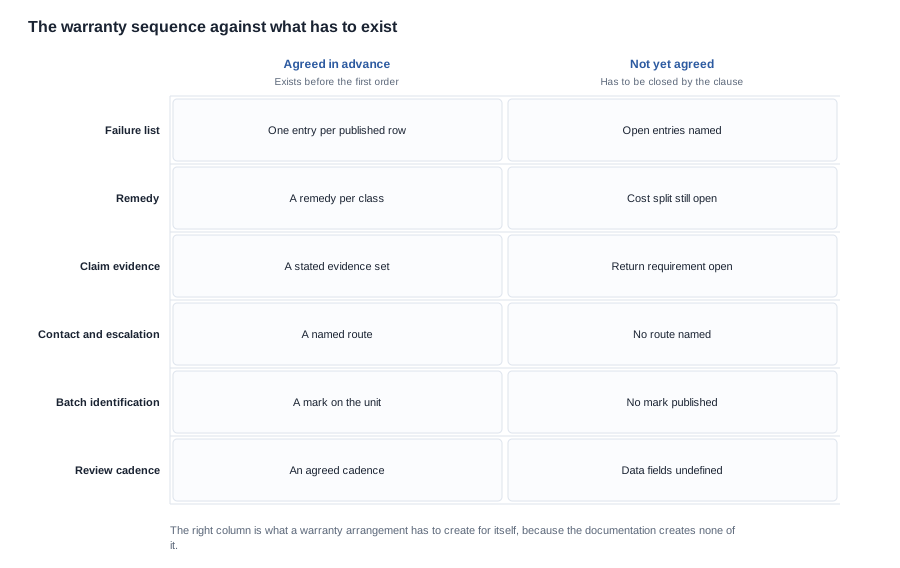
The identity row is the third. Twenty-five of the twenty-eight entries carry a model code, and three do not, so a warranty claim cannot name a model for those three. Twenty-six entries publish no colour row, so a claim usually cannot state a colour either. And no model in the range publishes a batch mark, so a warranty that wants to ask whether a fault is concentrated in one production run has no evidence to ask with. These are not edge cases to be handled by an exception process. They are the normal state of a claim form in this category, and the form has to carry fields that the documentation does not.
The six OEM ready platforms stages, and why each one comes before the next
The first stage is building the failure list, and it has to be built from the published rows rather than from a component inventory. The catalogue does not publish a component list for any model. It does not say what microphones, speakers, hinges, joints or radios a model carries, and the camera models do not publish a wireless version at all, while the audio models do. So a failure list written as a bill of materials would be a list of components nobody has documented, and it would place failures on parts that may not be separable in a repair. The list that survives contact with a claim is built differently, and the criteria for building it are these four.
- One entry per published row that can fail. The charge method, the endurance figure, the case configuration, the wireless version where it is published, the ingress marking where it is published.
- One entry per published row that carries a condition to be agreed. The endurance figure is the clear case, because every model publishes one and none of them states the condition it was measured under.
- One named entry for each row the documentation leaves open. The frame weight, the capture behaviour, the packaged weight, the charging input, and the contents of the box.
- One entry for the identity rows. What a claim has to state about the unit so it can be identified at all, which on this range means a code and a configuration rather than a name.
That last group is what makes the list honest, because it records where the boundary between a defect and a misuse is currently undefined, which is precisely what a claim will be argued about. The list is also the only part of the warranty that a buyer can write from the documentation on its own, and everything after it depends on the two parties agreeing.
The second stage is agreeing the remedy for each failure class: repair, replacement, credit or refusal, and who pays the freight in each direction. Agreeing it in advance is what stops a per-unit negotiation, and a distributor who has to ask the factory what to do with each return will do something inconsistent, and the inconsistency becomes the customer experience. The reason this stage belongs immediately after the failure list is that the remedy depends on the class, and a class that has not been defined cannot have a remedy attached to it.
The third stage is setting the claim evidence. What a claim has to carry, whether the physical unit has to come back, and what the claim has to include. Requiring the unit back stops the claims that are not real and slows the claims that are, and it means paying return freight and handling a queue of inbound units. The returns and warranty notes cover how to structure that trade, and the returns packaging guidance covers what to ask a customer to send back.
The fourth stage is the cost split: the replacement unit, the return freight, the outbound freight, the inspection and the disposal of the failed unit. The largest variable in that arithmetic is the failure rate, and the largest reason it is unknown is that nobody has collected the data, because no test report exists to compare a field figure against. The troubleshooting orders for this range and the audio equivalent exist partly to make the data collectable, because a diagnosis sheet is what turns a pile of returns into a classified set of failures.
The fifth stage is naming the contact point and the escalation route. One named channel with a response expectation, for a distributor to route a claim through, plus a defined second tier for a disputed claim: a named person, a response time, a decision rule. A warranty that says contact your supplier in a document both parties have signed is a warranty nobody will use. The reason the escalation route matters more than a generous initial policy is that a generous policy without a route produces a claim queue rather than a resolution, and a claim queue is invisible until a customer complains about it.
The sixth stage is reviewing the data on a cadence. The first shipments tell you which failure mode dominates, which channel generates the claims, whether one batch is worse, and whether the published endurance figure is holding up in the field. That last one matters more than it sounds, because a published figure with no test condition cannot be compared against a field measurement until the field measurement has a condition too. The returns data analysis covers how to read the pattern once it exists.
The data gaps the warranty has to close itself
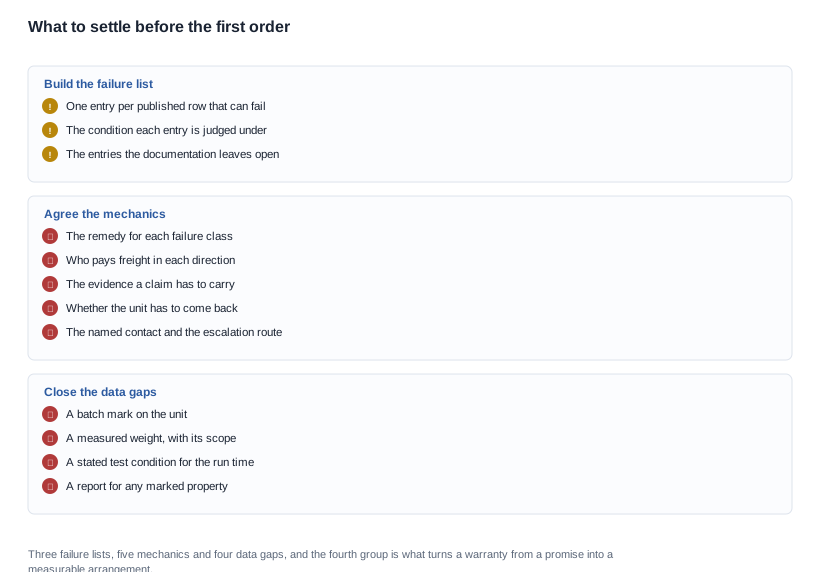
Four gaps sit inside the warranty arrangement rather than in a quotation, and a buyer can close all four by writing them down.
The first is a batch mark on the unit. Without it, the review stage has no way to ask whether a failure is concentrated, and every root-cause discussion stays at the level of a story. The second is a measured weight with its scope stated, because the only weight figure in the catalogue belongs to one model and does not say what it measures, so a weight dispute has nothing to be settled against. The third is a stated test condition for the run time, which is what makes the endurance figure usable as a threshold rather than as a number. And the fourth is a report for any marked property, so that the ingress marking on the two sport models stops being an assertion in a catalogue and becomes something a laboratory has looked at.
None of the four is a commercial term, and none of them should be negotiated as if it were. They are conditions of the arrangement, and a warranty that does not have them cannot produce the data the review stage needs.
The failure list also differs by category, and a warranty written for one of them will not transfer to another. A camera programme's hardest class is the capture, because the sensor, the lens, the field of view, the capture format, the frame rate and the storage arrangement are unpublished for every model, so the failure has to be defined against a scene, a lighting condition and a file, and both the buyer and the supplier have to agree what a correct file looks like before the claim can be judged. An audio programme's hardest class is the sound, because the product record states plainly that acoustic performance has no third-party measurement behind it, so the class has to be written against a reference recording, a volume level and an environment rather than against any published figure. A sport programme's hardest class is the ingress, for the reason given above: two models carry a marking, it is a catalogue annotation, and the only instrument that settles it is a laboratory. And a programme in the children's category faces a class that is not a fault at all, because the record states that certification information is entirely not provided for those models and that children's products usually carry additional requirements in most markets, which means the warranty question is preceded by a question about whether the product should have been sold into that market.
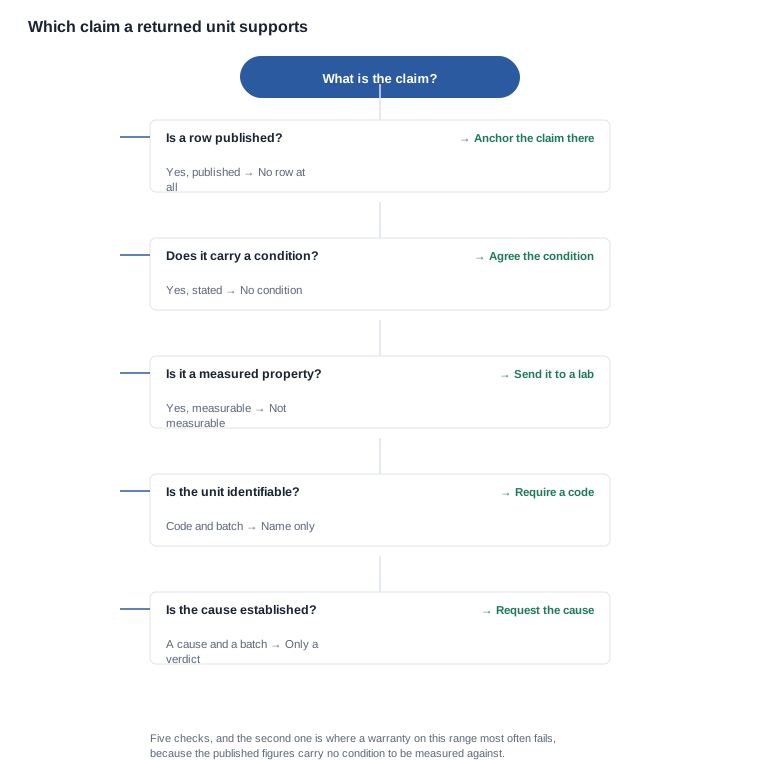
The criteria for deciding which class a failure belongs to are therefore four, and they are worth writing down as part of the failure list rather than leaving to judgement at claim time. Is there a published row for this property that the claim can be anchored to. Does that row carry a condition, so that both sides are measuring the same thing. If there is no published row, can the property be measured at all, and by whom. And if the property cannot be measured, is it a class the warranty should carry at all, or a class that should be excluded from it and handled as a customer expectation. That last question is the one with a real cost attached, because excluding a class means the channel absorbs it, and including a class that cannot be measured means the supplier absorbs a claim it cannot adjudicate. Both answers are legitimate. What is not legitimate is leaving the class out of the list and discovering which answer it was during a dispute.
There is one operational detail in the claim-evidence stage that decides whether the whole arrangement works, and it is easy to get wrong. The claim has to carry enough information for the supplier to adjudicate without the physical unit, because most claims will not be worth the return freight. That means the claim form needs a field for the condition the unit was used in, in the buyer's own words but in a form the supplier can read, and it needs a field for the configuration, and it needs the photographs. On this range, the photograph is doing more work than it would on a product with a test report, because there is nothing else to compare it against. A photograph of the unit, of the marking on it, of the charging behaviour and of the contents of the box will settle a surprising number of claims that a written description cannot, and the reason it can is that it is evidence rather than a claim.
The counterpart to that is the requirement that a claim state what has already been tried. Not because the answer is likely to be diagnostic, but because a claim that arrives with a diagnosis sheet attached can often be closed without the unit travelling back, and because the pattern across claims is the data the review stage needs. A claim form that asks for the steps already attempted is a form that produces a failure distribution rather than a returns count, and the difference between those two numbers is the difference between a warranty you can price and one you cannot.
The evidence set has to be agreed per model rather than as a single form, and the reason is the same one that runs through the rest of this catalogue: what can be stated about a camera unit is not what can be stated about an audio unit, and the fields that identify an audio unit include a wireless version that the camera pages do not publish at all. A single form across the range will ask for fields that cannot be filled in for most models, and a form with fields nobody can fill in is a form everybody completes partially, which means the data the review stage depends on is missing on exactly the claims where it would have been most useful.
Where the arrangement sits against the record
A warranty is a specification for the failure mode, and agreeing it after launch is the most expensive way to write one. We will publish the failure modes that a product's published rows make plausible, and we will say plainly where the boundary between a defect and a misuse cannot be drawn from the documentation. We will not present the published endurance figure as a warranty threshold, because no figure in this range carries a test condition, and we will not present the ingress marking as a tested property, because the record states it is a catalogue annotation with no report number behind it. We will not quote a warranty period, a failure rate or a cost share that the record does not contain, and we will not identify a failed unit by a model name or a colour where the record shows that neither is unique.
What the record does support is an arrangement that names the failure classes, states the condition each is judged under, requires the evidence a claim carries, and identifies the unit by a code and a configuration rather than by a name. That arrangement is writable today, and it is the thing that turns a warranty from a promise into a measurement. The criteria for judging it are simple enough to check before the first order and specific enough to check against a claim afterwards. Is every failure class anchored to a published row, or to a condition that has been agreed. Does every claim carry the fields needed to identify the unit and to describe the condition it failed in. Is every class that cannot be measured either excluded explicitly or handed to a laboratory. And is there a batch mark on the unit, without which the review stage produces anecdotes. A warranty that passes those four checks can be defended to a customer, and a warranty that fails one of them will produce an argument rather than a resolution, and the argument will be about which document governs rather than about which unit is at fault.
The after-sales support notes cover the operational side, and the failure list is best tested in the sample before bulk process, before the first order rather than after it.
Send us the models, the expected volume and the channels, and we will tell you which failure modes the published rows make plausible and where the boundary with misuse is undefined.


