

MT5 smart glasses vs CY05 use case fit is not decided by the cell and it is not decided by a price. The two models sit on the same eight-megapixel resolution class, publish the same two-hour-or-less charge ceiling, and share most of what a product page would need to say. What separates them is the accessory: the CY05 ships with a 1400 mAh case whose capacity is printed, and the MT5 ships with a case whose capacity is not published anywhere.
That single row decides which channel can describe its in-box product honestly, and it decides which channel has to close a gap before it can describe anything at all. Everything else in this comparison is a smaller version of the same question.
MT5 smart glasses vs CY05 use case fit: four questions that decide it
Before any specification is compared, four questions about your own operation narrow this pair to one answer. They are worth asking in this order, because each one removes options that the next one would otherwise waste effort on.
- Does your channel sell an in-box endurance story? If yes, the CY05 is the only one of the two that can carry it today, because its case capacity is a printed number a product page, a retailer listing and a customer service script can all repeat. If no — if your channel sells a brand, a bundle or a seasonal campaign — this question does not decide anything, and move to the second one.
- Is your freight model sensitive to parcel weight? If yes, the MT5's 220 mAh cell pulls in the right direction, and it is the only published row on that model that does. The effect is real but partial, because the case is unsized and therefore unweighed. If your freight is not weight-sensitive, this question stops mattering entirely.
- Are you building a range rather than a single line? If yes, neither model should be chosen in isolation. The 220 mAh platform and the 290 mAh platform are separate decisions with separate accessory, packaging and listing consequences, and the range decision should be made before either product is shortlisted.
- Can you get written answers before your first shipment? If yes, the MT5's gap is a scheduling problem rather than a strategic one. If your lead time is shorter than the supplier's response time, the gap becomes permanent, and a model with a published number is worth more than a model with a cheaper-sounding one.
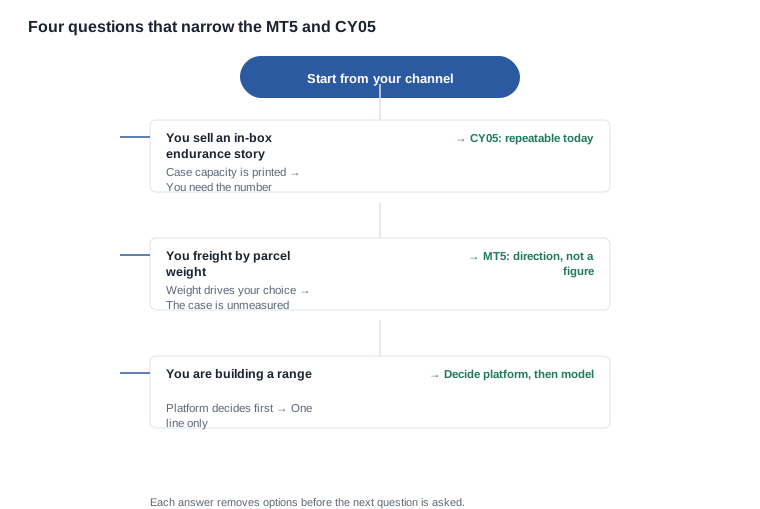
The fourth question is the one most often skipped, and it is the one that converts a specification gap into a permanent product characteristic. A gap that is closed before the first shipment is an inconvenience. A gap that is never closed becomes a feature of the listing, and the listing outlives the project team that could have fixed it.

The endurance comparison the documentation cannot settle
Both models publish a runtime figure and neither publishes the condition behind it. The MT5 states six to eight hours as a range. The CY05 states about seven hours as a point. On a camera product the camera is the dominant load, so the conditions that would move these figures most are the camera state and the radio state — and neither is published for either model.
That is the whole reason these two figures cannot be ranked. A range and a point, measured under two different protocols, produce two numbers that carry no information about which product runs longer. The wider range is not automatically the better measurement, and the single point is not automatically the more confident claim; they are two disclosures of different shapes, and the documentation gives no basis for converting one into the other.
The battery comparison across the AI camera range sets out the full camera grid, and the shape of the problem is visible across the whole group: four models sit in the five-to-eight-hour band, two in the six-to-eight-hour band, and five are published at about seven hours. Three disclosure shapes across eleven models is a catalogue-wide inconsistency, not a quirk of this pair, and it is the strongest single argument for asking every supplier the same protocol question in the same words.
Three questions close it:
- Was the camera running during the run, and at what resolution and frame rate?
- What were the audio and Bluetooth states while it ran?
- What were the battery states at the start and the end, and how many units were tested?
A supplier who answers all three can be compared with any other supplier who answered the same three. A supplier who answers none can be compared with nobody, and that is a qualification decision rather than a product decision.
The accessory is the real divider
Set the endurance question aside and the two models separate immediately.
The CY05 accessory regime. A 1400 mAh case is printed in the documentation, the largest case capacity published anywhere in the camera group. That capacity is shared with the CY03 and the L1 Pro, which means a buyer sourcing cases, cartons and retail packaging for the 290 mAh platform has one accessory specification across three models rather than three. What remains unknown for the case is its weight, its external dimensions and whether it recharges the frame or only holds a spare cell — none of which is published for any case in this catalogue.
The MT5 accessory regime. A case is documented as present, and its capacity is not stated. That leaves the accessory unsourceable, the carton unfinalised and the in-box description incomplete. It also means the MT5 sits in a group of exactly two camera models — with the KY06 — that are documented with a case and no capacity. It is a different situation entirely from the four models that carry no case row at all (the V06 and the S7, and the V03 Pro and the V03), and not one of those four is published as having no case.
The distinction between those three states is the single most useful piece of purchasing information on this pair, and it is routinely collapsed into a binary in buying conversations. A model with no case row needs one email. A model published without a case is a settled fact that changes the carton. A model with an unsized case cannot be costed, described or freighted until the number arrives.
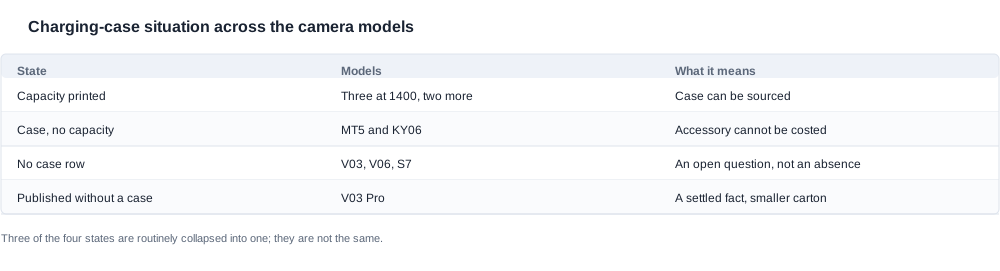
The freight consequence follows directly. The shipping weight analysis covers how parcel arithmetic runs once a packed unit has been weighed, and the reason it cannot be run here for the MT5 is precisely the unsized case. A smaller cell with an unweighed accessory is not a lighter parcel; it is an unknown one.

Choosing a platform rather than a model
The more consequential decision on this pair is not which of the two to stock. It is which cell platform a range should be built on, because that decision propagates into accessories, packaging, listing copy, quality control and spare parts.
The eleven camera models run to four published cell values: 220 mAh for the V03, the V03 Pro and the MT5; 260 mAh for the KY06, the V06 and the S7; 265 mAh for the MT6 alone; and 290 mAh for the L1 Pro and the CY03, and the L2 Utral and the CY05. Four cell values means four platform tiers for a procurement team to qualify and four accessory regimes to source. The grouping is structural and it is not a price tier — no price, price band or unit price is published for any model in this catalogue, so nothing here indicates what any of them costs.
What the grouping does tell you is how much of your range can share an accessory. The 290 mAh group has a printed case capacity across three of its four models, which is the only place in this catalogue where a printed case capacity covers a multi-model platform. If accessory consolidation matters to your operation, that is a structural argument for that platform, and it is the strongest argument available from the documentation.
The OEM ready platforms which models are ready overview sets out which models carry a documented customisation surface, and the OEM ready platforms pricing tiers piece covers the commercial structure around a platform commitment. Neither replaces the row-by-row reading of the two models, but both determine how much work the platform decision creates downstream.
The request list that turns the comparison into a decision
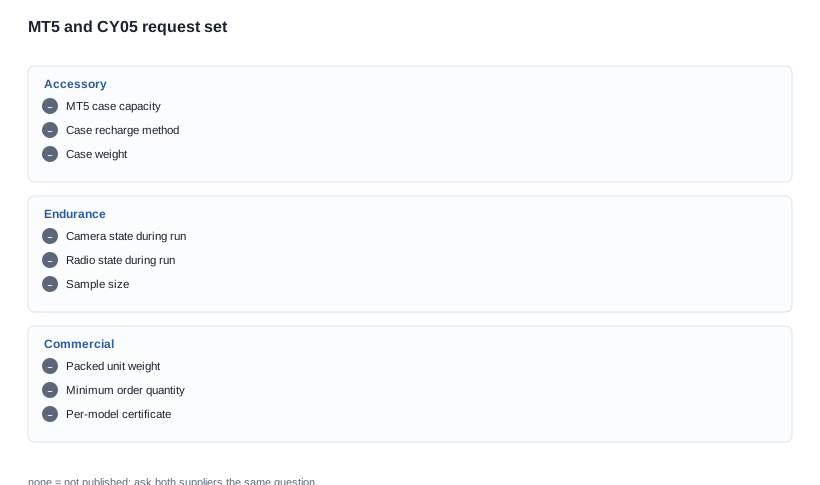
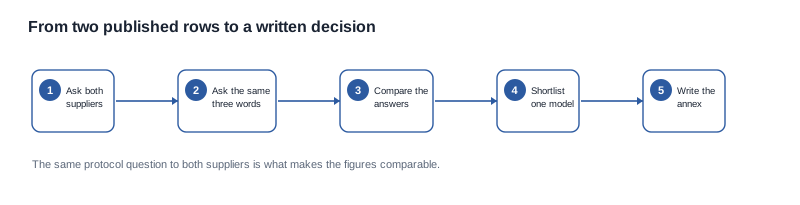
Six questions, asked in the same words of both suppliers, convert this comparison from a description into a decision. Ranked here by how much the answer is worth to the decision:
- What is the MT5's case capacity? One sentence, in the same format the CY05's 1400 mAh is printed in. This is the one answer that can move the MT5 from unpositionable to positionable.
- What does each model weigh, with its case in the carton, on a calibrated scale? Applies to both models, because neither publishes a frame weight and the only published weight anywhere in this catalogue belongs to the MT6's frame body.
- Does each case recharge the frame or only hold a spare cell? This determines whether a case-based endurance claim is even available, independently of capacity.
- What is the runtime test condition for each model? Same three sub-questions for each supplier: camera state, radio state, battery endpoints and sample size.
- What is the minimum order quantity, lead time and sample policy for each model? None of this is published, and it is what turns a specification into a quotation.
- What compliance documentation exists per model? One export certification page in our catalogue is scoped to the company and holds ten patent certificates — eight covering appearance designs and two covering utility models — and it carries no per-model certification row anywhere. In the European Union, radio equipment falls under the Radio Equipment Directive (EU) 2014/53/EU; (EU) 2014/32/EU, the electromagnetic compatibility directive, sits as a distinct requirement that buyers regularly mix up. Establish which scope covers the model named on your purchase order, and check that the designation on whatever arrives is the same one.
A seventh item is worth adding if the channel sells online: ask whether the supplier will state the case capacity in the product data feed rather than only in a PDF. A value that moves with the unit through the supply chain can be verified at the goods-in desk; a value that lives only inside a document has to be verified by a person.
Four shapes of reply, and how to assess each
The request list is the easy half. Judging the response is the half that determines whether the comparison survives contact with a supplier.
Responses to a specification request come in four shapes, and only one of them closes an item. A closed response carries a number, a unit, a test condition and a document reference. A partial response carries a number and a unit without a condition, which is better than silence and can still be written into a specification with the assumption stated on the face of it. A referred response points at another document — a distributor listing, a web page, a previous model — which resolves nothing because it cannot be traced back to this model. A restated response repeats the question back to you. That last shape is more common than buyers expect, and it should be answered by sending the same question again, more narrowly.
Sorting a response into one of those four shapes takes six short questions. Is a measurement named? Was a condition attached to it? Which method produced it? What tolerance was allowed? Where is the underlying evidence, and does that evidence name this model? Run those six questions over every answer and a specification separates from a sales reply, with no judgement call required at any point.
Two answers deserve particular scrutiny on this pair. The runtime answer, because a protocol description that omits the camera state is not a protocol — the camera is the dominant load on a camera model and any protocol that leaves it out describes a different product. And the case answer, because "it has a case" is not an answer to "what capacity is the case". If the second answer arrives in that form, the item is still open and should stay on the list with a date against it.
The total cost of leaving an item open is worth writing down, because open items are consistently undervalued. An open case capacity does not cost one number; it costs the accessory quotation, the carton dimensions, the freight class, the retail shelf allocation, the in-box copy on the listing, and the after-sales handling when a customer asks what came in the box. Naming those six consequences in the specification review is usually what converts an open item from a technical curiosity into a scheduled task.
Red flags worth naming before you commit
Four responses deserve a second conversation rather than a signature, and all four occur regularly in this category.
A specification that arrives pre-dated. Documents whose revision date predates the model, or whose model designation differs from the purchase order by a suffix, are the most common cause of a compliance dispute in this category. It happens precisely because the platform is shared across several models. The remedy is trivial and must be applied anyway: read the model line on the cover of every document before it is filed.
A runtime figure offered as a guarantee. When a range of six to eight hours becomes a single committed number in a quotation, the protocol question has been answered by commercial pressure rather than by measurement. The trade-off to negotiate is a narrower published claim in exchange for a documented one, and taking that trade-off explicitly is cheaper than losing it through a returns pattern.
A case capacity given as a range or an approximation. "Around one thousand" is not a specification, and an accessory that is quoted against it will be quoted against a different number on the next order. Ask for the value in the format the CY05's 1400 mAh is printed in, or record the approximation as an approximation and accept that the carton is provisional.
A freight advantage asserted without a weighed unit. Any claim that one model ships lighter than the other is unsupported until a unit with its case in the carton has been on a calibrated scale. That measurement costs a supplier minutes and is the one number that makes the small-cell argument real instead of theoretical.
None of these four is a reason to walk away from a supplier. They are reasons to convert an assurance into a written commitment, because an assurance that is wrong later costs the same as a commitment that was never made.
The checklist that closes the decision
Before you commit to either model, the following should be answerable without opening an email:
- Which model's in-box story can you publish today, and which needs an answer first? One of the two is the CY05; the MT5 is the other until the case capacity arrives.
- Which case regime are you sourcing against? A printed capacity across three models, or an unknown across one.
- Can both suppliers answer the same three protocol questions in the same words? If one can and one cannot, that asymmetry is itself a due diligence finding worth recording.
- What is your packed unit weight assumption for each, and who will replace it with a measurement? An assumption with an owner and a date is acceptable; an assumption without either is not.
- Which platform does your range sit on, and have you made that decision explicitly? The 220 mAh and 290 mAh platforms carry different accessory, packaging and listing consequences across the whole range, not just across this pair.
- What compliance document set will accompany each model, and does the model designation match your purchase order? The export certification page we publish is scoped to the company and shows ten patent certificates — eight of them for the appearance designs, two for the utility models — and no per-model certification row, so this has to be requested and checked rather than assumed.
- What is your shortlist, and what single unanswered item would reverse it? Naming the reversal condition in advance is what stops a decision from being quietly justified after the fact.
The trade-off that remains after all seven questions is the honest one: the CY05 lets you start sooner, and the MT5 may end up cheaper for your operation once its case is sized. Only one of those is knowable from the documentation today, and a buyer who names which one they are relying on is making a decision rather than deferring one.
One practical note on sequencing. If the same supplier quotes both models, ask for both responses in a single message, because a per-model conversation tends to produce per-model answers that cannot be compared, and a comparative request forces a comparative answer. If the two models come from different suppliers, the protocol questions matter even more, since neither party has any incentive to standardise a measurement the other will not perform. In both cases the criteria are the same: same words, same conditions, same document reference, and an answer that names the model it applies to.
The boundary of this comparison
The honest summary is narrow. On the published rows, these two models are closer than their positioning usually suggests: same resolution class, same charge ceiling, no imaging detail on either, no weight on either, no Bluetooth version on either. The difference is the accessory, and the accessory difference is a documentation difference as much as a hardware one.
What we will publish is the eight-megapixel class, the 220 mAh and 290 mAh cells, the two-hour-or-less ceiling, the six-to-eight-hour range and the about-seven-hour point, the magnetic method on one and the absent method row on the other, and the 1400 mAh case capacity. What we will not publish is a ranking, a recommendation, a price or a value claim, because the documentation supports none of them and the use-case question has to be answered against your own channel rather than ours. The published CY05 specification list and the MT5 limitations analysis are the two honest baselines, and the V03 Pro comparison covers the third option on the smaller cell platform.


