

We do not publish our development costs, our tooling costs or our unit prices, so this article is not a price list and it should not be read as one. It is a structure: where money goes in an ODM programme, which costs are one-off and which scale with volume, and which lines buyers are usually surprised by. A buyer who understands the structure can build a budget before a quotation arrives, and can tell whether a quoted figure is reasonable by seeing which line it belongs to.
The other half of this is knowing which numbers we do publish, because a cost structure is only usable if it is anchored to something real. We publish the product data the cost is built on: the charging interfaces, the case capacities, the camera tiers, the charge times, the structural features, the battery capacities, the colour options and the rated runtimes. We do not publish development costs, tooling costs, unit prices, minimum order quantities, capacity or lead times, and all of those remain open internally.
So odm development cost breakdown here means the shape of the cost, and every figure in this article belongs to that shape rather than to a quotation.
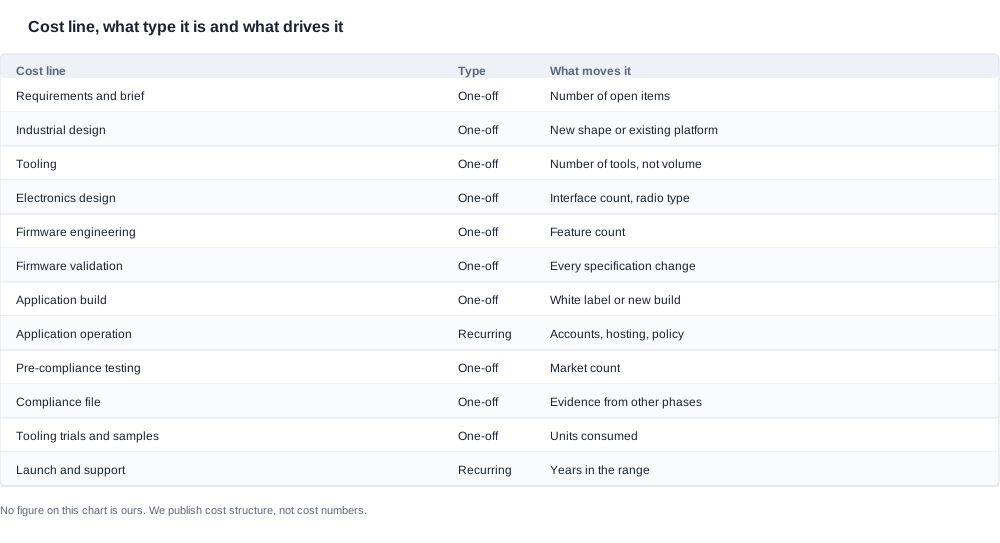
odm development cost breakdown: the twelve lines and what each one is
| Cost line | Type | What moves it | Usual surprise |
|---|---|---|---|
| Requirements and brief | One-off | Number of open items | Looks small, decides everything after it |
| Industrial design | One-off | New shape or existing platform | New shape adds a mould, not just a fee |
| Tooling | One-off | Number of tools, not volume | Depends on volume you actually order |
| Electronics design | One-off | Interface count, radio type | Each added interface costs across phases |
| Firmware engineering | One-off | Feature count | Underestimated relative to hardware |
| Firmware validation | One-off | Every specification change | Grows with every late requirement |
| Application build | One-off | White label or new build | White label is a fork, not a discount |
| Application operation | Recurring | Accounts, hosting, policy | Starts after launch, runs for years |
| Pre-compliance testing | One-off | Market count | Consumes finished units |
| Compliance file | One-off | Evidence from earlier phases | Depends on phases you do not control |
| Tooling trials and samples | One-off | Units consumed | First line cut, last line needed |
| Launch and support | Recurring | Years in the range | Never in the launch budget |
The requirements and the brief. Engineering time, and it looks trivial on a quotation and large in a schedule, because it is the phase that determines whether everything after it runs smoothly. This is the line most likely to be cut and the line least safe to cut.
Industrial design. Design fees and the drawings that go to the tool maker. The cost depends entirely on whether you start from an existing platform or commission a new shape, and the difference between those two is the difference between a design fee and a mould. Buyers frequently assume a new shape is "more design" rather than "new tooling", and the surprise arrives as a line item they did not plan for.
Tooling. The mould, amortised over a volume. This is the line that catches buyers, because it is a one-off that looks enormous at a small volume and negligible at a large one, and the amortisation depends on the quantity you actually order rather than the quantity you hope to order. Ask for the tooling cost as a separate figure and ask which volume it is amortised over; both are legitimate questions and a supplier unwilling to answer either is telling you something about how the quotation was built.
The electronics. Design, components and test. This is the part of the programme that is genuinely engineering rather than making, and it is where a change in requirement costs the most, because an added interface propagates through the board, the firmware, the validation and the compliance file.
The firmware. Engineering and validation. Validation is the part routinely underestimated, because it is the testing of every behaviour against the specification, and every specification change adds to it. A programme that adds four features late has not added four tasks; it has added four features plus four validation scopes.
The application, if there is one. Development, the store accounts, the privacy policy and the ongoing operation. This is the line most often missing from a smart glasses budget, because the application is a separate product with a separate lifetime, and it is the part of the system that keeps costing money long after the hardware has shipped. A quotation showing a one-off application fee and no operating cost is incomplete, and the omission usually surfaces in year two.
Pre-compliance and formal testing. Laboratory fees and the units consumed. The units matter more than buyers expect: testing consumes finished goods, and on a first order of a few thousand units that is a visible number rather than a rounding error.
The compliance file. Documentation time, and this is the phase a schedule underestimates most, because it depends on evidence produced by other phases being complete. It is also the phase with the least schedule control, because part of the evidence sits with third parties.
Tooling trials and samples. Units and engineering time, and this is the learning that moves the design. It is a cost with no visible output, which is why it is the first line cut when a programme is squeezed — and cutting it is how design problems arrive in production.
Launch and after-sales. Support staff and spare parts. The part of the cost that is never planned, because it starts after launch and runs for the years the product remains in the range.
Three lines are routinely missing from a first-order budget, and it is worth naming them together because they share a cause: all three begin outside the programme. The first is spare parts held as inventory, which is not a development cost and not a unit cost and is frequently not budgeted at all until the first failure rate is known. The second is the cost of a model change — a second colourway, a revised packaging specification, a firmware update shipped to the field — which is small per event and which compounds across a range with several models. The third is the importer's own obligations, including the evidence retention that compliance requires and the product liability exposure that nobody prices until someone asks.
None of these are exotic and all three are foreseeable at the point where the range is being planned. What makes them miss budgets is timing rather than uncertainty: a cost that begins after the launch date belongs, in most accounting processes, to a different budget year, and a programme costed only to shipment therefore appears to have finished on budget while carrying obligations it has not funded.
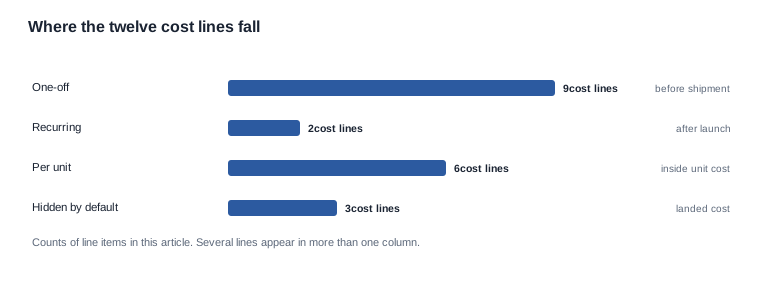
The bars count line items in this article rather than money, and several lines appear in more than one column: tooling is one-off and also sits inside the unit cost, application operation is recurring and sits outside it entirely. The column that matters most for a buyer building a budget is the last one — the costs that land outside the unit price and outside the development quotation, which are the landed costs: freight, duty, certification maintenance, the importer's own obligations, and the support cost of years three and four.

One-off against variable: the only distinction that matters for a budget
The single most useful thing a buyer can do before requesting a quotation is decide which costs they intend to carry once and which they intend to carry forever, because the two behave completely differently at different volumes.
A one-off cost per unit falls as volume rises, and falls steeply at first. A variable cost per unit falls too, but slowly, because component pricing moves on its own schedule and assembly labour moves on a different one. The practical consequence is that the total cost per unit curve is flatter than most buyers expect, and a buyer modelling a business case on "the unit price halves if I triple the order" is usually wrong.
The case where this matters most is tooling. If a mould is quoted as a single figure with no stated amortisation volume, a buyer cannot model anything, because the same figure is correct for two very different programmes. The right question is not "how much is the tool" but "how much is the tool, over what volume, and what happens to the unit price if I order half as much as that volume". A supplier who answers all three has built a quotation a buyer can use.
The second case is the case, and it is unusual because it is both a manufacturing cost and a retail decision. A case is a significant line in the unit cost, and its capacity option changes both the margin and the shelf presentation. Buyers frequently optimise it as a cost item when it should be optimised as a packaging item, and end up with a configuration that is cheap to make and hard to sell.
It is worth being precise about why tooling behaves differently from every other line, because the difference is mechanical rather than commercial. Every other variable line moves with component availability, labour rates and yield, all of which drift gradually. Tooling is a step function: it is a large fixed cost that lands on a single schedule and then disappears into the unit price. A buyer who models it as a gradual cost will be wrong in both directions — too pessimistic at high volume, dangerously optimistic at low volume — because the real behaviour is a cliff rather than a slope.
The same reasoning applies to compliance scope, which is the other step function in the structure. Adding a fourth market is not a proportional increase; it is a new assessment, new documentation and a new lead time, most of which land before the first shipment. Buyers who model markets as a percentage uplift on cost consistently underestimate them, and the surprise arrives during the phase where the schedule is least flexible.
The case where this matters least is assembly labour, and that is worth saying because buyers sometimes spend disproportionate effort negotiating a line that barely moves. If assembly is a small share of the unit cost and it changes slowly, negotiating it hard is a poor use of the effort available before you commit. The lines worth negotiating are the fixed ones, the scope ones and the volume ones, because those are the three that actually move the total — and knowing which is which before you start is most of the advantage available in a price negotiation.
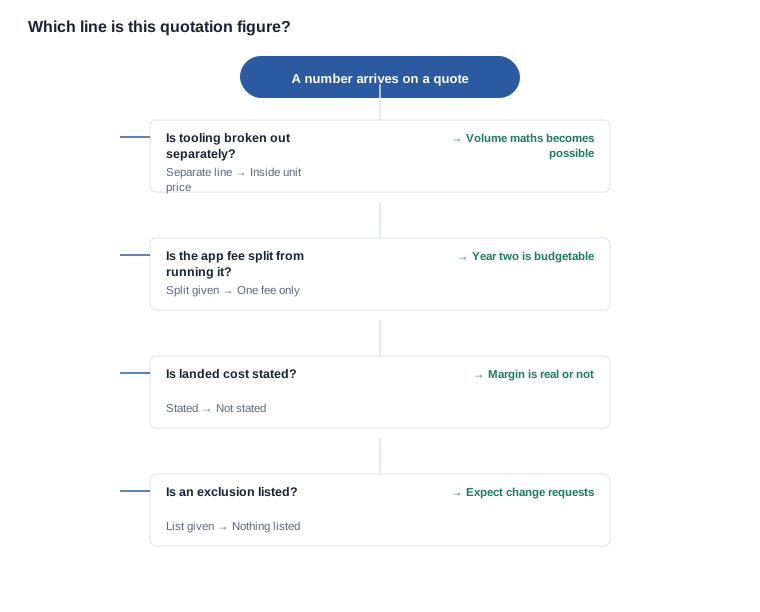
Four questions get most of the value out of a quotation. Is the tooling broken out separately and amortised over a stated volume. Is the application fee separated from the cost of running it. Is the landed cost stated, or does the quotation stop at the factory gate. And what is excluded — because the exclusion list tells you what will arrive later as a change request, and the number of exclusions predicts the final cost better than the quoted total does.

What changes after a freeze, and what it costs
The most expensive line in a development programme is the one that does not appear on a quotation at all, and it is the cost of changing something after the design has been frozen.
A change to the firmware after the freeze is a validation cycle and a documentation change. A change to the housing after the tool is cut is a new tool. A change to the bill of materials after the compliance assessment is a re-assessment. Each is a normal thing to need and each costs several times more than the same change before the freeze. That is the argument for spending real time in the requirements phase rather than treating it as a preliminary email exchange — which is why the requirements phase is where the schedule is actually won.

The pattern is worth understanding rather than resenting. Each stage has a different set of consequences, and the cost curve reflects the number of things already built on top of the thing being changed. Early in the programme, a change invalidates a document. After the design, it invalidates a drawing set. After the tool, it invalidates a physical asset with a lead time attached. After the compliance assessment, it invalidates evidence that a third party produced, on a schedule that is not yours to control.
That last one is the reason a bill of materials freeze is earlier than most buyers expect. The assessment depends on the components as much as on the design, and a component substitution for availability reasons can force a re-assessment even when nothing about the product's behaviour has changed. Buyers who substitute components quietly to protect a delivery date are making a cost decision, and it is one they should be making deliberately.
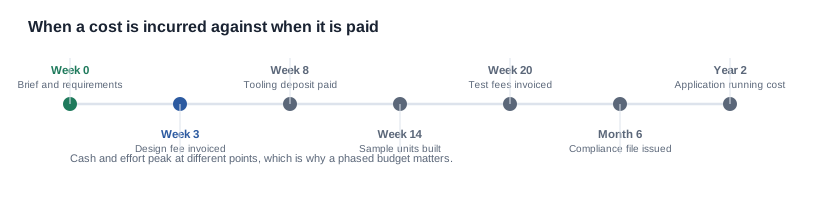
The last point on that timeline is the one that catches most first-time buyers. The application running cost, the spare parts position and the support cost all begin after launch, and they begin regardless of whether anyone budgeted them. A programme that budgets only to shipment has a budget that ends at the point where the product starts generating problems. The supply continuity discussion covers the other side of that problem — what happens when the cost of supporting a model rises after the person who agreed it has left.

What we name before we quote a number
We quote a development programme by phase, with the one-off costs separated from the unit cost and tooling shown as its own line, because a buyer who can see the structure can plan around it and can challenge a figure that looks wrong. Quoting a single blended number is easier and it is worth less: it hides the one item most sensitive to volume and it conceals which costs continue after the order.
Alongside the number we name the assumptions, and the assumption list is short enough to be useful: which volume the tooling is amortised over, which markets are in the compliance scope, whether the application is a skin or a build, whether the specification is frozen for pricing, and which published figures in the catalogue the configuration depends on. If any of those change, the quotation changes, and saying so in advance is a courtesy that costs nothing.
What we will also do is tell you which lines would move if the volume changed. A quotation is a statement about one configuration at one quantity; a buyer planning eighteen months of orders needs to know which parts of it are structural and which are negotiated. The tooling line is structural. The unit price is partly structural and partly negotiated. The compliance scope is structural once the markets are fixed. Lines that are pure negotiation are worth identifying, because they are the lines you can renegotiate at the next order — and lines that are structural are the ones you can only change by changing the product.
The standard OEM path sets out the engagement levels these costs attach to, and development cost drivers covers which requirements produce which line items. If you send the model, the configuration and the volume, we will quote the programme phase by phase with the one-off lines separated and the assumptions written down.
How to compare two quotations that are not the same shape
The most common difficulty in this category is not that a supplier is overcharging. It is that two quotations are structurally different objects, so the totals can be compared on paper and mean nothing in practice. A buyer who has been quoted a blended unit price with development included cannot compare it with a quotation that separates the tool, separates the application and states the compliance scope. One of those figures is lower, and the lower one may be lower because it excludes the four items that will arrive later as change requests.
The way to compare is to normalise before you compare, and normalisation takes four steps. Put every quotation into the same column structure — one-off development, tooling, application build, application operation, unit cost, landed cost, exclusions. Then identify which lines are absent rather than zero, because an absent line and a zero line are different and only one of them is free. Then convert every tooling figure into a per-unit figure at your own expected twelve-month volume rather than at the volume the supplier chose. Then subtract nothing, and record what remains as the comparison you actually made.
After normalisation, three differences usually explain almost all of the gap, and each is worth interrogating rather than negotiating directly. The first is compliance scope: the same product quoted for one market and for four is not the same product, and the difference is legitimate. The second is the specification freeze state: a quotation made against a frozen specification is cheaper than one made against an open one, and the difference is the cost of optionality that the buyer chose. The third is tooling strategy: a new tool for a distinctive geometry is a different commercial proposition from modifying an existing platform, and buyers frequently compare the two without noticing they are not comparable.
Three red flags are worth naming because they survive normalisation. The first is a quotation with no exclusions at all, which almost always means the exclusions are in a second document rather than absent. The second is a tooling figure presented without a volume, which makes the per-unit comparison impossible and therefore not attempted. The third is an application fee with no operating cost attached, which means either the application is not being operated — in which case the feature set is a decision, not a specification — or the operating cost is being carried elsewhere and will surface later.
The practical checklist before you commit to a supplier on price is short: every line separated, every absence identified rather than assumed to be zero, tooling normalised to your own volume, compliance scope stated per market, and the specification freeze point written into the agreement so that the quotation's validity is tied to a condition you control. When two suppliers are within a few per cent on the normalised total, the decision is usually made by the assumptions list rather than by the total, and the assumptions list is the part worth reading twice.
What to ask, in order, when the numbers do not explain themselves: which line is the difference, what assumption would close it, and is that assumption something I can change. Most cost conversations in an ODM programme are three questions long, and the reason they take three weeks is that nobody asks them in that order.
Related reading
- The stage where the scope is fixed — the requirements phase
- The engineering that a change touches — engineering customisation
- The certification work in the schedule — the certification pathway
- The levels of engagement and what drives them — standard OEM end to end
Tell us the model, the configuration and the volume, and we will quote the programme phase by phase.


