

Open-ear audio glasses fail commercially in a specific way: the product performs to its specification and the returns still arrive. Open ear audio glasses smart glasses common mistakes is a list of six decisions that produce that outcome, and every one of them is a positioning or expectation decision rather than an engineering one — which is good news, because they are all made before the tooling is committed.
The pattern is worth stating once, because it is the reason this list is shorter than most buying-error lists: in five of the six, the device is behaving correctly and the promise is wrong. A buyer who has tested the unit and understood it still writes a listing that misdescribes it, because the listing was written by reference to somebody else's page rather than from the unit on the desk.
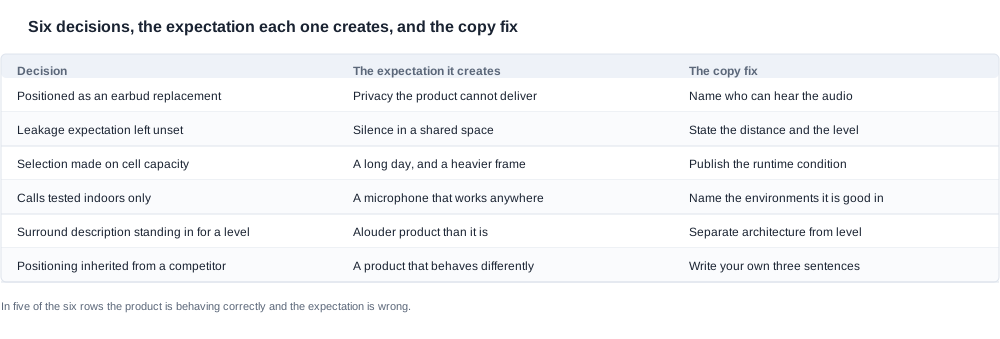
Open ear audio glasses: six decisions, six returns
A buyer making these decisions is usually a brand or an e-commerce seller preparing a launch, and holds samples, a target price, a channel plan and a competitor's listing. What they will not hold is a set of expectations for their own copy, and the copy is usually written by reading the competitor's copy.
That is the mechanism behind most of the six mistakes below. The competitor's positioning becomes the buyer's positioning by default, and the competitor's positioning was written for a different product. A buyer who writes the expectations themselves — what the customer will hear, what the people around them will hear, what happens when the phone changes — has already avoided four of the six.
Mistake one: positioning an open-ear product as an earbud replacement
That comparison invites a comparison the product cannot win, because the earbud is quieter, smaller and cheaper. A customer who buys an open-ear product expecting earbud privacy will be disappointed by the first phone call in a café.
The fix is not to stop mentioning calls. The fix is to say what the product is for. Open-ear audio wins where ambient awareness matters — walking outdoors, working in a room where you need to hear a colleague, keeping your ears on the street. It loses where masking is severe, because a product that deliberately does not block the world cannot also defeat the world. Writing the product up for the environments it wins in is not a limitation of the copy; it is the difference between a product that satisfies a customer and a product that disappoints one and then refunds.
Mistake two: leaving the leakage expectation unset
Open-ear audio is audible to the people nearby by design, and the customer's reaction to that is a function of the expectation they were given, not of the volume.
This is the single most common cause of a return with a vague reason. The customer was not unhappy with the sound; the customer was surprised that people could hear it. Nobody tells a customer in advance that a format designed for awareness is, by definition, audible, and nobody tells them that the level rises as the wearer pushes the volume up to overcome noise in a street.
Two things fix it. The listing should say that the audio is audible to people nearby, in the way that a speaker is, without embarrassment about it. And the number should be stated with its conditions — a distance, an environment and a playback level — so that the customer can decide whether the product suits the place they will use it. Neither of those is a claim of inferiority. A customer who knew the product was audible to others and bought it anyway does not return it.
Mistake three: selecting on cell capacity alone
Several of our audio models state two cells — two 55 mAh or two 90 mAh — which reads as an advantage on a spec sheet. It also puts mass at the ends of the temples rather than centrally, and that changes how the frame feels over a long session.
The listing is where this error usually becomes visible, because the listing is where the runtime is quoted. A runtime quoted without its workload is a promise the product will break on a heavy day, and the break arrives as a complaint about battery life against a figure the customer read. The fix is to publish the condition with the figure, or to publish nothing at all, and to be careful with the word "all-day" in a way that a factory is not.
Mistake four: testing calls only indoors
A quiet office is the one environment in which every open-ear product sounds acceptable, and it is where most demos happen and where most internal tests happen.
The listing then inherits the indoor result. If the copy says the microphone handles calls, and the only evidence for that claim is a test performed in a quiet room, the claim is wider than the evidence, and the first customer to make a call outdoors will be the one who finds the gap. Test in a street, in a café, in an office — and ask the far end to score intelligibility rather than assessing the volume yourself, because the wearer's own perception of a call is not the far end's.
Mistake five: letting a surround description stand in for a level
Surround and loud are different properties, and the copy usually implies the second when the product delivers the first. Our catalogue publishes a surround or stereo configuration on the ZH12 and the D17, the YKC02 and the D11, and the YK12, and it publishes no output level for any model in the family.
The copy fix is to separate the two in a single sentence: what the configuration refers to, and what the playback level is. If the level cannot be stated, the configuration can still be described — as an architecture, in architecture words. The customers who are satisfied by an open-ear product are not waiting for a loudness figure; they are waiting for the listing to be true.
Mistake six: inheriting a competitor's positioning
The competitor's positioning becomes the listing by default, and the copy was written by reference rather than from the product's own behaviour.
There is a specific mechanism here that is worth naming, because it is invisible in review. A competitor's listing contains a set of implicit promises that describe a different product: a privacy expectation, a loudness expectation, a "works everywhere" expectation. The buyer copies the structure and the vocabulary, and the promises come with it, because a promise is not written as a promise. It is written as a description of a benefit.
The way to break the mechanism is to write the three expectation sentences before opening anybody else's page, and then to test each sentence against a unit. A sentence that cannot be checked against a unit is a sentence that will disappoint somebody.
The six decisions and the return each one produces
Each of the six has a recognisable return reason, and the reason codes on the returns platform usually identify them. Knowing which return reason belongs to which decision is what turns a return rate into a diagnosis.
| The decision | The return that arrives | The reason code it lands under | The copy fix |
|---|---|---|---|
| Positioned as an earbud replacement | Returned after a first call in a café | "Not private" or "does not work as described" | Say who can hear the audio, and where it is for |
| Leakage expectation unset | Returned after using it in a shared space | "Too loud for others" | State the distance, the environment and the level |
| Selected on cell capacity alone | Returned after a long day | "Battery does not last" | Publish the runtime condition, or publish nothing |
| Calls tested indoors only | Returned after a call outdoors | "Microphone quality" | Name the environments it is good in |
| Surround description read as a level | Returned as not loud enough | "Volume too low" | Separate the architecture from the level |
| Competitor positioning inherited | Returned against the buyer's own listing | "Not as described" | Write three sentences from your own product |
The last row is the one worth dwelling on, because it is the only one of the six where the return reason is a description of the listing rather than of the product — and where the remedy is entirely in the buyer's control, and entirely free.
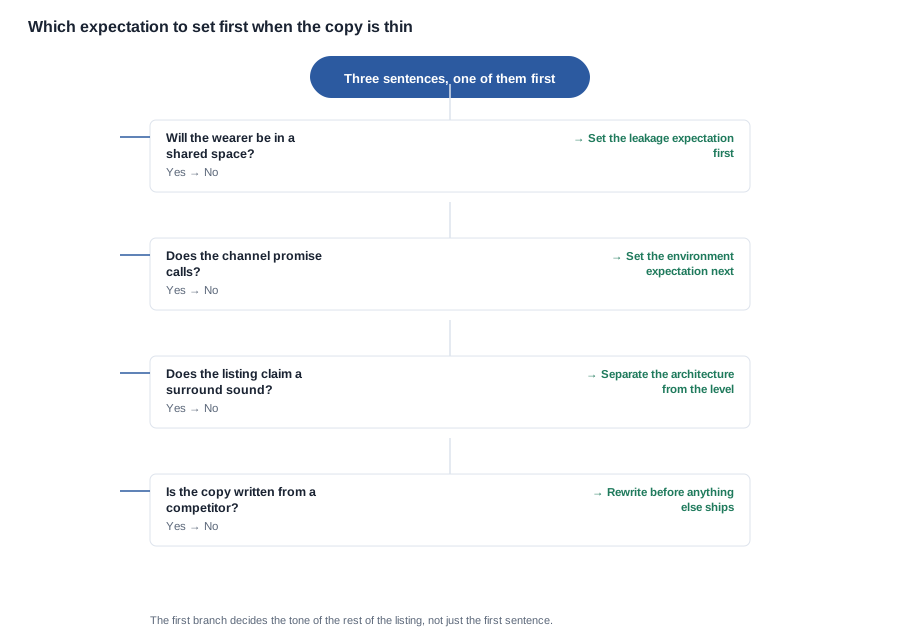
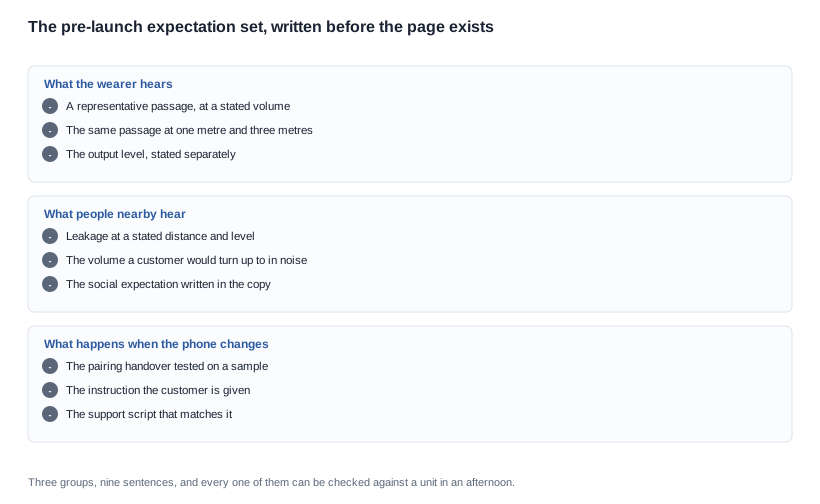
Writing the three expectation sentences before the product page exists
Three sentences, and they are the three most common sources of returns in this category. They are short enough to fit above the fold and specific enough to be testable, which is the whole point.
Sentence one: what the wearer hears. A representative passage at a stated level, plus the output level stated separately, plus the three-metre result if you have it. The customer is buying a sound, and the listing should describe a sound rather than a feature.
Sentence two: what people nearby hear. The distance, the level and the environment for the leakage figure, and the social expectation in plain words. This is the sentence that prevents the "in a café" return, and it is the one most often left out because the brand does not want to lead with a limitation. Leading with it is what makes the product usable.
Sentence three: what happens when the phone changes. The pairing handover, described in the way the customer will experience it, plus the instruction they will be given. Customers replace their phones every two to three years, and the product has to survive that event without the customer being told to reset something they do not know how to reset.

The order of the work matters more than the sentences themselves, and it is the same order every time. Collect what your own team would have written before looking at anyone else's page, because the moment you read a competitor's listing, their framing becomes your default. Then pull the competitor's listing for comparison only, and mark every claim you cannot evidence yourself — those marks are the copy rewrite list. Then write the three sentences from your own product's behaviour, and test each one against a sample unit before the page goes live.
Reading the first month of returns with these six in mind
Once the product is live, the returns arrive faster than the returns dashboard is usually built to explain them. Reading them with the six decisions in mind turns a rate into a diagnosis, and there are three things to do in the first month specifically.
Code the returns by the decision, not by the product. The six rows of the table above give a ready-made set of reason codes that a channel can adopt without a meeting, because each one is a customer complaint that a customer actually types. A return coded "not as described" is worth nothing on its own; a return coded "too loud for others" is a leakage expectation that was never set, and it points at a specific line in the listing.
Look for the pairing cluster. A phone replacement cycle produces a return cluster that has nothing to do with sound quality and everything to do with a handover the customer was not told about. The cluster is identifiable because it is time-limited and it follows the release of a new phone model, and the fix is a support-script line and a leaflet line rather than anything the factory can change.
Watch for the comfort and battery pair. These two arrive together and are usually read as one problem. They are not: a heavy temple and a long day are two separate decisions, and separating them is what tells you whether the remedy is in the copy, in the acceptance criteria, or in both.

The commercial terms you can still move after the sample is approved
The good news about these six mistakes is that they are all made before the tooling is committed, and the commercial position is similar: several levers are still available at the point where the sample is approved, and the ones that are still available are the ones a buyer usually has not thought to use.
A supplier has real discretion over the number of models and colours committed, the artwork round count, the per-market label scope, the packaging and insert design including the market labels and the language of the documentation pack, and the market list itself. Each of those is a decision the buyer has already made and is therefore a decision the buyer can change. A colour or a packaging variant is frequently a better way to buy a smaller commitment than a discount on a larger one, and the artwork round count is worth negotiating directly because each round is a week on the launch schedule.
Delivery splitting is often granted more easily than a price concession, because it moves the approval risk onto the schedule where it belongs. Splitting a first order against a sample-approval milestone means the buyer's exposure is the sample, which is small, rather than the whole lot, which is not.
Payment node structure is the other standard area, and in this category the right structure follows the actual failure modes. A deposit, a balance on inspection before shipment, and a retention held against the documentation package protects the buyer on the failure that costs most here, which is a product that arrives with paperwork that does not cover it.
What a supplier cannot move is the certification cost and the elapsed certification time, which are per product family and set by the test laboratory. It is also the acoustic design — the transducer, the frame geometry and the signal chain — because that is the product itself, and a supplier who will change it is telling you the acoustic behaviour is fixed.
The evidence to request before the deposit is paid
Seven items, and the list is short because most of it is written evidence that either exists or does not. The point of requesting it before the deposit is that every one of these items is cheap to obtain and expensive to discover later.
- The leakage figure, with its distance, environment and playback level stated.
- The playback output level, or a written statement that it is not published.
- The microphone pickup figure, with the noise condition it was measured in.
- The processing description — a named technique and its expected artefacts, not a label.
- The cell configuration and the frame weight, with the weight per temple if it can be broken out.
- The pairing behaviour statement across a phone change.
- The certificate numbers, with the issuing body and the validity dates, and the model designation written on the quotation.
The acceptance criteria that come out of this list are the ones that go into the purchase order. A criterion that lives in an email is not binding, and in a category where the supplier's own documentation is often thin, the buyer's own written standard becomes the enforceable one. The sample criteria should reference the leakage measurement, the call test and the long-session comfort test, and the contract should say who bears the cost when a sample does not meet them.
One clause is worth more than the others in this family, and it is the one about notice before any change of transducer, DSP tuning, default processing state or firmware. A firmware change alters the acoustic result without altering the hardware, so a product that was measured in April can behave differently in October with no physical change and no notice.
What our published rows settle, and what stays open
To put it plainly — we publish the technique for the Bluetooth audio family — open-ear acoustic structure, directional audio and smart noise reduction — and we publish no acoustic specification for any model in it: no driver size, no frequency response, no leakage figure and no microphone specification. We will not quote a figure from the industry for a product we have not measured, and we will not present a technique name as a result.
What we do publish for this family is the charge time, the cell configuration, the Bluetooth version, the runtime, the charging mode, the surround configuration where it is stated, and the additional features on the models that have them. We publish no charging case for any model in this family, and we will not describe a case that stores as though it were a case that charges.
The four figures your copy needs and our catalogue does not hold are the leakage figure, the output level, the microphone pickup and the frame weight. All four are obtainable, and all four are obtainable by a buyer with a sample and a protocol — a sound level meter, a second person in a noisy room, a set of scales and a three-metre passage. The protocol is written out in the evaluation template, and it is the same protocol that converts a draft listing into one your support script can defend.
We will also say plainly that these six mistakes are the buyer's to make or to avoid. The positioning is yours, the expectations are yours, and the copy is yours; what we can give you is the protocol to set them with, and the published rows to set them against. The specification-reading errors that belong to the selection stage are treated separately in open-ear buying mistakes, and the loudness question has its own treatment in is it loud enough for calls.
What we will do is supply units and a written test script, work through the leakage, the call and the comfort tests with you, and tell you plainly which of the expectations your copy should carry. The background is under open-ear audio and the range is Bluetooth audio glasses.
Related reading
- The related errors — open-ear buying mistakes
- The loudness question — is it loud enough for calls
- The background — open-ear audio
Send us your draft copy and we will tell you which of the six expectations it sets wrongly.


