

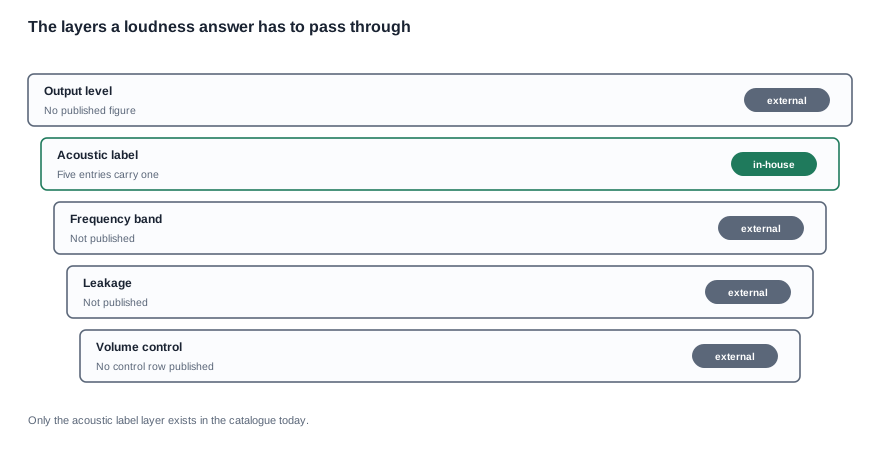
"Is it loud enough for calls" cannot be answered from any page in this catalogue, and the reason is more interesting than a missing number. Loudness is not one property. It is a chain — a level at the ear, a band of frequencies that carries speech, a noise floor under both, a leakage figure that determines what the far end of the call hears, and a control granularity that decides whether the level can be adjusted to a condition. The catalogue publishes exactly one acoustic label across twenty-eight models and one numerical figure, and neither of them measures output. So the useful answer to this question is not a verdict. It is the list of rows a buyer has to request, and the order in which to request them so that a supplier's answer can be checked rather than believed.
There is a second reason this matters for a procurement team specifically. A loudness complaint from an end customer is not a returns problem, it is a listing problem, because the purchase was made on the strength of a page the buyer never saw. If the page cannot carry a defensible statement about output, then the page is carrying an implication, and the implication is a commercial exposure that has nothing to do with the hardware.
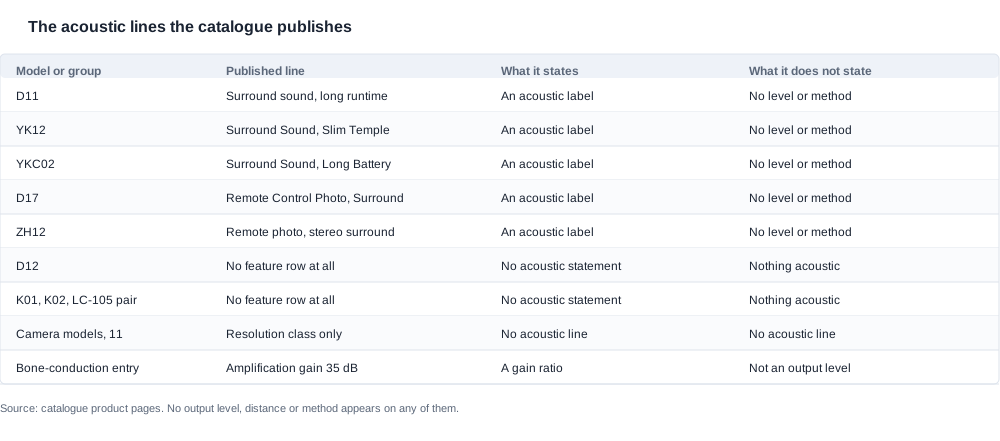
is it loud enough for calls: what is published and what is not
Across the whole range, the catalogue prints one kind of acoustic statement: a surround sound descriptor. It appears on five entries, and they are the five in the range where an open-ear configuration is explicitly advertised. The D11 publishes a surround sound line together with a long-runtime line. The YK12 publishes a surround sound line together with a slim temple line. The YKC02, which is a sport model rather than an audio model, publishes a surround sound line and a long battery line. The D17 publishes a remote-control photo line together with surround sound, and the ZH12 publishes a remote photo line together with stereo surround sound in the original wording. Five rows, and each of them is a label without a definition attached.
That leaves the other twenty-three entries with no acoustic line at all. Five of the eight audio models are in that group — the K01 and the LC-105-2, the K02 and the LC-105-1, and the D12 publish standard rows only, with no feature row of any kind. The D12 is the case most often quoted in a comparison table, because it shares its cell figure, its charge ceiling, its runtime and its charging method with the D11 and differs from it by nothing that appears on the page; the absence of the surround sound line is the only published difference between those two, and it is a label rather than a measurement. All eleven camera models publish a resolution class and no acoustic line. The three children's models publish a cell, a runtime, a charge time, a charging method and, on the A07, a Bluetooth version. The AR entry publishes an indicator light and a button control. The photochromic entry publishes a cell, a runtime, a charge time, a charging method and a Bluetooth version.
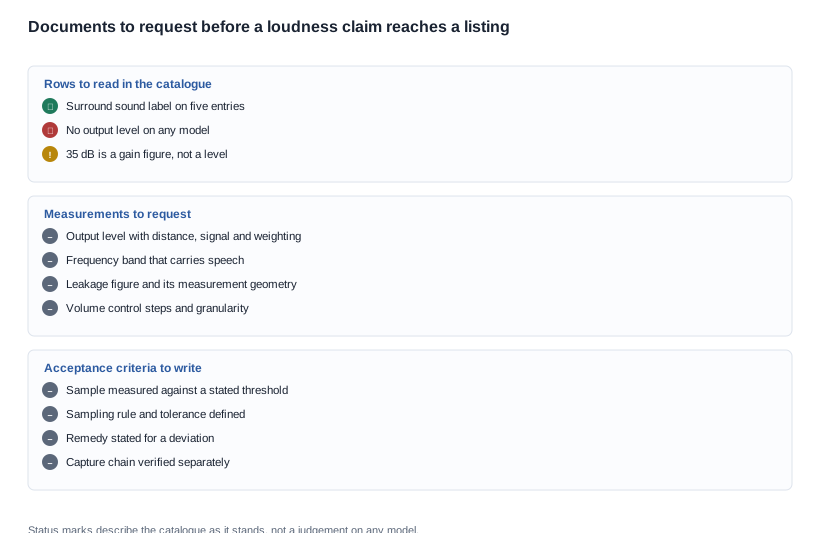
There is one numerical acoustic figure in the catalogue, and it belongs to the bone-conduction entry: an amplification gain of 35 dB. It is worth being very clear about what that number is, because it is the single most likely thing to be misread. An amplification gain is the ratio between the electrical signal entering the amplification stage and the signal leaving it. It is not an output level, it is not a sound pressure level, and it says nothing about how loud the device is at the ear or at any distance. It also belongs to an entry that carries no stock keeping unit, so it cannot be quoted against a model a buyer can order. This article does not treat it as a loudness figure, and a buyer who finds it in a competitor comparison table should ask what was measured.
The published acoustic lines, and the gaps inside them
| Model or group | Published acoustic line | What it states | What it does not state |
|---|---|---|---|
| D11 | Surround sound, long runtime | An acoustic label on the page | Level, distance, method, band |
| YK12 | Surround Sound, Slim Temple | An acoustic label on the page | Level, distance, method, band |
| YKC02 | Surround Sound, Long Battery Life | An acoustic label on the page | Level, distance, method, band |
| D17 | Remote Control Photo, Surround Sound | An acoustic label on the page | Level, distance, method, band |
| ZH12 | Remote photo, stereo surround sound | An acoustic label on the page | Level, distance, method, band |
| D12 | No feature row at all | No acoustic statement | Nothing acoustic |
| K01, K02, LC-105-1, LC-105-2 | No feature row at all | No acoustic statement | Nothing acoustic |
| Camera models, 11 | Resolution class only | No acoustic line | No acoustic line |
| Bone-conduction entry | Amplification gain 35 dB | A gain ratio | Not an output level |
Three categories in that table carry no acoustic line whatsoever, and they are the three categories where a call is most likely to be the primary use. The audio models publish their radio and their cell and their runtime; the camera models publish their resolution class; the sport models publish their surround sound label but not a single figure. What is missing across the board is the same set of five things: an output level, a measurement distance, a measurement method, a frequency band, and a leakage figure.
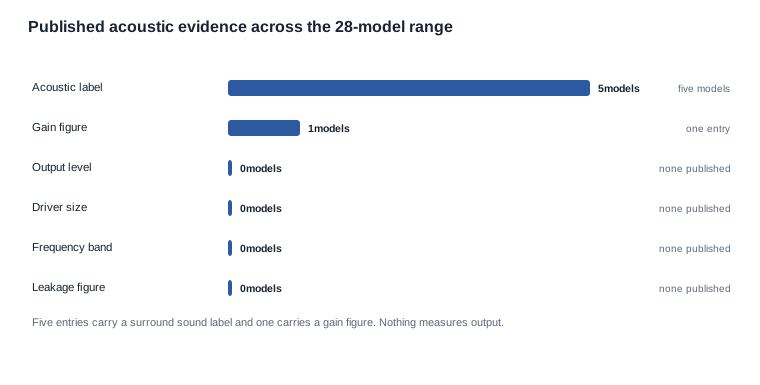
There is one structural point about the acoustic labels themselves that matters more than their absence elsewhere. A surround sound descriptor, like a spatial descriptor or an immersion descriptor, describes a processing mode or a driver arrangement rather than a measured outcome, and the catalogue does not say which of the two it is. A buyer reading the row on the D17 or the ZH12 cannot tell whether the entry means more than one driver, a different signal processing path, or a marketing name attached to a single driver. Until that is answered, the row can be copied into a comparison table but it cannot be used to answer a technical question, and it certainly cannot be used to state that one model is louder than another.
The seven questions that stand in for a loudness figure
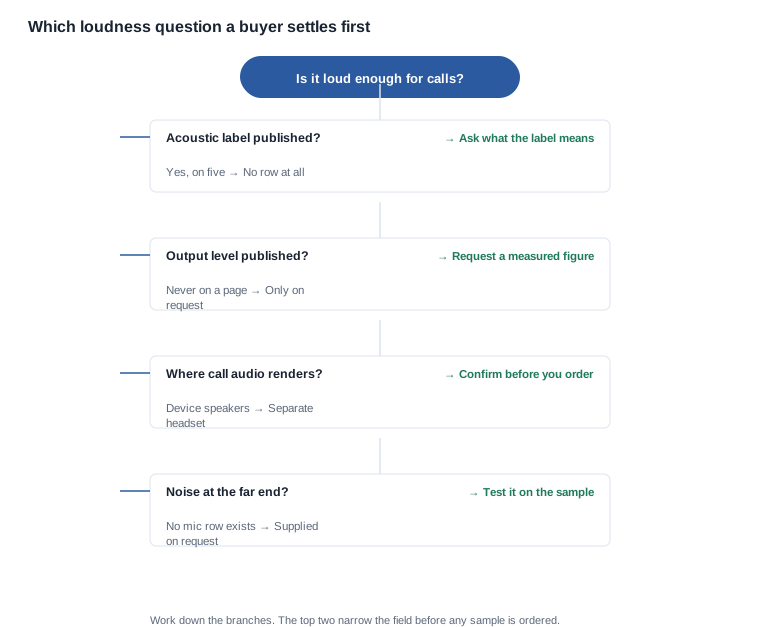
Because the catalogue publishes no output level, the buyer has to build the answer from questions. These seven are ordered so that each one either becomes irrelevant once an earlier one is answered, or narrows the request that follows.
- Does the model publish an acoustic descriptor, and what does that descriptor mean in engineering terms? This is the first question because the answer splits the range in two. Five entries publish a label; the rest publish nothing. Where a label exists, ask for the mechanism — driver count, driver position, processing path — because a mechanism can be reasoned about and a name cannot.
- What output level can be measured, at what distance, with what signal and weighting? A figure without a method is not comparable with anything, including another figure from the same supplier. Ask for the measurement convention explicitly: the distance from the driver, the signal used, the weighting, and whether it is an average or a peak. A supplier who supplies these four has done the work; a supplier who supplies a bare decibel number has not.
- In which frequency band does the level sit, and where does speech sit within it? Output level and intelligibility are different measurements, and a device can be loud in a band that carries music while being poor in the band that carries a voice. The band figures a buyer needs are the ones the measurement was taken in.
- What does the level look like at the far side of the call, and what does the environment hear? Leakage is the other half of the call question. A device that produces a usable level for the near end and radiates into a shared space creates a problem that is not a hardware defect and cannot be fixed by a firmware update; it becomes a policy question about where the device may be used. Ask for a leakage figure and for the measurement geometry that produced it.
- How is the level controlled, and how many steps are there? Granularity is what makes a device usable in a variable environment. A continuous control, a stepped control and a fixed output are three different products for this use case, and the catalogue publishes no control row for any model in the range. The published rows show the charging method and the runtime but say nothing about how output is set, which is an odd omission for a category whose main acoustic promise is an open-ear listening experience.
- Where does the call audio actually render? A call carried by a pair of glasses may render through the glasses, through a separately paired headset, or both. The catalogue publishes a Bluetooth version for all eight audio models — version 5.3 on the K01 and the K02, version 5.4 on the other six — and publishes no Bluetooth version for any of the eleven camera models, so for a camera model even the transport leg of a call is unpublished. This is where a procurement team has to be careful: a headset that is loud is not the same answer as a pair of glasses that is loud.
- What happens on the capture side under noise? This question is deliberately last in the list because it belongs to a different chain, and it is the one that turns a loudness question into a call-quality question. The catalogue publishes no microphone row, no microphone model and no noise-handling row for any model, so the answer is not available on any page. It is covered separately in this range of articles, and it is the reason a loudness specification on its own is not enough.
The seven questions together form a procurement checklist rather than a technical specification, and the order is deliberate. Questions one and six are answerable from the catalogue and cost nothing; questions two, three and four are measurement requests; question five is a product definition question; question seven is a sample test. A buyer who asks all seven at once will get seven vague answers. A buyer who asks them in this order will usually find that the first two narrow the field considerably.
What a surround-sound label does and does not tell a buyer
The surround sound descriptor appears on five entries and is the only acoustic vocabulary the range uses, so it is worth spending some attention on what can be done with it. Three uses are defensible. It can be quoted as a published feature, attributed to the right model, and used to group entries in a comparison sheet. It can be used as the reason to ask the mechanism question, because the buyer now knows the supplier has an acoustic configuration worth describing. And it can be used to distinguish entries from their closest siblings — the D11 against the D12 is the cleanest example, since the two publish identical standard rows and the surround sound line is the only published difference between them.
Four uses are not defensible, and they are the four that appear most often in comparison work. The label cannot be read as a louder output. It cannot be read as a better output. It cannot be used to rank one model against another, because five entries carry it and the label carries no relative figure. And it cannot be carried across to a model that does not publish it, because a page without the row is not a page with a weaker version of the same feature.
The same discipline applies to the 35 dB amplification gain on the bone-conduction entry, with one extra step. It is a gain figure, it belongs to an entry with no stock keeping unit, and it describes a signal path rather than an acoustic outcome. A buyer comparing it against a surround sound label is comparing a number with a name, which is not a comparison. The correct treatment is to note that the range contains one numerical acoustic figure, state what kind of figure it is, and route the loudness question to the measurement requests above.
There is a fourth category of evidence that is worth naming because it is often confused with the catalogue. A sample unit produces an audible impression, and the impression is real data about that unit. It is not data about the model. A single unit, in a single room, on a single day, with a listener who has already been told what to expect, is a demonstration rather than a measurement, and the gap between the two is where most of the disputes in this category live. The way to close that gap is not a better demonstration but a stated method, which means writing down the measurement convention before the units are shipped rather than after the complaint.
The position we hold on this is deliberately narrow, and it is worth stating in full because it decides what a buyer should expect to receive. We do not publish an output level for any model in the range, and we would rather record that absence than print a number whose measurement convention cannot be shown alongside it. What we will do when a buyer asks about output is give the published acoustic rows for the specific model, name which of the seven questions above remain open for it, and say plainly where the answer has to come from a measurement request rather than from this catalogue. A buyer who works from that file can tell the difference between a supplier who has nothing and a supplier who has not been asked the right question, and that distinction is the one that matters when quotations are being compared side by side.
For a team evaluating this category rather than a single model, the checklist version of the same position is simple enough to carry into a shortlist. Any entry whose only acoustic evidence is a label is a candidate for a measurement request. Any entry whose acoustic evidence is a number has to be asked what the number measures before it is used. Any entry with no acoustic evidence at all is not a weaker product — it is an entry whose listing has to be built from the rows it does publish, which in practice means the cell, the runtime, the charging method, the Bluetooth version where it exists, and the physical features where they exist. That is a narrower page than a competitor's, and it is a page a buyer can defend.
Turning the answer into an acceptance criterion
Once the measurement requests come back, the value of the exercise depends entirely on what happens to the numbers. A procurement team that collects a decibel figure and files it has gained a data point and nothing else. A procurement team that writes the figure into an acceptance criterion has gained a control. The difference is in three sentences that should accompany every measurement in the file: what was measured, under what conditions, and what happens when a unit falls outside.
The first sentence should carry the method, not the conclusion. "Measured output level of X at Y centimetres using a broadband signal" is a usable sentence. "Sufficiently loud for open-office calls" is not, because it cannot be measured and cannot be disputed, which means it cannot be enforced. The second sentence should state the tolerance and the sampling rule — how many units, drawn from where in the batch, and whether the criterion applies to every unit or to a sample. The third sentence should state the remedy, because a criterion without a remedy is a preference. A deviation on a sample batch, a rework, a downgrade of the claim on the listing, or a credit against the order are all legitimate answers, and the one that is not legitimate is having no answer.
Three commercial points follow from that. The first is that a listing claim and an acceptance criterion should not be the same sentence. The listing has to survive a platform review and a customer challenge, and it should therefore state the feature in the vocabulary of the catalogue — a surround sound configuration on the D11, the YK12, the YKC02, the D17 or the ZH12 — rather than a number that has no stated method. The second is that a model with no published acoustic line is not a harder product to sell than one with a line; it is a product whose listing has to be written in a different register, describing the published rows it does have. The third is that the whole exercise is a total cost question: the measurement requests, the sample round and the acceptance testing all sit before the first production order, and a buyer who does not ask for them at the sample stage will pay for the same work later as a complaint investigation.
There is a scope question that a procurement team should settle before the sample order is placed, and it is a question about which leg of the chain is actually in scope. If the product is sold as a call device, the capture chain is in scope even though no microphone row exists anywhere in the catalogue, and the loudness specification is incomplete without it. If the product is sold as an open-ear audio device with calls as a secondary use, the loudness specification can stand on its own, and the capture chain should be handled by the partner headset. These are different products with the same catalogue rows, and the difference is what a buyer should be verifying rather than what a supplier should be guessing.
is it loud enough for calls: what to put in the order
The written answer to this question has three parts, and the order in which they are read matters.
What the catalogue publishes is one acoustic label on five entries — the ZH12 and the YKC02, the D17 and the YK12, and the D11 — and one numerical figure, the 35 dB amplification gain on the bone-conduction entry, which measures a signal path rather than an output level. What it does not publish is any output level, measurement distance, method, frequency band or leakage figure for any of the twenty-eight models, and no microphone or noise-handling row either. And what to ask is the seven questions above, followed by the measurement requests they generate and the acceptance criteria that turn those requests into control.
Two framing points are worth carrying into the negotiation. The first is that this question is not answered by comparison. Because five entries publish the same label and none of them publishes a figure, there is no published basis on which one entry in this range can be called louder than another, and a buyer who is shown a ranking that implies otherwise should ask what it was derived from. The second is that the answer will come from a sample, not from a page, and that the sample round should therefore be specified with the measurement convention attached in advance. That single decision — writing the method down before the units ship — is what separates a loudness answer from a loudness argument.
For the wider picture on where a call sits in a device chain, the open-ear audio page sets out the architecture, and how to choose open-ear audio glasses works through the selection criteria. The calls range note covers the use case itself, how loud is the sound leakage covers the other side of the conversation, and can I adjust the volume per device sets out what control granularity means commercially.
Related reading
- Where a call sits in the product brief, and how to write it: calls range note for open-ear models.
- The other side of the conversation: sound leakage explained for procurement.
- Control granularity as a commercial term: adjusting volume per device.
- Weather effects on the same hardware: what rain does to the speakers.
- Selecting on acoustic criteria rather than on labels: how to choose open-ear audio glasses.
Ask for the measurement convention before the sample ships, and the loudness question stops being a comparison and becomes a criterion.


