

Five symptoms account for nearly all of the support traffic on an open-ear product, and every one of them can be diagnosed in under five minutes with no equipment. Open ear audio glasses smart glasses problems and fixes is a triage arranged by symptom and ordered by how often each one appears, with the check that settles it, the check that does not, and the point at which a unit should go back to the factory rather than to the customer service desk.

The commercial reason to care about the order is that a support ticket costs several times what a line in a manual costs, and a returned unit costs the freight, the packaging and the channel margin on top of that. Most of the tickets below never needed to become either, and the reason is almost always that the first check was not run before the second one was assumed.
Open ear audio glasses: five symptoms in order
Why the order matters more than the tools
The order below is built from how often each cause turns out to be the real one, not from how serious it sounds. That is a deliberate choice, because the most expensive symptom is not always the most common cause.
There is one structural fact underneath all five, and it explains the ordering. An open-ear frame has several states that a customer cannot see and does not know to check: whether the unit is connected to the phone, whether the unit has charge, whether the charge contacts are fouled, and whether the phone's own volume is at the bottom of its range. Each of those presents identically to a hardware failure from the outside, and each of them is cheaper to find than to replace.
A second structural fact shapes the escalation rule. The published rows for this tier include a rated runtime with no test condition attached, a capacitive control method, and charging by magnetic interface on seven models and Type-C on four — with the D17 and the ZH12 publishing a charge time at or under one hour while the other nine publish at or under two. A supplier who knows the model's configuration can tell you which of those facts is relevant to the symptom in front of you, and a support team working from a generic script cannot.
The symptom map
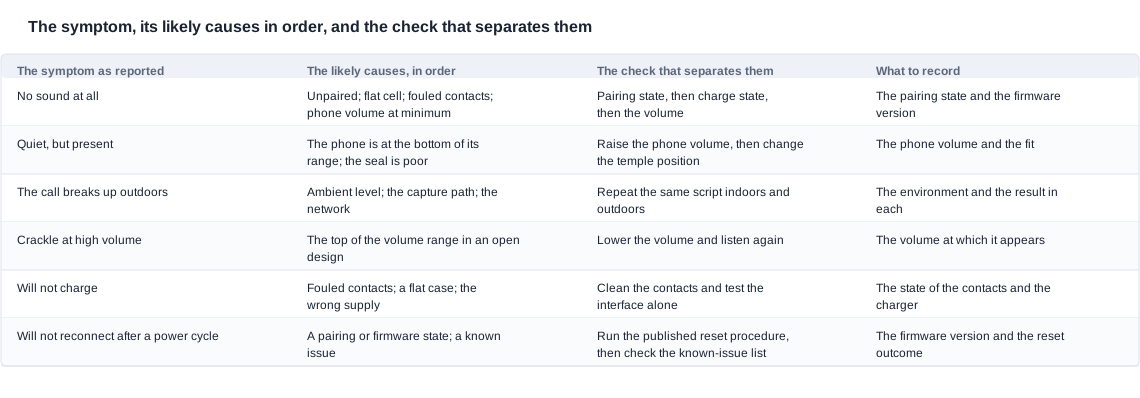
Read the second column as a ranked list rather than a set of possibilities. In each row the first cause accounts for most of the cases, and the last cause is the one that genuinely needs the factory.
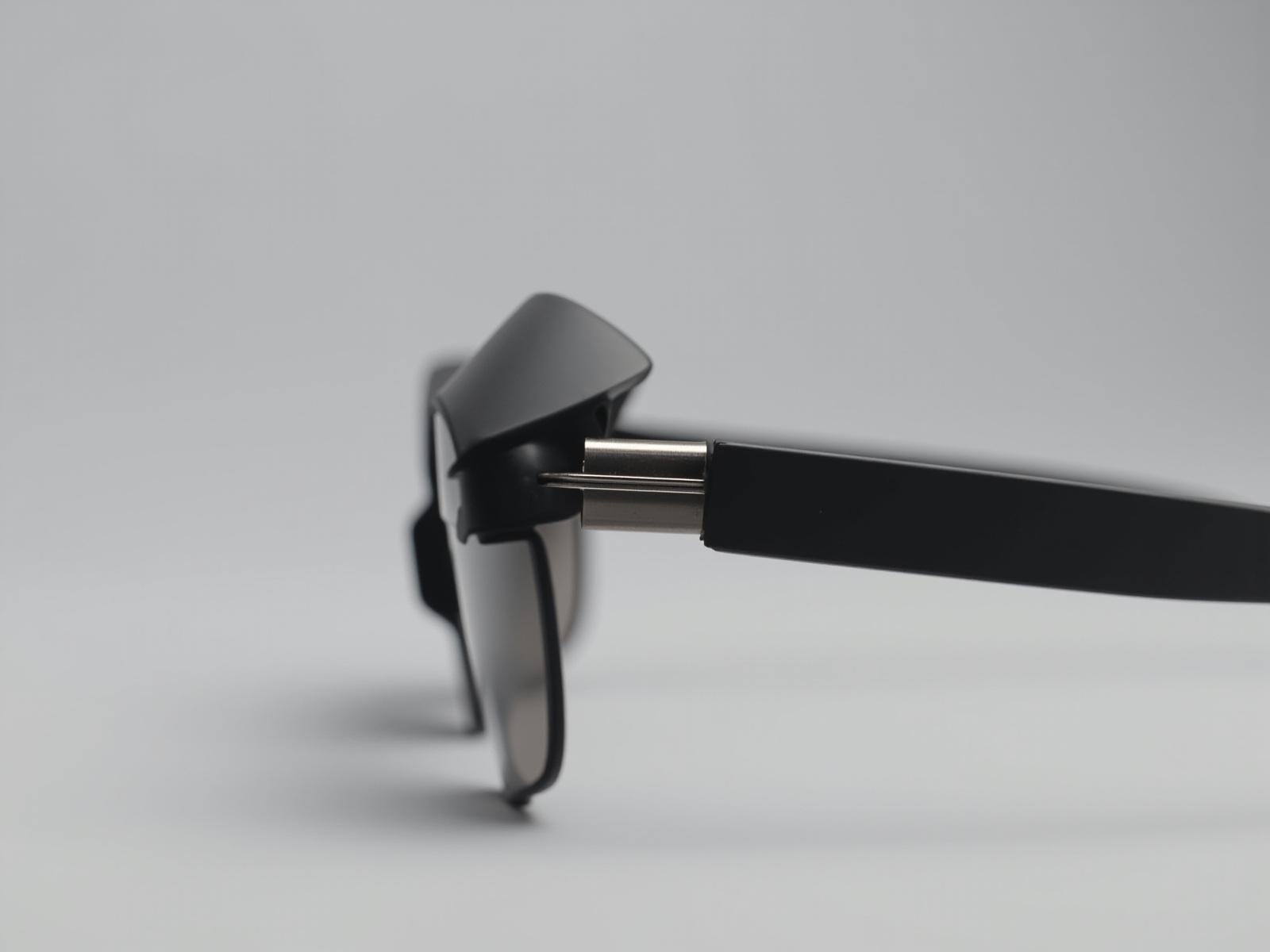
No sound at all, and the three checks that end it
The connection state and the known-issue list
The most common cause of "no sound at all" is that the unit is not connected to the phone. Not a hardware fault, and not in the category of things a customer service team would think to mention, because a customer with a working pair of headphones does not think about the connection.
The check is a question: has this unit ever produced sound, or did it stop after a phone change, an app reinstall or a firmware update? If it has never worked, this is a connection or a firmware matter and it belongs in a different queue from a unit that stopped working. If it stopped after a specific event, that event is the fault, and the known-issue list for that firmware build is where the answer will be.
The known-issue list is the document that turns this from a guessing game into a register check. It has to be versioned, because the behaviour of a unit after a firmware update is not the behaviour of the same unit before it, and a support script that cites a procedure without a version will not resolve anything. Asking the supplier for the known issues by firmware build is one of the highest-value requests in the whole category, because it converts a class of tickets from a diagnostic exercise into a lookup.
The microphone side of a related symptom is set out separately in how to measure smart glasses microphone quality, and the radio behaviour is covered in Bluetooth version myths.
The charge state, and a case that is flat
The second most common cause is that the unit is flat, and it is the one a customer cannot see. A frame that has been used all day and left unconnected presents exactly as a frame with a failed cell, and the customer's mental model is "it is broken" rather than "it is off".
The check is a question about the indicator, and the underlying requirement is that the indicator has to be observable. If a customer cannot tell the difference between a flat unit and a failed one, the first ticket is a return regardless of what the product is doing, and the design has already decided that outcome.
One point specific to this tier: no charging case is listed for any of the eight audio models, so the end-of-day routine is the interface itself — magnetic on six models and Type-C on the D11 and the D12. The sport models publish the same kind of row, with the YKC02 on magnetic charging and the D17 and the ZH12 on Type-C at around one hour. Where a programme does add a case from another line, the same flat-check applies to the case, because a case that is flat while the frame appears charged produces exactly the same ticket.
The contacts, and the fault that a cloth removes
The third cause is the cheapest to fix and the most reliably misdiagnosed as a hardware failure. On the magnetic models in this tier, lint and skin oil on the charge pads prevent charging with no visible fault at all, and a surprising share of units reported as dead are fixed by wiping the contacts and trying again.
The reason this ends up in the factory is that nobody wrote the instruction down. A support reply that says "please check the contacts" resolves the ticket, but it does not resolve the next one, because nothing in the documentation pack told the customer to check. The instruction belongs in the documentation pack as well as in the reply, because the cost of a ticket is several times the cost of a line in the manual.
This is the clearest example in the category of a problem that is a documentation failure rather than a product failure, and it is worth naming it that way internally, because the two have completely different owners.
Quiet but present, and the fault that is not a fault
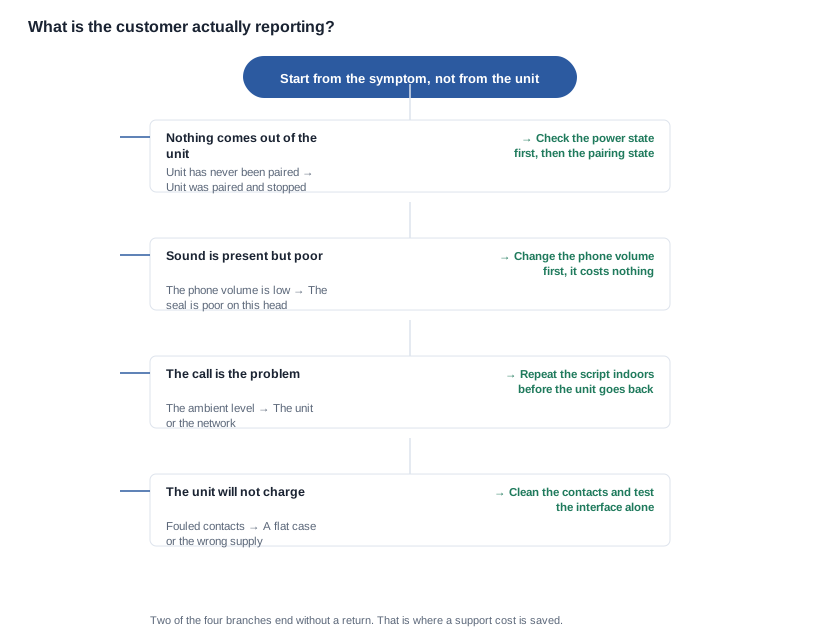
The phone volume at the bottom of its range
The fourth cause is the phone. At the bottom of its volume range a phone makes an open-ear design genuinely very quiet, and a customer who has to find the right setting will conclude that the product is quiet rather than that the setting was wrong.
The check is to raise the phone volume, which takes four seconds and requires no equipment. A supplier who says the product is loud while the customer's phone is at minimum is not being unhelpful; they are describing a measurement taken with a different assumption about the phone.
The fix is not only in the support script. Stating the phone volume assumption in the listing copy removes the ticket as well as the complaint, because a customer who knows the assumption does not report it. It is a sentence, and it is the cheapest sentence in this article.
The seal, and why one head produces one answer
The fifth cause is the one that is not really a fault at all. The level a listener receives is set by how the frame sits on the head, and the same unit produces a different level on a different person, and on the same person after a long session with the temples adjusted differently.
The check is to change the temple position and listen again. If the level changes materially, the unit is working and the geometry was the issue.
This is where the troubleshooting and the scoping meet, and it is worth being careful about the boundary. If the level on a particular head is unacceptable, that is a product characteristic meeting a customer characteristic, and it is a returns problem regardless of what the ticket says. If the level is fine on the head that tries it and wrong on the next one, that is a head characteristic and a fitting problem.
The diagnostic distinction is simple and useful: the fault travels with the unit, or it travels with the head. Any symptom that survives a change of head is a product matter, and any symptom that moves with the head is not. That single question separates a genuine defect from a mismatch more reliably than any measurement, and it costs nothing to ask.

The call that breaks up, and the crackle at the top of the range
The ambient level at the microphone
A call that breaks up outdoors is usually the environment rather than the unit, and the diagnostic that settles it is to repeat the same script indoors. If the call is clear indoors and broken in the street, the ambient level at the microphone is the cause and no hardware change will fix it.
That finding matters for how the programme proceeds, because it converts a fault into a scoping decision. The measurement procedure for the microphone path is set out in the microphone measurement protocol, and the environmental condition behind it — the ambient level, not the device — is the variable that has to be specified.
The error to avoid is escalating on the basis of a single field report. A call fault reported once, with no environment recorded, cannot be diagnosed by anyone. A call fault reported with the ambient level, the distance and the result indoors and outdoors can be diagnosed in minutes, and it is worth writing those three fields into the ticket form before the programme launches rather than asking your team to remember them.
The volume ceiling in an open design
Crackle at high volume is a design question rather than a defect question, and it is the one most likely to be misclassified.
The reason is structural. The three things that reduce leakage are the same three that reduce output — a smaller radiator, a narrower pattern and a lower volume — so the top of the volume range is exactly where the format shows its cost. A unit driven there will produce artefacts, and the artefacts are a consequence of the architecture.
The check is to lower the volume and listen again. If the artefact disappears and the level becomes usable, the unit is performing as designed and the expectation was wrong. The fix is in the copy: say what the product is for, name the environment, and do not imply unlimited level.
The commercial consequence of getting this wrong is disproportionate, because the complaint arrives with a description that says the product is faulty. It gets logged as a defect, it is counted against the defect rate, and the quality effort moves to the wrong place while the actual cause was a sentence that should have been written differently.
Charging and reconnection, the two faults that look like hardware
The charge interface and the supply in the box
A unit that will not charge is a contact problem more often than a failed cell, and the diagnostic order is: wipe the contacts and test the interface alone, then test with a different supply, then look at the unit.
Two facts about this range make the question sharper. The D17 and the ZH12 publish a charge time at or under one hour while the other nine publish at or under two, so a slow charge on one of the nine is not necessarily a fault. And the charging interface splits the tier seven to four between magnetic and Type-C, so a unit that will not charge with the cable in the box may be a unit where the cable is the wrong type for the model.
The firmware state after a power cycle
A unit that will not reconnect after a power cycle is usually a connection or firmware state rather than a hardware fault, and the check is to run the published reset procedure for that firmware build and then consult the known-issue list.
The requirement on the supplier is specific. The procedure has to be written down, versioned, and delivered with the unit. A supplier who will give you a per-version reset procedure has an operation; a supplier who will describe the behaviour in a call has a product.
There is also a commercial point here that sits outside the support desk. The reconnection behaviour is a published claim risk, because "Bluetooth 5.4 for a stable connection" is one of the most common phrases in this category and it is the kind of phrase a customer tests by power cycling. Establishing the behaviour on a sample and writing it into the manual converts an untested claim into a documented one, which is the cheapest protection available against a falsified listing claim.
What the factory needs with a returned unit, and what to settle before launch
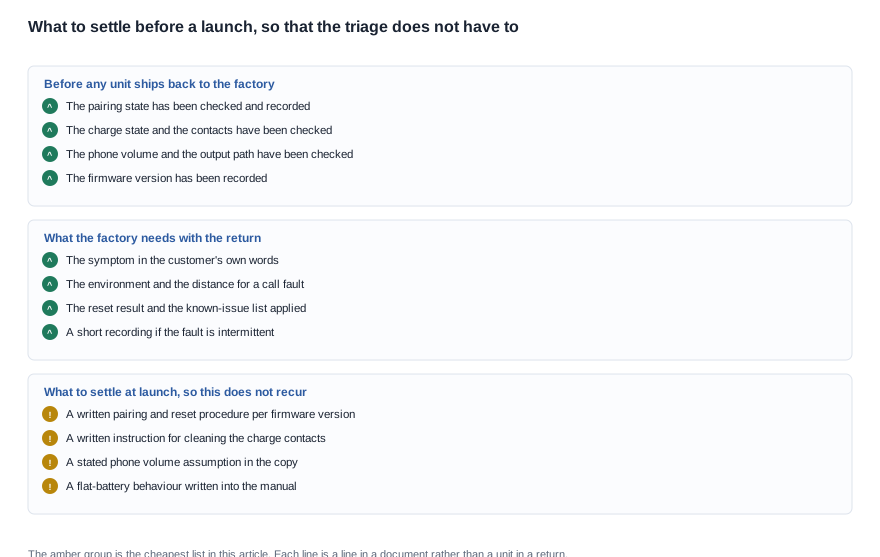
The escalation packet matters as much as the triage, because a unit that arrives at the factory with nothing but a description of a symptom will be diagnosed as a hardware fault by default and will come back as a no-fault-found, which is the most expensive outcome in the whole chain.
The packet has four parts. The symptom in the customer's own words, because the customer's description of the failure is often more diagnostic than the technician's summary of it. The environment and the distance for anything involving a call. The reset result and the known-issue list that was applied. And a short recording if the fault is intermittent, which is worth more than a paragraph of description because it captures the fault rather than the report of it.
The cost allocation for a unit that comes back with no fault found should be settled before launch, and that case is common enough to plan for rather than to argue about later. As a general principle the position is that a fault reproduces on the buyer's unit is a fault, and a fault that does not reproduce is a documentation problem — but the specifics depend on the agreement, and the agreement should exist before the first return rather than after the first argument about it.
There is a second reason to settle it in advance. The no-fault-found rate is one of the most informative numbers a programme has. A high rate means the triage is not working, and the fix is in the documentation pack and the script rather than in the factory. A low rate with a rising defect rate means the opposite. The number is worth watching because it tells you which of the two problems you have.
The commercial side of the triage, and where the negotiation sits
The triage is a support-cost decision and it should be treated as one, because a returned unit costs the unit, the freight, the packaging, the channel margin and the review opportunity, and a unit returned for a fault the product never had is the most expensive kind.
Two documents carry most of the value and both are negotiable in scope. The documentation pack — quick start guide, safety information, the contact maintenance instruction, the reset procedure per firmware build and the phone volume assumption — is a production item with a per-language cost and no tooling implication, so it is usually inexpensive to extend. The support script and the warranty process are negotiable in what they cover, and a supplier who supplies a written per-version procedure rather than a paragraph is saving the buyer money.
The payment structure is worth putting on the table in the same conversation. A balance held against inspection before shipment, and a retention held against the documentation package, both protect the buyer on the two failures that cost the most in this category — a lot that does not match the configuration ordered, and a programme that launches with a documentation pack nobody has read.
Building the support cost model into the purchase decision
The four cost lines behind a returned unit
A returned unit in this category carries four costs and they are not equally visible. The direct cost is the unit, the freight, the packaging and the channel margin, and none of it is recoverable because the product was sound. The reputational cost is the rating, which is permanent, indexed and visible to every future buyer and to every distributor doing a risk assessment on your listing. The operational cost is the ticket handling, which scales with the volume of tickets rather than with the volume of units. And the fourth is the one nobody budgets for: the inflation of the defect rate, which sends quality effort to the wrong place.
How to evaluate whether a support process is worth building is therefore not a question about ticket volume. It is a question about what fraction of tickets are documentation failures, and the answer changes the investment decision completely. If most tickets are triage failures, the investment is a manual and a script. If most tickets are genuine defects, the investment is a fixture and a tolerance in the factory. Both are real programmes, and confusing them is how a support cost turns into a tooling cost.
The three numbers to track, and what each one tells you
The no-fault-found rate. The share of returned units that the factory cannot reproduce. A high rate says the triage is not working, and the fix is in the documentation pack, the ticket form and the support script. A low rate with a rising defect rate says the opposite, and the fix is upstream in the inspection regime. The number is worth watching monthly because it tells you which of the two problems you have, and the two require completely different budgets.
The share of returns that are expectation failures. Returns that describe a documented boundary rather than a fault — a level that is too quiet on a particular head, a call that fails in a loud environment, a crackle at the top of the volume range. These are not defects and should not be counted as such. The measurement is straightforward: the ticket description says which of the boundaries it is, and the ticket form should be built so that it is easy to tell.
The repeat-offender rate. The share of returned units that had already been through support once. A number above a few per cent usually indicates that the first ticket was closed without a diagnosis, and that the closure criteria are too loose.
The three numbers together are a much better diagnostic than a single return rate, which is one of the traps in this category: a return rate can be stable while all three of its components are moving in opposite directions.
The criteria for deciding whether a symptom is a defect
The criteria should be written before launch, because writing them afterwards means writing them in response to a customer.
- The symptom reproduces on a second unit of the same lot. A fault that does not travel with the unit is a head, a phone or an environment characteristic.
- The symptom survives the documented checks. If the connection state, the charge state, the contacts and the phone volume have all been checked, the remaining causes are a much smaller set.
- The symptom is outside the published boundaries. If the symptom is one of the conditions the format produces by construction, it is not a defect, and it belongs in the copy and the script rather than in the factory.
The trade-off in the third criterion is worth naming. A boundary that is treated as a defect costs the programme money twice — once in the factory time spent investigating it and once in the inflated defect rate. A boundary that is treated as an expectation costs the programme its rating, which is worse. The reason the criteria have to be written in advance is that this decision is made under pressure, and it should be made under policy instead.
What to ask the supplier, and what to put in the contract
Four questions get most of the value here. What is the pairing and reset procedure for each firmware build, and can it be supplied as a written document. What is the contact maintenance instruction for the charge contacts, and can it be included in the documentation pack rather than only in a support reply. What is the known-issue list by firmware build, and how often it is updated. And what is the return route and the cost allocation, including the case where a unit comes back with no fault found.
The contract clauses that follow are short. The documentation pack and the support script supplied in the market languages. The return route and the cost allocation, with the no-fault-found case named explicitly. The known-issue list updated with each firmware release. And notice before any change of transducer, chamber geometry, DSP tuning, default processing state or firmware, since each of those invalidates a diagnostic step.
Whether you should build the full triage before launch or after the first hundred tickets is a judgement about your support cost and your volume, and the safest answer for a first programme is to build the documentation part before launch and the script part after, because the documentation part prevents tickets and the script part only shortens them.
Our position, and what we can do about it
The support conversation is a design input rather than a customer service problem, and most of the five symptoms above are documentation failures rather than product failures. We publish the electrical rows and the technical methods for the audio family, and we publish no acoustic measurement for any model in it, so we will not tell you that a unit is sound on the strength of a specification we do not hold. If a unit is behaving as this article describes, the checks will find it.
We will also be direct about the commercial point. A returned unit costs the freight, the packaging, the channel margin and the review opportunity, and a unit returned for a fault the product never had is the most expensive kind there is. The five checks above are a support cost decision, and they are cheaper than the returns they prevent.
What we can do is supply units and a written test script, and help you build the acceptance criteria that separate a design limit from a defect. The related errors in specification work are set out in the open-ear buying mistakes piece, the radio behaviour is in Bluetooth version myths, and the confidentiality point — which matters if you are sharing a fault sample with a supplier during evaluation — is in smart glasses OEM confidentiality. The background is under open-ear audio.
The support ticket list
-
Send us your support ticket list. We will tell you which of the five checks each ticket is missing, and which of them are symptoms that the documentation pack should have prevented.
-
Send us the ticket form you use. We will tell you which fields have to be on it for the factory to be able to diagnose anything, and which of them are worth adding before the launch rather than after the first escalation.
-
Send us the firmware build and the known-issue list you have. We will tell you where the symptom sits in the version history and whether the behaviour is expected.
-
Ask us which of the five symptoms we can close with a document. The answer is more of them than most buyers expect, and it is cheaper than the returns they prevent.
Related reading
- The related errors — open-ear buying mistakes
- The microphone protocol — how to measure microphone quality
- The background — open-ear audio
Send us your support ticket list and we will tell you which of the five checks each of them is missing.


