

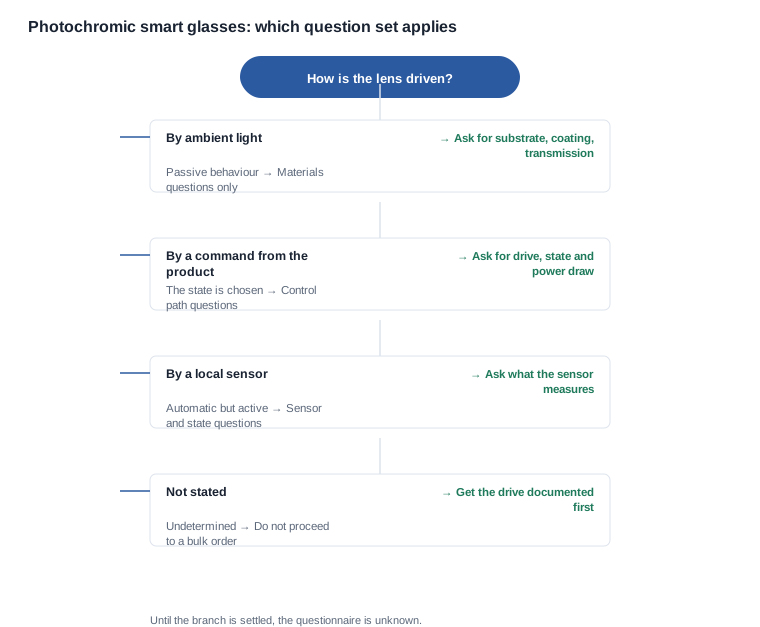
The first thing to establish about photochromic smart glasses is that the search term covers two different mechanisms, and only one of them is the mechanism behind the product our catalogue publishes. That distinction is not a technicality. It changes what a buyer has to ask, which supplier can answer, what the documentation has to cover, and what the commercial risk actually is.
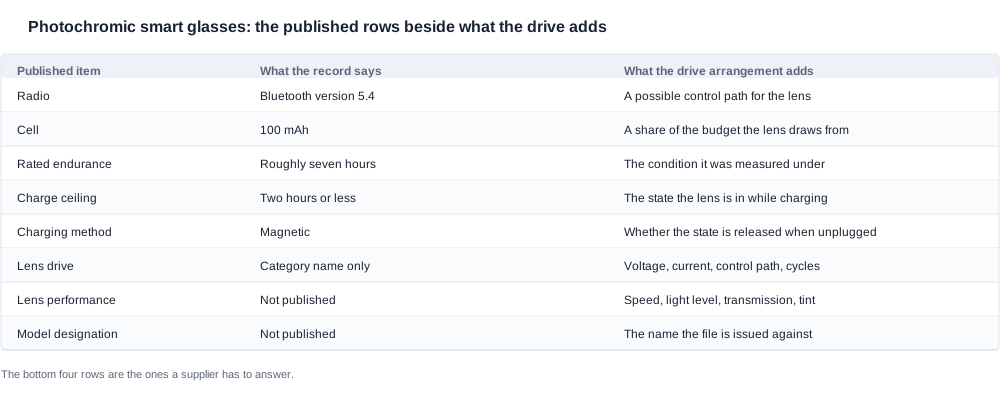
The row in question is published as an AI electrochromic smart glasses line, with no model designation. The five documented fields for it are a Bluetooth version 5.4 radio, a 100 mAh cell, roughly seven hours of rated endurance, a charge time of two hours or less, and a magnetic charging method. The catalogue publishes nothing at all about the lens: not the drive arrangement, not the switching speed, not the light level, not the transmittance, not the tint depth, not the operating temperature range, not the substrate and not the thickness.
This article is therefore not an explanation of the chemistry. It is an explanation of why the mechanism decides the kind of question you are asking, and of what follows from that. A buyer who has not established the drive arrangement is not merely missing a specification; they are asking the wrong set of questions, and every answer they get back will be about a different product.
Photochromic smart glasses: how the drive mechanism changes the kind of question you are asking
The market word is used loosely, and the two mechanisms behind it have almost nothing in common from a procurement point of view.
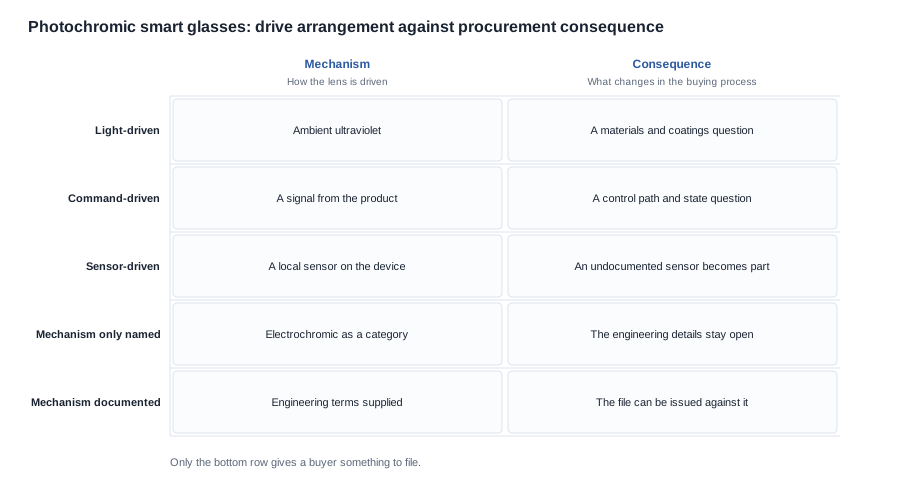
A light-driven lens responds to ambient ultraviolet. It is a material property: a photochromic film or a doped glass that changes its absorption as the ultraviolet level around it rises. Nothing in the product controls it, nothing in the product has to be designed around it, and the questions a buyer asks about it are materials questions. What is the substrate. What is the coating. How thick is it. How is it bonded into the frame. What is the transmission in each state, and at what light level. What happens to it in the cold. Whether it can be replaced in service.
An electrically driven lens changes state because a voltage is applied across an active element. It is a systems question, and every part of it has an engineering owner. What drives the element, at what voltage and current. What the control path is — a command over the radio, a button, a sensor, or some combination. What the state is when the drive is removed. What happens at the end of the cell's charge. How much of the power budget the lens consumes. How many cycles the element tolerates. And the question that the whole product's documentation turns on: whether the lens is part of the assessed product or a fitted material, because the answer determines what the technical file has to contain.
So the mechanism is not a detail of the lens. It is a fork in the buying process, and the two branches do not converge. A buyer who skips this step does not save a week; the trade-off is a question list that has to be rebuilt, and a supplier conversation that has to be restarted, at the point where a purchase order is supposed to be ready. Knowing when to stop and establish the mechanism is therefore part of the selection criteria, not a preliminary nicety. A buyer who asks a materials question of an electrically driven product gets an answer about a component. A buyer who asks a systems question of a light-driven product gets an answer about something the product does not contain.
The catalogue's own position is that this entry is the electrically driven one, and the honest reading of the row is that the drive arrangement is an undocumented property of the product rather than an open question. It is not open because the supplier can answer it; it is documented only to the extent that the category name states it. Everything below it — voltage, current, control path, response, power draw, cycle life — is absent, and it has to come from the supplier.
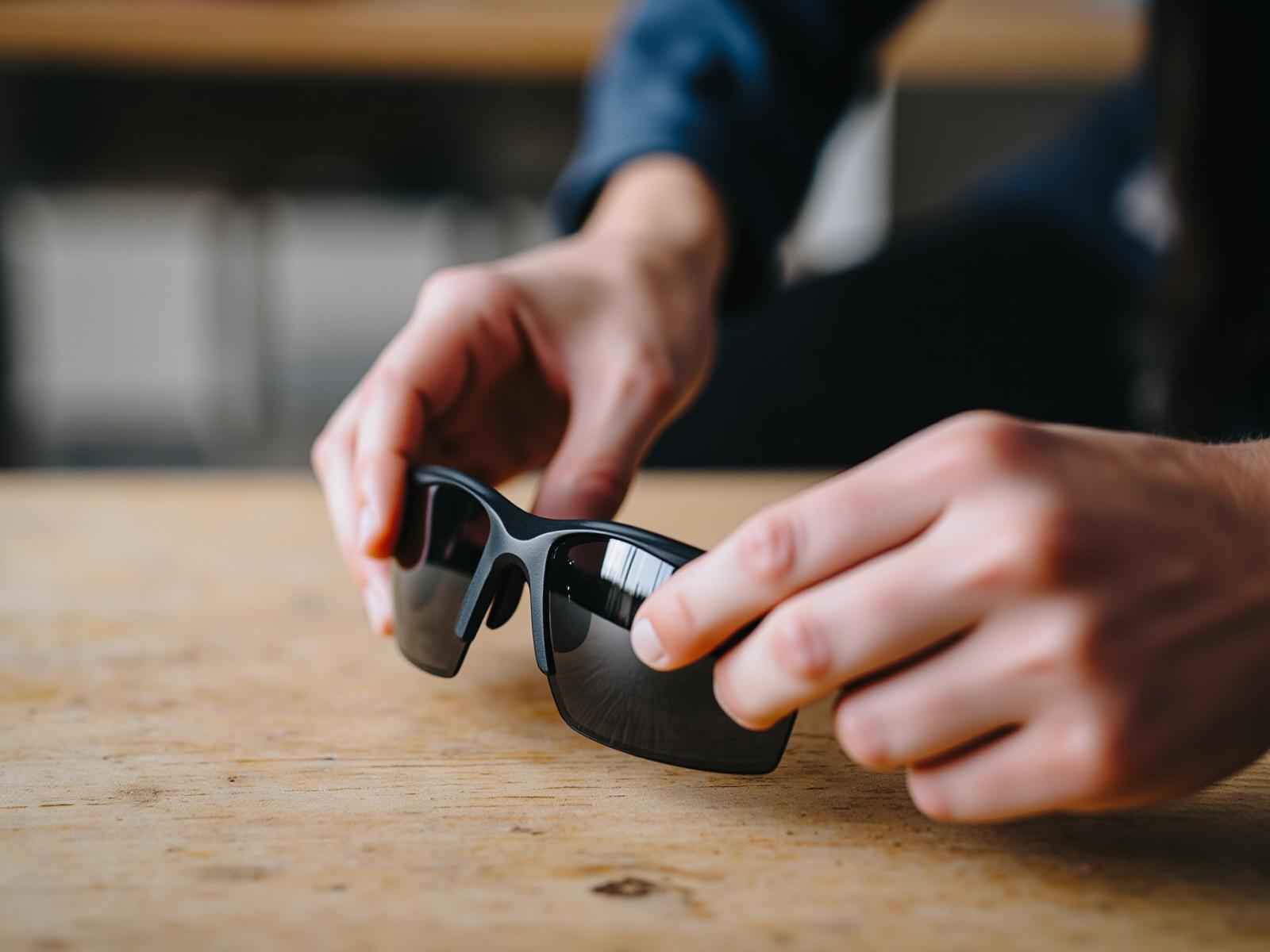
The catalogue line, and the two mechanisms the market word covers
It is worth being explicit about the boundaries of the published record, because the confusion in this category is not usually caused by a supplier. It is caused by a search term.
Our catalogue contains two families of products whose optics can be described as changing in response to light. One of them carries a tinted-lens configuration in a camera product line, and it is a separate line with its own electrical figures and its own charging approach. The other is the entry this article concerns, published without a model designation and driven electrically. Neither of them publishes a single lens performance figure. What the catalogue does publish for the driven entry is the set of five fields already listed, and the fact that the product is described as electrochromic.
Three things follow from that, and they are worth stating separately because they are frequently merged.
First, the drive arrangement is the only lens attribute that the record discloses, and it is disclosed as a category name rather than as a specification. That is enough to establish which branch of the fork applies and not enough to buy a lens on.
Second, the electrical row and the lens row are published in the same place, and that placement is a trap. A reader who sees a cell, an endurance figure and a radio version next to a lens that changes state will naturally assume the endurance figure is the endurance of the whole product doing the thing the lens does. Whether the published rating was measured with the lens in its driven state, in its released state, or in a laboratory at all is not published, and for an electrically driven lens that is the difference between a figure that describes your product and a figure that describes a product with its main feature switched off. The switching-time note treats the timing question in isolation, and the temperature-effects piece treats the environmental dependence; both of them assume a drive arrangement has already been established.
Third, the market word creates a reasonable expectation that a buyer is not obliged to accept. A listing that describes a lens as photochromic may lead a customer to expect the lens to darken in bright sunlight by itself, without any action, on any device. If the product is driven and the state is commanded, that expectation is wrong, and the correction has to be built into the product description and the instructions rather than left to a support agent. The mechanism comparison places the two mechanisms side by side precisely so that the wording can be chosen accurately.

What changes when the lens is driven electrically
Once the product is understood as electrically driven, four consequences follow that a light-driven product does not have. Each of them is a question to put to the supplier, and none of them can be answered from the catalogue.
The lens enters the power budget. A 100 mAh cell and a rated endurance of roughly seven hours are the published figures for the product as a whole, and the lens is part of the product. What is not published is how much of that budget the lens consumes when it is changing state, whether it consumes anything at all while holding a state, and whether the published rating was obtained with the lens active. A buyer should treat the published rating as the ceiling of what is documented and ask for the condition it was measured under. If the answer is that the rating was measured with the lens in a settled state, that is a perfectly good answer, but it has to be the answer on the record rather than an assumption.
The lens enters the control path. This is the question with the largest commercial footprint. If the state is commanded over the radio, then the lens's behaviour is coupled to a Bluetooth version 5.4 link, and a link that is busy, weak, or reconnecting will affect the state of the lens at exactly the moment the user is moving between light conditions. If the state is driven by a sensor on the product, the sensor becomes an undocumented part of the product. If it is driven by a button, the instruction set has to describe a manual step that a light-driven product never needs. These are three different products with the same cell, the same radio and the same nominal endurance, and the catalogue does not distinguish between them.
The lens enters the failure modes. A light-driven lens has one failure mode: it stops responding to light. An electrically driven lens has at least four, and they generate different customer reports. The element may stop switching. The element may switch but not hold a state. The control path may fail while the element works. And the cell may run out with the element in a state nobody has defined, so that the product is found in a condition its owner did not choose. The last of these is the one that generates a support call that cannot be reproduced, and it is a direct consequence of the drive arrangement.
The lens enters the documentation. A light-driven lens is a material, and a material appears in a bill of materials. An electrically driven lens is a functioning part of the product, and it has to be described in the product description that the conformity documentation is issued against. Which means the description has to state the drive arrangement, and which means the description has to be stable across production runs. That is a heavier requirement than a material line, and it is a requirement that has to be met before the file is assembled rather than while it is being assembled. The certification route for this category covers how that file is built and in what order.
The questions that exist only because the lens is driven can be put in a single list, and that list is the practical output of establishing the mechanism. It is worth sending it as a numbered set rather than as a paragraph, because a numbered set gets answered in a numbered set, and because the gaps in the reply are then visible as gaps rather than buried in prose. The red flags in a reply are consistent: a mechanism described only as a category name, an endurance figure with no condition attached to it, a state described in the passive voice, and a cycle figure that arrives without a test method. Any of those four means the answer is going to have to be obtained again later, and the total cost of a second round is higher than the cost of the first.
- What drives the element, and is the drive command sent over the radio, triggered locally, or both?
- What is the state of the lens when the product is switched off, and when the cell reaches the end of its charge?
- Does the lens hold a state without continuous power, and does the state persist across a power cycle?
- How much of the cell's capacity is used while the element is changing state, and what is the condition attached to the published endurance figure?
- What is the control path for a user who wants a particular state, and is that path available without a phone?
- What is the defined behaviour when the radio link is lost while the lens is changing state?
- How many switching cycles is the element specified for, and under what test condition?
- What does the supplier's own product description say about the drive arrangement, in the words that will appear on the declaration?

A comparison table of the procurement questions each mechanism raises
The table below is the most useful artefact in this article, and it is a table of questions rather than of technologies. It is what a buyer actually needs: once the mechanism is settled, the questionnaire is determined, and the same questionnaire can be sent to any supplier in either branch. The criteria for using it are simple, and they are the criteria a shortlist should be built on anyway: what to ask, in what order, against what acceptance criteria, and what a supplier has to produce for the answer to count as evidence rather than as a description. The common pitfalls are visible in the table itself, because every row where the right-hand column adds a question is a row where a buyer who skipped the mechanism will send the wrong question and receive a confident, irrelevant answer.
| Question | If the lens is light-driven | If the lens is electrically driven |
|---|---|---|
| What governs the optical result | The material and its coating | The element, the drive and the state definition |
| Where the specification comes from | A material datasheet | The product description and the supplier's engineering file |
| Does the lens affect the power budget | No | Yes, and the condition on the rating has to be stated |
| Can the state be commanded | No | Yes, and the control path has to be identified |
| What happens when the power is lost | The lens simply reverts to the ambient condition | An undefined state unless the supplier documents it |
| What is the main failure mode | The lens stops responding to light | Several, and they produce different reports |
| Where the lens sits in the file | As a material in the bill of materials | As a functioning part of the assessed product |
| What the buyer must sample | The lens in different light conditions | The product in different states and power conditions |
| What drives the re-order decision | The material | The drive arrangement and the control path |
Read down the right-hand column and it becomes clear why the two branches do not converge. The right-hand column has an extra question in every row, and each of those extra questions is one that the published record does not answer and that the supplier has to.

There is one more line in the table that is easy to miss and expensive to overlook. The sampling requirement differs. A light-driven lens is sampled by putting it in different light; an electrically driven lens is sampled by putting the product in different states, and that means the sample has to be connected, charged, and driven through a sequence rather than simply placed on a desk. It also means the sample and the production unit have to agree on the control path, which is a configuration question rather than a materials question, and it has to be settled before the first sample is ordered. The selection sequence note sets out the sample-first sequence in full, and the questions buyers most often ask covers where this one sits among the others.
The wording that survives a legal and technical review
A driven lens raises a specific drafting problem, and it is one that a category name does not solve. The word that buyers and customers use for this feature carries an established meaning — it implies that the lens responds to light by itself — and the product may or may not behave that way.
The drafting rules that follow from that are short.
- Describe the drive arrangement, not the category name, wherever a performance claim is made. A listing that says the lens is driven electrically and states who or what drives it is defensible. A listing that says only "photochromic" is not, because it does not tell a customer what the product will do when they walk from a dark building into the sun.
- Keep the two words apart. The catalogue uses electrochromic for this entry, and the market word is used far more loosely. A buyer who writes "photochromic" on a carton for a product whose lens is command-driven is making a statement about behaviour, and the behaviour has to match the statement.
- Do not publish any lens figure that has not come from the supplier in a form that names the test condition. That covers switching time, transmittance, tint depth, cycle life and temperature range alike, and the reasoning is the same for all of them: an unsourced number in a listing is a claim the seller is making, and the seller is the one who has to stand behind it. The tint figure note sets out what a re-orderable figure has to contain.
- Do not let the product description drift from the declaration. If the description that the conformity documentation is issued against says the lens is driven, then the product, the instructions, the listing and the description have to agree, and the agreement is maintained by version control rather than by memory.
Our own position is the same one we take everywhere in this category, and it is worth stating precisely because the alternative is so easy to do. The catalogue records this entry as an AI electrochromic smart glasses line, and its published specification is five fields: a Bluetooth version 5.4 radio, a 100 mAh cell, roughly seven hours of rated endurance, a charge time of two hours or less, and a magnetic charging method. We publish no switching time, no transmittance, no tint depth, no drive arrangement in engineering terms, no temperature range, no lens substrate and no thickness, and we will not fill those gaps with values taken from a different product or from the wider industry. What we can do is tell you which questions the drive arrangement has created, which of them the published record answers, and which of them a supplier has to answer before a purchase order is worth raising — and that is the whole of what can honestly be said about how photochromic smart glasses work at the level a buyer can act on.


