
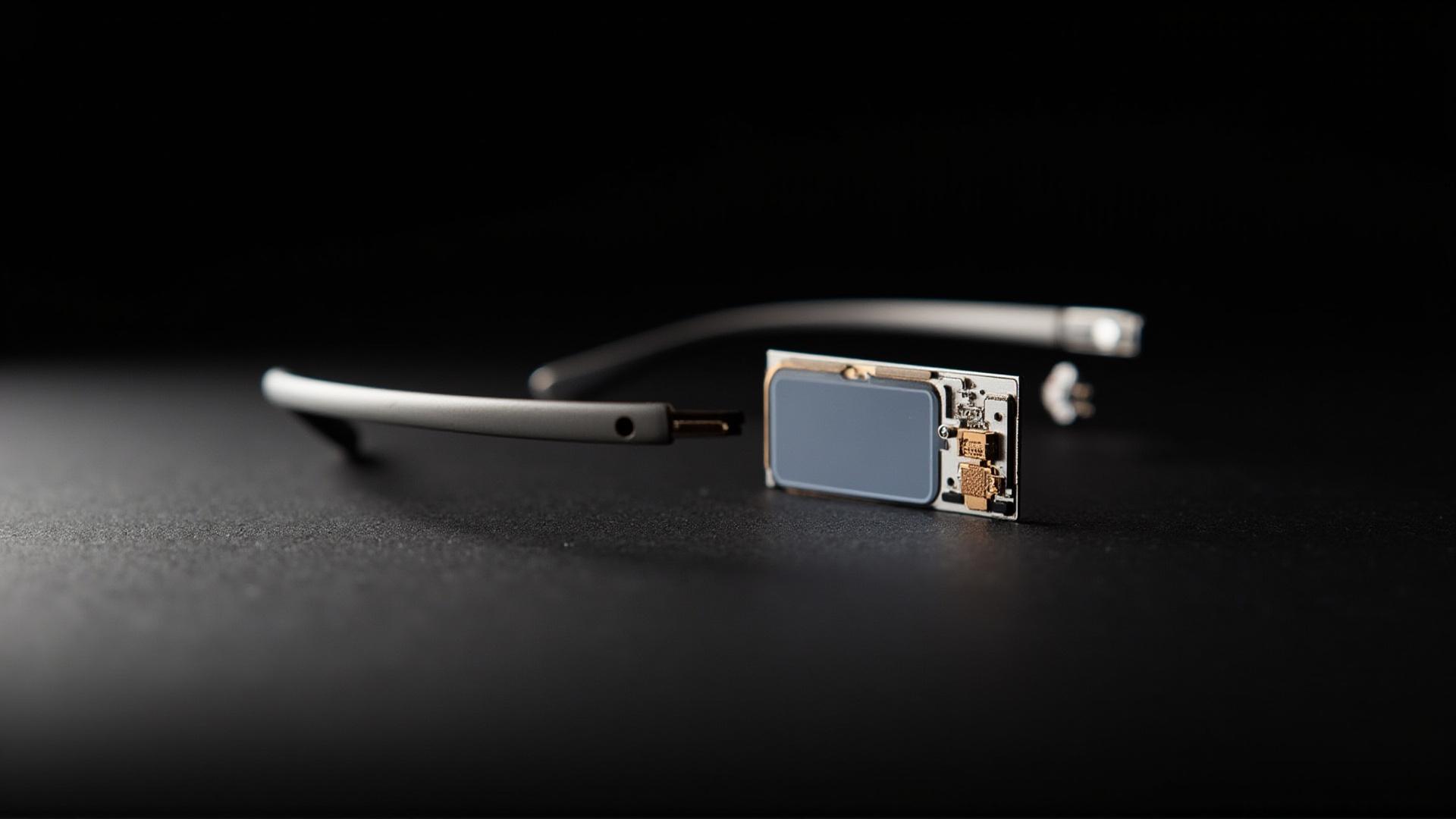
Comparing the S7 against the other camera models is mostly a question of what the catalogue is willing to print. The S7 page gives a resolution class, a cell figure, a usage band, a charging ceiling, a charging method and four feature lines, and that is the whole of the material you can set beside the ten other camera models. What follows is the mechanics of that exercise: which published rows can carry a comparison at all, where the comparison runs out of published material, and how to ask for what is missing without converting an absent row into an invented one.
A comparison sheet built from printed rows behaves differently from one built from impressions. Printed rows can be checked against the page they came from; an inferred row cannot be checked against anything, because the moment a buyer writes that the S7 also has a row from a neighbouring page, the sheet stops being evidence and becomes a claim nobody in the transaction has made. The rule applied throughout this page is narrow: a row is usable when it exists on both sides of the comparison, means the same thing on both pages, is printed in the same shape on both pages, and carries a condition that is either published or obtainable in writing.
What the S7 publishes
Nine lines carry the S7 through the catalogue: five specification rows — resolution, cell, endurance band, charge ceiling, charging method — and four feature rows describing the frame design, the pixel count, the removable inner frame and the ingress marking. Read as a page they are disciplined. Read as a comparison sheet, each line has a different job, and the job depends on what the other ten camera models print in the same place.
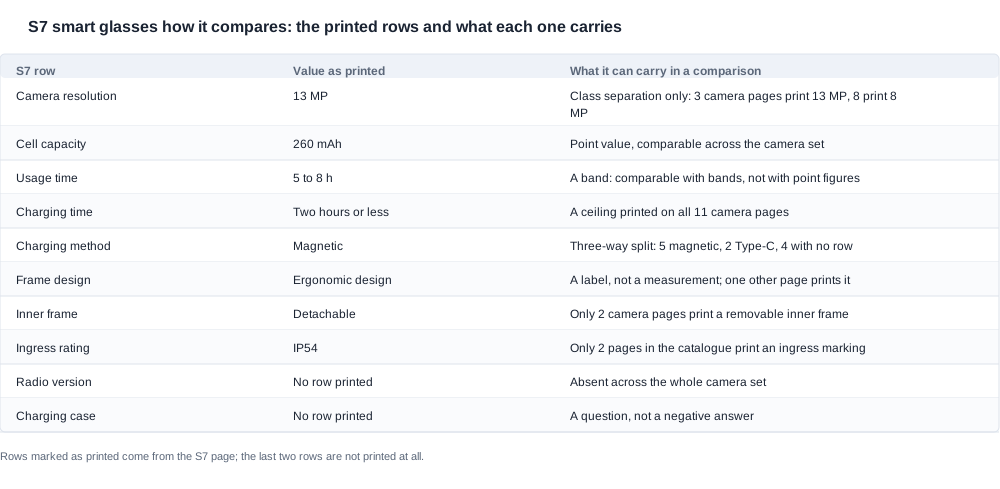
The inventory below is the working sheet. Two of its entries are not printed at all, and they are there on purpose: a buyer who leaves the radio line and the case line off the sheet will meet both of them later, in a radio approval file and in packaging artwork, and the late discovery costs more than the question.
| S7 row | Value as printed on the S7 page | What it can carry in a comparison |
|---|---|---|
| Camera resolution | 13 MP | A class separation: three camera pages print 13 MP, eight print 8 MP |
| Cell capacity | 260 mAh | A published figure comparable across the camera set, printed under a different label on some pages |
| Usage time | 5 to 8 h | Comparable with the two other band rows, not with the five point figures |
| Charging time | Two hours or less | Nothing between camera models: the same ceiling is printed on all eleven |
| Charging method | Magnetic | A three-way split: five magnetic, two Type-C, four with no charging row |
| Frame design | Ergonomic design | A label rather than a measurement; one other camera page prints the same line |
| Inner frame | Detachable | A separation: only two camera pages print a removable inner frame |
| Ingress rating | IP54 | A separation: only two pages in the catalogue print an ingress marking |
| Wireless radio version | No row printed | No comparison possible; the line is absent across the whole camera set |
| Charging case | No row printed | A question, not a negative answer: the catalogue prints no case row for the S7 |
Two of the printed rows carry labels that differ from their neighbours. The cell row on the S7 page uses one of two labels the camera pages employ: six pages print it that way, including the S7 page, and the remaining five print the same row as a battery capacity. Nothing about the hardware changes between those pages; only the heading does. A sheet that copies a heading from one page onto another has imported a difference that does not exist, so the safe procedure is to write the value, cite the page it came from, and leave the heading in the catalogue's own words.
The resolution appears twice on this page — once among the specification rows and again among the feature rows — and that is one value stated in two places rather than two independent confirmations of it. A sheet that treats the two mentions as separate evidence will overstate what the page proves. Copy the value once and mark the second mention as the same value.
The shape of each value decides what a row can be set against. The cell figure is a point value, so it can be set against any other point value. The usage band is a range, so it can be set against a range and against nothing else. The charge time is a ceiling, so it can tell you only whether one model sits inside another model's bound and never which of two is quicker. The ingress marking is a classification, so it can tell you that two pages carry the same label and nothing at all about either unit. Putting these shapes on one sheet is how a comparison usually goes wrong, because a band and a point figure read the same way in a spreadsheet column.
Feature lines are where the catalogue is least consistent about what it prints. Five of the eleven camera pages carry a feature line of some kind: the S7 page, the V06 page, the V03 Pro page, the MT6 page whose line describes portability and a folding charging case, and the L2 Utral page which names two variants and a charging interface. The other six print nothing beyond their specification rows. Even inside the feature lines the weight differs. The ergonomic line appears on the S7 page and the V06 page and nowhere else in the camera set. The removable inner frame appears on those same two pages, and the only other removable component anywhere in the catalogue is a detachable temple on the G07 page, which is an audio model. The ingress marking appears on those same two pages across all twenty-eight entries. Three lines that look decisive on a single page turn out to be shared with exactly one other model, which is still a separation against the six camera pages that print no feature line at all, but it is a separation of two rather than a separation of one.
The S7 against the other camera models
Eleven models in the catalogue carry a camera, and the structure of that set is what decides whether the S7 can be compared on a given row or only described beside it.
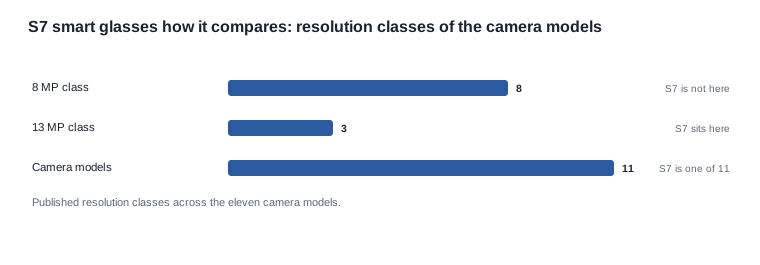
Resolution comes first, because it is the row buyers reach for and the row the catalogue supports least. Three of the eleven camera pages print 13 MP — the S7 and the L1 Pro, and the L2 Utral — and the remaining eight print 8 MP. That split is real, and it is the only work the resolution row can do: it tells a buyer which class a page belongs to. It cannot rank the three models inside the 13 MP class, because no camera page in the set prints anything beyond the figure itself. Not one of the eleven prints a sensor model, a lens, a frame rate, a video format, a stabilisation description or a low-light behaviour. A sheet that sorts the camera set by megapixel produces one group of eight and one group of three, and then implies an ordering inside the group of three that no printed row supports.
The cell row supports more, because the camera set prints four capacity values across its eleven pages: 220 mAh on the V03 Pro, the V03 and the MT5; 260 mAh on the KY06 and the V06, and the S7; 265 mAh on the MT6; and 290 mAh on the L1 Pro, the CY03 and the L2 Utral, and the CY05. The S7's 260 mAh therefore ties it with two models and separates it from eight, and the tie with the V06 is the closest in the set because those two pages agree almost everywhere.
The usage row splits the set into three shapes rather than three values. Four pages print a band of five to eight hours — the V03 Pro and the S7, and the V06 and the V03. Two print a band of six to eight hours, the KY06 and the MT5. The remaining five print a point figure of approximately seven hours: the MT6 and the CY05, the L1 Pro, the L2 Utral and the CY03. This is where a comparison sheet most often breaks, because the S7's band sits beside a second band that overlaps it almost completely and beside five point figures that sit inside both. All eleven camera models publish a usage figure and not one of them publishes the condition it was measured under, so the bands and the point figures cannot be reduced to a shared measure. What can be said is structural: the S7's page describes a duty cycle that moves with the workload, exactly as the V06's, the V03's and the V03 Pro's do, and that is a different kind of claim from the approximately-seven-hour pages. Two different kinds of claim on one sheet is precisely the situation in which a buyer should stop ranking and start asking.
Charging splits the set three ways, and the S7 sits in the largest group. Five pages print magnetic charging — the MT5 and the V03, the V06 and the S7, and the KY06. Two print a Type-C interface, the V03 Pro and the L2 Utral. Four print no charging row at all, the L1 Pro, the CY05 and the MT6, and the CY03, and each of those four does print a charging-case capacity, which is the only reason the absence reads as an open question rather than as a different product. For a buyer writing a cable into a packing list, the magnetic group of five is the workable set, the two Type-C pages are a different programme, and the four unanswered pages are not yet a programme at all. The S7 belongs to the group where no cable is required.
The charging case needs three states rather than two, and this is where the S7 is most often misread. Five camera pages carry a case capacity: three of them at 1400 mAh — the CY03 and the CY05, and the L1 Pro — one page with a 900 and 1400 mAh pair on the L2 Utral, and one at 1200 mAh for the MT6 folding case. Two further pages, the KY06 and the MT5, name a charging case without publishing a capacity for it. And four pages carry no charging-case line at all: the V03 and the V06, and the V03 Pro and the S7. That last group matters most for the S7, and for a reason that is easy to miss: an absent line is not a statement. Nothing in the catalogue says the S7 arrives without a case, and nothing in it says the S7 arrives with one either. The question is simply unanswered, and an unanswered question about the S7 belongs on a written request to the supplier, not on a specification sheet or a packaging artwork. A sheet that turns a blank into a negative answer will be corrected by the first person who opens a carton.
Two more absences shape the sheet. No camera model in the set publishes a wireless radio version, so the column cannot be built at all; and because radio versions are printed on eight of the audio models elsewhere in the same catalogue, a figure carried across from an audio page would read as plausible and would be false. Only two camera pages print colours, the V03 Pro with three and the V06 with four, and the S7 page is not one of them, so a programme that needs a colour list for artwork has no printed colour for this model.
The weight row is the sharpest trap in the whole set. Exactly one page in the catalogue prints a unit weight, and it is the MT6 page: 158 g for the eyewear body, measured without the folding case printed beside it. That number belongs to a different model, and setting it beside the S7 on a comparison sheet would be a fabricated specification rather than a transferred one. This model's own page carries neither a weight nor a dimension nor a temple length, so there is nothing on it to set anything against.
Ingress protection is the opposite case. Only two pages in the entire catalogue print any ingress marking, the V06 and the S7, which makes the marking a genuine separator on this page and makes the surrounding silence a strong argument for requesting the report rather than for treating the marking as a tested result. The same reasoning applies to the detachable inner frame, which appears on two camera pages, and to the resolution class, which appears on three: in both cases the rarity makes the row worth requesting in writing rather than worth asserting in copy.
Certification and commercial terms sit outside the comparison altogether, and for a structural reason rather than an accidental one. No camera model in the eleven carries a certification line, and the catalogue text never names CE, FCC or RoHS. What the certification page holds instead is a plate of ten patent images — eight appearance-design, two utility-model — which describes the supplier's design portfolio rather than any one SKU. A buyer can still write the applicable assessments into a request; the radio-side instrument is the Radio Equipment Directive (EU) 2014/53/EU and the emissions-side one is the EMC Directive 2014/32/EU, and neither of them says what this model holds. Prices, order floors, lead times, capacity, warranty periods and certificate numbers appear for no model at all, the S7 included, and a comparison that stops at the specification table has not reached the decision a procurement team has to make.

Where a comparison runs out of published rows
Every comparison against the camera set runs out of published rows at a predictable point, and the point differs by the kind of evidence. Sorting the material by the strength of the evidence behind it makes the boundary visible and shows where each open item belongs.
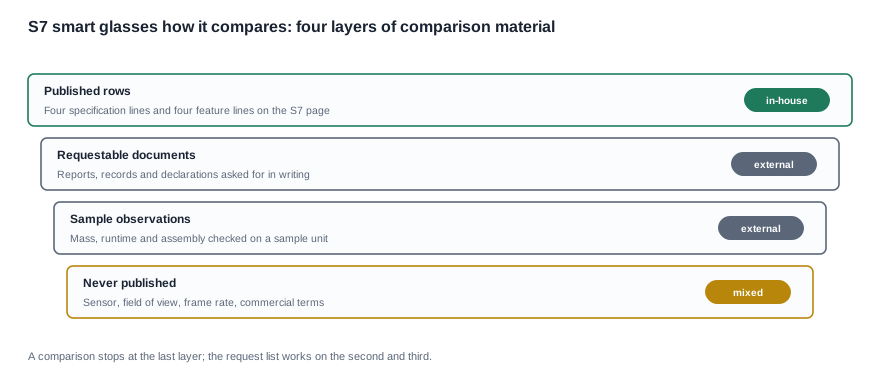
The first layer is published. For the S7 it holds five specification lines and four feature lines; for each of the other ten camera models it holds what that page prints. This layer is the only one that can be used without a conversation, and the only one that can be shown to a customer.
The second layer is requestable, and it is larger than most buyers expect. A written request can produce the ingress test report, including which configuration it covers and whether the detachable inner frame was fitted when the unit was tested; the sensor and lens record for the production units; the wireless radio version; the charging method for the four camera pages that print none; the charging-case position for the V03 and the V06, and the S7, stated in words instead of left blank; the unit weight as shipped; and the conformity file for the finished product — the assessments that apply, the certificate numbers behind them and the schedule of models those certificates cover. Nothing on that list is refused because it is confidential; it is simply not printed, and a request is the only mechanism that moves a line from the second layer to the first.
The third layer can only be closed by a sample. Unit mass, the endurance figure under a stated duty cycle, the ingress behaviour of the assembled unit, the interchangeability of the inner frame, the charge time measured from a stated starting condition and the behaviour of the magnetic contacts while the unit is docked are all observations, and no observation becomes a specification until it is written down as a condition and a number. This is where a buyer's due diligence should be scheduled, because a sample order is the only instrument that produces evidence for this layer, and it is far cheaper to schedule it with the specification request than to schedule it after a purchase order has been confirmed.
The fourth layer will never be printed by anyone, and it is worth naming so that no programme is built on it. Nothing in the camera set names a sensor, a lens, a viewing angle, a frame rate, a file format, a stabilisation scheme or a low-light performance. It publishes no unit mass for any model except one, no colour row for any model except two, and no certificate number, unit price, minimum order quantity, lead time or warranty period for any model at all. It also publishes no correspondence between the two variant names and the two case capacities printed together on the L2 Utral page, so a sheet that pairs one capacity with one variant name and the other capacity with the other name has invented a structure the catalogue never states. When a buyer hits this layer, the honest move is to rewrite the requirement rather than chase a number, because the total cost of a specification nobody can evidence is paid in returns and in credibility.
Two habits keep a sheet honest once it reaches that layer. The first is to write every absence in one form: the catalogue does not publish this. That wording is accurate, it is checkable, and it leaves the door open for a document. The second is to treat a figure printed on another page as untouchable. The MT6 page prints three parallel items in one line — portability, a 158 g weight and a folding charging case — while the 1200 mAh case capacity is printed separately on that same page. A sheet that copies 158 g into a unit-weight column for the S7 has moved a number between models, and a sheet that reads that line as describing a 158 g package holding a 1200 mAh case has built a contradiction the catalogue never contains.
What the S7 does and does not settle
Three questions decide whether a comparison is worth running at all, and the order matters more than the wording. First, where the customer's requirement is written: on a published row, or nowhere. Second, which side of the comparison answers that row: the catalogue, or a supplier document. Third, when no answer exists anywhere, whether the remedy is a different model or a different requirement.
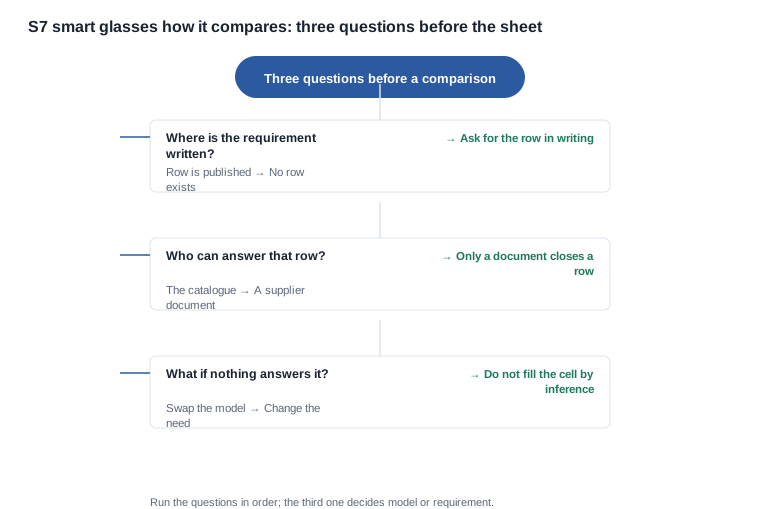
Worked against the S7, those three questions produce a short and unsentimental answer.
- A requirement for a 13 MP camera row is answered by the catalogue. Three camera pages print it and the S7 is one of them, so the row functions as a class filter rather than a discriminator.
- A requirement for an ingress marking is answered by the catalogue at the same limit: two pages print IP54 and the S7 is one of them. The marking is the published fact; the report behind it is a document to request.
- A requirement for a charging case in the box is not answered for the S7, because the page prints no case row. The third question does the work here: either the programme moves to a page that prints a case capacity, or the requirement changes and the case becomes a packaging decision rather than a product decision.
- A requirement for a colour list for channel artwork is not answered for the S7, and only two camera pages answer it at all.
- A requirement for a wireless radio version is not answered for any camera model, so it cannot separate one camera page from another.
- A requirement for unit weight is answered by exactly one camera page, and it is not this one.
- A requirement for imaging quality, endurance across a working shift, ingress performance or any commercial term is not answered anywhere in the published material, and belongs in the request and the sample rather than on the sheet.
Before a sheet circulates, four groups of lines have to be separated, because they behave differently in front of a customer and in front of a supplier.
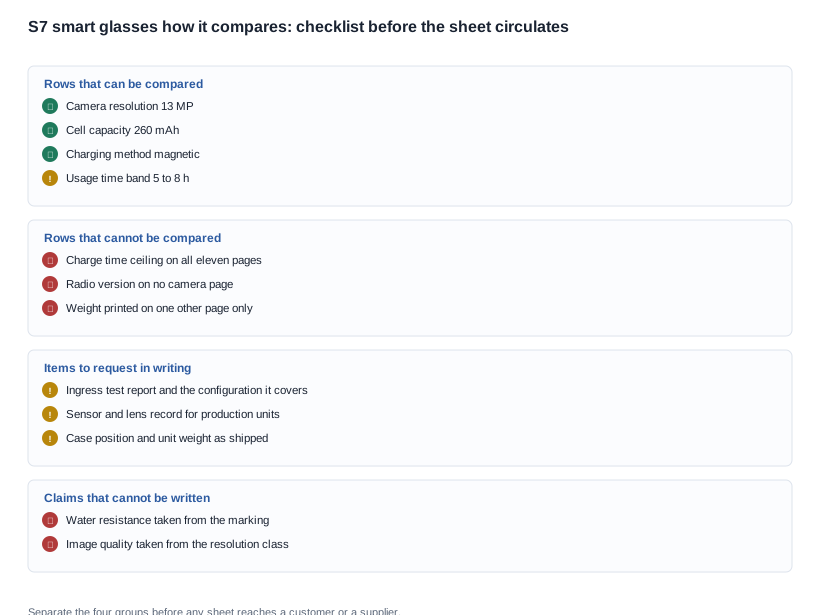
Comparable rows are the ones that exist on both pages in the same shape: camera resolution, cell capacity, usage time, charging time, charging method, and the feature lines where both pages print them. Rows that cannot be compared are the ones where the shape or the coverage differs: a band against a point figure, a ceiling against a measurement, a classification against a tested result, and a figure printed for one model against a blank on another. Items to request are the lines where a document exists but has not been printed: the ingress report, the sensor and lens record, the radio version, the weight as shipped, the conformity documentation and the case position. And the claims not to write are the ones the printed rows cannot carry: a tested water-resistance result derived from a marking, a quality ranking derived from a resolution class, a radio version carried over from an audio page, a weight carried over from a different product, and any commercial term the catalogue does not publish.
That separation is also what keeps a negotiation honest. A buyer who arrives with four requestable items and two open lines is negotiating a specification; a buyer who arrives with a filled sheet is negotiating against a document that does not exist, and a supplier is right to ask where each number came from. We do not publish a figure we cannot stand behind, so what reaches a buyer from us carries an open marker rather than a blank that reads as a negative answer.
What the S7 does settle is narrower than it first appears. It settles its class position on resolution, its cell figure, its usage band, its charging method, the presence of an ingress marking and of a detachable inner frame on its page, and the absence of a colour row, a radio row, a case row, a weight row and a certification row. What it does not settle is anything about the sensor or the produced image, anything about how the runtime behaves across a working shift, anything about ingress performance beyond the printed marking, anything about mass or geometry, and every commercial term, because the catalogue publishes none of them. Which model to shortlist for a given programme therefore follows from the requirement list rather than from the specification list, and the criteria to apply are simply the three questions above, asked in order.
The S7 smart glasses how it compares
The S7 comparison resolves into a small set of published rows and a long list of requests, and our position is that a row which exists on one side of a comparison only is a question and not a result. We do not publish a figure we cannot stand behind, so what reaches a buyer is a sheet with open markers rather than blanks that read as negative answers.
The request list is worked in a fixed order, and we will keep the specification questions ahead of the commercial ones. The specification questions go first, in writing, in the same message as the sample order, because they determine what is actually being bought: the ingress report and the configuration it covers, the sensor and lens record, the radio version for the production units, the charging-case position, the weight as shipped and the conformity documentation for the finished product. The commercial questions follow, because they are conditional on the specification answers: unit pricing at each volume tier, minimum order quantity, lead time from the point the order and the artwork are confirmed, incoterms, payment terms, the warranty period that applies to the frame and to the cell, and how a repeat order of one configuration would be handled. For a private-label programme, packaging, artwork approval and tooling ownership belong in the same agreement rather than in the behaviour of whoever packs the first shipment. The sport smart glasses range page is where the camera models sit in the wider line, and it is worth reading before a requirement list is written, because a requirement that another model answers outright is a requirement that should not have reached this stage.
The second question in that decision frame — whether the remedy is a different model or a changed requirement — is the one buyers most often skip, and it is where the published rows earn their keep. When a requirement is a charging case in the box, the S7's page does not answer it, and the answer is to change either the model or the requirement. When a requirement is a 13 MP camera row, the catalogue answers it three times over and the decision moves to the rows that are not printed. When a requirement is an ingress marking, the catalogue answers it twice and the document request does the rest. A buyer who knows which of those three situations they are in before the request goes out gets answers that can be set against the next model on the shortlist, which is the only comparison a procurement team can actually use.
For the s7 smart glasses how it compares question, the finished article is a sheet with no invented cells: one column for the published value, one for the document that confirms it, and one for the source of that confirmation. Send the question list with the sample order, keep the answers and the documents in the same file as the specification, and the comparison stops being an opinion and becomes a shortlist you can act on.
Related reading
- The rows themselves, printed and marked — every row the S7 page prints
- Where this model's own page stops short — S7 limitations worth knowing up front
- The same method applied to a different camera model — how the V03 Pro compares across the range
- The nearest camera page to compare against — the S7 and V06 row by row
- The duration rows in detail — the duration rows for the S7


