

Most product limitations are described as faults, and that framing is unhelpful to a buyer. A limitation in this sense is not a defect: it is a boundary in the published evidence that will shape a decision later, usually after the purchase order has already been placed. The practical value of listing limitations is not discouragement but sequencing, because each open boundary corresponds to a specific question that is far cheaper to ask in writing than to discover in the field. The interesting cases are the ones where nothing looks wrong on the page, and the S7 is one of them. Its catalogue page prints nine rows and stops there, leaving six questions that every buyer ends up asking anyway. The count is worth reading carefully, because the resolution is stated twice, once in the pixel row and once in the feature rows, so the page carries nine lines and eight separate facts.
S7 limitations: what the published rows cannot settle
A published specification row answers one question and implies a family of others. Reading a page accurately means knowing which kind of answer you are holding, because the three kinds behave differently once the order is placed. Some rows carry an exact value, which can be written straight into a specification sheet. Some rows carry a range or an upper bound, which fixes a ceiling but not a typical figure. Some rows carry a qualitative label with no test scope attached, which describes an intention rather than a result. The limitations of a model live mostly in the third group, and partly in the second.
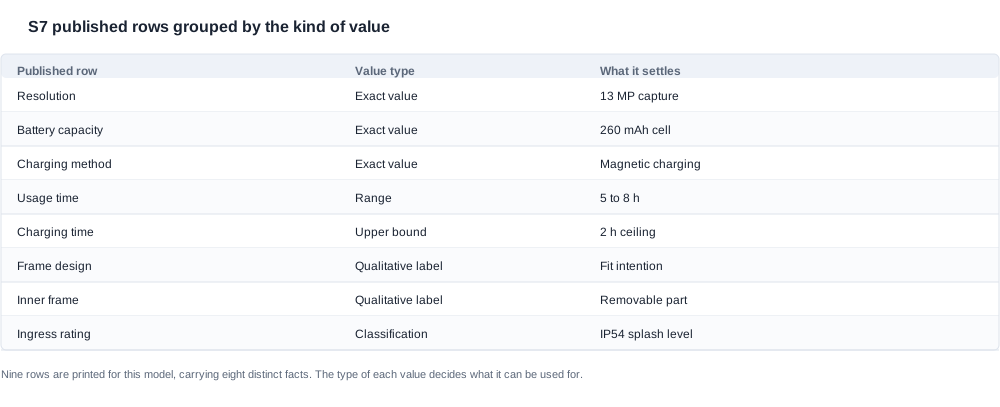
The table above sorts the eight distinct facts of this model into those three kinds, and it is the fastest way to see which questions the page already answers and which it merely appears to answer. Only four of them are exact values. Two are bounded or ranged. Two are qualitative. A buyer who treats all eight of them as commitments will build a specification on two labels that carry no measurable meaning.
The silent rows are the first limitation, and they are worth listing precisely because a vague impression of completeness is what causes trouble. The page prints no Bluetooth version, no unit mass, no sensor model, no field of view, no charging case row, and no certificate identifier. Each omission has a practical consequence:
- Without a published Bluetooth version, a buyer cannot state the radio baseline in a channel document, and cannot check whether a paired accessory will behave as expected.
- Without a published mass figure, comfort and all-day wear cannot be judged from paperwork, only from a sample in the hand.
- Without a published sensor model and field of view, the camera row cannot be turned into an imaging specification.
- Without a case row, the charging accessory that carries the magnetic contacts is itself unspecified, including its capacity and its protection.
The second limitation is the bounded rows. The usage time is printed as a range of 5 to 8 h, and the charging time as 2 h maximum. Neither is a typical figure. Across the catalogue, twenty-six of the twenty-eight models print a 2 h charging ceiling and only two print an approximate 1 h, so a 2 h entry is the outer bound of a category rather than a measurement of this unit. The same pattern holds for the charging method: magnetic charging is printed on seventeen models, Type-C on seven, and left unstated on four. Reading "2 h" as "charges in two hours" is the single most common misreading in camera-glasses procurement.
The third limitation is the qualitative rows. "Ergonomic design" and "IP54" both appear as short labels. The first describes an intended result, and the second describes a classification whose test scope is defined elsewhere. Two further rows deserve a note: not one model in the catalogue carries a capacitive control row, and no model carries a translation row either, so neither can be assumed from a camera specification or from a feature summary.
Turning all of this into a workable question list is straightforward, and it is the part worth doing before ordering:
- Take the eight distinct facts and mark each one as exact, bounded, or qualitative.
- Add every silent row to the list, with the reason you need it.
- Rank the silent rows by what they would change in the specification, not by how interesting they are.
- Send the list as one written request with the sample request, and mark each answer with its source.
- Keep the answer and the document behind it in the file, so the next order starts from a record rather than from memory.
If a buyer wants the published surface of this model laid out row by row before working through the gaps, the full specification and feature reference is the companion read, and the battery and charging discussion covers the two bounded rows in more detail.
One distinction is worth holding on to, because it decides who needs this list at all. A limitation of the evidence is a problem for whoever writes the specification; a limitation of the hardware is a problem for whoever uses the unit. Only the first kind can be closed with a document, and only the first kind should be raised as a question to a supplier. Mixing the two produces the opposite of what a buyer wants, because it invites reassurance in place of evidence. The quick test for how to evaluate any limitation is simple: can the answer be a document? If yes, it belongs in the list above; if no, it belongs in the sample plan. The rows on this page fall almost entirely into the first category, so they say more about how much is published than about how the product behaves in service. Schedule the two reviews separately, so that neither borrows confidence from the other.
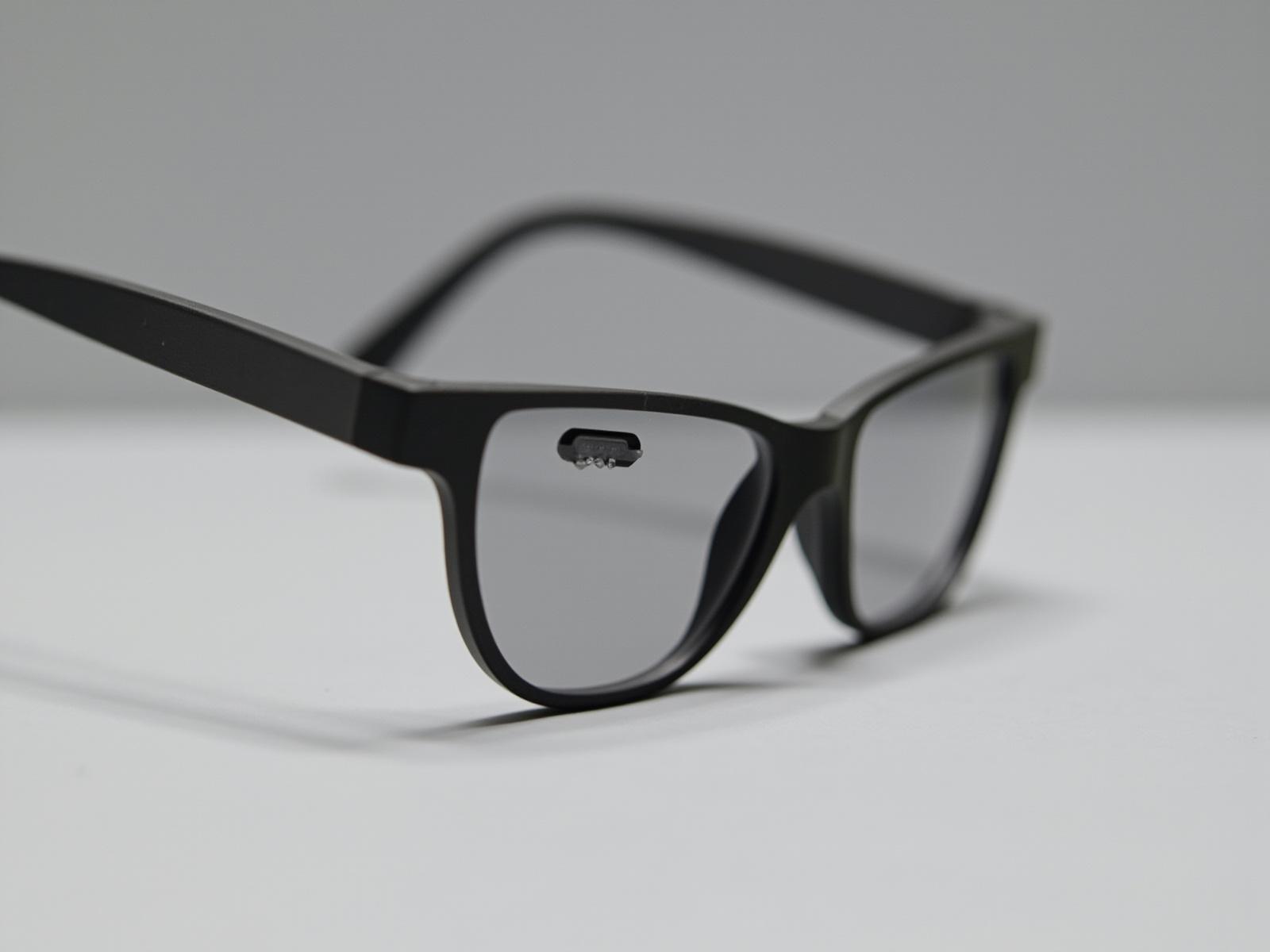
Misconception one: 13 MP and what it does not prove
The first misconception is the most expensive one, because it travels from the spec sheet into marketing copy and then into a customer promise. The misconception reads like this: the camera row says 13 MP, therefore this unit takes better pictures than the 8 MP units beside it, therefore the figure settles the camera comparison. Nothing in the printed evidence supports any of those steps.
What the row proves is narrow and true. It proves that the image is captured at thirteen megapixel, and that is the end of the claim. It does not prove a sensor model, a lens, a stabilisation system, a video format, a frame rate, a field of view, or any behaviour in low light. The catalogue publishes a resolution figure and stops there, and it does the same on every model in the library.
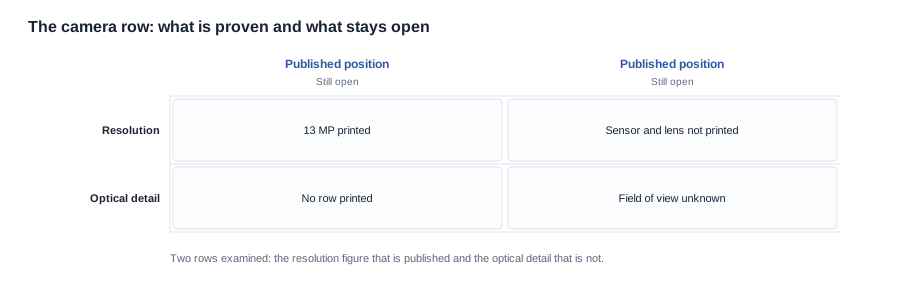
The scarcity argument does not rescue the misconception either. Thirteen megapixel is printed on three models in the catalogue, and eight megapixel is printed on eight, including the closest sibling of this model. A figure that appears on three pages out of twenty-eight is not a differentiator that speaks for itself; it is a common entry whose meaning depends on what sits beside it on the page, and nothing is published there.
The cost of the misconception lands in three places. Channel copy built on the number raises expectations that a unit in the hand cannot confirm, because the printed figure says nothing about the assembled system. Customer returns and support contacts then rise against a model that has not failed. And the procurement conversation gets harder, because the buying team is arguing about a number that was never a specification.
Closing the gap takes a short, ordered set of questions:
- Ask which sensor and lens are fitted to the units you would receive, and whether that pairing is fixed.
- Ask for the field of view, and for the video format and frame rate, if any, in writing.
- Ask what is documented about image processing and low-light behaviour, and accept the answer only in a form you can file.
- Compare the answers against a sample rather than against the resolution figure, and treat any mismatch as a red flag rather than as noise.
Two things to keep out of the requirement list entirely. There is no capacitive control row anywhere in the catalogue, so a touch, gesture, or tap interface cannot be assumed for this model or for any other. And there is no translation row anywhere, so a translation capability cannot be written into a specification on the strength of the catalogue. If either is wanted, raise it on the written question list and attach the answer.
Our camera imaging notes set out the imaging parameters a buyer normally needs beside a resolution figure, and the S7 value discussion covers how the camera row should and should not be weighed against the other published rows.
A related trap sits on the other side of the comparison. Buyers often treat a competitor's specification sheet as more reliable because it carries more fields, when in practice a longer sheet is usually a longer marketing document. The question that holds up is not which sheet is longer but which sheet is traceable: which values come from a defined configuration, which are the manufacturer's own commitments, and which are inherited from a component supplier's data sheet. On that basis this model is not thin so much as explicit. The thirteen megapixel figure, the 260 mAh capacity, the 5 to 8 h range, the 2 h charging ceiling, the magnetic charging method, the ergonomic row, the detachable inner frame, and the IP54 marking are all stated without hedging, and a buyer who needs more than those eight values can ask for them in a form that can be filed. That is a better starting position than a specification that looks fuller than it is, and it is why the sample carries more weight for this model than the printed page does.

Misconception two: IP54 and what it does not cover
The second misconception is older and more durable: an ingress marking is read as a promise of water resistance without limit. The usual reading of the digits is that the first covers solid particle protection and the second covers water ingress at a splash level. That is a modest claim, and it is routinely inflated in conversation into "waterproof", which usually implies immersion, rinsing under a tap, or surviving a washing mistake.
None of those is what the marking means. It does not describe immersion, it does not describe a high-pressure jet aimed at the unit from any direction, and it does not describe salt water or prolonged exposure to a wet environment. It also says nothing about drop or impact resistance, which is a separate test with a separate marking. When a buyer writes "waterproof" into a specification on the strength of this row, the specification has quietly become stronger than the evidence, and the mismatch usually surfaces in the field rather than in the sample room.
The geometry of this particular model makes the scope question sharper rather than softer. Two features of the printed rows sit close to the ingress claim. The inner frame detaches, which means the unit has a seam that is closed in one configuration and open in another, and a rating written for one configuration says nothing about the other. The charging method is magnetic, which means the contacts are exposed whenever the unit is not on its accessory. Neither point makes the marking worthless; both make it a question about the assembled product rather than about a number in isolation.
The same reasoning applies to the charging accessory. This model prints no case row, which places it in a group of three models in the library that print none, alongside models where a case capacity is printed in mAh and models where the presence of a case is stated without a figure. Since the docking accessory is what carries the contacts, an unspecified accessory is an open row on the protection question.
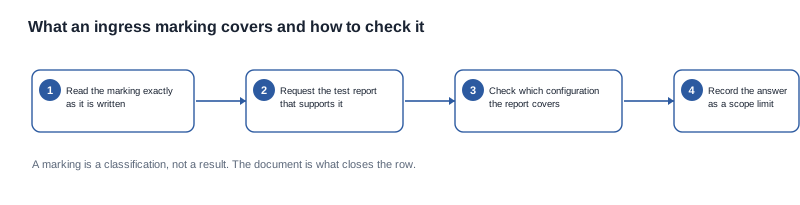
The verification path is deliberately short:
- Read the marking as it is written, and write it into the specification in exactly those words.
- Ask for the test report behind the marking, and keep the document.
- Check which configuration the report covers, whether that is the bare unit or the assembled unit with the inner frame fitted.
- Ask what the marking does not cover, and record the answer as a limitation rather than as a defect.
- Ask whether any reworking for a particular market changes the marking.
One point about documentation is worth stating plainly. The certification page in the catalogue is a set of patent images rather than a text list, and no certificate identifier is printed against this model. That means the ingress marking sits outside any numbered document in the published material, and the report has to be requested separately. Buyers who need the background on how these markings are structured can use how an ingress rating is put together, and which compliance documents to request covers the document set when a model uses certification language at all.
Misconception three: an ergonomic frame and what it leaves out
The third misconception is the most human one. "Ergonomic design" is read as a comfort guarantee: the frame will fit every wearer, it can be worn all day, and the fit question is closed. The printed rows do not say that. They say ergonomic design, and they say the inner frame is detachable, and that second statement is the one with commercial content, because a separable component can be changed, replaced, and stocked.
What the pair of rows leaves out is substantial. The page prints no unit mass, so the weight argument that usually accompanies a comfort claim cannot be made from paperwork at all; the catalogue prints a mass figure for exactly one model, and it is not this one. The page prints no colour row, so the cosmetic options for this model are an open question, even though two models elsewhere in the library do print colours. And the page prints no case row, so the accessory that would normally hold the unit, the spare inner frame, and the charging contacts has no published specification.
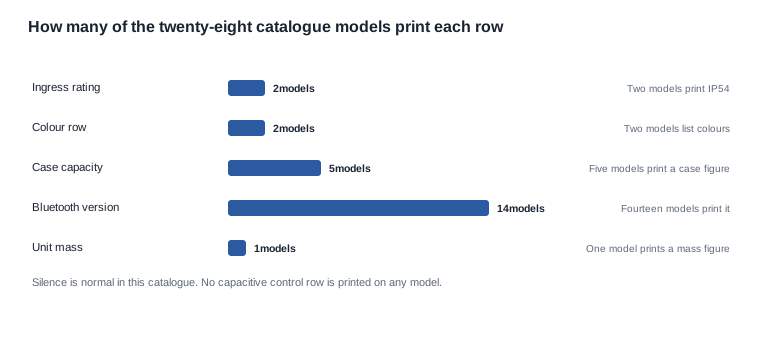
The bars above put those silences in proportion. Across twenty-eight models, an ingress rating appears on two pages, a colour row on two, a charging case capacity on five, a Bluetooth version on fourteen, and a mass figure on one. Silence is the normal condition of this catalogue, not a mark against a particular model. That matters for how you approach a supplier: the useful question is not why the page is incomplete, but which of the open rows will change your programme.
The detachable inner frame, meanwhile, commits a buyer to three things that have to be confirmed rather than assumed. The first is availability of the component itself, in the quantities a rolling programme needs, rather than in a single sample lot. The second is interchangeability, whether one inner frame option fits the same outer shell across the range you intend to sell. The third is documentation of the fitment rule, because a swapped-in component that is not the identical part reopens the ingress question from the previous section for every unit in the field.
The criteria to apply are therefore narrow and practical:
- Ask which inner frame options exist for this model, and whether the option list is fixed or open.
- Ask how spares are supplied and how they are identified, and keep the identification rule in the file.
- Confirm whether the inner frame and the outer shell are separately identified parts in the documentation.
- Treat fit and comfort as sample questions, and do not close them from the print.
For how this model behaves in day-to-day use, the S7 comparison piece covers the practical side, and S7 versus V06 specification comparison is useful when the frame question is the deciding one between two closely related pages.
Where CYNRIN stands on the S7 limitations
The sharpest gap on this model's page is a missing document rather than a missing number: IP54 is printed, and no test report number is published against it. We publish the values we can commit to, and we do not fill the empty cells with figures that would be convenient rather than true. That is why this model prints nine rows rather than a longer list, and it is why we do not read an ingress marking as a test report or a resolution figure as an imaging specification. Where a question can be answered in writing, we will answer it in writing, with the document attached.
Three limits of that position should be stated as plainly as the rest. First, some questions are genuinely open rather than deliberately conservative: the sensor model and the field of view are not published for this model, and no answer we can give today would make them published rows. Second, our published material is the catalogue, so a claim that exists only in a conversation, a sample, or a photograph is not yet part of the specification. Third, a limitation here describes the evidence, not the product, and a well-run sample review can close more rows than any number of written questions.
The checklist below is the version we would hand to a buyer who wants to turn this model into a specification:
- Sort the eight distinct facts into exact, bounded, and qualitative, and write each one into the sheet with its own wording.
- Add the six silent rows as questions, ranked by what they would change.
- Ask the camera question, the ingress question, and the frame question as three separate written requests, because each one is closed by a different document.
- Check the answers for the usual red flags: an ingress claim with no test report behind it, a pixel count with no sensor attached to it, and a comfort claim with no part number on it.
- Hold the sample against the answers, and record what the sample contradicts.
- Keep the answers, the documents, and the sample notes in one file, so the next order repeats the work instead of repeating the questions.
If your programme is rolling rather than a single order, add one more item to that list: name the components you would need to hold as stock, and separate them from the components you would order on demand, because the availability of spares changes the total cost argument more often than the hardware does.
The last practical step is the one that closes rows fastest. Send the question list with the sample request and the specification discussion you want to run, and we will work through the answers line by line rather than in summary.
Related reading: S7 specifications and features in full, S7 battery life and charging explained, S7 versus V06 specification comparison, ingress protection ratings explained, and camera imaging technical notes.


