

Buying the S7 smart glasses is a judgement about a quoted configuration, not about a catalogue entry, and the distance between those two things is where most of the value argument in this product family goes wrong. The published material for this model is short and specific: four quotable figures — 260 mAh of cell, an endurance band of five to eight hours; a charge ceiling of two hours or less; and a thirteen megapixel camera class — plus a charging method, a frame description, a removable inner frame and an IP54 marking. Nothing on that page carries a price, an order floor, a production timetable, a warranty term or a certificate number, and the catalogue's export certification page consists of patent images rather than a per-model compliance record. So the question a procurement team actually has to answer is not whether the S7 is a sound purchase — that question cannot be settled from published material — but what is present on the quotation when it arrives, and what has been settled by silence rather than by a decision. This page is written for the buyer assembling that quotation, and for the reseller who has to argue for the S7 on a shelf with no price ladder to point at.
What the S7's published rows can and cannot settle
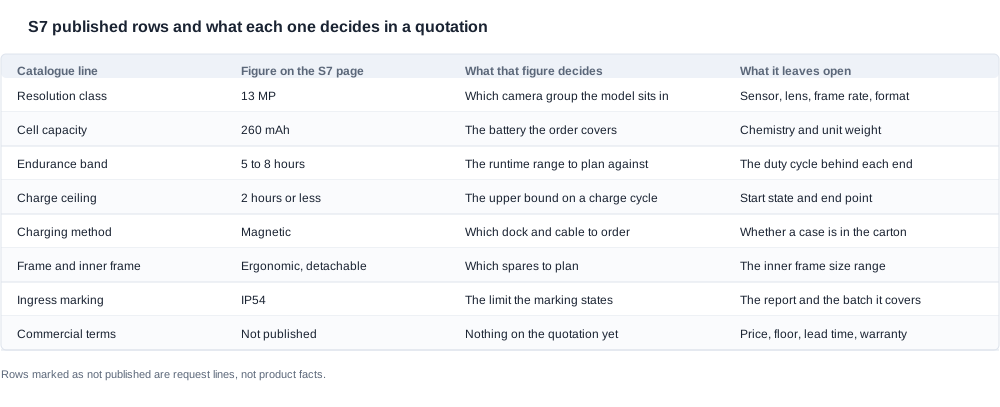
The nine printed lines fall into three groups, and the group a line belongs to determines what a buyer can safely do with it. The count is worth reading carefully before anything else: the resolution appears twice — once as the pixel class and once as a feature line — so nine rows carry eight distinct facts. The first group is quotable as it stands: the cell capacity of 260 mAh, the endurance band running from five to eight hours, the charge ceiling of two hours or less, the magnetic charging method, and the thirteen megapixel resolution class. A sixth line — the detachable inner frame — belongs to a second group, because it names a feature without publishing the size range, the material or the interchange rules that a parts programme needs. The second group also holds the three other printed lines that are neither values nor omissions: the pixel count repeated as a feature line, the ergonomic design descriptor and the ingress marking. The third group is everything the page leaves out, and it is the largest of the three: no unit weight, no dimension, no temple length, no colour list, no radio version, no charging-case line, and no camera detail beyond the resolution class.
The distinction matters because a quotation is read as a set of commitments. When the factory writes 260 mAh onto a quotation line, the buyer is entitled to treat that cell as the one that ships. When the factory writes nothing at all, the buyer is entitled to nothing in particular, and the gap transfers silently onto the buyer's own specification, onto the packaging artwork and onto the channel claim. That is the mechanism by which an unquoted line becomes an expensive one, and it is why a value argument built on published rows alone is a value argument about the published rows alone.
What the catalogue publishes settles a second question, which is the composition of the order. A thirteen megapixel class tells a buyer that the model belongs with the three camera models rather than the eight that sit at eight megapixel, and it tells a brand owner that the storage, the transfer and the file-handling arrangements attached to the product are part of what is being bought. A 260 mAh cell in a magnetic-charging arrangement tells a buyer that the charging dock, the cable set and the spare-unit policy are all part of the same line. A detachable inner frame tells a buyer that spares are a real category in this order rather than an afterthought, and a spare programme has its own minimum order quantity, its own packaging artwork and its own shelf life that nobody has published. None of that is a value claim. It is a statement about which parts of the bill of materials are fixed before the quotation and which are still open when it arrives.
What the catalogue does not publish is at least as informative. The absence of a colour list is worth noticing, because the S7 sits beside a model that prints four colour names, and a brand owner ordering shelf stock needs to know whether colour is a variable on this product at all. The absence of a radio version is worth noticing, because every model in the audio group prints one and the eleven camera models print none, so the radio behaviour of a camera unit is a question rather than a specification. And the absence of any camera detail beyond the resolution class means the image claim cannot be built from the page. How a buyer should approach that last gap is set out in more detail in the note on the limits of what the S7 pages print, and the practical reading of the resolution row is covered in the S7 page row by row.
Where the S7 sits against the models that publish a case capacity
The charging case is where the eleven camera models separate from one another, and the S7 belongs to a specific group inside that separation. Five camera pages print a case capacity as a figure: 1400 mAh on the CY05 and the L1 Pro, and the CY03, a 900 mAh / 1400 mAh pair on the L2 Utral page, and a 1200 mAh folding case on the MT6. Two more pages name a case without attaching a number to it — the KY06 and the MT5. The remaining four, which are the V03, the V03 Pro, plus the V06 and the S7, carry no case line whatsoever on their pages.
That last arrangement is the one that matters for this model, and it is easy to read backwards. A blank line is not a published negative. Nothing in the catalogue states that the S7 is supplied with a case, and nothing in it states that the S7 is supplied without one, and the only honest description of the position is that the question is open. The commercial consequence is direct: the buyer cannot know from the page whether the carton contains one charging accessory or none, whether a case needs to be added to the bill of materials as a separate line, and whether the retail packaging for the S7 has to be designed around a case that may never arrive. The correct treatment is a written request, and the answer belongs in the quotation as a line in its own right, because a case that turns out to be absent after the packaging artwork is committed is a packaging rework cost, not a minor accessory question.
Against the models that do publish a capacity, the S7's position is therefore structural rather than comparative. It cannot be placed on a ladder of case sizes, because it prints no rung. It also cannot be placed on a ladder of models without cases, because that ladder would have to be constructed from silence. The only honest grouping is the three-state one: a printed capacity, a named case without a figure, and no line at all. Buyers who need a case in the carton should say so in the request, and should treat the S7's silence on the point as an open line on the quotation rather than as a specification to be assumed in either direction. The way a charging case changes the commercial arithmetic is examined in the S7 charging case overview.

The three gaps that decide whether the S7 is worth quoting
Three gaps between the published page and a shippable configuration carry most of the risk. They are worth naming separately, because each one has its own remedy and its own point of failure, and because collapsing them into a general request is how a quotation comes back with two of the three still open.
The first gap is the carton. The S7's page prints no case line, and neither does the V06's, so the accessory set for this model is entirely undefined in published material. The question to put in writing is not whether a case exists but what the carton contains: which items ship in the box, which are ordered separately, and whether the packaging artwork is drawn against a case that is not yet confirmed. The reason to raise it before the order rather than after is that artwork and BOM changes are expensive to unwind once tooling is committed, and because the answer determines whether the accessory line is a cost line or a packaging line on the quotation. A request that asks only "does it come with a case" will often be answered with a yes or a no; a request that asks for the carton contents list will produce something a buyer can put in a purchase order.
The second gap is mass. One unit weight is published anywhere in the catalogue, and it appears on a page for another model, which lists 158 g for the MT6 eyewear body and leaves the folding case out of that figure. Nothing is printed for the S7. That single fact leaves an entire category of downstream work unstarted, because shipping weight drives the freight calculation, the carton size drives the pallet and container plan, and the master carton dimensions drive the warehouse slotting. The request should ask for the weight as shipped, in the packaging configuration that will actually be used, and for the master carton dimensions separately from the retail unit. A buyer who asks for "the weight" and receives a bare-frame number has gained a figure that cannot be used for freight, because a frame weight and a shipped weight answer different questions.
The third gap is the endurance condition behind the band. The page prints five to eight hours. That is a band, and a band is the correct way to publish a runtime, but it does not say what workload produced the figure at each end. Continuous video capture, intermittent stills and a mixed workload with the wireless link up will not produce the same result on the same cell. The same applies to the charge ceiling: two hours or less says the upper bound, not how long a typical charge takes, and it does not say whether the clock starts from an empty cell or from a part-charged one. The request should ask for the test condition behind each end of the band, the duty cycle behind the figures, and the state at which a charge is considered complete. A quotation that carries the band without the condition is a quotation that carries an assumption.

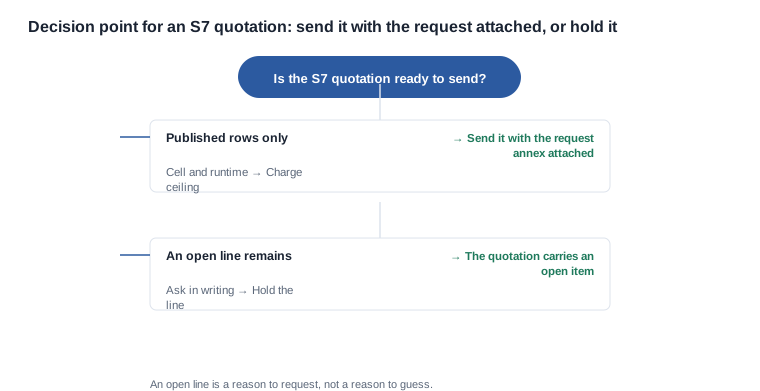
These three gaps share a property that makes them manageable: none of them is unusual, and none of them is refused. A factory that has quoted a camera product before has an answer to all three and simply has not been asked for them on the catalogue. The commercial risk comes from sequencing, not from the answers themselves. The remedy is to attach a request annex to the enquiry, list the three gaps on it, and require the answers to be returned as part of the quotation rather than as a separate email thread, so that the answer and the price are read against the same version of the configuration.
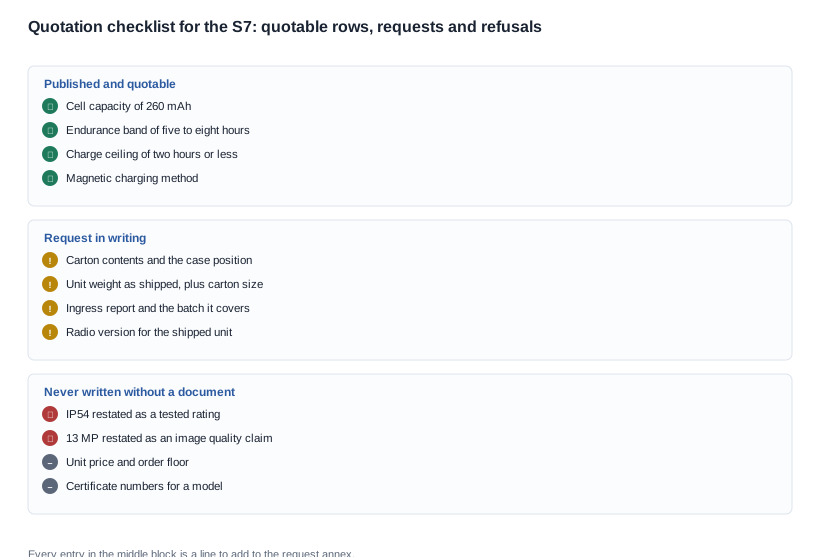
A single annex can carry the whole set. The lines below are the ones that move this model from a catalogue entry to a quotable configuration:
- The complete carton contents, with the charging case position given in words rather than left blank.
- The weight of the packed unit, and the outer carton dimensions listed on their own.
- The test condition behind each end of the five to eight hour band, and the duty cycle behind the figures.
- The state at which a charge is treated as complete, and the state the cycle starts from.
- The ingress test report, with the laboratory, the standard and the sample batch it covers.
- The radio version fitted to the units that actually ship.
- The size range and material of the detachable inner frame, and the route by which spares are ordered.
- The unit price, the order minimum, the production lead time, and the warranty terms as they apply to the frame and to the cell.
One request annex, eight lines on it, one reply. The value of sending them together is that the answers come back against a single configuration version rather than accumulating across a thread, and that a line nobody answers stays visible in the reply instead of being inferred later. For a buyer assembling a shortlist, the unanswered lines are themselves a criterion: a model that answers all eight of those request lines is a model whose configuration can be compared, while a model that answers two is a model whose configuration has to be negotiated line by line, which is a different commercial conversation and usually a different one in cost as well.

What would change the S7's position on a quotation
A value argument for this model improves in a predictable way once the open lines are closed, and the criteria for judging that improvement are worth writing down before the first request goes out rather than after the first quote arrives.
The first criterion is completeness of the accessory set. Once the carton contents are confirmed, the S7 can be compared against any other camera model on the same basis, because the comparison no longer depends on an assumption about what is in the box. The second criterion is the weight and packaging data, which converts the product from a specification into something a logistics plan can be built on. The third criterion is the endurance condition, which converts a band into a figure a deployment team can plan shifts against. These three are the ones that change the position of the S7 on a quotation, because each of them removes a line of assumption rather than adding a line of specification.
A second set of criteria governs how two quotations are compared against each other, which is a different exercise and a common one for a brand owner evaluating the same requirement across models. The first rule is to normalise the configuration before the numbers are read: same colour count, same inner frame quantity, identical case treatment, one packaging specification, the same accessory line, and the same order quantity. A quotation that includes a spare inner frame programme cannot be read against one that does not, because the second is not the same product. The second rule is to separate the lines that are fixed from the lines that are quoted, and to price the two separately, because a tooling element and a per-unit element are often bundled into one figure that hides which is which. The third rule is to make the payment nodes, the inspection criteria and the warranty response part of the comparison, since acceptance criteria written into the agreement are worth more to a buyer than the price difference between two quotes.
There are also warning signs worth naming, because they tend to show up in the space where a value argument is being put together. The first is a quote that answers the case question with a specification on another model. The second is a quote that supplies a weight without saying whether it is a frame weight or a shipped weight. The third is a conformity claim with no certificate number and no model schedule attached, which is a claim rather than evidence. The fourth is a volume tier that exists in the quotation but not in any document behind it. None of these are reasons to walk away from the S7; they are reasons to send the request annex and let the answers settle the comparison. The certification side of this, in more detail, is covered in the S7 certification status and what it does not state.
How CYNRIN positions the S7 inside the sport range
The S7 publishes four quotable figures and nothing that can be ordered from, which is the shape of the value case: the page settles what the unit is, and the quotation settles what it costs. We publish the rows that we can stand behind, and on everything else we would rather hand over a quotation with a visible gap in it than a sheet carrying a number we cannot defend. That is why this model prints nine lines and not a longer list, and it is why the page carries no price, no order floor and no lead time. Those are commercial terms, and they belong to a quotation rather than to a catalogue page.
What that means in practice is that we would rather answer the three gaps above in writing, with a document attached, than present the S7 with a claim it cannot support. The S7 publishes eight distinct facts and no more: a resolution class, a cell capacity, an endurance band, a charge ceiling, a charging method, a frame description, a detachable inner frame and an ingress marking. Everything a buyer needs to judge whether those nine lines are adequate is published; everything needed to judge what the configuration will cost is not, and we do not pretend otherwise.
The sport range itself contains a structural point that is easy to miss and useful to a buyer. The S7 and the V06 share the same power rows, the same frame descriptors and the same ingress marking, and they separate on the resolution class and on the colour list. The YKC02 and the D17 are a different product class altogether, and comparing them to the S7 on price is a category error rather than a judgement — the reasoning is set out in the YKC02 form factor note. The useful way to read the range is as a set of published structural groups: eleven camera models, eight in the audio group, three in the sport group, and the S7 sitting in the camera group with a thirteen megapixel class.
If you are preparing a request for this model, the sequence that tends to work is short: attach the published rows, list the three gaps, ask for the answers in writing, and require the returned quotation to carry the answers as lines of its own. If you want the published material behind the numbers in one place, the S7 review sheet for factories sets out the same nine rows in a form you can put in front of a factory. The S7 is a model whose published position is clear, and the value of it is decided in the quotation rather than in the catalogue, which is the correct place for that decision to be made.


