
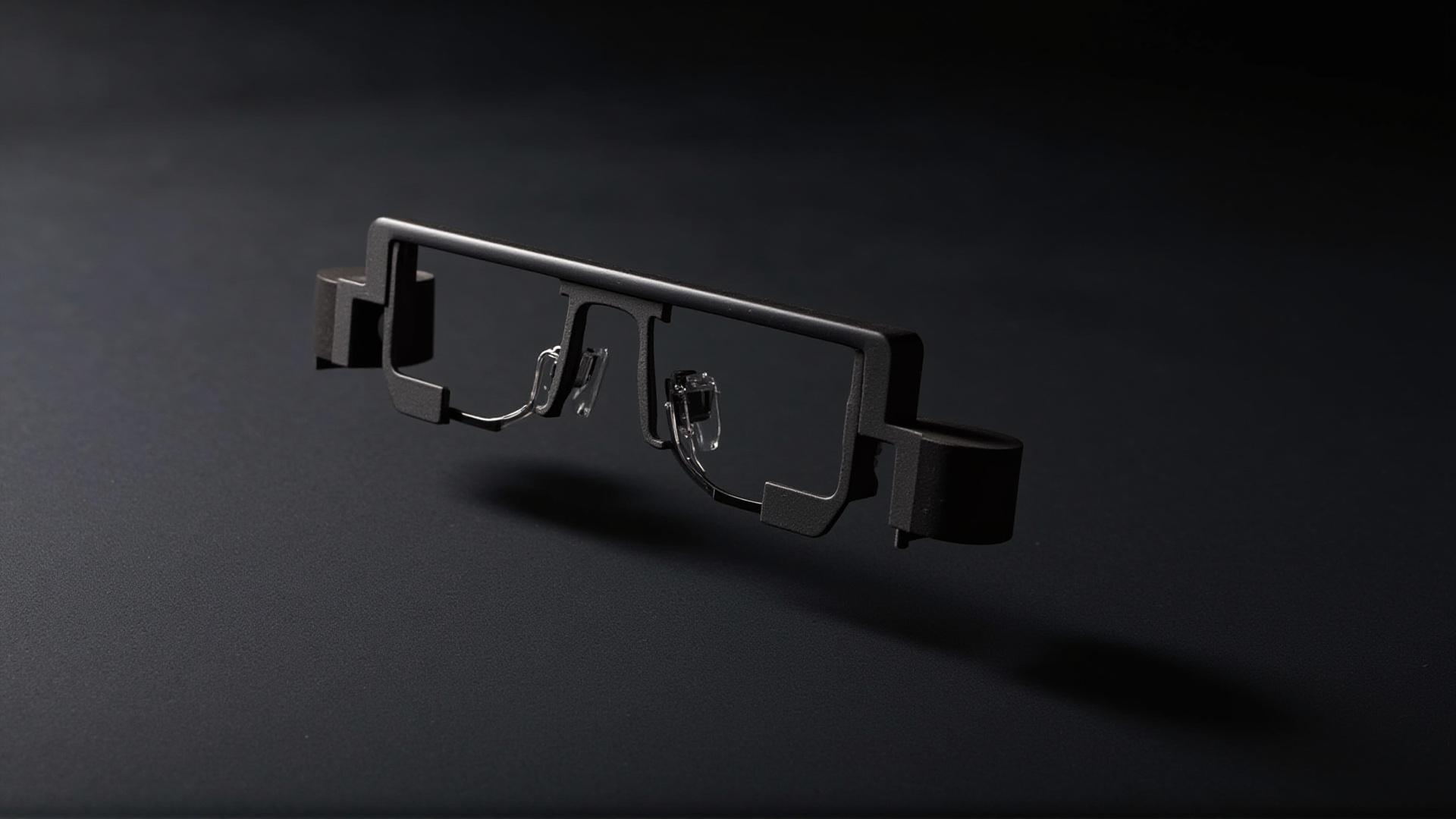
Positioning the S7 smart glasses against the D17 on price is not a question the published material can answer, and the reason is worth stating before anything else. No unit price, no volume tier, no order floor, no production timetable and no warranty term is published against any model in the catalogue, the S7 and the D17 included, so there is no ladder on which the two could be placed. Underneath that, the two models do not sit on the same rung of the same requirement in the first place. The D17 carries a remote shutter and a surround sound descriptor and belongs to the sport group of this library; the S7 belongs to the camera group, publishes a thirteen megapixel resolution class, a detachable inner frame and an ingress marking, and its sport name describes the shape of the product rather than the group it belongs to. Putting a price on a difference between them would therefore be a comparison of two different briefs. This page is written for the sourcing team deciding whether those briefs should share an order, a shelf and a request list, and for the reseller who has to explain the two products without inventing a price relationship that no document supports.
Why the D17 and the S7 are not priced against each other
The most common way this comparison is handled badly is to treat it as a substitution question — as though a buyer deciding between the two is choosing one product over another, and the price difference is the interesting part. The published rows do not support that framing. The two models print almost disjoint sets of attributes, and the overlap between them is limited to the general shape of a device that charges over a cable or a contact and lasts for hours.
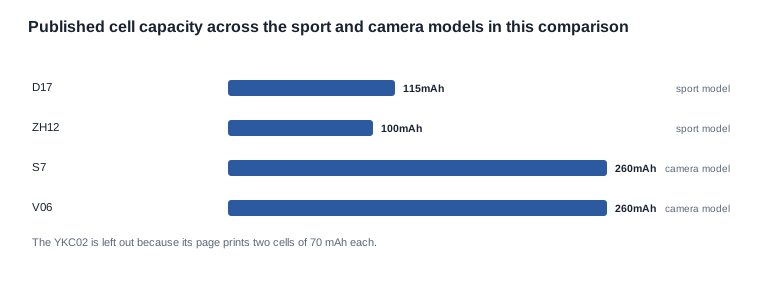
Start with what each page actually carries. The D17 prints a 115 mAh cell, an endurance figure of about seven hours, a charge time of about one hour, a Type-C charging method, a radio version of V5.4, and two feature lines: remote control photography and surround sound. It prints no resolution class, no unit weight, no ingress marking, no colour list, no inner frame and no charging-case line. The S7 prints a thirteen megapixel camera class, an endurance band of five to eight hours and a charge ceiling of two hours or less, alongside 260 mAh of cell, magnetic charging, an ergonomic frame, a detachable inner frame and an ingress marking. It prints no radio version, no colour list, no unit weight and no charging-case line either.
Set those two lists beside each other and the substitution framing collapses, because the requirement that produces a D17 order and the requirement that produces an S7 order are not the same requirement. A buyer who needs a device to stay with an operator for a long session, with a remote shutter in reach, has specified a requirement that the D17's published rows answer and the S7's do not. A buyer who needs captured stills from a moving operator has specified a requirement that the S7's published rows answer and the D17's do not. Neither of those is a price question, and neither is settled by comparing a 115 mAh cell with a 260 mAh cell.
What can legitimately be built from this pair is a positioning of requirements, and that is more useful to a procurement team than a price ladder would be, because it is the only part of the decision that survives contact with a factory. The positioning has three parts: the requirement, the published rows that answer it, and the lines that have to be requested before it can be confirmed. Any two models can be put through that structure, and the output is a shortlist of configurations that can actually be ordered, rather than a ranking that has to be redone when the first quotation arrives with different accessory assumptions.
There is a commercial reason the substitution framing persists. A procurement team is often asked to defend a single order, and a comparison between two models makes that order appear deliberate in a way that a single-model order does not. The risk of that move is specific: a shortlist that mixes models with different published attribute sets produces a comparison sheet whose cells are mostly empty, and an empty cell in a comparison sheet is usually filled by whoever is presenting it. The result is a sheet that appears rigorous and rests on assumptions, and it will be read as a specification.
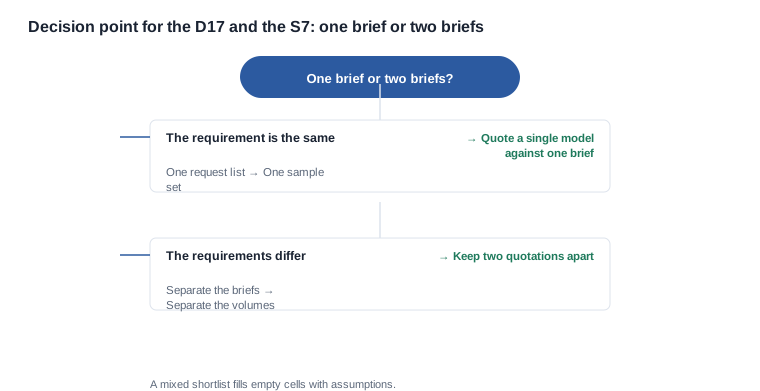
The alternative, which takes longer and survives better, is to quote the two models separately against their own requirements. The D17 gets a brief about endurance, audio, the remote shutter and the charging cycle. The S7 gets a brief about capture, the runtime band, the inner frame programme and the ingress evidence. Each brief carries its own request list and its own acceptance criteria, and the two quotations are then compared on commercial terms — configuration basis, order quantity, payment nodes, inspection and warranty response — which is where a like-for-like comparison is actually available. That comparison is set out in what to ask before comparing two sport platforms, and the group structure the two models belong to is covered in the S7 and YKC02 form factor note.
The published rows that separate the two sport platforms
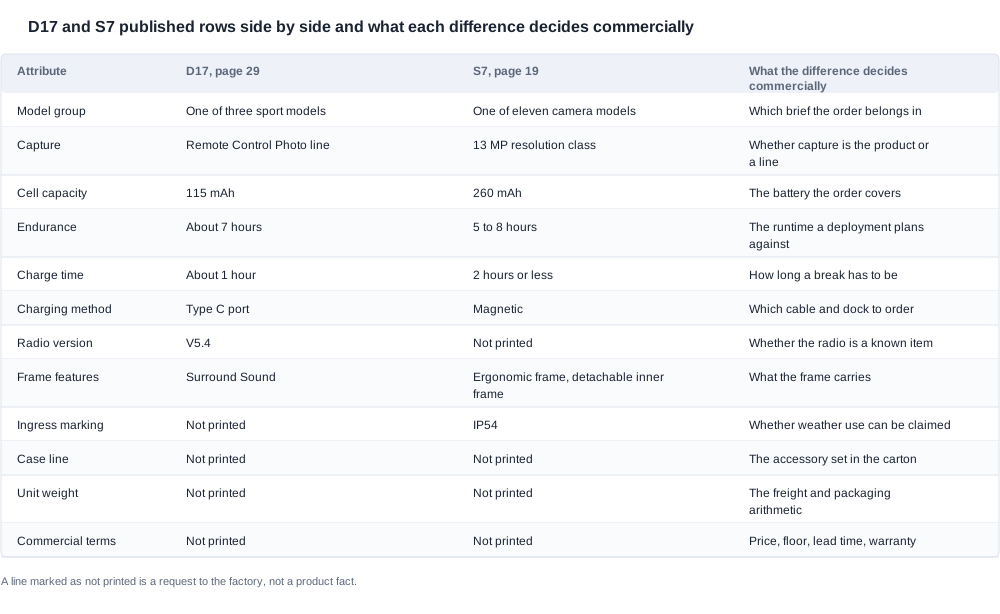
Read as a table, the separation is immediate, and it is worth reading in one view because the two pages publish so little in common that any single row invites misreading. The table below is arranged by what each row does commercially rather than by the order the pages print them, and the last column is the part that matters for a buyer assembling a request.
Two rows in that table deserve a note because they are the ones most often misread. The first is the charge time. The D17 prints about one hour, and the S7 prints two hours or less, and these are not two measurements of the same quantity. One of them is an approximate figure and the other is a ceiling. The catalogue publishes a charge time for every model, twenty-six of them at two hours or less and these two exceptions at about an hour, so a comparison that puts a 1 and a 2 in the same column without the wording is comparing an estimate with a bound.
The second is the remote control photography line on the D17. That page names remote control photography as a feature while publishing no resolution class for it at all, and the S7's page names a thirteen megapixel class in the row a buyer would turn to. These are not two capture specifications, one precise and one vague. One of them is a camera class; the other is a feature line on a page that publishes no imaging row, which means the output of the shutter is not something the page publishes for that model. The treatment differs accordingly: the S7's camera class can go into a specification annex, and the D17's shutter has to be requested with a sample and a written answer.
The third row worth a note is the radio version. The D17 prints V5.4, and the S7 prints nothing, and that is a systematic pattern rather than an omission specific to this pair: every model in the audio group prints a radio version, and none of the eleven camera models does. A buyer reading a comparison sheet with a blank radio cell should not treat it as a gap in one model; it is the normal state of the camera pages, and it is one of the recurring request lines across the whole camera group.

Fast charging on the D17 against camera capture on the S7
Put the two strongest points side by side and the contrast reads like a trade. On one side, the D17 recharges in about an hour over Type-C, which is one of only two charge figures in the catalogue that sit below the two-hour ceiling the rest of the library publishes. On the other side, the S7 carries a thirteen megapixel camera class, a detachable inner frame alongside an ingress marking, which is the feature set a capture-led brief is built on. The temptation is to treat those as two advantages being weighed, and for a catalogue-based comparison that temptation is a trap, because the two advantages are answers to different questions and neither question is priced in the published material.
The charge time is where a real operational difference can be found, and it is a good example of how to convert a published row into a deployment question. A charge time of about an hour means a unit can be back in service within a break, provided the charging contacts seat properly and the cable is present at the point of use. A ceiling of two hours or less means the same thing less precisely: the cycle is bounded, but how long it actually takes depends on the state the battery started in and on when the charger decides the unit is finished. For a fleet where devices rotate between operators on a short break, the first is a planning input and the second is a constraint. Neither tells you the duty cycle behind the endurance figure, which is why the request for the test condition matters more than the charge figure itself.
The capture side of that contrast works the same way round. A resolution class tells you which group of cameras a product belongs to — three pages in the catalogue print thirteen megapixel, eight print eight — and it tells you that storage, transfer and file handling are part of what the product is. It does not tell you how the images come out, and nothing on the S7's page attempts to. The row that would answer that is the row that is absent: the sensor, the lens, the stabilisation, the file format, the frame rate and the field of view, and nothing on low-light performance. So the S7's capture capability is real as a class and unproven as a result, and the only way to close the gap is a sample shot under conditions you specify, compared against a reference, with the comparison written into the acceptance criteria.
Neither of these two advantages has a price attached to it in any published document, and that is not an oversight in the material — it is a deliberate boundary. What a buyer can do is attach the question to the requirement: if the requirement is short-break turnaround, ask the D17 for its charge test method and the endurance duty cycle, and if the requirement is captured stills from a moving operator, ask the S7 for a sample and a written image acceptance criterion. The first question tests the published claim; the second one creates the evidence that the catalogue does not carry.

What a buyer should ask before comparing the two
The request lists for the two models are different, and the discipline that makes them comparable is asking for them in one message against one configuration version. For the D17, the lines worth raising are the carton contents, the evidence behind the surround sound descriptor, the unit weight as shipped, the radio configuration as fitted, and the test condition behind both the seven hour figure and the one hour charge. For the S7, the lines are the carton contents and the charging case position, the ingress test report with its laboratory and sample batch, the size range and interchange rules of the detachable inner frame, the unit weight as shipped, and the test condition behind the five to eight hour band.
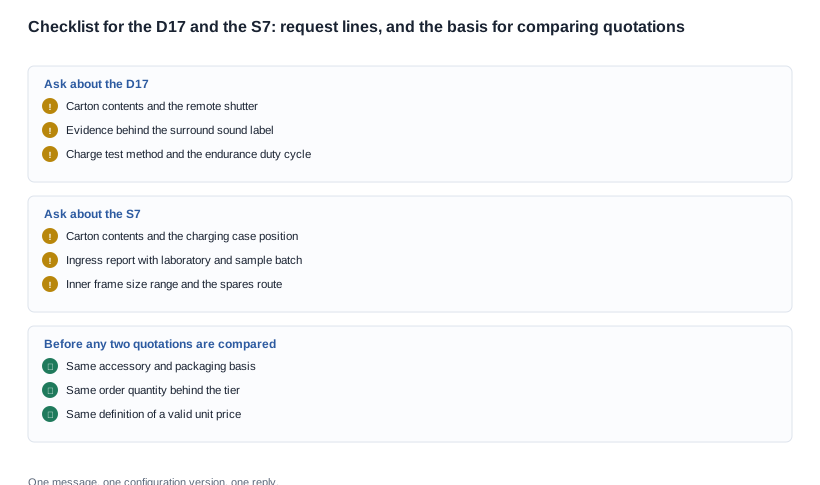
Put on paper, the shared portion of the request is short enough to send as a single annex:
- Carton contents for each model, with the charging case position given in words.
- The weight of the unit as it will be packed, and the master carton dimensions on their own.
- The test condition behind the endurance figure printed on each model.
- The start state and the completion criterion for a charge cycle.
- The radio version fitted to the shipped units.
- The price per unit at the stated quantity, the smallest order the factory accepts, the production lead time and the warranty terms that apply to it.
- The conformity documentation, with the model schedule and the certificate numbers behind it.
Two lines are then added for the D17, covering the trigger method for the remote shutter and the evidence behind the surround sound descriptor, and three for the S7, covering the ingress report, the inner frame size range and its interchange rules. The order of the annex matters less than its completeness: a request that arrives in one message comes back in one reply, and a reply that arrives complete is a reply that can be scored against the criteria rather than against a preferred outcome.
A price comparison between the D17 and the S7 only works if the two briefs describe the same thing. If the two briefs are genuinely different, comparing them is a category error and the comparison should be dropped rather than softened. If they turn out to serve the same requirement — which happens more often than the catalogue structure suggests, because buyers frequently begin from a brand idea and land on a requirement later — then three things have to be normalised before any number is read: the accessory and packaging basis, the order quantity and the volume tier behind it, and the definition of a valid unit price. Two quotations that differ on any of those three are not two prices for one product, and reading them as such is the most common way a sourcing comparison goes wrong.
There are also some red flags to watch for in the returned answers. A charge time given without its test method is a number without a condition, and it cannot be planned against. A weight given as a frame figure is a number that cannot be used for freight. A surround sound descriptor repeated with no acoustic evidence is a marketing phrase rather than a specification. A remote shutter with no stated trigger method leaves the operator interaction undefined. And an ingress marking offered as a general capability rather than as a report covering a named sample batch is a statement about the supplier rather than about the goods.
Two of those red flags deserve a specific instruction rather than a warning. The first is the frame weight: ask for the weight of the unit as it will be packed, and ask separately for the master carton dimensions, because the two numbers answer different planning questions and only the first one is a product property. The second is the remote shutter: ask how it is triggered, what the D17 page means by it, and whether a camera specification for the output exists in a document that has not been published. A written answer that names a document is worth considerably more than a descriptive phrase, because a document can be filed, audited and attached to a purchase order, while a phrase can only be repeated.
Finally, the two questions that are never answered by a product page, and which should be in the request on their own terms: what the carton contains, and what the goods are worth under the commercial terms. For the first, the request should ask for a carton contents list for each model rather than a yes-or-no on a case, because a list can be quoted and a yes cannot. For the second, the request should ask for unit price at a stated quantity, the order floor, the production timetable, the payment nodes and the warranty response for each model, so that the two answers can be placed against the same basis. The S7 certification position, which covers the documentary side of that request in more detail, is set out in the S7 certification status note.
How CYNRIN handles the D17 and S7 comparison
The D17 and the S7 are not two answers to one requirement, and treating them as alternatives misstates both pages. The D17 is one of the three sport models in the catalogue and publishes a 115 mAh cell, an endurance figure of about seven hours, a charge time of about an hour, Type-C charging, a V5.4 radio, a remote control photography feature line and a surround sound descriptor. The S7 belongs to the eleven camera models. Its page gives an endurance band of five to eight hours, a charge ceiling of two hours or less and 260 mAh of cell, then the camera class, the charging method, the frame descriptors and the ingress marking. Neither page publishes a price, and we do not publish one either.
What we do instead is keep the two requirement briefs separate and complete. A D17 brief is answered by the rows on page 29 and by a written request for the rest. An S7 brief is answered by the rows on page 19 and by a written request for the rest. When a customer arrives with a single requirement and asks which of the two to specify, the answer we give is a set of criteria — the one hour charge, the remote shutter, the surround sound, the camera class, the inner frame programme, the ingress evidence — and a note of which model publishes which of them, so that the specification follows the requirement rather than the other way round.
That approach costs a buyer a little more work at the start, and it removes a large amount of ambiguity at the end. It also means the two models can end up in the same order without either one having been sold on a claim that a document does not carry. If you want the whole published row set for the S7 in one place before drafting a brief, the S7 page row by row is the reference, and the S7 review sheet for factories converts it into a request annex. The useful question to put to either factory is not which model costs less, but which of the two published sets answers the requirement in front of you, and what has to be requested before that answer can be relied on.


