

Smart glasses ai features smart glasses key specifications have an unusual property: almost none of them are hardware, and almost all of them are the ones a hardware supplier cannot give you. The published specification for a camera platform in our range is a resolution tier, a charge time, a cell capacity, a rated runtime and a charging method, and those five numbers are comparable across suppliers on the day they arrive. The AI capability sits alongside that as a use case rather than as a set of rows, and the gap between the two is exactly where a sourcing decision goes wrong. So the useful output of this article is a request list: eight rows, the form each answer has to take, and the answer that should make a buyer ask again.
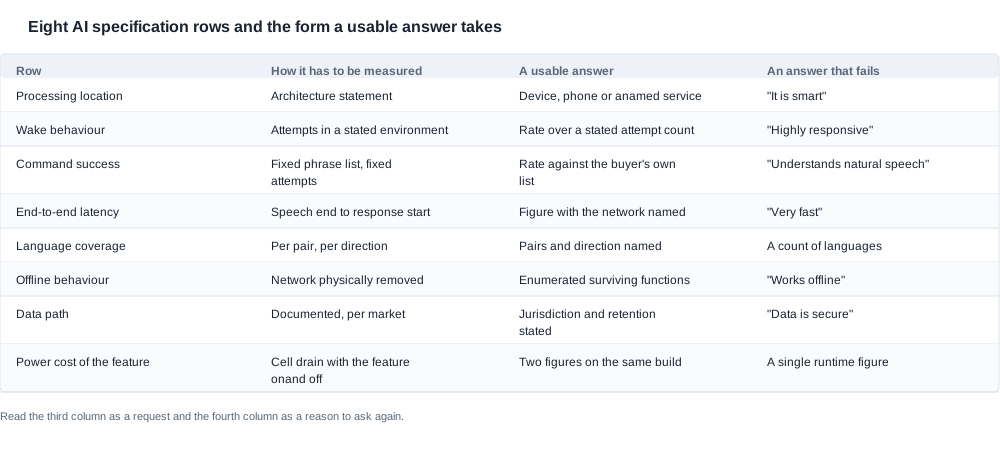
Smart glasses ai features: eight defining rows
The buyer, and the moment the specification gets written
The reader is a product manager, a sourcing buyer or a channel buyer who has just been told that the product needs an AI voice assistant, and who now has to write a specification that a factory can quote against. The moment of maximum leverage is before the request for quotation goes out. After the quotation arrives, the specification is a negotiation about a number somebody else chose; before it, the specification is a list of questions, and the list is the buyer's to choose.
What makes this list unusual is that most of it cannot be answered from a product page. A hardware buyer is used to every row on a datasheet being checkable against a measurement. An AI buyer is used to a datasheet that lists a feature name and stops. The gap between those two experiences is where the specification has to be manufactured, and the method is to write the rows as requests rather than as descriptions.
The second thing that makes it unusual is that the same eight rows apply to every model in the range, whether or not the model has a camera. That is useful: a buyer can write one specification request and send it to several suppliers, then compare the answers in the same shape. That is also how the empty rows become visible. When three suppliers return the same row blank, the buyer has learned something about the category rather than about one supplier.
The eight rows, and the order to ask them in
The rows are: processing location, wake behaviour, command success, end-to-end latency, language coverage, offline behaviour, data path, and the power cost of the feature. The order is not arbitrary — it is the order of dependency, and asking out of order produces answers that cannot be interpreted.
Start with processing location, because it decides the rest. If the assistant runs on the device, on the phone, or in a named service, then the latency, the connectivity requirement, the data position and the recurring cost all follow from that one fact, and asking about them first produces answers that will need to be retracted. The data path comes second because it decides whether the product can be sold into a market at all, which is a harder constraint than any performance figure. Offline behaviour comes third because it decides the customer experience and the shape of the listing. Accuracy and language coverage come fourth, because they decide the copy. Subscription and power cost come last, because they are commercial consequences rather than blockers.
The rows that must carry a number, and the form that number has to take
Four measurements, four acceptable forms
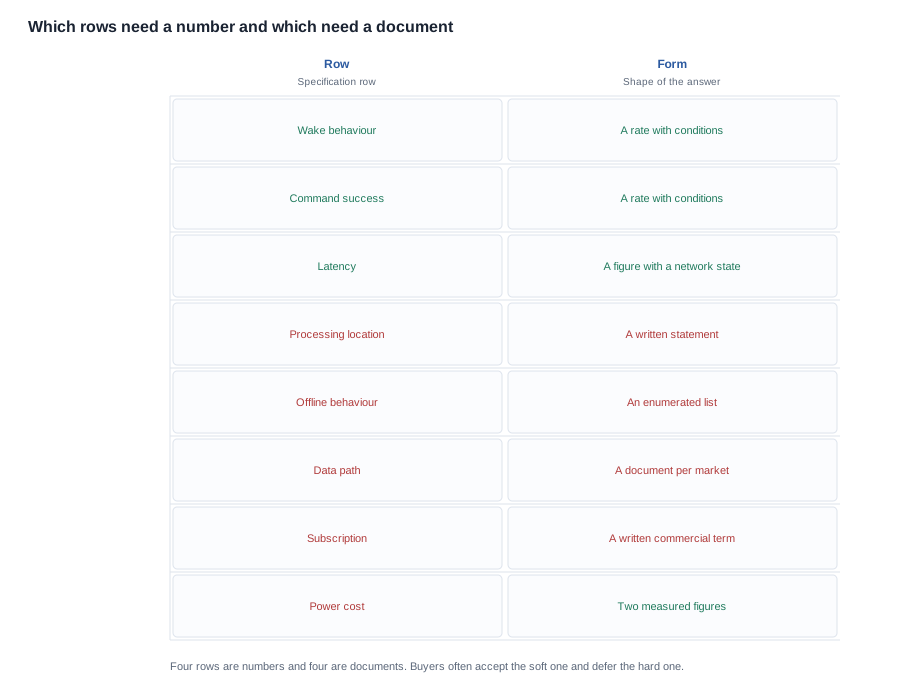
Four of the eight rows are numbers, and a number is only usable when it arrives with the condition that produced it.
Wake behaviour is the rate at which the device detects that it is being addressed. The acceptable answer is a percentage over a stated attempt count in a stated environment. The number alone is not a measurement: a wake rate obtained in a quiet office and a wake rate obtained on a busy street are two different measurements, and only the second predicts anything about a customer in a market.
Command success is the rate at which a request is understood and carried out. The acceptable answer is a rate against the buyer's own phrase list. A rate against a supplier's list is a different measurement, and it is the less useful one, because the phrases in the supplier's list are the phrases the supplier was able to recognise.
End-to-end latency is the time from the end of speech to the start of the response. The acceptable answer is a figure measured with the network state named, because latency without a network state is not a number but an impression.
Recognition and translation accuracy is the quality of the output on real speech. The acceptable answer is a figure per language pair, per condition, judged against the buyer's own material. A count of languages without an accuracy position is not an accuracy specification.
Why a number without a condition is worse than no number
This is worth stating bluntly because it is the most common failure in the category. A number without a condition does not sit harmlessly in a specification. It gets copied, and it loses its condition on the way, because a condition is a sentence and a number is a token. The result is a figure that appears in a purchase order, a listing page and a marketing deck with no statement of what it was measured on, and it is then defended in a customer dispute by people who never saw the condition.
There is a second reason to prefer a blank over a borrowed figure: a blank is actionable and a borrowed figure is not. A blank in a request for quotation produces a chase. A borrowed figure produces a false certainty, and the buyer's evaluation criteria become meaningless because every row appears answered.
The rule that follows is short. If a supplier offers a figure without a condition, ask for the condition. If they decline to give it, the row stays open, and you decide whether an open row is a blocker or a condition on the order.
The rows that are documents, and why a number cannot replace them
Four documents
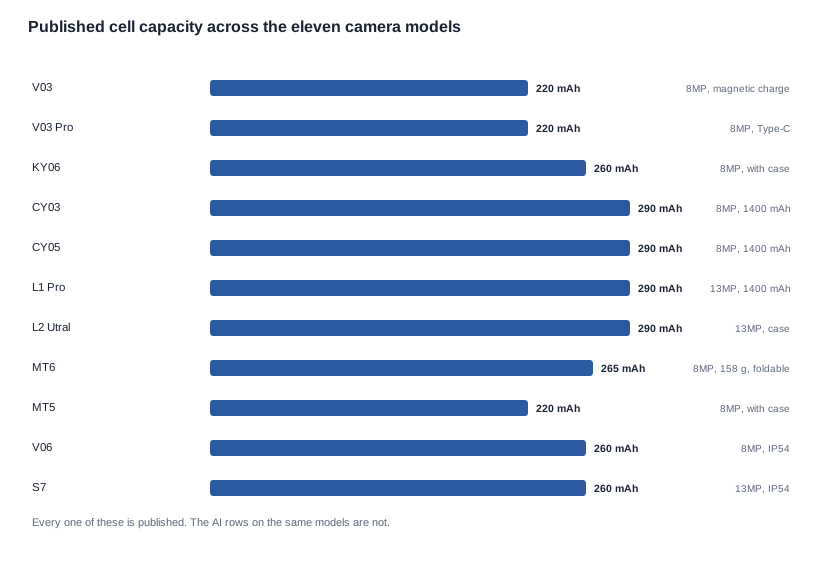
Processing location is answered by an architecture statement: what runs on the device, what runs on the phone, what runs in a service, and who operates it. A wearable with a cell in the 220 to 290 mAh range is not running a large language model locally, which means the interesting part of the assistant is somewhere else, and the buyer needs to know where.
Offline behaviour is answered by an enumerated list of the functions that survive with the network physically removed. The word "offline" on its own is a marketing word, and it covers everything from "the display still shows the time" to "capture, transcription and playback all work". Only an enumeration distinguishes them.
Data path is answered by a document naming where audio and image data are processed and stored, in which jurisdiction, for how long, and with what deletion path. This is a document rather than a number because every one of those elements is a fact about a service architecture.
Subscription is answered by a written commercial term: whether a plan is required, what it covers, what it costs per user or per unit, and what happens to the feature when the plan ends. It is on this list because it changes the business model, and because a subscription attached to a hardware feature that a customer believed they had bought is a support and churn problem that does not appear in any engineering document.
The eighth row, which connects the AI specification to the battery specification
The power cost of the feature is the row that most often gets missed, and it is the one that connects two teams who rarely meet. The question is what the assistant takes out of the cell while it is running. The acceptable answer is two figures on the same build: runtime with the feature off, and runtime with it on, under the same conditions.
This matters commercially because the runtime a customer reads on a product page is a published figure, and a feature that consumes a large part of the cell will change what the customer experiences. In our catalogue the camera models publish runtime bands of roughly five to eight hours with charge times at or under two hours across cell capacities from 220 mAh to 290 mAh, and models with charging cases at 1400 mAh or a 1200 mAh folding case. Those are hardware figures. If the AI feature changes the usable runtime, the buyer is selling a number that the customer will not reproduce.

Turning a catalogue phrase into a testable acceptance criterion
The six steps
A supplier listing gives a phrase. An acceptance criterion needs a condition and a threshold. The conversion takes six steps, and doing them in order is what stops a criterion being written in a way that cannot be failed.
- Take the phrase from the listing exactly as written, without editing it, because editing it during the conversion hides the original claim.
- Classify what it asserts: a capability, a number, a privacy statement, or an absolute.
- Name the document or the test that would substantiate it.
- Write the condition and the threshold into the criterion — the environment, the attempt count, the network state, the language pair.
- Add the criterion to the purchase order, where it becomes an acceptance standard rather than a note.
- Agree the consequence in advance: what happens to a lot that fails the criterion, and who bears the cost of the re-test.
The three phrases that cannot be converted
Some phrases cannot be converted at all, and recognising them early saves a lot of time.
"Always accurate" cannot be converted, because it is unconditionable. There is no environment in which it is true and no threshold that could be breached, which is a definition rather than a claim. "Works offline" cannot be converted until the surviving set is enumerated, because the phrase covers several different products. "Your data stays private" cannot be converted, because privacy is a conclusion and the specification rows underneath it — processing location, jurisdiction, retention, deletion — are the things that can be tested.
There is a fourth category that is convertible but expensive: a capability phrase with a number attached, such as a language count. It becomes testable once the pairs and the direction are named, and once the test material is the buyer's rather than the supplier's. The cost is that the test material has to be written, which is a day of work and the only way the criterion means anything.

What to request with the RFQ, and what to do with the answers
The pack, and why it goes out with the request
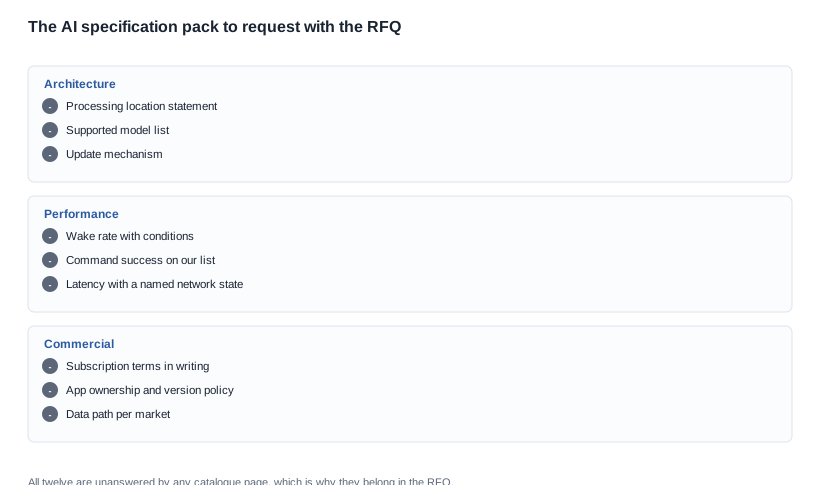
The twelve items in the pack below should travel with the request for quotation rather than following it as a questionnaire. The reason is commercial as much as technical: a supplier that knows the AI layer will be interrogated sets the quotation to reflect it, and a supplier that finds out after the price has been agreed treats the questions as a negotiation tactic rather than as a specification.
The pack groups into three blocks. Architecture: processing location statement, supported model list, update mechanism. Performance: wake rate with its conditions, command success against the buyer's list, latency with a named network state. Commercial: subscription terms in writing, app ownership and version policy, data path per market.
Two of those items are worth flagging because they are the ones that decide whether a private-label programme is viable at all. App ownership means the domain names, the developer accounts and the store listings are held in the buyer's name from the first day, not in the supplier's. Data path per market means there is a written answer for each market the product will be sold into, not one answer for the product.
Reading the answers back
When the answers come back, the evaluation is a three-step comparison rather than a judgement. First, mark each of the eight rows as closed, partially closed or open, and note the form of the answer for the closed ones. A row closed by a document and a row closed by a sentence in an email are both closed, and they are not equal, so the form is recorded separately. Second, compare across suppliers: rows that are open everywhere are category gaps, and rows that are open at one supplier and closed at another are where the shortlist is decided.
Third, decide what an open row means for the order. There are three legitimate treatments. A blocker, where the row decides whether the product can be sold at all — the data path is usually here. A condition, where the row is written into the order as an acceptance criterion attached to the first shipment. And a disclosed gap, where the product ships and the listing describes the limitation, such as a network requirement stated in the copy. Choosing between these three treatments, per row, is the difference between a specification and a wish list, and it is the part of the evaluation that a buyer should do before the purchase order rather than after.
The commercial terms that follow from the rows
The rows have a commercial consequence, and it is worth pricing it before you order rather than discovering it in the first quarter. A subscription attached to the feature is a recurring cost per unit or per user and it is a support obligation on the end customer's account, not on the brand's. A feature that requires a continuous connection creates a support load that scales with the number of customers who are in poor-signal locations, and that load is invisible until it arrives. A narrow claim, decided at the specification stage, avoids a compliance programme that would otherwise land between the artwork approval and the launch date.
These are the trade-offs a buyer negotiates against, and they are more visible at the specification stage than at any point afterwards.
The rest of the commercial structure follows the normal pattern for a hardware programme and is worth separating out, because it is a different negotiation from the AI layer. Minimum order quantity tiers, the colour and temple configuration, the logo and lens tint, retail packaging and the market labels, and the split between a pilot tier and a run tier are all negotiable and all worth negotiating at the same time as the specification is being written. Payment structure is standard: a deposit, a balance on inspection before shipment, and a retention. Tooling is a one-off cost that is normally amortised across the first order, and the useful questions are over what volume it is amortised and what happens to it if the programme is discontinued. Certification cost and certification lead time are the two items that are not levers at all, because the fee is per product family and the elapsed time sits with the test laboratory rather than with the supplier. Fixing the specification early is what gives a buyer the leverage to negotiate the parts that are genuinely open.
Where our own specification sheet stops, and what that means for your shortlist
The rows we can answer, and the rows we cannot
We publish the AI capability as the catalogue states it: an AI voice assistant named as a key technology across the camera tier, and AI real-time translation among the use cases, with the K01 the only model carrying an explicit translation claim and that claim sourced from our own site rather than from the product catalogue.
Everything in the right-hand column of the eight rows is empty for our range, and that emptiness is the specification, not an omission. We publish no inference architecture, no offline behaviour, no language list, no latency, no accuracy figure, no subscription position, no app operator and no data-storage jurisdiction, for any model. We publish the hardware rows in full, and we publish no per-model certification rows, because the export certification on the catalogue cover is a company-level capability and a company-level capability does not establish that a particular model carries a particular certification.
We will not fill these rows with figures borrowed from a different product. A language count or a latency number that nobody has measured against this hardware is worse for a buyer than no number at all, because the blank gets chased and the borrowed figure gets used.
How we classify an AI claim against the eight rows
We can classify an AI claim in a supplier specification sheet in the same way we classify a Bluetooth claim, and tell you which of the eight rows it is really asserting and what has to be established before it goes into a listing. We can take a buyer's phrase list and tell you what a test against it would establish and what it would not. And we can say which rows our documentation answers today and which have to come from the platform owner in writing, which is usually a shorter list than buyers expect and always a more useful one.
We would rather a buyer narrows a claim than publishes one it cannot defend, and we will decline briefs that ask us to position an AI capability in a way we cannot evidence. The background is under AI features in smart glasses, the claims that need correcting are in ai features myths, the comparison method is in how to compare ai features, and the procurement version of the same list is in ai features procurement checklist. The documentation obligations that follow from these rows are at ai features certification requirements.
The eight rows, as your supplier sheet shows them
Send us the eight rows as they appear in a supplier specification sheet, and we will tell you which of them that sheet actually covers, which answers need a condition attached before they are usable, and which remain open. Send us your phrase list instead and we will tell you what a test against it would establish.
Related reading
- The claims to stop repeating — ai features myths
- The procurement version of this list — ai features procurement checklist
- The documentation an AI feature obliges you to produce — ai features certification requirements
- How to read a datasheet
Send us the AI rows in a supplier specification sheet and we will tell you which of the eight they actually cover.


