
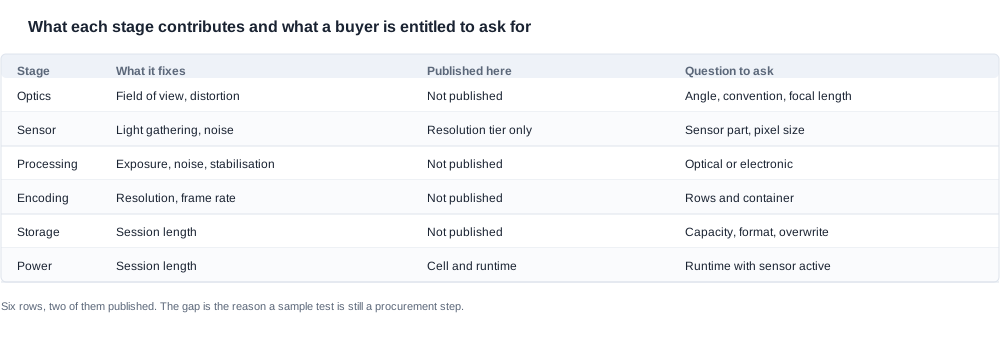
The camera tier's published record is two resolution tiers and the electrical rows around them, and understanding why the record stops where it stops is what turns a resolution comparison into a procurement conversation. Thirteen megapixels sits on the S7 and the L1 Pro, and the L2 Utral; eight megapixels runs across the V06 and the MT5, the MT6 and the V03, and the V03 Pro and the CY05, and the KY06 and the CY03. Underneath that, the rated runtime, the cell capacity and the charge time are published for every one of the eleven camera models, the charging interface for seven of them and the case capacity for five. Inside the camera itself — the sensor part, the field of view, the video rows, the stabilisation, the low-light behaviour, the storage format, the capture latency — nothing is published, and no amount of reasoning reconstructs it from the electrical rows.
So smart glasses camera technology smart glasses how it works is a question about the chain, not about the device. The chain runs optics, then sensor, then processing, then encoding and storage, and then power and thermal. Each stage can set a limit that the stages after it cannot recover, and each stage produces properties that belong to specific parts rather than to the product. The published rows cover the resolution class and the electrical budget, which is why they can tell you how many pixels and how long, and nothing about how the picture looks. A buyer who knows where each number comes from knows what a supplier's answer will look like, and can ask the question that produces a checkable figure instead of a marketing sentence.
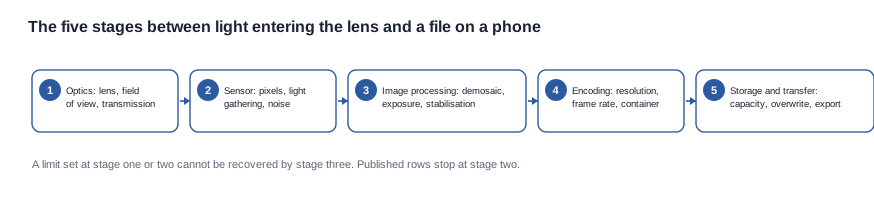
Smart glasses camera technology: the five-stage capture chain and where rows stop
Working from the light inward, the chain has five stages, and each one hands a constraint to the next.
Stage one, optics: the lens decides what can be seen
A short lens inside a temple produces a moderate angle rather than a wide one, because the geometry of the frame is fixed before the optics are chosen. The lens also introduces its own transmission loss and its own distortion profile, and the frame itself occludes part of the scene, which is why a component's angle is never the same number as the product's usable angle. Everything the buyer will complain about later about composition, about the subject being too small in the centre or the edges bending, is decided at this stage.
Stage two, the sensor: the pixel count is the smallest part of this
The sensor converts gathered light into a signal, and its performance is set by the pixel size, the process generation and the read noise. This is where the resolution tier becomes meaningful as a description and stops being meaningful as a ranking. A thirteen-megapixel sensor built from small pixels can gather less light per pixel than an eight-megapixel sensor built from large ones, and in the low-light conditions that decide whether a first-person recording is usable, the smaller-pixel sensor loses. Nothing in the tier figure tells a buyer which of the two situations applies.
Stage three, processing: the stage that decides what the picture looks like
The image signal processor demosaics the sensor output, applies noise reduction, runs auto-exposure, and may apply stabilisation. Its behaviour is a configuration rather than a component, and it is tuned against the optics and the sensor as a set. A processor that behaves well with one sensor and one lens can behave badly with another, which is why a camera module is supplied as a tuned combination and why swapping it is a change to the product rather than an interchange of parts.
Stage four, encoding and storage: the stage the customer actually experiences
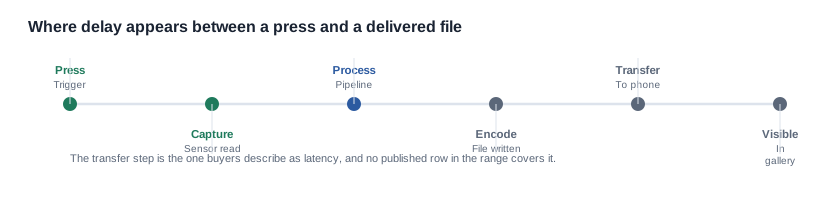
The raw signal becomes a file with a container, a resolution, a frame rate and a bitrate, and it lands somewhere with a finite capacity. The behaviour at the moment the storage fills is a product decision with a customer-visible consequence, and it is one of the rows the catalogue does not publish. The same is true of the transfer path from the device to the application, which is where most of what people describe as latency actually lives.
Stage five, power and thermal: where the session length is decided
The camera is the dominant electrical load in this tier, and the published runtime figures reflect that. Heat is the other half of the same story: a module pressed against the head dissipates into a small thermal mass, and a long continuous recording session can reach a thermal ceiling that no published row describes.
Optics and sensor: the two stages that fix the ceiling
These are the two stages a buyer should spend sampling budget on, because they are the two that set a limit no later stage can undo.
Why the angle is the most consequential unpublished row
The field of view decides whether the product works for first-person video at all, and it is the row most often left as a marketing adjective. It has to be quoted with its convention, because a diagonal, a horizontal and a vertical angle are three different measurements of the same lens, and the conversions between them are large enough to reverse a conclusion. It also has to be quoted as a product figure rather than a module figure, since the frame occludes part of the scene. For a content channel this is a blocker rather than a detail, and the only way to close it is to ask for the figure with its convention and then check it against a grid on the sample.
Why the sensor part number is the row that unlocks the others
One part number settles the pixel size, the generation and the plausible low-light behaviour, and it is also the shortest route to the other rows because a sensor datasheet carries the format, the frame rate capability and the power budget. A supplier who has a sensor part number and a measurement method behind it has a camera programme; a supplier who has a resolution tier has a marketing sheet. That distinction is the reason this article treats the part number as the first question rather than the field of view, even though the angle matters more to the customer.
The three properties of this stage that no datasheet substitutes for
Tuning to the host product. A module supplied against a reference board is not the same configuration as a module integrated into a housing with a particular lens, and the tuning is a per-configuration engineering task. This is why a supplier's sample can look better than the production unit, and why the evaluation has to be run on a unit built to the ordered configuration.
The fixed exposure or the automatic one. A device with a fixed exposure behaves predictably in a controlled test and unpredictably in a shop, and a device with an automatic one has an adaptation time that the customer experiences as a fault if it is not described. Our catalogue publishes no exposure behaviour for any camera model, so the question has to be answered by observation and then written into the manual.
The rolling or global shutter behaviour. A wearable camera is nearly always moving, and how the sensor reads the frame determines whether motion smears. This is one of the least visible specifications in the category and one of the most visible in a review.
Processing, encoding and storage: the stages nobody publishes
The stages after the sensor are the ones where the catalogue is completely silent, and they are the stages where a buyer can most easily be led astray, because each of them supports a claim that sounds technical and settles nothing.
The difference between a still capture specification and a video specification
A resolution figure describes the still-capture path. A video path has its own resolution, its own frame rate, its own bitrate and its own container, and the two do not have to agree. A product that captures only stills and a product that records video are different products, and the megapixel row does not tell a buyer which one is being offered. This is the most common disappointment in the category, and it is entirely invisible in a catalogue row.
Why frame rate matters more than resolution in first-person footage
A first-person recording is dominated by motion, because the camera moves with the operator. A frame rate that is too low turns ordinary movement into a stutter, and no amount of pixel count recovers it. This is also where the thermal behaviour of stage five becomes visible: a long continuous recording has to hold its frame rate, and a device that throttles mid-session produces a clip that changes character halfway through.
The storage rule is a product decision with a customer-visible consequence
Recording stops, or the oldest file is overwritten, and the two behaviours produce completely different complaints. A customer who loses a shoot because the product overwrote it without warning will not separate that from a defect, however reasonable the engineering decision is. The catalogue publishes no storage capacity, no file format and no overwrite rule for any camera model, so the rule has to be established on a sample and then written into the listing and the manual.
The transfer path is where most of the perceived latency lives
Between the shutter and a file in a gallery sit the encoding, the write, the link and the application. The link may be local, network-mediated or cloud-mediated, and the three fail in different ways and need different support answers. No transfer time is published for any camera model in our range, which is why the evaluation protocol in how to test camera technology treats a full session export as a timed measurement rather than a subjective impression.
Power and thermal: why the camera sets the session length
The electrical rows are the only part of the camera story our catalogue publishes completely, and they are also the part that decides whether the product survives a working day.
What the published rows are
Across the eleven camera models, the cells run at 220 mAh on the MT5 and the V03, and the V03 Pro; 260 mAh on the V06 and the KY06, and the S7; 265 mAh on the MT6; and 290 mAh on the CY05 and the L1 Pro, and the L2 Utral and the CY03. The rated runtimes are five to eight hours on the V03 and the V06, and the S7 and the V03 Pro; six to eight hours on the KY06 and the MT5; and roughly seven hours on the L2 Utral and the CY03, and the CY05 and the L1 Pro, and the MT6. The charge time is two hours or less on every one of them.
What those rows do not settle
The published charge time carries no starting state of charge and no termination criterion, so it cannot be converted into the length of an interruption, and it is not a case turnaround figure. The rated runtime carries no duty cycle, so it cannot be read as a continuous-recording figure. What a buyer needs for a shift plan is the runtime with the sensor active continuously, the runtime with it active intermittently, and the case behaviour for a mid-shift top-up. None of the three is published, and all three are obtainable in a programme conversation.
The mass at the end of the temple is a thermal and a mechanical question
A camera module at the front of a temple concentrates mass at the end of a lever and sits close to the head, which is the least thermally forgiving position on the body. It loads the hinge in a way a balanced product does not. The catalogue publishes a unit weight for one model in the whole range, the MT6 at 158 g, and that is the glasses body including the battery and the camera and excluding the foldable charging case, whose capacity is published at 1200 mAh and whose weight is not published. A buyer who needs a mass figure for any other model has to request it, and a supplier who cannot produce one for every candidate is telling the buyer something about the programme.
The AI features draw on the same budget
The camera tier names an AI voice assistant as a key technology, and everything that would decide what it costs the session — which models run, whether the work happens on the device or in a service, whether a subscription is attached — is not published. A buyer who enables an assistant on a camera platform is making a bill of materials decision, and should make it with the session length in view rather than discovering it in a returns queue.
A hypothetical build review of one camera configuration
This is a hypothetical case rather than a client project, written to show the order in which the chain is interrogated when a configuration is being locked for a first order.
A brand is locking a camera configuration for a first production run. The review starts at the output rather than the sensor, because the output is what the customer buys. The team writes the requirement that the unit has to record a continuous first-person clip of a working technician and hold a usable frame rate while the technician walks, and that requirement is what the rest of the review is measured against.
The encoding question comes first: which resolution and frame rate will the unit hold, and does the configuration include video at all or only still capture. That answer fixes the budget the whole chain has to live inside.
The storage and overwrite rule is requested in the same message, because it determines whether a technician can work a full shift without losing footage, and because the answer is a product decision that has to be written into the manual and the listing rather than discovered by the customer.
The sensor and the angle are then requested together, with the convention stated, because a module without an angle is not a camera programme and a module without a part number cannot be re-ordered identically at a second run. The thermal behaviour over a long continuous take is requested as a timed measurement, and the sample is confirmed to be the production configuration, because a reference-board module and an integrated module are not the same thing.
The power budget is closed last: the runtime with the sensor active, the runtime with it intermittent, and the case configuration that supports a mid-shift top-up. That last answer is what connects the camera work back to the published electrical rows, and it is the answer that makes the session plan defensible.
The output of the review is a short document: the configuration, the seven rows that were closed in writing, the two rows that remain open, and the test that will confirm both on the incoming units. That document is what a procurement manager signs before the purchase order, and it is the document that makes the second run cheap, because the rows do not have to be renegotiated when the order is repeated.
The three questions the review is designed to catch
A configuration that is not the production configuration. The most expensive finding in a camera programme is that the sample that was evaluated is not the unit that will ship. The check is simple and it belongs in the purchase order rather than in a good-faith assumption: the model designation on the unit has to match the designation on the paperwork, and the configuration has to match the one the review locked. The sample evaluation procedure exists for exactly this, and it costs a few minutes per unit.
A cell chosen without reference to the camera. The cell and the camera are usually specified by different people in different conversations. A cell selected for cost or for a case configuration rather than for the load the sensor creates produces a runtime that is a guess, and the guess is discovered in the field rather than on the bench.
A storage rule that nobody has decided. If the overwrite behaviour has not been decided by the time the configuration is locked, it will be decided by an engineer's default, and the customer will meet it as a defect. Deciding it explicitly costs nothing at that stage and costs a return later.
What we hold, what we mark open, and what we will not infer
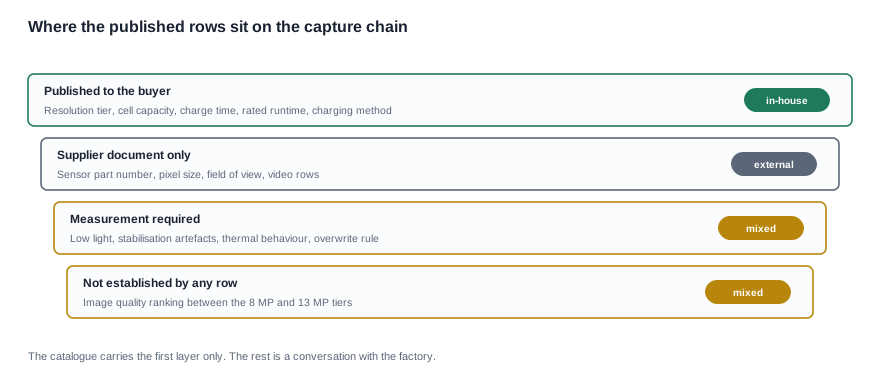
The boundary we hold: we publish the 8 MP and 13 MP resolution tiers and the electrical rows accurately, and we will not infer an image quality claim from them, because the optical and sensor stages that would decide such a claim are not published to us.
We publish the resolution tier, the cell capacity, the rated runtime and the charge time for every camera model in the range, the charging interface for seven of the eleven and the case capacity for five, and the unit weight for the MT6 alone. We publish no sensor model, no field of view, no video resolution or frame rate, no aperture, no stabilisation method, no storage capacity or overwrite behaviour, no low-light figure, no transfer time and no capture latency. We publish no model-level certificate numbers and no test report numbers, and the minimum order quantities, the production capacity and the lead times remain open internally.
We will also tell a buyer when the difference between two models is a case configuration rather than a camera, which happens more often than a shortlist expects. It is worth adding one boundary here, because it is the boundary that causes the most argument late in a programme: we will tell a buyer which rows in the chain decide the purchase, but we will not rank two platforms on image quality, and we will not convert a resolution tier into a quality statement in a quotation or a listing. The evidence that would rank them is not published to us, and a ranking built on an inference is a ranking that a customer can overturn with a unit in their hand.
The cost factors behind that decision are at camera cost factors, the trade-offs beyond this tier are at camera advanced considerations, the behaviour outside the laboratory is at camera real-world performance, the procurement-form checklist is at the camera procurement checklist, and the supplier-side verification procedure is at camera supplier verification. The background is at AI camera glasses imaging, the sample-stage procedure is at sample evaluation, the certificate register is at certification checklist, the transport documentation is at battery transport, the clause language is at contract terms and the first-order structure is at pricing.
The practical form of the offer is short. Send us the models you are evaluating, the content the unit has to record, the session length and the target price band, and we will tell you which parameters of the chain decide the purchase, which of them our published rows already cover, and which have to be obtained from the factory in writing before a purchase order is signed. For a buyer doing due diligence before an order, the procurement checklist is the shortest route through the document set, and the pricing page sets out how a first order is normally structured so that the sampling and certification work sits on the buyer's schedule rather than the supplier's.
Related reading
- The technical context — AI camera glasses imaging
- The procurement checklist — camera procurement checklist
- The cost factors — camera cost factors
- The supplier-side verification — camera supplier verification


