

The charging arrangement you choose decides which compliance obligations your product carries, and the decision is made in a product meeting while the file is assembled in a compliance meeting two months later. A magnetic cable and no mains adapter produces a smaller file than a wall charger in the box; a case with its own lithium cell produces a second battery file on top of the device file. Nothing about this is visible in the specification, so it has to be made explicit before the purchase order, not discovered at market review. The rule we work to is simple: decide the box contents first, then let the file follow the contents.
Smart glasses charging: the box sets the file
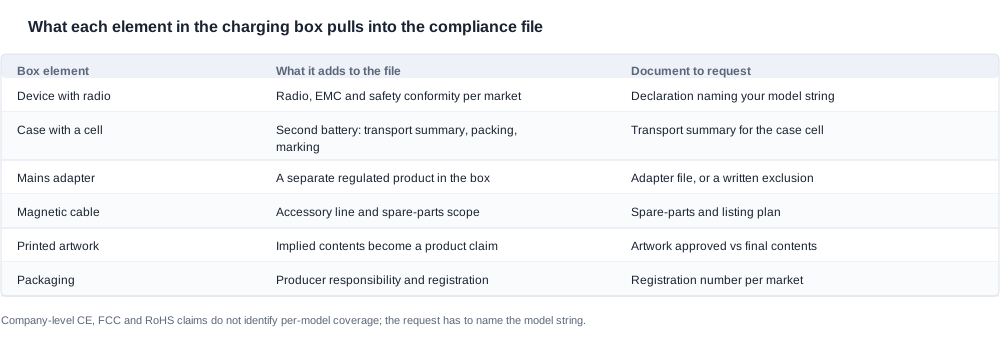
Most charging compliance conversations start at the wrong end. A buyer asks for a certificate number for a specific model, gets told that the catalogue does not publish certificate numbers, and the conversation stalls. The productive version of the same question is: what is in the box? Because in this category the charging elements are what determine the shape of the file. A device with a Type-C port and no case in the box is one regulated product. A device with a case that carries its own cell is two regulated products sharing one carton and one brand name. A device that ships with a mains adapter adds a third product, and a third product carries its own declaration and its own conformity marking.
That is why the charging arrangement cannot be treated as a packaging decision made after the product is designed. On our range the charging method is fixed at the model level — magnetic contacts, Type-C, magnetic plus case, magnetic plus charging case — and it determines the accessory bill, the spare-parts strategy, the transport documentation and the artwork. A buyer who locks the model first and the box contents later has already made the compliance decision without noticing.
Three facts frame the rest of this article. First, our catalogue's export-certification page shows ten patent certificates — eight appearance-design patents and two utility-model patents — and names no CE, FCC or RoHS marking, and it carries no per-model certification rows at all: no certificate number, no issuing body, no expiry date, and no statement of which model each document covers. A design patent proves a shape is ours; it does not tell you the file for your specific model string, and it cannot be read across to a product line the way a conformity certificate can. Second, our catalogue publishes stated charge time and cell capacity for all twenty-eight models, the charging method for the twenty-four of them that carry one, and case capacity where the catalogue states one, and publishes nothing about cell chemistry, cycle life, deep-sleep current or any fast-charge protocol. Third, the charging elements themselves are the part of the box that a brand owner most often leaves out of the compliance plan, because they think of them as accessories rather than as products with obligations attached.
The regulatory consequence follows directly from those three facts. You can verify a model against our published electrical rows. You cannot verify a certificate against our catalogue, because we do not publish one. And you cannot scope the compliance work by counting SKUs, because the scope is set by the box contents, which is a commercial decision the product team owns.
The practical criteria for sizing that work are three counts a procurement manager can produce in an afternoon: the number of target markets, the number of model strings, and the number of charging elements in each box. No supplier catalogue will produce those counts for you, and every one of them changes the schedule of the compliance work rather than the price of the hardware. A buyer who arrives at a supplier with three counts and a contents list gets an answer about the file. A buyer who arrives with a PDF of specifications gets a catalogue back.

The device's own radio and safety file applies whatever charger you ship
The device itself is the part of the file that does not vary with the charging arrangement, and it should be settled first because it is the longest-lead item in most schedules.
A wireless device placed on a market falls within the relevant radio equipment framework. In the European Union that is Directive 2014/53/EU, which pulls together radio spectrum, electromagnetic compatibility and electrical safety under a single conformity procedure and a single declaration of conformity. The United Kingdom and the United States operate separate frameworks with their own technical requirements and their own declaration, and the declaration is written against the product as placed on the market rather than against the product as designed. The practical consequence for a procurement team is that the declaration has to name the model string you intend to ship, which means the model string in your quotation has to match the model string on the label in your carton. A white-label program that ships one product under three brand names needs three sets of paperwork against what may be one hardware platform, and that is a cost and a lead-time item, not an administrative afterthought.
Our published position is deliberately narrow. The export-certification page in our catalogue carries ten patent certificates, eight of them appearance-design patents and two utility-model patents, and names no CE, FCC or RoHS marking, so the specific model coverage on any conformity document is not published. So the honest characterisation is this: the evidence for your model string has to be requested, and the request has to name the market, the model and the variant. A supplier that can produce a declaration for the exact model string in your order is meeting a normal expectation. A supplier that offers a company-level certification statement as if it were your model's file is not.
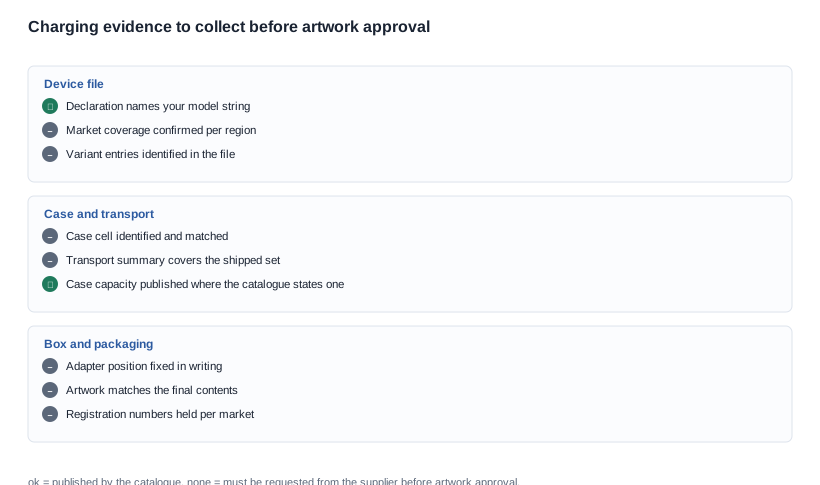
The questions to ask here are specific, and a good supplier answers them without needing a week:
- Which markets is this model string documented for, and against which framework in each?
- Does the declaration of conformity name the model string exactly as it appears on the carton label?
- Where a variant changes the radio configuration, is it a separate model string in the technical file or an entry under the parent?
- What is the relationship between the white-label programme and the certification — is the brand owner's name on the declaration, and does the technical file travel with the goods?
On the fourth point, the answer determines how much of the file you own. Where the brand owner appears on the declaration, the brand owner becomes the party that a market authority contacts, and the brand owner becomes responsible for keeping the technical file, the instructions and the product information aligned with what was actually shipped. Where the manufacturer appears alone and the brand owner's name appears nowhere on the product, the file sits with the manufacturer and the brand owner has a much thinner role — but also much less ability to answer a market query directly.
Two of the answers to these questions are red flags. The first is a document that names a product family rather than the model string, because a family-level document cannot support a declaration for the unit in your carton. The second is a supplier who treats the model string as a formality and offers to amend it later, because a model string amended after the declaration is written is a new product as far as the file is concerned. Neither of those is a negotiation point; both are reasons to move the model string to the top of the schedule.
The charging arrangement does not change this part of the file. It is worth saying plainly because a buyer who believes that choosing a different charger avoids the radio work is going to be disappointed. The charging arrangement changes the accessory scope, the transport scope and the packaging scope. The device scope stays where it is.
A charging case with its own cell is a second regulated product
This is the most common gap in the category, and the reason it is common is that a case is intuitively an accessory. Legally it is not. A case that contains a lithium cell and a charge management circuit is a battery assembly: it has its own cell, its own identification, its own test summary requirements for transport, its own marking, and its own failure modes. It also has its own weight and its own shipping volume, which changes the freight and packing instruction for every unit.
The transport framework is where this becomes concrete. UN38.3 is the test summary that lithium cell and battery manufacturers produce, and the cell or battery carries that summary through the distribution chain. When a case adds a second cell configuration to the shipment, the transport paperwork has to cover the configuration that actually ships, which is not necessarily the configuration that a single-product summary was written against. A frame cell rated at 290 mAh and a case cell rated at 1400 mAh are not one battery; they are two, in one carton, with a combined weight, a combined packing instruction and a combined set of labels.
Our catalogue publishes the case capacities where they exist, which is the useful part of this for a buyer doing landed-cost work:
- The CY03 and the CY05, and the L1 Pro each publish a 1400 mAh case.
- The L2 Utral publishes two case options, 900 mAh and 1400 mAh.
- The MT6 publishes a 1200 mAh folding charging case.
- The KY06 and the MT5 ship with a case, and the case capacity is not published for either.
- The V03 Pro has no charging case, which is a materially different product from its sibling the V03.
No cell references, no test summaries, no chemistry and no cycle life are published for any case cell, and the case cells are not included in the catalogue's "twenty-eight models" count as separate models. A buyer therefore has a published capacity number with no documentation attached to it, and the number is enough to model freight but not enough to close the transport file.
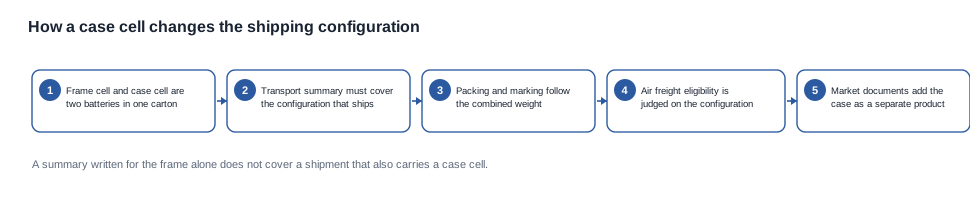
What has to be requested, per case-equipped model and per market:
- The UN38.3 test summary covering the case cell, with the cell's own model and rated capacity matching the one in the assembly.
- The handling, packing and labelling instruction that applies to the shipment configuration — frame plus case, not frame alone.
- The declaration of conformity for the case as a separate product in the markets where the case is sold.
- The cell chemistry and the cycle life, which is what a buyer needs to size the warranty exposure and the channel's spare-parts policy.
That fourth item is the one that is asked for least often and matters most commercially. A case that stores but does not charge, and a case that charges a 290 mAh frame from a 900 mAh cell, are different products with different retail expectations and different support costs. Our catalogue states charging method on the twenty-four rows that carry one, which lets a buyer establish which is which at the specification stage for those models, and that is the point at which the case's documentation should be requested — not when the first container is booked.
The buyer assessing a case-equipped model should assemble a small due diligence pack before you order a container rather than after the production order: the case cell identity, the transport summary, the case declaration where the case is sold as a separate item, and the cycle life. The trade-off between asking early and asking late is schedule rather than money — a supplier who answers in a week has answered, and a supplier who answers in six weeks has answered after the shipment date.
The broader principle for the case question: the case is a product, so it gets a product's diligence. If you would not ship a second device in the same carton without a technical file, a battery case does not get a lighter treatment simply because it is small.

The mains adapter is decided last and paid for first
The mains adapter is the element buyers plan last and pay for first, and the reason is that it looks like an accessory on the bill of materials. In the markets where you ship, a mains adapter is a regulated product in its own right. It carries its own declaration of conformity, its own marking, its own instructions and its own documentation obligations. That is a real project with real lead time, and it is owned by whoever puts their brand on it — which, in a private-label programme, is you.
If you include a mains adapter, you are adding a regulated product to the box, and the decision is really about whether that product's economics are worth the compliance work it triggers. If you do not include one, you have not avoided the obligation — you have moved it. Extended producer responsibility schemes for packaging and for electronics still apply to the product as sold, and the duty to tell the customer how to handle the device at end of life still applies in the jurisdictions that require it. The difference is not free versus paid; it is a one-off compliance project versus an ongoing administrative cost, and the second one scales with the number of markets and the number of SKUs you carry.
The commercially sound position is to make that choice deliberately, in the same meeting where the charging architecture is fixed, and to write the answer into the quotation rather than leaving it to the packaging artwork. Three things follow from it:
- If the adapter is in the box, the adapter's model and its documentation status have to appear on the purchase order, because a mismatched adapter is a non-conformance against the goods you contracted.
- If the adapter is not in the box, the product listing, the printed quick-start and the packaging artwork all have to be consistent with that, and the customer needs to know what to source.
- Either way, the cost of the adapter and the cost of the compliance work around it belong in the same line of the landed-cost model, not in two different budgets owned by two different teams.
None of this is a reason to ship no adapter. It is a reason to price the adapter as part of the total cost of the charging arrangement rather than as a trivial line in the bill of materials, because the compliance work it triggers is not proportional to the adapter's own price.
A fourth point belongs with the adapter even though it is not regulatory, and it is the most common source of the "it does not charge properly" contact in this category. A customer who has bought a device expecting a wall charger and has to source a compatible one will use one they already own, and the one they already own may deliver a lower current than the device expects. That is a listing-quality decision and a returns decision, and it is cheaper to settle at the drawing stage than in a returns queue.

The cable, the artwork and the packaging obligation nobody budgets
A proprietary magnetic charging cable is a passive component. It has no radio, no battery and no conformity marking of its own, but it is an item in the bill of materials, an item in the spare-parts strategy and a line in every parcel. The decision to include it, to sell it separately or to stock it through distributors has to be made once and applied consistently, because the customer will need one whichever way it is decided — and a customer who cannot source a replacement has a dead device, whatever the manual says.
Artwork is where charging specifications become a legal claim without anybody deciding to make one. A carton printed with a picture of a wall charger implies that the charger is in the box, because that is what a reasonable customer concludes from the picture. If the adapter is excluded, the artwork has to change, and artwork change at the pre-production stage is a plate cost and a schedule; artwork change after the print run is an inventory write-off. This is the single most avoidable charging compliance cost in the category, and it is avoided by approving packaging artwork against the final contents list rather than against an earlier revision of it.
The two pitfalls that recur most often in this category are both paperwork mistakes rather than hardware faults: an artwork file approved against an earlier contents list, and a contents list changed in the last week before the print run without the documentation being re-checked. A one-page charging evidence checklist, held by whoever owns the purchase order, prevents both, because the checklist asks what is in the box and forces the answer to be a single list that everyone else works from.
Packaging itself is a regulated item in several markets regardless of what electronics obligations apply to the product. Registering with the relevant packaging and electronics schemes is a cost line and a lead-time item, and it belongs in the landed-cost model from the first quotation rather than appearing as an unexpected charge when someone asks for a registration number.
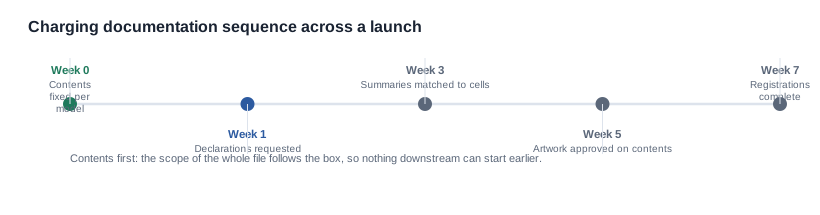
The order in which those things are settled is worth stating because it is the part that saves rework. Contents first, because contents determine scope. Documentation second, because it is the long-lead item and it cannot start until the contents are fixed. Artwork third, because it has to be approved against the final contents list and against the labels the documents require. Registration fourth, because it depends on the final packaging as shipped. And the contract terms last, once there is something concrete to write into them.
Building the charging file in an order that avoids rework
Knowing how to evaluate a charging programme starts with knowing which model strings it contains, because the model string is the key every document in the file is indexed against. The next question is when to escalate, and the answer is early: if the model string is not settled before the sample order, the documentation cannot start, and the documentation is usually the longest-lead item in the whole schedule.
The sequence below is the working order we would hand to a procurement team opening a new smart glasses charging programme. Each step has a completion criterion, because a step without one is a topic rather than a task.
- Fix the box contents per model. Device, case, cable, adapter, written into the quotation as a line per element. Done when the quotation states the contents for every model on the order.
- Confirm the charging method per model against the catalogue. Our published rows give the method and the stated charge time — two hours or less across most of the range, about one hour on the D17 and the ZH12 — with no protocol stated for any model. Done when each model on the order has its method and charge time written into the specification.
- Request the device documentation for each model string and each target market. Not a company-level statement. Done when you hold a declaration that names your model string, and you have checked which variants are separate entries.
- Request the transport documentation for the shipping configuration. One summary if the case is absent, a configuration that covers frame plus case if it is present, matching the cells actually fitted. Done when the summary's cell references match the assembly.
- Decide the adapter position. In the box, or out of it, with the compliance consequence and the cost line recorded either way. Done when the answer appears on the purchase order and in the artwork brief.
- Confirm the packaging artwork against the final contents list. Done when the printed contents match the carton exactly, including which accessories are depicted.
- Complete the packaging and electronics registrations for each market. Done when registration numbers exist for every market and every scheme that applies.
- Write the charging terms into the agreement. Done when the contract states the contents, the charging method, the stated charge time and its conditions, the case capacity where a case exists, the documentation set that travels with the goods, and the consequence of a change in contents.
The commercial negotiation in a charging programme is not a haggle over unit price. It is a negotiation over who carries which cost when the contents change. What the negotiation can actually move is the packaging configuration, the accessory bundle, the delivery split by model, the payment milestones against sample and production orders, and the tooling schedule. What it cannot move is the cost and cycle of a certification or test regime once it is triggered, and the nature of mould tooling as a one-off non-recurring cost that is only recovered across volume. A good quotation separates the two, because a buyer who is told that the tooling fee is negotiable will later be told that the compliance fee is not, and the credibility of the first answer collapses.
One term worth insisting on: a change to the box contents should be a priced change. A case removed from the bundle is not only an accessory substitution — it changes the transport configuration, the packaging, the artwork, the documentation set and the per-unit freight. A clause that treats a contents change as a variation to be re-quoted is what stops a mid-programme decision from landing on the compliance team without a schedule.
What we publish and what we do not is the last thing a buyer needs from a supplier, and it is where our own position sits. We publish the stated charge time and the cell capacity for every model in the range, the charging interface and the charging method for the twenty-four models that carry one, and the case capacity where the catalogue states one. We publish no certificate numbers, no issuing bodies, no expiry dates, no per-model certificate coverage, no battery test references, no cell chemistry and no cycle life, because our source document contains none of them. We will supply documentation that exists for a specific model and a specific shipment, and we will say so plainly when we are relying on a company-level claim rather than on a document for your configuration.
That is a narrower position than some suppliers will offer, and it is a deliberate one. A certificate number that cannot be traced to a model string and a shipment is a liability in the file rather than an asset in it, and a cycle life figure that is a typical value rather than a measured one is worse than an empty field, because it gets designed into a warranty.
Send us the destination markets, the target model list and the box contents you have in mind, and we will tell you which of the obligations above apply to you, which of them our documentation already answers, and which ones need a document we will have to request or a test we will have to run.
Related reading
- The wider quality and documentation expectations: smart glasses oem quality expectations.
- The case-cell question in detail: does the charging case need its own report.
- Specification fields that decide whether a charging figure means anything: what the spec sheet never tells you about charging.
- The vocabulary used across this category: charging glossary.
- The charging arrangements these obligations attach to: charging solutions.
Tell us the destination markets and what you plan to put in the box, and we will tell you which of these apply to you.


