

A smart glasses contract in this category is asked about for one structural reason: almost none of the numbers a buyer needs are published, so the contract is the only document in which they can exist. Minimum order quantities, production lead times, unit prices, tooling charges and warranty periods are all absent from the catalogue, and so are the product facts that a specification annex has to carry — frame weights for all but one model, per-model certification references, and the configuration rules that decide what physically ships in the box. This article works through the questions buyers most often ask about a smart glasses contract, in the order they usually come up, and sets out the clause behind each answer, the failure that starts when the clause is missing, and the one question that decides whether the rest of the document is worth anything.
Smart glasses contract: the terms nobody publishes have to live here
Eight clauses, four of them free
Most of what buyers most often ask about a smart glasses contract resolves into eight clauses, and four of the eight cost nothing to agree. Acceptance and claims, tooling and design ownership, schedule escalation, and document precedence are all drafting choices rather than commercial concessions. The two that genuinely have to be settled per programme are the certification responsibility, because a declaration of conformity is signed by the party placing the product on the market and cannot be delegated retrospectively, and the change-control rule, because a catalogue that publishes model-level data and an order that is written at configuration level will drift apart unless something forces them back together. The commercial terms — price, quantity, schedule, tooling cost — are not published for any model in this range, which is why they belong in the contract rather than in a catalogue and why no two programmes can be compared until both sides have written them down.
Who is asking, and what the contract has to survive
The reader is a procurement manager working for the brand, a channel buyer or an importer who is about to sign, or who has signed and is now negotiating an amendment. The contract is being written because a programme has passed the point where a purchase order and a friendly email will do, and it has to survive three kinds of event: a component or configuration change after signature, a delivery date that moves, and a dispute about what was actually ordered.
The reason the contract is worth writing properly is that each of those three events is a documentation problem before it is a commercial one. A buyer who has defined the model, the configuration, the packing list and the acceptance window in one place can resolve a substitution, a late delivery or a mismatch in a conversation. A buyer who has not will end up resolving it in a channel, in front of a customer, which is a different and more expensive forum.
What this catalogue does and does not give the contract
The published position shapes the annex directly, and knowing the boundary is more useful to a buyer than any drafting advice. The catalogue publishes 28 models with their cell capacities, charge times, run times, charging interfaces, camera classes, Bluetooth versions where they are published, and charging case capacities where they are published. It publishes the colour availability for the models that have it, such as the orange, off-white and black options on the Pro camera model and the orange, ice blue and black options on the V06. It publishes a company-level export-certification page and no per-model certification row at all.
Against that, the catalogue does not publish minimum order quantities, unit prices, production lead times, capacity, yield, warranty periods, tooling charges, or any of the commercial terms a contract needs. It does not publish a frame weight for any model other than the MT6, and even that figure is the glasses body including the cell and the camera, with the folding charging case excluded and the case weight unpublished. It does not publish a charging interface for the CY05 and the CY03, and the L1 Pro or the MT6, even though all four publish a charging case capacity. It does not publish a Bluetooth version for the camera models. Every one of those absences has to be written into the contract as either a value or an obligation to deliver it.

The clauses a smart glasses contract needs, and what each one settles
The eight clauses, and the failure that starts when one is missing
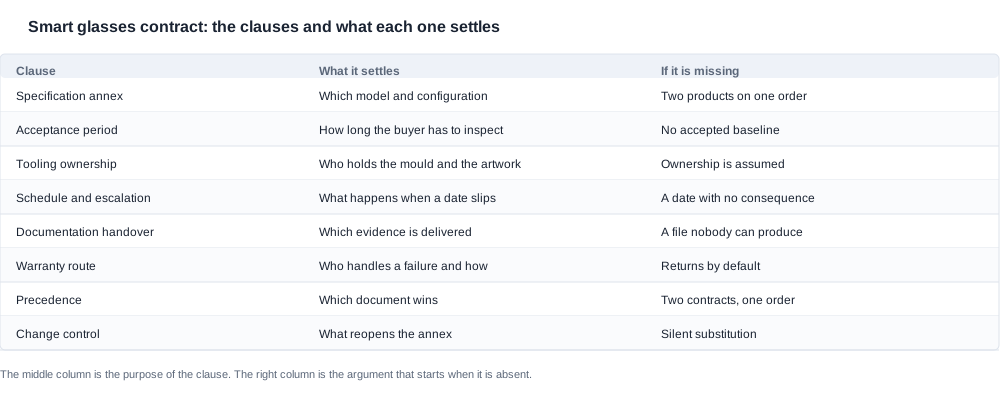
The table below is the working set. The middle column is the purpose of the clause rather than its drafting; the right column is the argument that begins when the clause is absent, which is the most practical way to decide whether a clause is worth the time it takes to agree.
The clause buyers most often underwrite: acceptance and claims
The most frequently agreed clause is the least frequently defined one. A claim period and a warranty period are different numbers with different purposes, and a contract that uses one word for both leaves the other undefined. What the clause needs is five elements: the inspection period, measured from what event rather than from what date, the named contact who receives a discrepancy, the response time, the freight arrangement, and the written decision that closes the item. Without the event at the front, the period has no start. Without the named contact, the notice arrives into a general inbox and the response time becomes an argument about when it was received.
The specification annex and the acceptance clause work together. The annex says what the unit is, down to whether a charging case ships in the box and at what capacity, and the acceptance clause says how long the buyer has to say that the unit is not that. The contract documentation requirements article is the field-level list of what the annex has to contain.
The clause buyers most often get wrong: tooling and design
Ownership, amortisation and the write-off condition are three separate clauses, not one, and buyers frequently accept the first because it is the easiest to agree and discover the other two at the point where the second order is placed. Ownership says who holds the mould and the artwork once it exists. Amortisation says how the cost is recovered across order quantities. The write-off condition says what happens if the programme is cancelled at the first order and the tooling is never used again, which is the only situation in which the third clause is tested.
The question is worth asking in the buyer's own frame, because the who owns the design article sets out why the answer matters once packaging, firmware and artwork start to diverge from the catalogue, and the tooling ownership article sets out the supplier-side view of the same negotiation. Neither the ownership clause nor the amortisation figure is published for any model in this catalogue, so both are contractual.

Which clauses carry the money, and which carry the schedule
The commercial terms and why they are not comparable across quotations
Two quotations in this category are not comparable until both sides have written down the commercial terms, because the catalogue does not carry them. A quotation that states a price without stating the minimum order quantity has not quoted a price; it has quoted a price for a quantity the reader has to guess. A quotation that states a delivery date without stating whether it is to production start or to dispatch has not stated a delivery date. A quotation that omits the tooling or setup charge has not saved that amount, it has moved it somewhere invisible.
The three terms that decide total cost are the unit price, the minimum order quantity and the schedule, because the first two multiply and the third decides how much working capital the order ties up. A buyer comparing two suppliers on unit price alone is comparing the two numbers that happen to be visible and ignoring the three that determine the invoice. The MOQ verification article is the question set for the quantity term, because the basis of the minimum matters more than the number: a minimum per model, per configuration and per order produce three different plans.
The schedule, and the escalation rule behind it
A delivery date with no consequence attached to it is a preference. The escalation rule is what converts it into an obligation, and it needs four elements: what triggers it, who tells whom, by when, and what the consequence is. The trigger matters most. A trigger tied to a supplier's internal milestone is weaker than one tied to an agreed event such as a deposit, a signed artwork approval or a confirmed production release, because the internal milestone can move without anybody having done anything wrong.
The rule should also state what is not a trigger, because a schedule that pauses whenever anything at all changes will simply be ignored. The lead time schedule template is the working format for writing the rule down, and the pricing negotiation guide covers the currency and component questions that belong in the same negotiation rather than in a later one.
### The milestones the commercial terms sit on
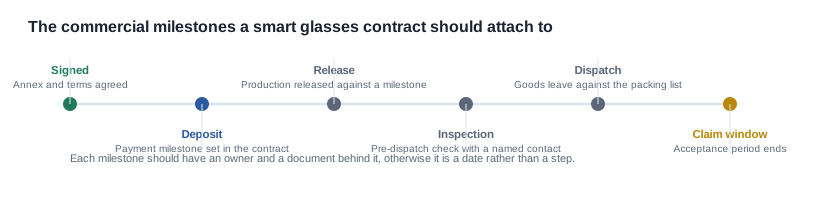
The three commercial terms — the unit price, the minimum order quantity and the delivery schedule — are the ones that decide the total cost of a programme, and all three have to be written into the contract because none of them is published for any model in this range. The unit price multiplies the quantity, the minimum sets the quantity, and the schedule decides how much working capital the order ties up. A contract that carries the first two and not the third is missing the part the buyer's own finance team will ask about.
Each of those terms belongs on a milestone rather than on a line in a schedule, and each milestone needs an owner and a document behind it. A milestone with only a date is a wish, and a wish cannot be escalated.
The certification clause, and the party that has to sign it
This is the clause with no standard answer, and it has to be settled per market and per model. The reason is structural rather than procedural: a declaration of conformity is signed by the party responsible for placing the product on the market in the destination market, which in most programmes is the importer, and the supplier's role is to supply the technical evidence the declaration rests on. No supplier can sign it on the importer's behalf, and the importer cannot delegate it retrospectively.
Two further points belong in the clause. The first is the scope of the evidence: in this catalogue the export-certification material is company-level and there is no per-model certification row, so the clause should require the model-specific evidence rather than reference a company page. The certification documentation requirements article is the field-level list of what the schedule has to contain, and the declaration of conformity article covers the importer side. The second is the model scope, because a camera model with a charging case and the same camera model without one are different commercial products, and the evidence has to be requested against the configuration that ships.
The order to write the clauses in
The clauses are not independent, and drafting them out of sequence is what produces a document that has to be reopened. The order below is the one that works, because each step depends on the one before it and none of them depends on a negotiation that has not happened yet.
- Write the specification annex first, because every commercial term after it is priced against a defined product. Name the model designation, the configuration, the packing list, the destination market and the channel. Where the catalogue publishes a row, use it as published; where it does not, write the obligation to supply it rather than leaving the line out.
- Fix the acceptance period second, because it determines the length of the risk window and therefore what the schedule has to achieve. State the event the period runs from, the named contact, the response time, the freight arrangement and the written decision that closes the item.
- Write the commercial schedule third, once the product is defined, because the unit price, the minimum order quantity and the delivery milestones are only meaningful against a fixed configuration.
- Add the escalation rule fourth, next to the schedule it protects, so that the trigger, the notification duty and the consequence sit in the same clause rather than in a separate appendix nobody reads.
- Settle the certification responsibility fifth, per destination market, because the signatory has to be identified before the evidence is requested and not after.
- Add the precedence sentence and the change-control rule last, because both refer to the annex as it now stands, and both need a version number to be meaningful.
Doing it in this order also keeps the negotiation short. The first two steps are drafting, the third is the only step that trades money, and the last three are one-hour conversations once the first three are agreed.
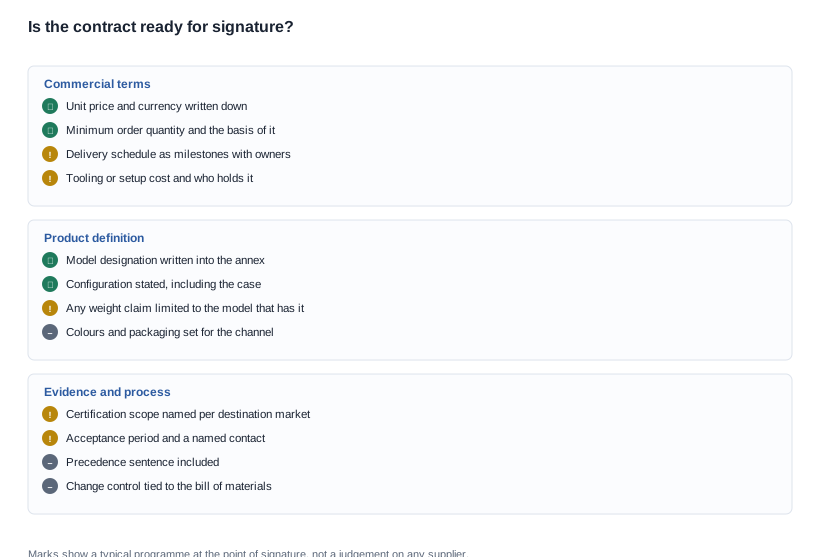
Is the contract ready for signature
The checklist below is the pre-signature review in a form that can be handed to a colleague. The marks show a typical programme at the point of signature rather than a judgement on any supplier, and the bottom two lines of the third group are the ones most often discovered afterwards.

The precedence question, and the one sentence that settles it
Why two documents describing the same product is the normal condition
The precedence question is really asking whether anyone has decided what the product is. In this category the published data is model-level and the order is configuration-level, so two documents describing the same product in slightly different words is the normal condition rather than an exception. A catalogue row identifies a model. An order line identifies a model plus a case configuration, a destination market, a packing format and a channel. A specification annex is written at the second level. A purchase order is often written at the first, and the two drift.
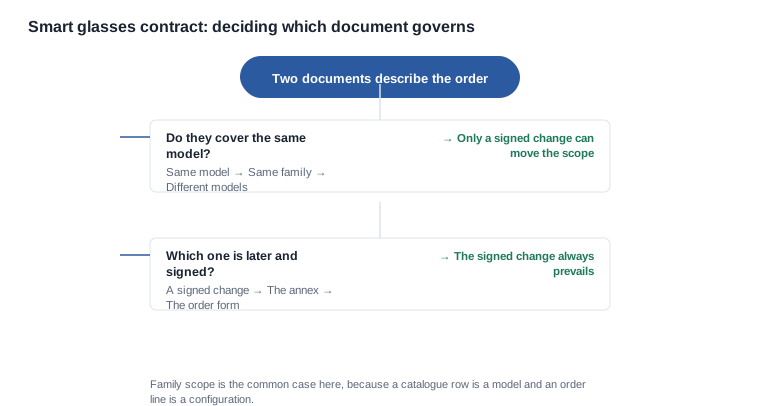
The rule is one sentence: the specification annex prevails over the purchase order, and a signed change prevails over the annex. It is the cheapest clause in the document and it prevents more arguments than any other, because it removes the question of which document to read first and replaces it with a document hierarchy.
The two questions behind the precedence question
The first is whether the annex names a model or a family. A model-level annex is unambiguous. A family-level annex covering several models is the normal case, and it is workable, but it requires a per-model confirmation for anything the programme is going to claim publicly — an ingress marking, a battery figure, a charging interface, a case capacity. The second is whether the change is signed. An unsigned instruction, a message and a marked-up drawing do not move the annex, and treating them as if they do is what produces a build that nobody has approved.
Where a change reopens the annex
The clause that closes this section is change control, and it is the one most often missing. The rule should say what changes reopen the annex, and it should list at least the cell part number, the camera module, the charging interface, the case configuration and the firmware version, because each of those changes what a buyer can claim or what a channel will ask to substantiate. The control is not to forbid change, which would be unrealistic, but to make the change trigger a written reissue of the file and a dated update to the annex.
The lifecycle below shows the order the steps happen in. The final step is the one that protects the evidence, and it is the step that most agreements leave out.

A hypothetical negotiation, clause by clause
The scenario
The following is a reasoning exercise rather than a customer story. No client is described and no figures are claimed; the model, the quantity and the market are assumed so that the reasoning can be followed. A channel buyer is signing for a camera model in the 8 MP class, for a single retail channel in a single market, with a charging case in the box, and with a fixed listing date eight weeks out. Two suppliers have quoted. The buyer's legal reviewer has asked for the contract to be checked against a list of clauses, and the answer is that the two suppliers have supplied very different documents.
The first pass: what is missing from each side
The buyer's first step is not to negotiate but to read. The catalogue side of the picture is already known: the model publishes a cell capacity, a charge time written as a ceiling, a run time, a camera class and a charging interface, so none of those needs to be agreed. What is not published and therefore needs a clause is the weight, the certification scope, the Bluetooth version for a camera model, the case capacity where the row does not carry one, and all of the commercial terms. So the specification annex is short and the commercial schedule is long, and the two suppliers are quoting against different versions of the same list.
The second pass: the four clauses that cost nothing
The acceptance clause, the tooling clause, the escalation rule and the precedence sentence are agreed in one session because none of them trades money for anything. What the buyer gives away is nothing, and what the buyer gets is a document in which a later dispute has an answer. The negotiation effort is better spent on the two clauses that are genuinely per programme, which are the certification responsibility and the change control.
The third pass: the two clauses that trade
The certification clause is settled by asking who signs the declaration for the destination market. The answer is the importer, and the clause is written to say so, with the supplier's obligation to supply the model-specific evidence written as a deliverable with a date. The change-control clause is settled by asking what happens to the file when the cell or the case configuration changes, and the answer is that the file is reissued, which is written into the order as a standing obligation rather than a one-off.
The fourth pass: the commercial terms
Now the money. The buyer converts both quotations onto the same basis: the same configuration, the same case, the same packing, the same destination, the same payment schedule and the same documentation scope. Once the two are on the same basis, the visible gap narrows, and the remaining differences are the ones that matter: the evidence already in hand, the schedule structure, the change-control rule, the warranty route and the after-sales responsibility. That is the correct point at which to compare, and doing it earlier is the most common way a buyer ends up with the wrong shortlist.
The commercial milestones then go into the contract as the schedule, with an owner and a document behind each one, and the acceptance period is written as a number of days counted from a named event rather than from a date. The contract negotiation guide sets out the priority order for that negotiation, and the procurement contract terms pillar holds the wider framework.
It is worth being precise: a smart glasses contract should carry the numbers nobody publishes, because a contract that leaves them to a purchase order has left the most important decisions of the programme to a document nobody reads. We publish the model data, the case options, the interfaces and the colour availability that a specification annex is built from, and we do not publish prices, minimum order quantities or lead times, so those terms have to live in the contract, in writing, where the buyer can see them. If you tell us the model, the market and the volume, we will say which of the clauses is most likely to be the one that causes a dispute, and we will tell you which parts of the annex the catalogue already answers.


