

A smart glasses factory audit does not produce a quality score, and it does not certify a supplier. It produces a list of findings, and the findings are shaped less by the factory on the day than by the specification the buyer brought with them. That is the part buyers rarely expect to hear. An audit can confirm that a process exists; it cannot confirm that a requirement nobody wrote down has been met. The variables that change the result of a smart glasses factory audit therefore sit mostly on the buyer's side of the table: how specific the configuration is, how complete the written specification is, how wide the agreed scope is, how mature the supplier's own records are, and how rigorously the findings are turned into order terms.
This matters commercially because the cost of a process problem discovered after a programme has launched is an order of magnitude higher than the cost of a day of travel. A returned lot, a reschedule, a revision of the product listing, and a channel conversation all follow from the same root cause, and none of them can be undone by a well-written report. The visit is cheap; the consequence of visiting badly is not.
Smart glasses factory audit: the order the five variables are set in
The five variables that cap what an audit can conclude
Five variables determine the ceiling on any audit, and all five are established before anyone travels.
The specification. This is the largest single variable, and it is the one buyers most often leave half-written. In this category the published catalogue describes the product class rather than the testable configuration. We publish twenty-eight models with battery capacity, run time, charge time, charging method, Bluetooth version where the model has one, and a resolution class for the eleven camera models — eight megapixels across eight of them, thirteen megapixels on the S7 and the L2 Utral, and the L1 Pro. We publish no sensor part number, no field of view, no video frame rate, no stabilisation figure, no microphone pickup distance and no defect rate for any model. An audit can check a running process against a written limit; it cannot check a process against a limit that was never written. A camera model whose frame rate appears in no document is a row the factory may hold privately, may hold only as a working assumption, or may not hold at all, and the audit will not settle which.
The configuration. A second variable is whether the thing being audited is the thing being ordered. A model code plus a colourway plus a charging case option plus a destination market is a configuration; anything less is a product family. Our catalogue publishes colourways for the V03 Pro, for instance, which shows plainly how one model code becomes several commitments once the colourway is fixed. An audit of a family tells you about a family.
The scope. The third variable is how much of the production route the visit covers. An audit that walked final assembly and packing has told you the answer to the question it was supposed to answer, and it has done so in writing, which makes it easy to act on. The gap between the written scope and the full route is the most useful output of the first conversation of the day.
The maturity of the supplier's records. The fourth variable is not a property of the factory's capability but of its documentation. A supplier that records a bench result against a unit identifier has a history you can interrogate. A supplier that produces a summary sheet per batch has a history you can only accept. Both suppliers can build the same product; they cannot both be audited to the same depth.
The follow-through. The fifth variable is what happens after the findings. An audit whose findings become order terms is worth the day. An audit whose findings become a warm recollection is a day spent generating reassurance.
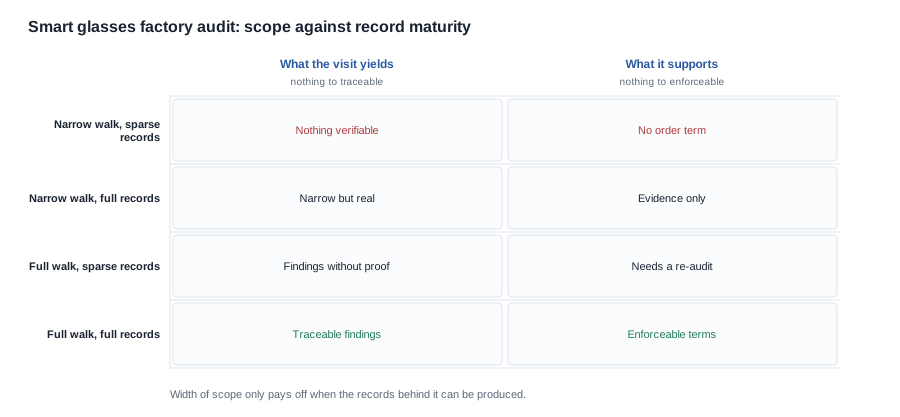
The matrix above is the practical summary. A narrow walk through a well-documented factory still yields narrow but real findings. A full walk through a factory with sparse records yields findings that cannot be enforced, because there is nothing behind them to enforce. Width of scope only pays off when the records behind it can be produced on request.
Why an audit cannot find a defect in a requirement nobody wrote
The most common disappointment in this category is a buyer who expected an audit to catch a specification problem and instead received a process assessment. It is worth being precise about why, because the answer changes what the buyer should have asked for.
A factory audit tests whether a process holds. Incoming inspection accepts or rejects purchased parts against a rule. Assembly applies a torque or an alignment rule. A test bench measures a parameter against a limit written in a measurement plan. Despatch applies a labelling and packing rule. Every one of those steps is bounded by something written down somewhere. Where the document exists, an audit can check the step against it. Where the document does not exist, the step is performed by judgment, and no walk of the floor will reveal what the judgment is based on.
That has a direct consequence for the buyer's preparation. The single most valuable thing you can do before the visit is convert each published row into a stated requirement and each absent row into a question. A buyer who arrives with a written requirement for the charging method of the ordered model code gets an answer. A buyer who arrives with "tell me about the charging" gets a tour.

What the catalogue publishes, and the four gaps only the floor can close
The published data is not merely background for an audit. It is the baseline against which a supplier's answers can be checked without leaving your desk, and it is short enough to read in a few minutes.
What you can check before you travel. We publish the cell capacity and the cell count for every model, the run-time band, the charge time for all twenty-eight models, the charging method for twenty-four of them, the charging-case option where one applies, colour availability, the ingress marking on the two models that carry it, the resolution class for the eleven camera models, and the one published weight — the MT6 glasses body at 158 g including its 265 mAh cell and its camera and excluding the foldable charging case, whose own weight is not published. Those rows let you test whether a supplier's description of their own catalogue is accurate, which is a surprisingly effective first filter.
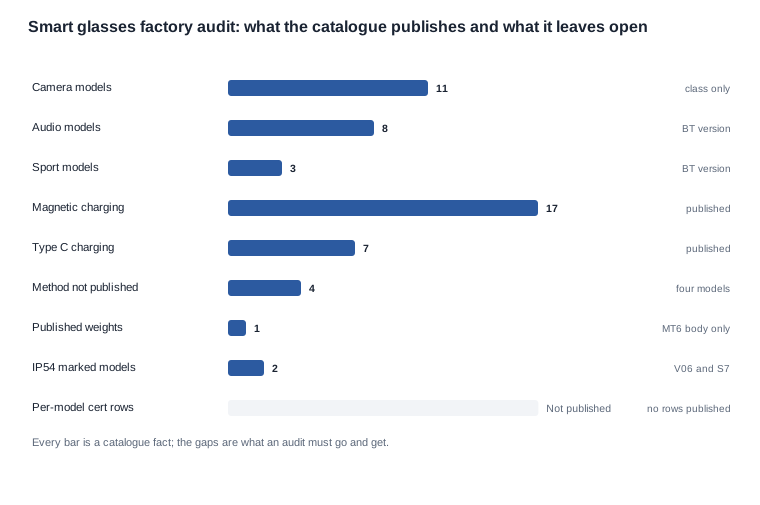
What is not published, and therefore a question for the floor. Frame weight for twenty-seven of the twenty-eight models. Sensor part numbers. Field of view, video resolution, frame rate, stabilisation. Microphone pickup distance. Ingress test report numbers. Certificate numbers. Defect rates and yield. The charging method for four camera models — the MT6 and the CY05, and the CY03 and the L1 Pro publish a charging-case capacity but no charging-method row at all. Unit price, minimum order quantity, production lead time and monthly capacity. None of these are withheld as a negotiating position; they are simply not in the document.
The four gaps where only the floor can answer
Four gaps deserve a prepared question, because in each one the public data runs out and the building has to take over.
- The charging method of the four camera models whose row is absent. The catalogue publishes magnetic charging on seventeen models and Type C on seven, and publishes no charging-method row for the CY03 and the CY05, and the L1 Pro or the MT6. For those four, the audit has to establish from the line which connector the order is actually being built with. A buyer whose operational assumption is "magnetic" holds an order that is materially different on four models.
- Whether the ingress marking has a report behind it. IP54 appears as a catalogue annotation on the V06 and the S7 only, with no report number attached. The audit question is whether the factory holds a test report for that marking or whether the marking is a catalogue-level statement, and the two answers lead to different product-page claims.
- Whether the acceptance criteria exist at all. No defect rate is published for any model, so the buyer's receiving inspection has to define its own sample size, defect classification and pass condition, and the audit has to establish whether the line is capable of reporting against a protocol it has never been given.
- Whether the supplier's sub-supplier list is controlled. The catalogue publishes no sub-supplier rows, no vendor list and no change-notification route. Those are exactly the documents a process check has to demand, and their absence is itself informative.
The preparation that moves the outcome more than the visit itself
Most of the value of a visit is produced before it happens, and the buyers who get the most from an audit are usually those who spent a day on preparation rather than a day on travel.
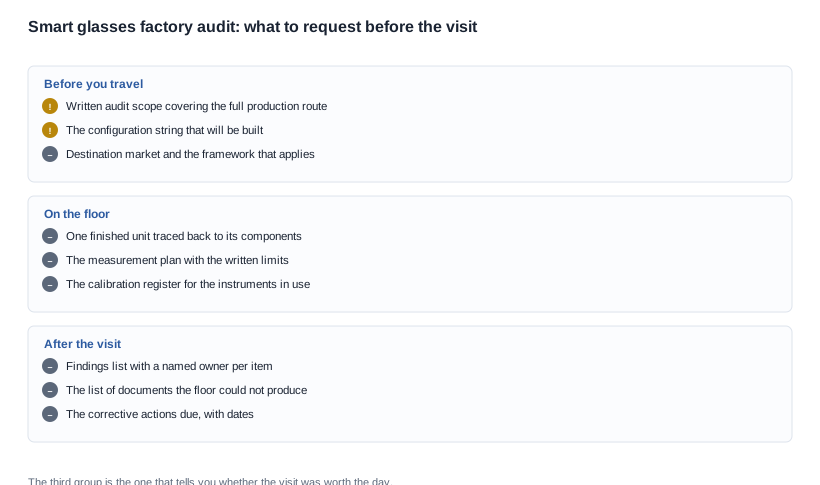
Write the scope before the visit, and compare it with the route. Ask for the audit scope in writing, in the form of a list of production steps, and ask for the production route. Compare them. The difference is the finding, and it arrives before anyone has spent a day's travel on it. A scope that stops precisely where the process becomes complicated is worth noticing, but a scope that stops at the incoming gate is only worth noticing once.
Turn the catalogue into a requirement list. For each model you are considering, write down the published rows you intend to rely on and the absent rows you intend to require. This is a short document — our catalogue is a product catalogue, not a specification pack — and it is the thing that turns a walk into a test. The published rows for a camera model give you something concrete to compare a bench sheet against. The absent rows give you something concrete to ask for.
Decide what the visit must settle before it starts. Write down the three or four questions whose answers would change your supplier decision. A buyer who has decided that "the factory holds records per lot" is the deciding factor can ask for it directly and can tell whether the answer was satisfied. A buyer who arrives with no deciding factor will find something interesting instead, which is the most expensive way to spend a day.
Prepare the questions whose answers are inconvenient for the supplier. These are the ones worth asking twice: what happens when a test fails, who signs off a concession, what the line does when an incoming component does not match, and which corrective actions from previous audits are still open. A supplier that shows only the closed actions has told you that the open ones are the interesting part.
Bring the claims your own team intends to make. The market-access and marketing obligations in your agreement have to be allocated to somebody, and the audit is where you find out whether the supplier can produce the documents that support them. For a Bluetooth-equipped device sold into the European Union, the route runs through the Radio Equipment Directive (EU) 2014/53/EU; for the United States, it runs through the radio authorisation pathway. The general product safety regulation's requirement for an established economic operator's details on the online product page has applied since 13 December 2024. None of these is a commercial variable, and all of them need an owner.
Reading two audit reports side by side without being impressed by length
Two suppliers can both welcome a visit and produce reports of identical length, and only one of them may be telling you something. The comparison works only when both were asked the same questions, and the criteria below are deliberately weighted towards evidence rather than towards presentation.
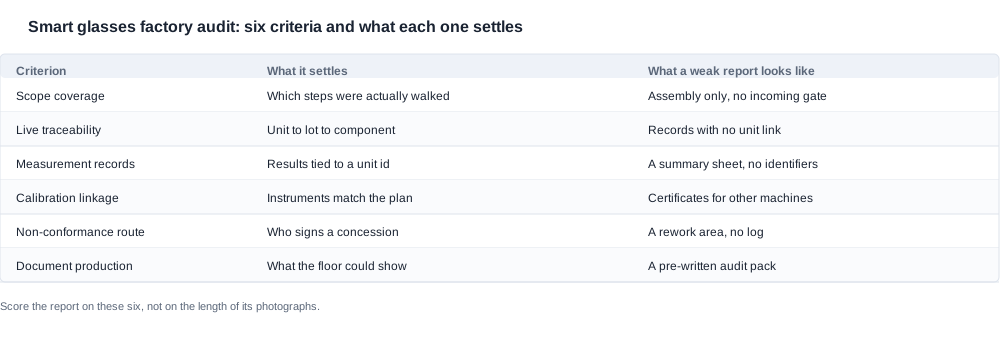
The six criteria are scope coverage, live traceability, measurement records, calibration linkage, non-conformance handling and document production. Each has a completion test that can be checked on the page of the report rather than in a meeting:
- Scope coverage is complete when every step of the production route is either listed as observed or explicitly listed as unvisited. A gap that is named is a finding; a gap that is invisible is a risk.
- Live traceability is complete when a finished unit was traced back to its components during the visit, rather than described. Records that exist but link to the finished unit only by hand are worth less than they appear.
- Measurement records are complete when bench results carry unit identifiers. A summary sheet with no identifiers cannot be used to argue about a specific unit.
- Calibration linkage is complete when the instruments named in the measurement plan hold current certificates. This is the row where the most audits fail, and the failure is administrative: the instruments are calibrated, the certificates exist, and nobody has connected them to the list of instruments actually used on the line.
- Non-conformance handling is complete when a disposition log exists and a named role signs a concession.
- Document production is complete when the list of what the floor could not produce is written down. That list is the most informative thing a buyer leaves with, because it separates what the factory does from what the factory claims to do.
Three comparison mistakes recur. The first is counting photographs. The second is treating a pre-written audit pack, delivered before the visit, as the audit itself. The third is accepting a scope statement in place of a route list. A supplier that produced everything asked for has a document control system; a supplier that produced nothing has a capability document and a visitor-friendly tour, and the two are not the same thing.
How to evaluate two reports on these criteria is to put them side by side in the same six-row table before reading either one's conclusions. The questions to ask are the same six in both cases, and a supplier that answered four of them is a different kind of counterparty from one that answered one, regardless of how well the visit went. The red flags worth naming are specific rather than atmospheric: an audit pack that arrives before the visit, a scope that stops precisely where the process gets complicated, a traceability demonstration that ends at the carton, and a measurement plan with no written limits anywhere the operator can reach. The total cost of a visit is one day of travel and one day of the supplier's engineering time; the trade-off is that a buyer who arrives with a long checklist is partly buying a slower delivery, and a supplier's willingness to absorb that cost is itself a signal.

Converting findings into order terms that hold at the next shipment
The output of an audit is not a report. It is three things, and each of them has a specific use afterwards.
A findings list with an owner and a date against each item. Every item should be convertible into a clause: a corrective action requirement, a right to re-audit, a notification route for a sub-supplier change, a notice of a process change, or a link between the audit findings and the incoming acceptance rule. If a finding cannot be written as a clause, it is an opinion, and opinions do not survive a shipment schedule.
A document request list — the things the factory could not produce on the day. This list is the starting point for the second visit, and it is the point at which a supplier's maturity becomes comparable between two candidates. A supplier that answers the list in one round and a supplier that answers it in three are different counterparties, and the price difference between them is usually smaller than the exposure difference between them.
A priced list of what the audit bought. The first audit is usually free and is almost always worth doing before a first order. Second audits and pre-shipment inspections are usually charged, and the question to ask is what each buys. A pre-shipment inspection bought as a formality is an expense without a control, and the way to tell the difference is to ask what it is for: if the answer is "to confirm the goods are as ordered", that is a control; if the answer is "to release the shipment", that is a signature.
The findings worth re-auditing rather than arguing about
Three findings justify a second visit, because each one describes a process rather than an event. A calibration register that exists but does not match the instruments on the line means the measurement plan is out of date, and the measurement plan decides what a defect is. A non-conformance log with no named approver means concessions are a practice rather than a control. A sub-supplier approval route that exists on paper but not in practice means the incoming acceptance rule cannot be enforced at goods-in, which is exactly where you need it enforced.
The findings worth converting to a clause and leaving alone are the ones about a specific sub-supplier's paperwork, because the clause is a better control than a second visit. And the findings worth escalating immediately are the ones about the configuration itself — a bench building a different model code from the one you quoted is not a documentation issue, it is a programme issue.
An audit day worked through, and the limits of what we publish
A constructed scenario
The scenario below is constructed. No client, no production order and no audit outcome is claimed; the camera model with its charging case, the European destination, the sizeable first order and the supplier's pre-written audit pack are all assumed, so that the sequence of decisions can be followed.
A brand is opening a programme with a new supplier for a camera model with a charging case, into a European market. The order is large enough to matter. The supplier has sent a capability document, a company-level statement about export certification, and a set of photographs of the production floor.
The first conversation is about scope, and it is where the visit earns its cost. The written scope covers final assembly and packing. The production route has seven steps, and two of them are not in scope: incoming inspection and the test bench. The buyer asks for the scope to be extended to cover both, and is told that access to a sub-supplier's area is restricted and that the measurement plan is still being revised.
That answer is informative rather than a refusal, and it changes the plan rather than ending it. A sub-supplier's area cannot be walked, so the component trace has to happen through documents: the incoming inspection records and the component approval list, tested to see whether they are recorded per lot and per decision rather than per week. A measurement plan under revision is a normal condition in a first programme, and it is also the reason the bench questions go first on the schedule rather than after lunch.
The bench question is the productive one, because the catalogue gives the buyer something to compare against. The published run-time band and the published charge time are numbers a bench result can be checked against, even though the sensor model and the acoustic measurements are not published. The buyer asks where the limit is written and who signed it, and the answer determines whether the rest of the visit is worth continuing.
The trace is the second productive moment. A finished unit is taken from the end of the line and walked backwards to its lot; a purchased cell is walked forwards from the delivery note into the line. The two traces meet on a work station, which is the evidence. The buyer then asks what the line does when the incoming cell does not match, and the answer is a recorded disposition with a named role, which is the finding that later becomes an acceptance clause.
At despatch, the retained samples are the last item. A factory that keeps a retained sample from every lot has a traceability culture; a factory that keeps none has a traceability system only on paper. The buyer's own programme then takes the findings and converts them: a corrective action requirement with a date, a right to re-audit if the incoming acceptance rule is broken, a notification route for a sub-supplier change, and a market-specific compliance allocation naming who owns a documentation failure before it becomes a shipment hold.
Where our position sits, and what we will not invent
Concretely, the gaps in the published catalogue are a fact about the category rather than a failure of any particular supplier, and the useful response is to attach an owner to each one rather than to pretend the number exists. We publish the electrical rows and the resolution class for every model that has one, we mark the rows that are open, and we will not fill an open row with a typical figure taken from a supplier's general data. A buyer who builds a claim on an estimated figure finds the error in the field rather than in the quotation, and the correction costs more than the question would have.
What we will not do is quote an audit outcome from a photograph, or state that our catalogue asserts a certification position it does not contain. The catalogue carries a company-level export certification page and no per-model certification rows, and its text contains no CE, FCC, RoHS, REACH or UN38.3 marking at all. A buyer who needs a model's compliance position is asking for material that has to be requested in writing, and the audit is the right moment to ask for it. What we will do is take a use case, a configuration and a destination market, and tell you which parts are settled, which are open, and which have to come from a sub-supplier.
The practical next step is short. Send the models, the quantities and the target market, and we will tell you which configurations exist, which of them leave rows open on the published data, and what the first set of questions should be for the supplier you are considering.
Related reading
- The audit questions — factory audit questions
- The structural check — factory vs trading company
- The audit context — factory audit and verification
Send the configuration, the quantity and the market, and we will say which parts of a smart glasses factory audit are settled before you travel and which are yours to find on the floor.


