
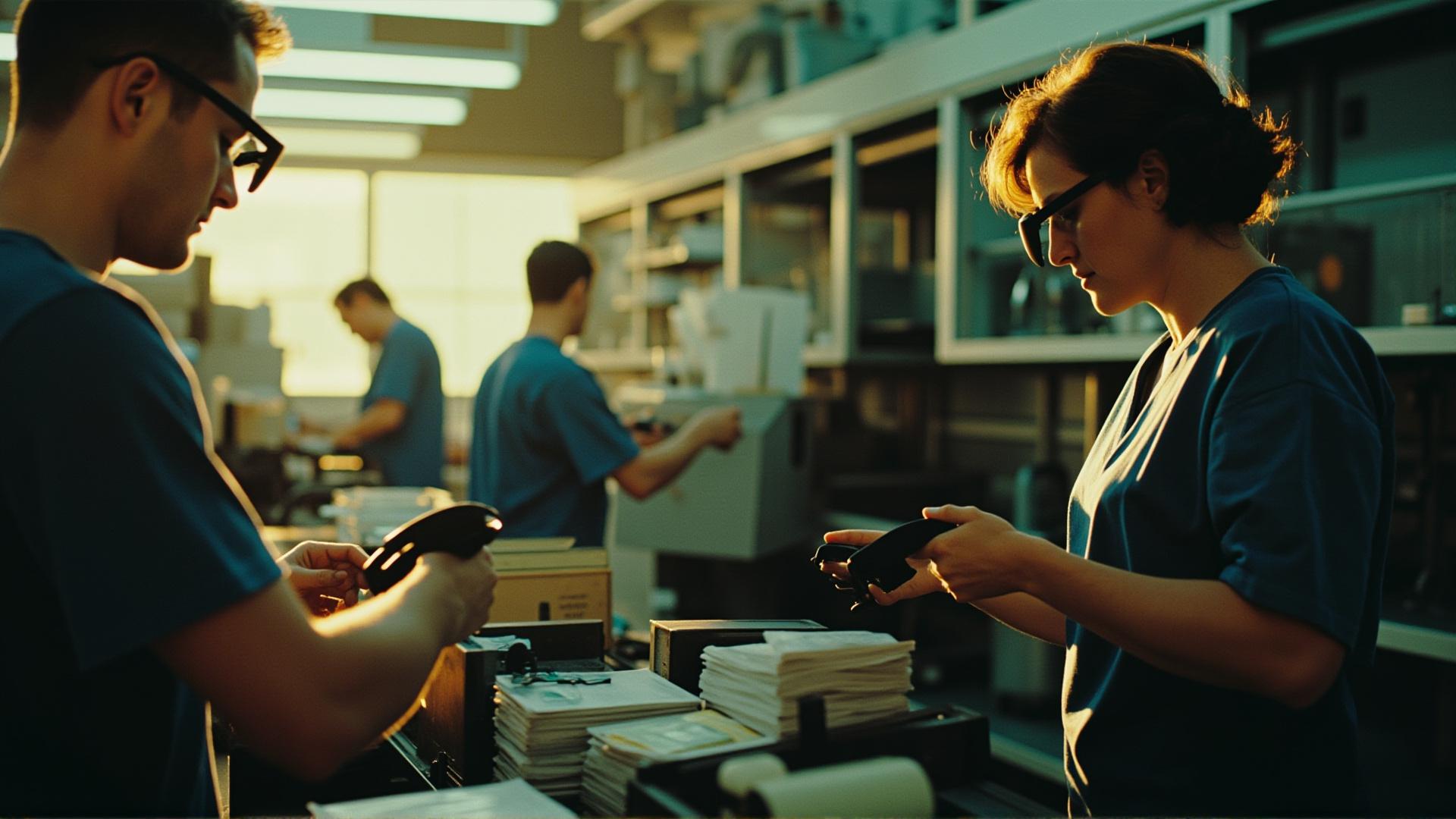
What to ask before ordering smart glasses after a factory audit is a short list, and the point of it is to convert what you saw into what you can hold somebody to.
That is the whole job. A site visit produces observations, and observations are worth nothing on their own because they cannot be attached to a clause, referenced in a claim, or shown to a colleague who was not there. The value of a visit is realised in the week afterwards, when three findings are written down, agreed, and put into the contract. A visit whose findings are written up within a week is a visit that produced three changes. A visit whose findings are written up a month later is a visit that produced an impression.
Our published position is what the audit cannot tell you. Unit prices, production lead times and minimum order quantities are not published. The camera specifications are not published. The unit weight is published for one model only, the MT6 at 158 grams, and that figure is the weight of the glasses body including the battery and the camera and excluding the foldable charging case, which is published separately at 1200 mAh. Certificate numbers and validity dates are not published. So a visit produces observations and documents, and the observations have to be turned into contract terms by someone who is prepared to ask for them.

Smart glasses factory audit: six questions, and the document behind each
1. Which document names the model I am buying? Ask for the document itself, not for a description of the certification approach, and check the model list on it. The certification buyer checklist is the field-level version.
This is the first question because the answer determines whether the remaining five can be asked at all. In this catalogue there are near-neighbour model designations — the CY05 and the L1 Pro, and the CY03 share a page style and differ in camera module and published case option; the V03 and the V03 Pro differ in the lens configuration and in whether a charging case is involved. A document that names one of a near-neighbour pair does not cover the other, and a factory audit is exactly the situation in which that mistake gets made, because the person showing you the document is looking at a wall of files.
2. What is the minimum for my configuration, on what basis, and in writing? Not a range and not a total for the range. The MOQ how to verify article is the question set.
3. Where does the clock start for my date, and what is the longest realistic time? The start point is the definitional question, and the tail is the one that misses a launch. The lead time supplier verification article is the wider set.
4. What is the configuration matrix for my order? Which configurations, which quantities, and which ones share a material set. It is the document that turns a schedule into a plan, and it is usually the one that does not exist.
5. What is the test plan, with pass criteria, and where are the records kept? Including the unit and case matching test, which is a separate line. The factory audit documentation requirements is the audit-side version.
6. What changes in the price, the terms and the documents as a result of the visit? Three written changes, with a date. This is the question that tests whether the visit was a process or a formality, and it is the factory audit quality implications article in one line.
The reader, and what an audit is actually for
The reader is a brand-side purchasing manager, a channel buyer or an importer. The situations are three. A supplier has been audited by somebody else and the buyer wants to know whether the same visit would produce the same answers for them. A first order is large enough to justify a visit and the buyer is deciding whether to spend the money and the time on one. Or a delivery has gone wrong — late, or different from the approved sample — and the buyer is establishing whether a visit would find anything.
The third situation is the one where the value is clearest and the temptation strongest. A buyer who has just received a bad shipment wants answers immediately, and a factory visit is a way of feeling that something is being done. It is worth being blunt about the arithmetic: a visit produces information about the factory, not about the shipment that has already gone wrong. The evidence that would have prevented that shipment is documentary, and it is cheaper to obtain before the order.
So the honest case for a visit is the second one: a first order large enough that the cost of getting it wrong exceeds the cost of the visit and the delay it causes. Below that threshold, the document set is the better instrument, because it is faster, cheaper and does not require the buyer's attention at the one moment the business is busy.
The questions that get better answers when asked on the floor
Some questions are stronger in person than in writing, and it is worth knowing which ones and why. The reason is not that the supplier is more forthcoming; it is that the floor contains evidence that no document set contains.
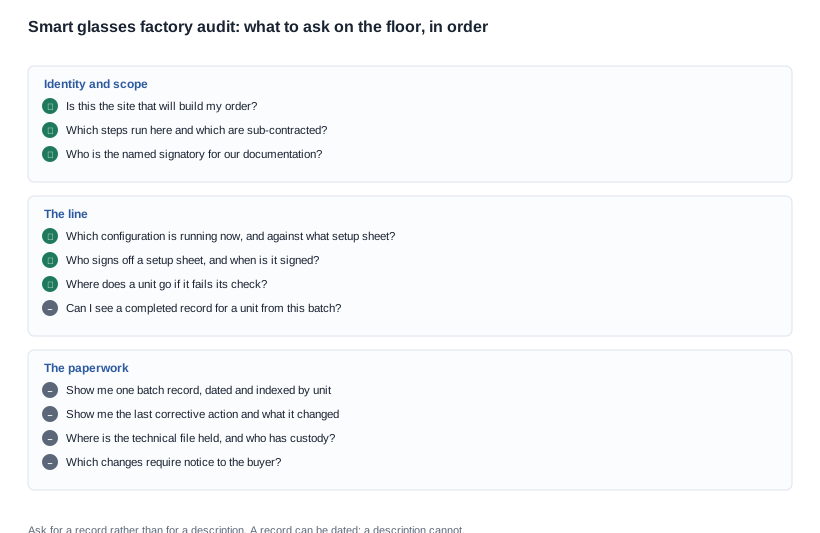
Where does a unit go if it fails its check? A written answer describes a quality process. The answer to this one is a physical location, and standing in front of it tells you whether the process is real, because a rework area that does not exist is obvious and a rework procedure that exists on paper is not.
Who signs off a setup sheet, and when is it signed? On the floor, you can look at the sheet for the configuration running now and see whether it has been signed and dated, and whether the date is before the shift started. This is the single most efficient check in the category, and it takes about ninety seconds.
Can I see a completed record for a unit from this batch? Ask for it by unit, not by batch. The response time is the answer: a factory with unit-indexed records retrieves one while you wait, and a factory with batch summaries needs to go and look. Both are legitimate, but they are different factories to buy from, and the difference shows up in the returns reserve rather than in the audit report.
Which steps run here and which are sub-contracted? The floor is the only place where the answer can be checked, because sub-contracting is visible in what is not being done on the line. A factory that sub-contracts the lens fitting and says so is a different risk from one that sub-contracts it and does not.
Who is the named signatory for our documentation? Ask to meet the person, or to see their name on a document that has been issued. The signatory for a declaration of conformity is often not on the factory floor at all, and knowing that before you place the order is worth the walk.
What a good answer sounds like against a poor one
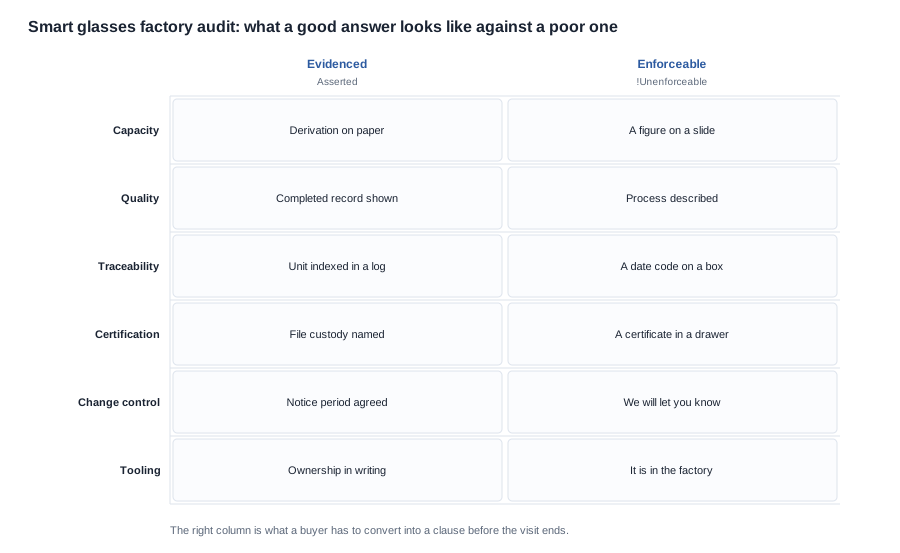
The matrix is a way of reading the answers while you are still standing in the room. The left column is the answer you can convert into a clause; the right column is the answer that requires you to write the clause from scratch.
The distinction that matters most is evidenced against asserted. A capacity derivation on paper is a figure you can check; a figure on a slide is a figure you have to accept. A completed record shown to you is evidence; a described process is a description. A unit indexed in a log is traceability; a date code on a box is an approximation of it.
None of this means that a supplier on the right-hand column is a bad supplier. It means that everything on the right-hand column has to be written down by the buyer, and that the buyer should be clear about which column each answer landed in before leaving the building.
Two questions to add when the answers are thin
Can I see a previous schedule from a comparable configuration? Redacted is fine. It is the only document that verifies a lead-time claim, and the lead time how it works article is the chain to read it against.
Can I see the approved golden sample next to a current production unit? If the answer is no, the quality process is a description rather than a reference, and the quality consistency template is what you would want to see instead.
The second of those is worth a special note in this category, because the golden sample is what makes the published figures usable. The published run times are bands — five to eight hours on several camera models, six to eight hours on others, about seven hours on the models with the 290 mAh cells — and the published charge time is two hours or less across the range without a stated starting state of charge or an end criterion. Those figures describe typical behaviour, not a specification of a particular unit. A golden sample held by the factory and available for comparison against a current unit is what turns them into something a buyer can enforce.
The timing of the follow-up
Set a date for the written changes at the end of the visit, and put it in the calendar before you leave. The findings are freshest in the two days after a visit, and the follow-up is the part that loses its momentum, because the next thing in the queue is always more pressing than a document request. A visit whose findings are written up within a week is a visit that produced three changes; a visit whose findings are written up a month later is a visit that produced an impression.
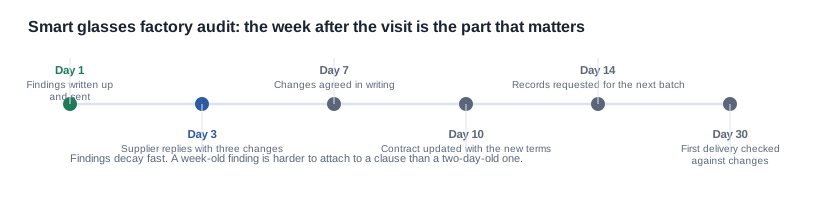
The timeline above is deliberately compressed, because the failure mode is not that the follow-up takes too long, it is that it takes long enough for the finding to stop being attributable to anything specific. A finding recorded on day one can be written into a clause. The same finding recorded on day twenty is a memory, and the supplier's response to it will be shaped by whatever else is happening in the business.
There is also a practical point about what makes the follow-up work. The request that works is a request for three specific changes, each with an owner and a date, rather than a request for "the audit report". A general request produces a general document, and a general document is not attachable to anything.

The three questions worth asking before you book the visit
A visit costs money, it costs the factory's attention, and it costs calendar time that the buyer's team does not have. Three questions before booking will tell you whether it is worth the cost.
-
Is the order large enough that the cost of getting it wrong exceeds the cost of the visit? A first order of a small quantity on a configuration the factory already runs is well served by the document set. A first order of a new configuration, or a programme with a fixed retail date, is not.
-
Do I have a list of questions that cannot be answered in writing? If the six questions above can all be answered by a document, the visit is redundant. If the answer is no — the configuration matrix does not exist, the setup sheet cannot be shown, the technical file custody is unknown — then the visit is doing work that correspondence cannot.
-
What will I do with the findings? This is the question that decides whether the visit is worth anything, and it has to be answered before the visit rather than after it. If the findings will not become three written changes in the contract, then the visit is a piece of due diligence theatre that costs a day and produces a feeling.
The third question is the one most often skipped, and it is the one that determines the return. A visit is not a research activity; it is an input to a contract change, and if no contract change is planned then the day produces a report that nobody reads twice.
The boundary we will state, and what we will do without a visit
It is worth being precise: a factory visit is worth exactly what the follow-up is worth, and the six questions above are how the follow-up is made specific. We publish the model data and we do not publish prices, minimum order quantities, capacity or lead times, and we will answer all six about our own operation in writing so that a buyer who does not need a visit does not pay for one.
There is one boundary worth stating plainly, because it is a common source of confusion in this category. One company-level export certification page sits in the catalogue and no per-model certification row, and the published material contains no CE, FCC or RoHS claim tied to a model string. The IP54 marking is published on the V06 and the S7 only, and as a marking without a third-party report number. So when a question asks a supplier to produce a per-model conformity document, that document comes from the supplier's own file — and the honest answer from us about our own position is that our catalogue does not contain one to hand over.
That is not a weakness in the audit. It is the reason the audit question is worth asking: a factory that can produce a per-model document on request has a file, and a factory that cannot has a company-level page and a good marketing document.
If you tell me the model, the market and the volume, I will say which of the six is the one that will decide the order. The factory audit beginner guide is the preparation, and the procurement pillar sets out the wider framework.
A hypothetical order, worked through
Treat what follows as an example rather than a client project. Its purpose is to show the order. A brand-side procurement manager is opening a new camera model with a charging case for a European retail programme, and the supplier has offered a visit.
The preparation is the six questions, sent in advance with a request for confirmation of which records will be available. Two answers change the plan. The configuration matrix does not exist, which means the supplier has never run this model and the visit is worth attending. And the setup sheets on the floor are signed by a shift supervisor rather than by a named production engineer, which means the question of who authorises a configuration change has no owner on the production side.
On the line, the check that produces the most is the one against the setup sheet for the configuration running at that moment. It is signed and dated, and the date is before the shift started, which is the good outcome — the process is real and it is the right configuration. The batch record check is less good: the factory indexes by batch rather than by unit, which the buyer records as a specific consequence, because it means the returns reserve on this programme has to be set differently from one where a failing unit can be traced.
The visit ends with the three questions that were not answered in writing: the configuration matrix, the naming of the person who signs the documentation, and the notice period for a product change. All three are requested in writing before the buyer leaves the building, with a date.
The follow-up is what makes the visit worth having. The three findings become three clauses: the acceptance test runs at batch level rather than unit level because the factory cannot index by unit; the configuration matrix is supplied as an annex before the first purchase order; and a change notification with a notice period is added to the contract. None of those three clauses would have been proposed by the supplier, and all three are now enforceable.
The commercial judgement was the batch-level acceptance test, and it came out of the visit rather than out of the correspondence. A buyer who had asked the same six questions in writing and received the same six answers would have had to ask for the same three clauses — but the visit produced them in a day rather than in six weeks, and it produced one additional finding, the unit indexing, that the written questions never asked about at all.
Send the model, the market and the volume, and we will tell you whether the six questions are likely to settle it in writing or whether the visit is what will close the gap.
What the visit changes that the documents do not
It is worth closing with the specific difference a visit makes, because it is the thing buyers are paying for and the thing they most often fail to extract.
A document set describes a system. A visit shows a system running on a particular day. The difference is not subtle once you look for it. A document set will tell you that a setup sheet exists; the floor will tell you that it was signed, and that it was signed before the shift, and that the person who signed it is on site today. A document set will tell you that non-conforming units are segregated; the floor will show you the area and tell you whether the units in it have a tag on them.
Three observations are worth writing down because they cannot be obtained any other way.
The rework area. If a unit fails a check, where does it physically go, and who is allowed to take it out again? A tagged area with a log is a controlled process. A corner of the line is a controlled process until someone decides to move a unit, at which point it becomes an unrecorded event.
The queue in front of the test station. A long queue of finished units waiting to be tested is a capacity constraint that no capacity document reveals, and it directly affects the lead time the buyer has been quoted.
The second shift. Whether there is one, and what changes between the two. A configuration that is set up on the day shift and reset on the night shift is a configuration that is built twice, and the two builds are not necessarily the same. This is a common source of the drift that shows up as an inconsistent batch.
None of the three is dramatic, and all three are things you can only see in person. That is what the day buys, and it is a different thing from what a document request buys, which is why the two are complements rather than alternatives.


