
A content-creation listing is the only kind of product page in this category where the product's own output is the evidence. Everything else in smart glasses can be argued from a specification sheet, but a camera listing is settled by footage: a creator picks the device, shoots with it, and decides in a week whether the channel's claim was true. That makes this channel unusually sensitive to the difference between a published row and a measurement, because the published row is what the supplier can put on a spec sheet and the measurement is what the creator can check.
The five mistakes below are all made in that difference. None of them is a wrong specification; each one is a claim that a buyer made in a gap where the catalogue is silent. The catalogue publishes the resolution class, the interfaces, the rated runtimes, the charge times, the cell capacities and the case capacities, and it publishes a photochromic lens as a feature on one model. It does not publish the video format, the frame rate, the field of view, the storage path, the transfer method, the low-light behaviour, the lens response time or the per-model unit weight beyond a single model. A channel that sells across that line without measuring is not making a claim about the product; it is making a claim about a category average.
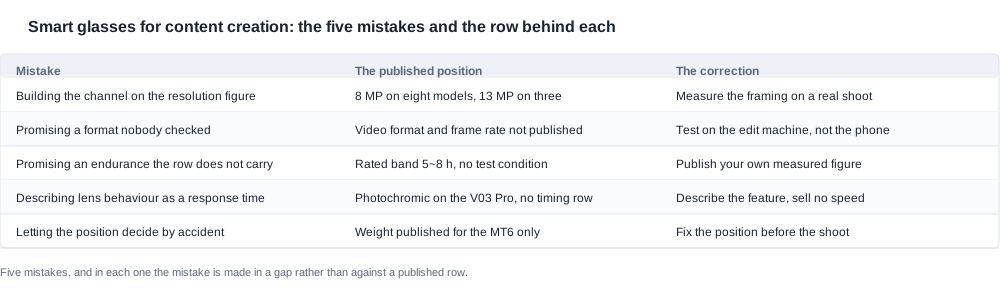
Smart glasses for content creation: the five gaps a channel gets wrong
| Mistake | The published position | The correction |
|---|---|---|
| Building the channel on the resolution figure | 8 MP on eight models, 13 MP on three | Measure the framing on a real shoot |
| Promising a format nobody checked | Video format and frame rate not published | Test on the edit machine, not the phone |
| Promising an endurance the row does not carry | Rated band 5~8 h, no test condition | Publish your own measured figure |
| Describing lens behaviour as a response time | Photochromic on the V03 Pro, no timing row | Describe the feature, sell no speed |
| Letting the position decide by accident | Weight published for the MT6 only | Fix the position before the shoot |
Why these five and not others. A content-creation channel makes three kinds of promise: what the camera captures, how long it keeps capturing, and what the creator experiences while it does. The five mistakes map onto those three promises — two on capture, one on endurance, two on the experience. The selection is deliberate, because a buyer who has never run a sample programme will otherwise treat every gap as equally urgent, and they are not equally expensive. The resolution mistake is a positioning error and costs a shoot to fix. The format mistake is a refund to fix. The endurance mistake is a planning error and costs a production day. The lens mistake is a copy error and costs a claim. The position mistake is an editorial error and costs a re-shoot.
The order they fail in. The order above is the order in which they usually fail in a live channel, and it is worth keeping, because the gates are cheap in that sequence. A channel that checks the format before it checks the framing will spend its sample budget on a file the editor cannot open, and will learn nothing about the picture.
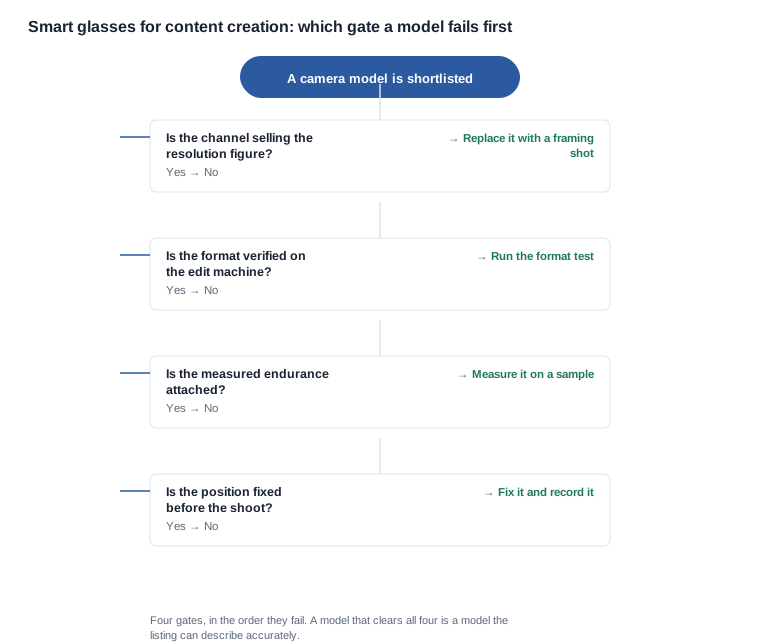
What to ask for before the sample order. Three questions settle most of the five: what the device actually records in a file, how long it runs under a continuous camera load, and what the creator is expected to do about the position. The first two are answered by a test on a sample of the exact configuration being listed, and the third is answered by an instruction. All three belong in the sample programme rather than in the listing, because a listing can only repeat what the sample programme established.
How this sits against the wider range. The camera models are the only ones with a resolution class, so this article is about a narrow slice of the catalogue: the eleven camera models, of which eight publish 8 MP and three publish 13 MP. The audio models have no camera, no file and no storage path, and the mistake list does not apply to them at all. The AI camera glasses family is where the configurations live, and the camera imaging notes cover the published optical rows.
Resolution class and framing are two different rows
Resolution is the row a creator can read fastest and a buyer can quote most easily, and it is the one that decides almost nothing. Eight of the eleven camera models publish 8 MP and three publish 13 MP, and the difference between them is invisible in a finished cut. What a viewer notices is framing — how much of the scene is in the frame, how the subject sits in it, and whether a head takes up the space a shot needs. Framing is a function of the field of view, and the field of view is not published for any model in the range.
The published resolution rows, stated exactly. The 8 MP models are the KY06 and the MT5, the CY05 and the V06, and the CY03 and the V03, and the MT6 and the V03 Pro. The 13 MP models are the L1 Pro and the L2 Utral, and the S7. That is the whole of it: a pixel class per model and nothing attached to it. There is no published sensor model, no published pixel size, no published frame rate and no published field of view, which means the three questions that actually decide a channel's claim — how much light the sensor gathers, how many frames a second the file carries, and how wide the frame is — are all open.
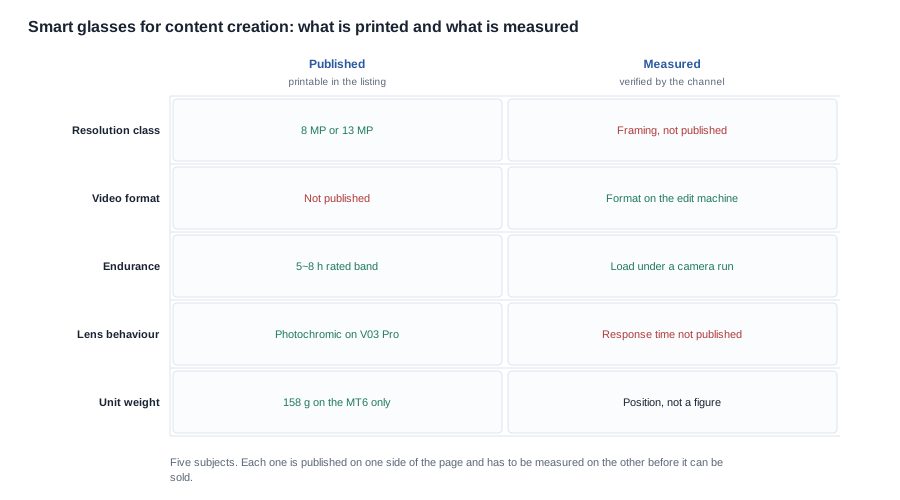
How a buyer should read the gap between the two columns. The matrix above puts the five subjects on one axis and the two kinds of evidence on the other. Every row has a published entry and a measured entry, and the measured entry is the one a channel has to own. Two of the five rows are open on the measured side — framing and lens response time — which means the channel cannot buy its way out of them and has to film them. The other three are open on the catalogue side, which means a supplier can answer them in writing, and asking is cheaper than filming. That distinction is the practical value of the matrix: it tells a procurement lead which questions belong in the quotation and which belong in the sample programme.
Why the resolution figure is the wrong anchor. It is the wrong anchor for two reasons, and both of them are commercial. The first is that the comparison a creator makes is between channels, not between sensors, and the channel difference — the lens, the coating, the position, the light — is larger than the pixel-class difference. The second is that a listing built on the resolution figure has no answer to the question the creator asks next, which is whether the picture is sharp. The honest response to that question is a sample, and a listing that quotes megapixels has skipped the step that would have answered it.
The correction, stated as a buyer. The correction is a fixed-scene test: a reference object at a known distance, the same lighting, the same position, the same model, and a framing shot that shows what the frame actually contains. Two things come out of it. The first is a defensible framing statement for the listing, in the form of what the frame covers at a given distance. The second is a decision on which model the channel should carry at all, because a model whose framing is wrong for the content type is wrong regardless of its pixel class.
What to write in the listing. Not a megapixel count as a quality claim, and not a silence either. A channel that has run the framing test can say what the frame covers and at what distance, which is a sentence a creator can act on. A channel that has not run it should say that the framing is demonstrated in the sample material, and it should not imply that a pixel class implies a picture quality. The how to choose models for content creation article covers the selection criteria that sit upstream of this decision, and the advanced tips article covers the workflow that follows.
Format, frame rate and the ten-minute edit-bay test
The video format and the frame rate are not published for any model in the range, and the consequences of that silence fall entirely on the channel. A platform will accept a set of containers and codecs, and a file outside that set is not transcoded by most upload pipelines — it is rejected, usually after a creator has already shot the day. The mistake is to assume that whatever the device records will open on the machine that edits it.
What is actually missing. The catalogue publishes the resolution class and nothing about the file. The video format, the frame rate, the container, the audio track layout, the transfer method from the device to an editing machine, the storage path and the storage capacity are all unpublished. There is no published file size, no published clip length limit and no published figure for how many clips a configuration holds before the file has to be moved. The storage capacity question is the one that catches people in this category, because "records your shoots" implies storage, and the storage row is not published for any model.
The ten-minute test. The correction is deliberately small, because this is a test that can be run by one person in one sitting:
- Record a clip on the sample of the exact configuration being listed, long enough to include a scene change, and long enough to include the point where the device is likely to stop.
- Open the file on the editing machine, not on the phone. A file that previews in a phone gallery can still fail in a desktop editor, and the failure is usually in the container rather than the picture.
- Write down what the editor reports — the container, the codec, the frame rate, the resolution of the file as recorded rather than as advertised, and the audio layout.
- Upload a short export to the platform the channel uses, before any campaign depends on it.
- Repeat on a second machine if the channel edits on more than one, because the codec bundle on a creator laptop and on a studio workstation is rarely identical.
The output the channel owns. After the test, the channel has four facts that no competitor's spec sheet can contradict: the container, the frame rate, the file resolution, and the maximum continuous clip length observed. Those four facts are what a creator actually needs, and they are the ones the listing should carry in place of the megapixel figure. A channel that publishes them has done something a channel quoting 13 MP has not.
The one that a spec sheet cannot fix. The file the device records is one thing; the file the platform accepts is another. Where the two do not match, the channel has a commercial decision rather than a technical one: a transcode step in the workflow, a different model, or a different platform. That decision is worth making deliberately, because the cost of it lands in the channel's margin and in the creator's time, and the only way to size it is to run the test on the sample.
What to ask the supplier. Ask what the device records in terms of container and frame rate, ask whether the settings are fixed or user-selectable, and ask what happens to the file at the end of a continuous recording — whether it closes cleanly, whether it is segmented, and whether the segments are playable without a proprietary tool. Those are answerable in writing, and they are the questions a channel should ask before a sample order rather than after a creator's first upload fails.
Endurance under a camera workload, and the case that changes it
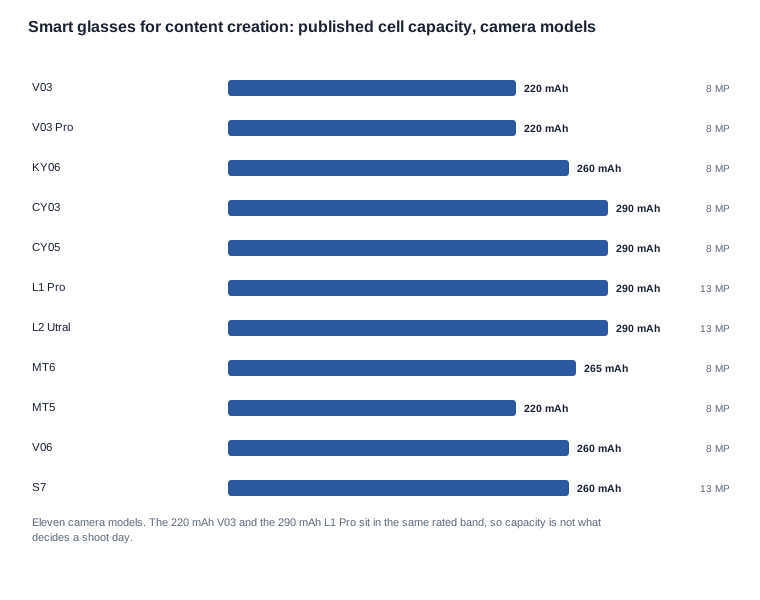
The published runtimes for the camera models are a rated band, not a measured figure, and the band is quoted without a test condition. The V03 and the V03 Pro publish 5~8 h, the KY06 and the MT5 publish 6~8 h, the L1 Pro and the CY05, the MT6 and the L2 Utral, and the CY03 publish about 7 h, and the V06 and the S7 publish 5~8 h. That is the whole of the published position, and the missing test condition is not a formality: continuous video capture is a materially different load from the condition a rated figure usually describes.
Why the cell capacity does not settle it. The published cell capacities for the camera models run from 220 mAh to 290 mAh, and the chart above shows how little the capacity varies against how little the runtime varies. The V03 carries a 220 mAh cell and publishes 5~8 h. The L1 Pro carries a 290 mAh cell and publishes about 7 h. A 70 mAh difference does not produce a visible difference in the published band, because the band is bounded by workload and conditions rather than by the cell alone. A buyer who sizes a shoot day by milliamp-hours is using a row that does not decide the question.
The published charge time, and the wording that matters. Every model in the range publishes a charge time, and across the catalogue that figure is a charge time of two hours or less. Two sport models publish roughly one hour instead. The distinction is worth holding precisely, because "two hours or less" is a ceiling and not the same assertion as "under two hours" — a device that takes exactly two hours satisfies the first and fails the second, and a listing that says "under two hours" has made a claim the documentation does not carry. The charging solutions page sets out the interface rows, and the battery life page carries the published runtimes.
Where the case changes the answer. The case is the part of this category that turns a single-session product into a two-session product, and the catalogue publishes it per model rather than as a range-wide feature:
- Case capacity published, five models. The CY05 and the L1 Pro, and the CY03 publish a 1400 mAh case. The L2 Utral publishes 900 mAh or 1400 mAh as a configuration choice. The MT6 publishes a 1200 mAh foldable case.
- Case present, capacity not published, two models. The KY06 and the MT5 are published with a charging case whose capacity is not stated.
- No case row in the catalogue, three models. The V06 and the V03, and the S7 have no charging-case row at all, which is a gap in the documentation rather than a statement that the case is absent.
- Published explicitly without a case, one model. The V03 Pro carries no charging-case row in the catalogue.
That is the whole of the eleven camera models, and the difference between "the catalogue does not list a case" and "the catalogue publishes this model without a case" is a real one: a buyer who treats the first as the second will overstate what a competitor model includes, and a buyer who treats the second as the first will promise a configuration that does not exist.
The correction for a shoot day. The channel measures endurance on a sample under the workload it actually has, and it publishes that measurement with the workload attached. Two figures come out of that: the continuous recording time before the device stops, and the recharge time with the case in the loop. Neither is a catalogue number, and both are more useful to a creator than a band, because a creator plans around the figure the channel will actually deliver.

What to ask about the case. Ask for the case capacity in the exact configuration being ordered, ask how many full device charges the case delivers in practice, and ask whether the case is included in the transit documentation for that configuration — a case is a second lithium cell, and the transport file is prepared against the configuration, not against the device. The battery transport framework is the reference, and the sample programme is where the measurement belongs.
The photochromic lens row and the position nobody fixes
Two mistakes in this list are about experience rather than output, and both are the kind that cost a channel credibility rather than money. The first is the lens. The second is the position, and it is the one almost nobody puts on a specification sheet.
The photochromic lens, described exactly. The V03 Pro is the model published with a photochromic lens, together with a flexible temple and a Type-C charging port. What the catalogue does not publish for that lens is the response time, the depth of the change, the transmission figures, the tint at a given light level and the operating temperature range. That means the lens can be described as a feature and cannot be described as a speed. A listing that says the lens darkens in thirty seconds is stating a measurement the documentation does not contain, and the photochromic lens page covers what the published row does and does not reach.
What a channel can say instead. Two sentences, both true: the configuration carries a photochromic lens, and the response characteristics are not published, so the channel demonstrates them in its own material rather than describing them. For a creator, the demonstration is worth more than the number anyway, because the number they would want is the number at their own location and light, and a channel that filmed it can show it. The lens care side of the same lens is covered at how to clean the lenses for content creation.
The position, which is not a specification. The catalogue publishes a unit weight for one model only, at 158 g for the MT6, and that figure is the whole unit including its 265 mAh cell and its camera, excluding the foldable case. No other model publishes a weight. For a channel that lists a model without a published weight, the position of the device during a take is therefore a test rather than a figure, and a device that is adjusted mid-take produces a worse shot and a longer edit.
Why it belongs on the list anyway. Two reasons, and both are commercial. The first is that position is the variable a creator changes most often, so it is the variable most likely to be inconsistent between the channel's own footage and a creator's footage — and an inconsistent shot is the thing a channel's audience notices. The second is that a position instruction is free. It costs one line in the kit, it is entirely within the channel's control, and it removes a source of variation that no specification would have fixed.
What to put in the box. A short instruction covering the position, the order of the steps before a take, and the rule that the position is not changed during a take. It is worth more than a paragraph about the coating, and it is the only item in this list that a channel can implement without a supplier at all.
Turning one shoot into a published measurement
What the five mistakes have in common is that each of them is fixed by a measurement the channel owns. None of the five requires a new product, a new supplier or a new tooling commitment. They require a sample of the exact configuration, a fixed scene, a written record, and the discipline to publish the measured figure with its conditions attached rather than the catalogue figure without them.
The workflow. Six steps, and the discipline is in the last one. Take a sample of the exact configuration being listed, not a showroom unit and not a different configuration. Shoot a fixed scene with a reference object in frame. Record what the file actually carries. Run the camera under a continuous load and log the time. Repeat with the case in the loop. Then publish the measured figures with the conditions attached.
The commercial case for doing it. A content-creation channel competes on claims it cannot verify from a competitor's page. A channel that publishes its own measured figures has moved the comparison onto ground where it is strong, and it has done so with a sample programme it was going to run anyway. The return on that programme goes from one unit of confidence to five: the framing, the format, the endurance, the recharge and the position all come out of the same shoot.
The commercial conditions behind the sample programme. The sample is a procurement decision, not a favour, and it is worth pricing it that way. The sample order cost, the lead time on it, and whether that cost is credited against a later bulk order are all negotiable, and the credit is the item most worth pressing for, because a sample that is not credited has quietly become the price of the channel's own due diligence. Beyond that, the terms that matter to a content channel are the minimum order quantity tiers and the split between a pilot tier and a run tier, the price tier each configuration lands on, the payment terms and the deposit structure, and the bulk order quantity that earns the tooling and packaging work being amortised rather than charged again.
Three things are not negotiable, and a channel that tries to negotiate them wastes the meeting. The tooling and the new tooling expense for private label packaging and artwork is a one-off cost that has to be quoted as a separate line rather than folded into the unit price. The certification cost and its lead time are set by the compliance regime of the destination market, not by the factory. The factory's production capacity and the lead time it can commit to are a function of its own loading, and a channel that presses on them gets a date it cannot hold.
The terms that decide whether a content channel survives its first year. Three of them, and none of them is the unit price. The first is the returns policy for production use: a device that has been on a set for a month is not the same object as a device that has been on a shelf, and a warranty written for domestic use is the clause most likely to turn a profitable listing into an unprofitable one. The second is the defect rate the supplier will commit to in writing, because a channel with a high defect rate on a camera model discovers it through its own creators. The third is the quality control evidence that comes with the shipment — the incoming inspection criteria the channel and the supplier agree before the first container, not after.
The compliance question the catalogue cannot answer for you. The catalogue holds a company-level export certification page, the content on it being images rather than text, and the catalogue text makes no mention of CE, FCC or RoHS. There is no per-model certification row anywhere, and no pending-confirmation record either. For a channel selling into a regulated market, that means the certification scope of each model is a written request to the supplier and a due diligence item in its own right — it is not a row you can copy from a product page, and the certification checklist is where the request should be framed.
How to verify what a supplier has told you. Four checks, and they are the ones worth running before you order rather than after. Verify the model designation on the unit against the paperwork, so a shipment is traceable. Verify the published rows against the unit you received — the cell capacity, the charge interface, the case configuration — because a configuration mismatch is the most common finding in incoming inspection. Verify the certification position against the issuing body's own register rather than against a photograph of a document. And verify the production sample against the specification sample that was approved, because the only procurement control that catches a change in the bill of materials is a physical comparison.
What the channel must still ask the supplier. Three things that measurement cannot settle on its own: the storage path and how a file leaves the device, whether the lens and the camera behaviour are configurable by the user, and what the warranty and the returns policy say about a device that has been used in a production context. A production context is not a domestic one, and a returns policy written for a domestic product is often the thing that makes a creator's channel unprofitable. The common problems article covers the symptom list, and the troubleshooting guide covers the sequence once something has gone wrong.
What we publish, and what we will not claim. We publish the resolution class per model, the cell capacities, the charge times, the rated runtimes where they are published, the charging interfaces and the case capacities, and the photochromic lens as a feature on the V03 Pro. We do not publish the video format, the frame rate, the field of view, the storage path, the transfer method, the low-light behaviour, the lens response time or the per-model unit weight beyond the single figure for the MT6, and we will not supply a typical value for any of them. We will also not describe any model in terms of vision protection, hearing assistance or any clinical outcome.
What to send us next. Send the models under consideration, the platform your creators upload to, the length of a typical shoot day and the configurations you intend to list, and we will return the published rows that cover each model, the questions that have to be answered in writing before a purchase order, and the list of measurements your channel will have to own. The content creation application page carries the wider framework, and the product family is at AI camera glasses.


