

A smart glasses for cycling buying checklist is not a list of things to inspect. It is a list of documents to obtain, and every item on it names the document, the party that issues it and the standard that tells you the document is complete rather than merely delivered. The reason the distinction matters is that this category's published rows describe what a factory can build, while a purchase order commits a buyer to something specific. The gap between the two is closed by ten documents, all of which can be requested before a deposit is paid and all of which are refused surprisingly often.
Who is running this checklist, and when. The reader is a brand buyer, a product person or a channel buyer who has a supplier quotation in hand and a launch date in the calendar. The checklist is run in one sitting, after the quotation and before the deposit, and its output is a single pack of signed documents that travels with the production order. The failure it prevents is specific: the order is placed, the goods are made, the file turns out to cover a different configuration, and the rework lands on the buyer because the deposit has already been paid.
Smart glasses for cycling: a buying checklist is a list of documents
The ten documents, and what each one settles
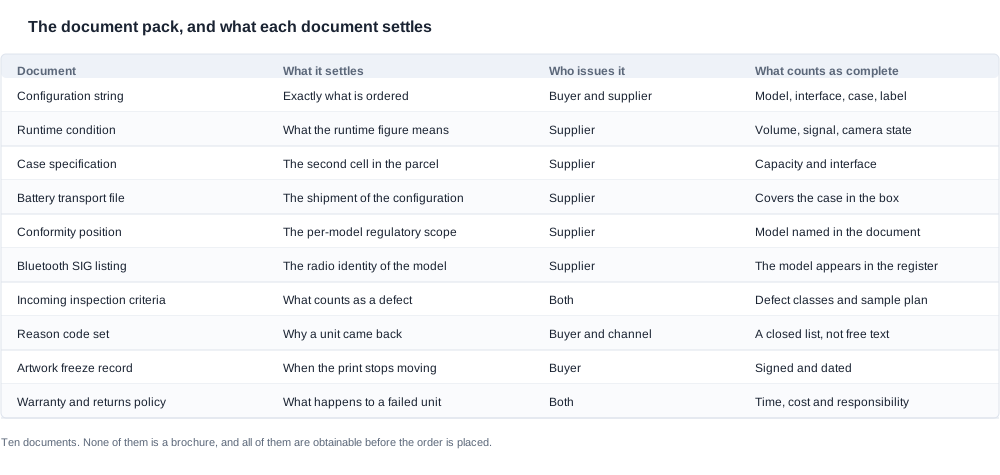
| Document | What it settles | Who issues it | What counts as complete |
|---|---|---|---|
| Configuration string | Exactly what is ordered | Buyer and supplier | Model, interface, case, label |
| Runtime condition | What the runtime figure means | Supplier | Volume, signal, camera state |
| Case specification | The second cell in the parcel | Supplier | Capacity and interface |
| Battery transport file | The shipment of the configuration | Supplier | Covers the case in the box |
| Conformity position | The per-model regulatory scope | Supplier | Model named in the document |
| Bluetooth SIG listing | The radio identity of the model | Supplier | The model appears in the register |
| Incoming inspection criteria | What counts as a defect | Both | Defect classes and sample plan |
| Reason code set | Why a unit came back | Buyer and channel | A closed list, not free text |
| Artwork freeze record | When the print stops moving | Buyer | Signed and dated |
| Warranty and returns policy | What happens to a failed unit | Both | Time, cost and responsibility |
The configuration string is the document everything else hangs on. It has to name the model, the charging interface, the case configuration and the label, because those four are the decisions that change the parcel, the artwork, the documentation scope and the price. A purchase order that says "one camera model, as quoted" has skipped the only sentence that a factory, a freight forwarder, a channel and an inspector can all read the same way. The published rows that belong in the string are specific: the cell capacity, the resolution class, the rated runtime, the charge time and the interface for that model.
The runtime condition is the document that turns a band into a claim. Every runtime figure in this range is a rated figure and the catalogue publishes no test condition for any of them. The V03 and the V03 Pro publish five to eight hours, the KY06 and the MT5 publish six to eight, the L1 Pro and the CY05, and the MT6 and the L2 Utral, and the CY03 publish roughly seven, and the V06 and the S7 publish five to eight again. A document that states the volume level, the signal condition and whether the camera was recording is the difference between a number you can print and a number you can defend. The measurement background is at battery life.
What the checklist actually asks for, item by item
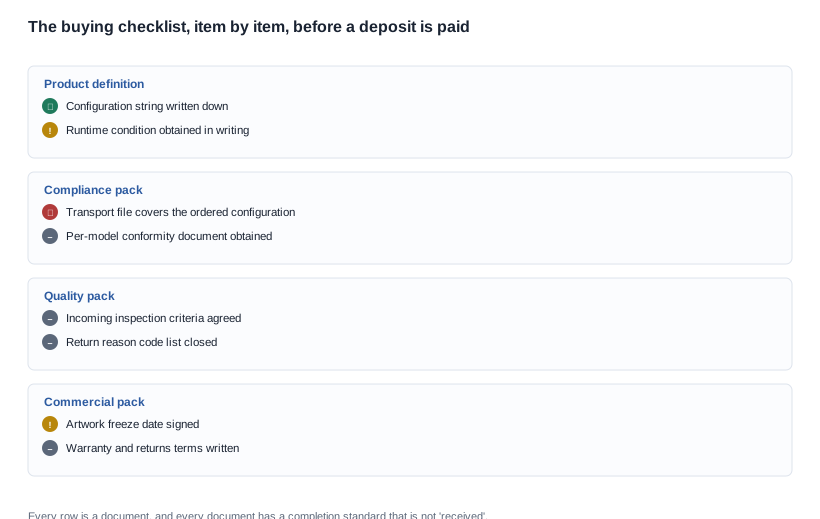
1. The task statement, in one sentence. What the device does, who uses it, for how long. Every later document is judged against it, and a document that contradicts it is a document that was not needed. This is the first item because it is the only one that costs nothing.
2. The configuration string. Model, interface, case, label, colour, and the artwork version. The interface is published per model — seventeen models charge magnetically, seven use Type-C, and four camera models publish no charging method at all — and the case is published for five camera models at 900, 1200 or 1400 mAh, with a 1400 mAh case on the CY03 and the CY05, and the L1 Pro, a 900 or 1400 mAh choice on the L2 Utral, and a 1200 mAh foldable case on the MT6. The KY06 and the MT5 have a case whose capacity is not published, and the catalogue publishes no case row for the V03, the V06 or the S7.
3. The runtime condition. As above. The question to the supplier is narrow: at what volume, at what signal condition, and with the camera in which state.
4. The battery transport file for the ordered configuration. A case in the box is a second lithium cell, and the file has to cover the configuration as it will ship, not the bare device. The requirement is at battery transport. A file that covers the glasses but not the case is the most common version of this failure, because the case is added after the file was written.
5. The per-model conformity position. The scope of the Radio Equipment Directive (EU) 2014/53/EU for the specific model, in a document that names the model. Our catalogue has an export certification page at company level and no per-model certification row, so the per-model scope is something a buyer obtains in writing and then checks against the issuing body's public register. The document list is at certification checklist.
6. The Bluetooth SIG listing. The radio identity of the model, checked in the public register. The camera models in this range do not publish a Bluetooth version, and the audio and sport models publish V5.3 on the K01 and the K02 and V5.4 across the rest — which is exactly why the listing is worth checking rather than assuming. The radio compliance entry point is at Bluetooth SIG.
7. The RoHS and REACH declaration, scoped to the model. A company-level declaration is not a model-level one, and the catalogue contains no RoHS or REACH wording at all. The scope has to be stated on the document. The material requirements are at RoHS and REACH.
8. The incoming inspection criteria. A written definition of a defect, a sample plan, and the classification of a configuration error separately from a component fault. This is the document that makes the returns discussion possible in month two, and it is far cheaper to agree before the goods are made. The criteria belong at quality consistency.
9. The return reason code set. A closed list the channel must use, so that a returns problem arrives as a diagnosis rather than as a count. Codes such as no charge, will not pair, lens damage, unit missing, configuration mismatch and other are enough to start, and they cost nothing to agree.
10. The artwork freeze record and the warranty and returns terms. A signed, dated point after which print does not move, and a written statement of what happens to a failed unit, in what time, at whose cost. The clause language is at contract terms and the sample route is at samples.
Why the order of the list is the argument
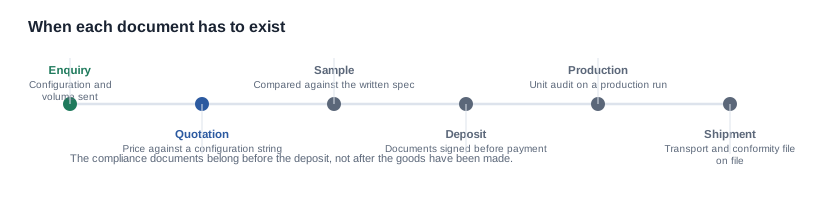
The items above are not in an arbitrary sequence. The task statement comes first because it decides which items are needed at all. The configuration string comes second because items four, five, six and seven are all scoped by it. The compliance documents come next because they are the ones with the longest lead time, and a file written after the artwork is frozen is a reprint. The quality documents come after the configuration because a defect is defined against a configuration. The commercial documents come last because the warranty and the returns terms are only meaningful once the configuration and the defect classes are fixed.

The one item that is routinely left until after the deposit is the artwork freeze. It is left there because it is the only item that has to be agreed by the marketing side rather than the buying side, and because a late change feels free while it is only free before the artwork is produced. Once the artwork is signed, a change is a reprint, a new transit file, a new insert and a delay of several weeks, and none of those are visible in a unit price.

Where the claims come from, and what is still missing
Two of the ten items are about the claim rather than about the goods, and they are the two that decide whether the listing survives a customer in the rain.
The ingress position. Only two models in the whole range carry an IP54 marking in the catalogue: the V06 and the S7. The marking covers splashing water and a dust protection level; it does not cover immersion and it does not cover a sustained downpour, and no third-party test report is published behind it. A listing that says waterproof on the strength of that marking is making a claim the documentation cannot carry, and the customer who tests it is the one in the downpour. The digit reading is at IP ratings, and the weather side of a cycling programme is at sports and outdoor weather considerations.
The lens and the surface. The lens material and the coating are not published for any model, and the frame weight is published once in the entire catalogue, for the MT6 glasses body at 158 g, which explicitly excludes the foldable case. That means the instruction insert has to be conservative, the listing cannot describe the coating as scratch-resistant, and no mount or accessory claim can be made on the strength of a mass figure that does not exist for the model being sold. The trade-offs in each direction are set out at cycling pros and cons.
The two questions that are not on the list because they cannot be closed by a document. Whether the frame sits as intended under a helmet, and how the device behaves with a wet lens, are sample observations rather than contractual rows, and they are worth doing anyway — on more than one head, with a helmet, and with the lens deliberately wetted. They are the two things a buyer can do cheaply and cannot delegate, and they are the two that a rider in a real ride will confirm.
The rule for the whole checklist is that a document is complete when it can be checked by someone who was not in the negotiation. That is the standard behind the table, and it is why a verbal confirmation of any item closes nothing. A file that names the model, a listing that can be found in a public register, a defect class list with a sample plan attached — these are the things that survive a dispute nine months later, when the person who gave the verbal confirmation has moved on.

A checklist run in ninety minutes
The checklist is worth describing as a working session rather than a document exercise, because the order in which the items are requested is the reason it can be completed in one sitting. The session has four parts, and the part that usually breaks is the first.
Part one, twenty minutes: fix the configuration. The task statement, the model, the interface and the case. Nothing else can be requested until this is settled, and the published rows make most of it quick — the interface split is seventeen magnetic, seven Type-C and four unpublished, the case capacities are 900, 1200 and 1400 mAh with the L2 Utral offered at two of them, and the charge time is published for every model with the D17 and the ZH12 at roughly one hour. A task statement that has to be argued about is the signal that the session has started in the wrong place.
Part two, thirty minutes: request the eight documents. Configuration string, runtime condition, case specification, transport file, conformity position, Bluetooth listing, material declaration, inspection criteria. All eight are requested in one message, because requesting them one at a time multiplies the weeks by eight and because a supplier who answers seven of eight has given a clearer picture than one who answers one of eight. The request names the model, the configuration and the market, because an answer without those is not an answer.
Part three, twenty minutes: run the register checks. The Bluetooth listing and the conformity position are checked in the issuing body's public register, and this is the step buyers skip, because it requires no cooperation from anyone. It is also the step that catches a document that names a family instead of a model, which is the most common way a supplier's paperwork turns out to be the wrong paperwork. A number in a register that does not match the designation on the unit is a finding, and it is much cheaper to find it now.
Part four, twenty minutes: close the commercial pack. The reason code list, the artwork freeze record and the warranty and returns terms, all three of which are decisions rather than requests, and all three of which take longer than twenty minutes when the marketing side has to be in the room. This is the part to schedule, not the part to squeeze.
What a completed session looks like. One pack, ten items, dated, with the two items that were not obtainable marked as not obtainable and named as such. A pack with two open items is a normal outcome; a pack with two open items that were never mentioned is a programme that will discover them at the border. The clause language is at contract terms, the order terms at MOQ and the commercial structure at pricing.
The three items most often refused, and why that is useful
The runtime condition. It gets refused because the supplier considers the rated figure a specification rather than a result. The answer is that the buyer is not asking for a better number, only for the condition behind the published one, and that the condition makes the published number usable rather than unusable. A supplier that will not state a condition is telling the buyer the number cannot be defended in a listing.
The per-model conformity position. It gets refused because the supplier holds a company-level file and treats the request as a misunderstanding. The answer is that the request is exactly the point: a company-level file is the right document for a company-level question and the wrong one for a listing that names a model. This is a reasonable position for a supplier to take, and it is also a hard limit on what a buyer may write on a product page.
The artwork freeze record. It gets refused because it looks like a cap on the buyer's own freedom. It is the opposite: the freeze is what allows the buyer to change its mind cheaply before the print run, and the absence of a freeze is what makes a late change expensive. A programme with a signed freeze date and a programme without one are the same programme with very different costs attached to the second month.
What we will and will not put on this list
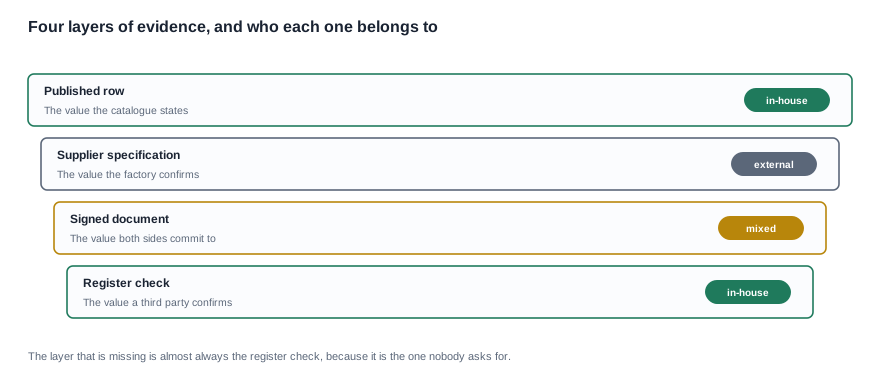
Concretely, a buying checklist should separate the published row from the supplier's specification from the signed commitment from the register check, because those four carry different weight and a buyer who collapses them has no way to know which one to challenge. We publish the rows: twenty-eight models across three families, the resolution classes with eight models at 8 MP and three at 13 MP, the cell capacities, the rated runtimes, the charge times, the charging interface per model, the case capacities where they exist, the detachable inner frame on the V06 and the S7, the slim temple on the YK12, the ultra-slim detachable temple on the G07, the flexible temples and the photochromic lens on the V03 Pro, the remote control photo feature on the D17 and the ZH12, and the IP54 marking on the V06 and the S7. No touch row is published for any model in the range, so a control surface is a question for the supplier rather than a published row.
What we do not publish, and will not put in a document we sign: unit prices, minimum order quantities, lead times, production capacity, defect rates, the lens material and coating, the frame weight for any model other than the MT6's 158 g glasses body, the runtime test condition, and the per-model certification scope. We will not state that any model in our range is tested to IP54, because no test report is published behind that marking. The catalogue's export certification page is a company-level page, and the catalogue text contains no CE, FCC or RoHS wording at all, which is why items five and seven on the list exist.
What we will do is produce the pack. Send the task statement, the model shortlist, the case configuration, the markets and the volume, and we will return the configuration string, the published rows that apply to it, the documents the supplier must issue for that configuration, the register checks we expect you to run, and the wording the listing can carry. The scenario entry point is smart glasses for cycling, the device families are at sport smart glasses and ai camera glasses, and the selection logic behind the shortlist is at how to choose smart glasses for cycling.
What to send us next. Send the task statement and the shortlist, and we will tell you which of the ten documents the published rows already settle and which four you have to take to the factory in writing.
Related reading
- The point where the scenario starts — smart glasses for cycling
- The document and compliance route — certification checklist
- The accessory programme — smart glasses for cycling accessories
Send the task statement and the shortlist, and we will tell you which documents the published rows already settle.


