

A distributor's first enquiry is usually a question about the range, and the honest answer to it is longer than either party expects. Our catalogue carries twenty-eight rows spread over four named families plus three entries that carry no model string — and it publishes a different subset of the specification grid for each of them. A channel partner asking "which models should I carry" is therefore asking a question that has to be answered with criteria, documentation and a set of boundaries, not with a list.
What follows is a description of how that work actually runs with us: what a first enquiry needs to contain, what we produce, what we decline to take on, and a worked example of an enquiry handled end to end. It is written as a representative enquiry rather than a client project, because the pattern repeats across the channel partners we work with and the pattern is more useful to a reader than any single case would be.
Smart glasses for distributors and retailers: what a first enquiry has to contain
The six fields a first enquiry needs
An enquiry that arrives with six fields gets a usable answer in one round. An enquiry that arrives with a product page and a price request gets a second round, a third round and usually a fourth before anything is quoted. The six fields are simple enough that their absence is usually deliberate — the partner has a page to launch against and wants a number on it.
- The markets. Destination markets determine the conformity documents, the labelling language and the wording rules, and they are the first thing a supplier needs in order to say whether its documentation covers the sale.
- The customer. The buyer at the end of the chain decides which family is relevant. Someone who wants first-person capture and someone who wants hands-free calls need different models, and selling the same unit to both is a returns problem before it is a marketing problem.
- The models or families under consideration. This can be a shortlist or a description of the intent, and either works. What does not work is an open request for "the range".
- The claims intended for the listings. Whether the pages will be specification-led or claim-led determines which documents are needed and how long the release takes.
- The after-sales route. Whether the distributor or the manufacturer receives a return changes the logistics of every unit that comes back, and it is far cheaper to settle before the first order than during the first return.
- The reorder pattern. The published configuration space is wide. A distributor who mixes many models across small volumes carries more set-ups than one who concentrates, and the reorder pattern is what tells us which of those two programmes is being proposed.
What we can answer from published rows and what we cannot
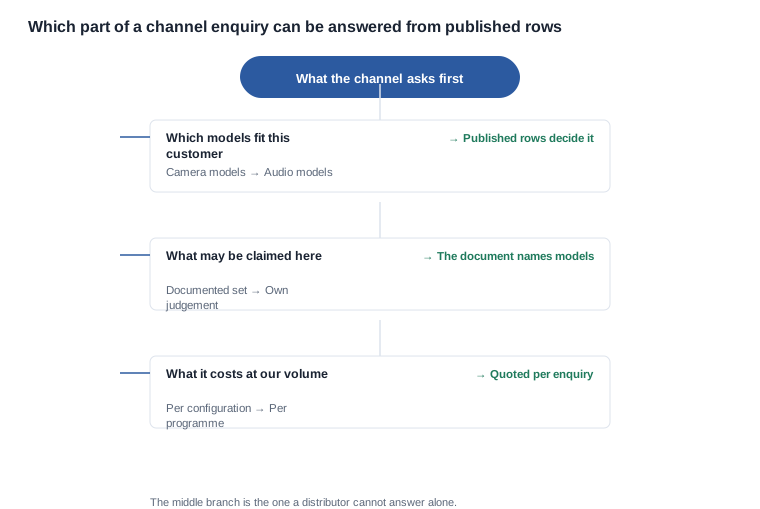
The boundary is worth stating plainly, because it determines how long a first round takes.
We can answer, from published rows alone: which families publish which rows, which models carry a resolution class and at what tier, the cell configuration and rated runtime for each model, the charge time for each model, the charging method where it is published, the case position where it is published, the Bluetooth version on the fourteen entries where it appears, the colour options on the two models that publish them, the ingress marking on the V06 and the S7, and the 158 g weight published for the MT6 glasses, a figure that leaves its foldable case out.
We cannot answer from the catalogue, and each of these is a document request: camera specifications for any camera model, because the catalogue publishes only the resolution class; per-model conformity status, because the catalogue body names no standard and carries no per-model certification row anywhere, although our own product record treats CE, FCC and RoHS as claimed across the camera, audio and sport records, and leaves the model list open, that the IP54 marking is a catalogue annotation carrying no third-party report number, and that nothing is recorded about the children's certification position; the weights of every model except the MT6; the frame geometry, the temple profile and the nose bridge; the acoustic performance, which carries no third-party measurement report; and the condition behind every runtime figure.
We also cannot answer commercially from anything published. Unit price, production lead time, minimum order quantity, tooling or development charges, artwork and packaging costs, and warranty terms are all confirmed per enquiry, because each reflects configuration, quantity, mix and the schedule then current.
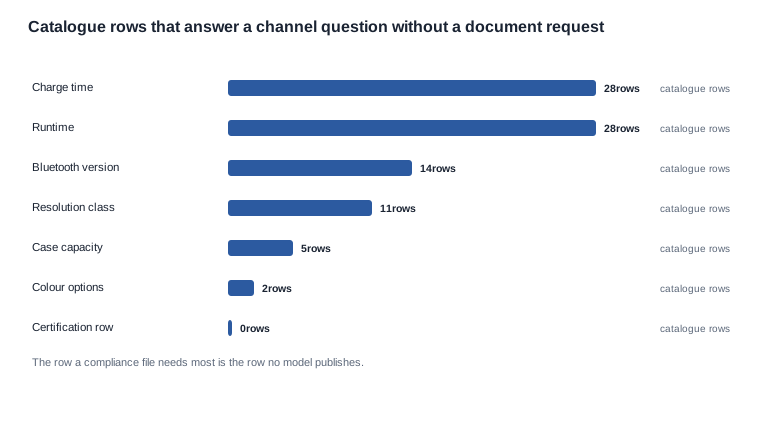
The chart above is the same boundary expressed as a count. Two rows — charge time and cell configuration — cover the whole catalogue. Three cover a minority of it. One row, the per-model certification row, covers none of it, and that is the row a compliance file most often needs.
Smart glasses distributor support: the four documents we produce
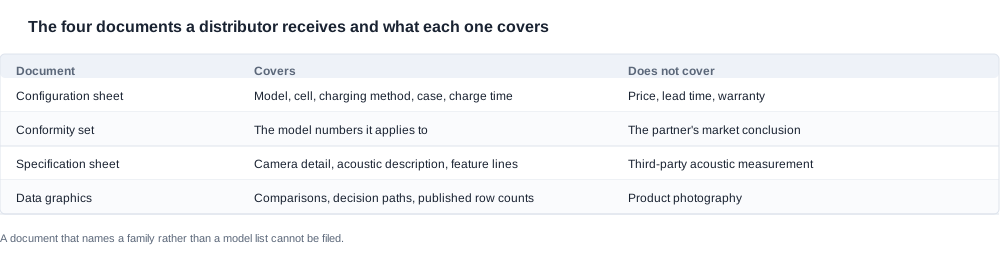
Once a configuration is defined, the work becomes concrete and it produces a bounded set of documents. Four of them carry most of the value.
The configuration sheet
The configuration sheet is the document that closes the gap between a catalogue and a shipment. It names, for one model, the resolution class where one applies, the cell configuration, the charging method, the case and its capacity where one is published, the charge time, and the rated runtime as the catalogue publishes it. Its purpose is to make a delivery auditable: when the unit arrives, it can be checked against a sheet rather than against a memory of a web page.
The three camera models whose charging method is not published — the L1 Pro and the CY03, and the MT6 and the CY05, which publish a case capacity but no charging method row — are exactly the models where this sheet earns its place. So are the two models that list a case without publishing its capacity, the KY06 and the MT5, and the three models with no case row at all.
Why the configuration sheet carries more weight than the others
Of the four documents, the configuration sheet is the one that keeps paying after the launch. The conformity set is filed once, the specification sheet is used while the pages are being written, and the data graphics are used while the range is being explained. The configuration sheet is used every time a shipment is received, every time a query is opened, every time a customer asks whether the unit in the box is the unit that was ordered, and every time a claim arrives that has to be checked against something.
That makes it worth getting right. The questions it should answer for every model on the order are: what is this unit, what was it supplied with, and what does the published record say about both. A sheet that answers those three will usually absorb the other documents, because the other documents are elaborations of the same facts at more detail. A sheet that answers only the first will leave every one of those occasions unresolved, and each of them will be resolved one unit at a time.
The conformity document set
This is the document a distributor's own compliance function will ask for, and it is the one we can produce most usefully. The requirement is simple: the model list has to be on it. A conformity document that names a family rather than a set of model numbers cannot be filed in a compliance record, because nobody can show which units it covers.
On what we can state, our position is recorded rather than implied. At company level the catalogue carries an export certification page made of images rather than words, and the body text names no standard at all. The page itself shows ten patent certificates, eight of them appearance-design patents and two utility models. That is a company-level page, not a per-model claim, and it does not tell a distributor which models may be sold in which market. The per-model answer comes from a document set we release against a named model list.
The specification sheet and the data graphics
The specification sheet covers what the catalogue publishes only in part, and its content depends on the family: camera detail for the camera models, acoustic description for the audio models, and the feature lines for the models that have them. Our own product record is explicit that acoustic performance has no third-party measurement behind it, and a distributor should treat any acoustic claim as one it has to make itself and defend.
The data graphics are a separate supply item and a popular one, because they are built entirely from rows we hold: specification comparison tables, decision paths, protocol sequences, and the published-row counts this article has used twice. They are auditable in a way a photograph is not, and they let a channel partner explain a range rather than push a single SKU. What we do not supply is product imagery. Our record states that none of the twenty-eight entries has real photography, video material or test reports attached to it, and generating a substitute image would show a product that does not exist.
What the documents do not settle
Three things sit outside the document set, and a partner who expects them there will be disappointed at the wrong moment. Commercial terms — price, minimum order quantity, lead time, warranty — are settled in the quotation and the order, not in the document pack. The channel's own regulatory position for its market is the partner's legal function's question, and we do not supply that advice. And the end-customer support relationship has to be agreed explicitly, because it determines who receives a return and who answers the first call.
Smart glasses distributor support: what we will not take on
Three parts of the relationship are commonly offered by suppliers and are deliberately left with the channel partner.
Compliance advice stays with the channel
Whether a product may lawfully be sold in a given market, and how it should be described there, depends on the partner's registrations, the destination country's rules and the claims the partner intends to make. We supply the documentation and the model list; the conclusion is the partner's. The exception worth naming is the bone conduction entry, where our own record identifies a 35 dB amplification gain as the most aggressive figure the catalogue publishes and, at the same time, the one carrying the highest compliance risk, and notes that marketing it with a hearing-assistance claim could pull it inside medical device regulation. We make no such claim ourselves, and a channel partner should not make one either.
The end-customer relationship
Unless it is agreed in writing, the first line for a retail customer is the retailer. The warranty position and the claim process both have to be explicit, and the warranty coverage discussion sets out the terms that are typically in scope for a product of this type. What we do not do is quietly become the retailer's customer service department while the retailer keeps the margin.
Prices without a configuration
A price quoted without a configuration is not a discount, it is an error waiting to be discovered. The configuration includes the model, the colour where one is published, the packaging, the artwork, the destination market and the quantity. Two quotations for the same model with different configurations are not comparable, and a partner who has two of them will usually conclude that one supplier is cheaper. That conclusion is a comparison artefact rather than a fact, and it is the most expensive kind of artefact in a channel relationship.

Smart glasses distributor support: a worked channel enquiry
The enquiry
A representative enquiry looks like this, and the shape of it is the point: a partner with a launch date, a customer description, five candidate models and a list of things they need before they can commit.
We are a distributor considering a smart glasses range for an outdoor retailer group and an e-commerce channel in two European markets. We are looking at five models: two camera models because the retailer wants first-person capture, two audio models for the e-commerce channel, and one sport model for the outdoor buyer. We need private label on the packaging and the insert, a conformity pack for our compliance file, and a price ladder for the first order. We also need to know how a reorder works, because the retailer's buying is seasonal and our own stock cycles faster than theirs.
The response
What comes back is organised against the enquiry rather than against our catalogue.
On the five models: each one's published rows, and the gaps in them named. For the camera models, the resolution class and the fact that no camera model publishes a Bluetooth version, a weight or any camera detail beyond the resolution class. For the audio models, the Bluetooth version, the cell configuration and the runtime. For the sport model, the Bluetooth version, and the question of whether it publishes a camera row at all — which depends on whether it is one of the three sport models or one of the two camera models positioned for sport, a distinction worth making explicitly because the two sport-positioned camera models are also the only two that publish an ingress marking.
On private label: the questions. Whether the packaging print is a specification the partner supplies or an item the supplier produces against that specification; whether artwork carries a separate version fee; what the minimum print quantity is; whether the insert and the manual are part of the same package or separate items; and what happens to the artwork if the model leaves the range. The range category comparison is the right starting point for deciding which models carry the programme.
On the conformity pack: a document set with the model numbers on it, released against the models on the order, and a clear statement that the catalogue itself contains no per-model certification row and no reference to CE, FCC or RoHS.
On the price ladder: an acknowledgement that unit price, minimum order quantity and lead time are not published and are confirmed per enquiry, with the specific variables that move them named — configuration, quantity, mix, and the current schedule.
On the reorder: the stock availability discussion sets out the layers that have to be distinguished, and the wholesale mechanics covers how a reorder is placed.
The checklist we work from
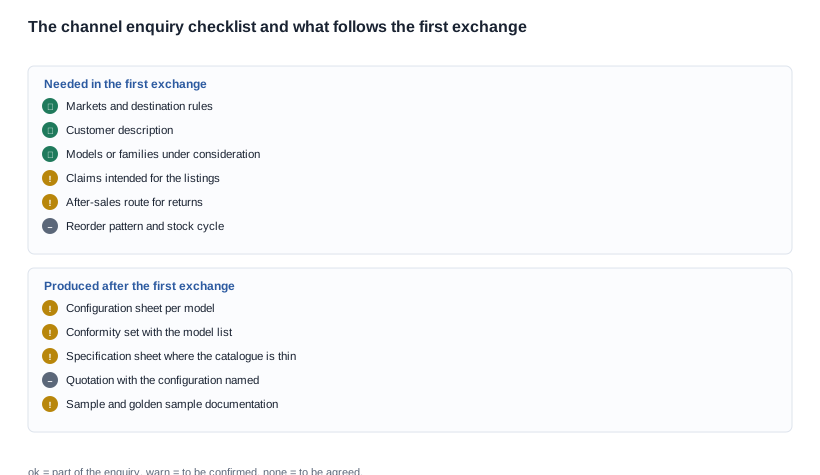
The checklist is short enough to hold in one document and specific enough to be checked off. The first exchange produces a written scope: markets, models, claims, after-sales route, reorder pattern. The second produces the document pack. The third produces the quotation with its configuration named. The fourth is the sample, and it is where the published rows and the physical unit are finally compared — which is the first point at which any of the gaps in the catalogue can be closed, because a specification sheet is a document and a sample is evidence.
The channel marketing side of the same relationship is covered in the channel marketing support note, and the commercial framework sits in the wholesale programme.
What the partner should do with the response
A response that names gaps is more useful than a response that sounds complete, and the sensible reaction to a list of unpublished rows is to triage it rather than to absorb it. Three questions sort the gaps into the ones that block, the ones that shape and the ones that can wait.
A gap blocks when the programme cannot honestly proceed without it: a conformity position for a model you intend to sell, or a camera specification for a page that describes capture quality. A gap shapes when it changes the design of the range rather than preventing it: the absence of a published weight, the absence of a Bluetooth version on eleven camera models, the three camera models with no case row. A gap can wait when it affects a later decision rather than a current one: a colour option for a model whose colour is already fixed by the artwork freeze.
Triage in that order, put the blocking gaps into the document request, put the shaping gaps into the range design, and let the third group sit. Most channel programmes stall because the third group is treated as blocking, which turns a two-week document release into a two-month one. The criteria that decide which group a gap belongs to are worth writing down before the response arrives, because they are much harder to apply once the launch date is in view.
Smart glasses for distributors and retailers: the value and the next step
Where the value sits
The value we offer a channel partner is accuracy rather than promotion, and a distributor who knows exactly which claims can be made will sell this category better than one working from adjectives. That value has three parts: the published rows and the documentation behind them, the data graphics that make a range explainable, and a plain statement of where the data is thin — which, in this category, is a lot of places, and saying so early is cheaper than discovering it at a retail counter.
What we add that a trading desk cannot: the model list on a document, a configuration sheet that makes a delivery auditable, and an answer to the question of what may be claimed. What we do not add: photography, certification conclusions for your market, and prices without a configuration.
The six fields that frame a distributor enquiry
Send the six fields — markets, customer, models, claims, after-sales route, reorder pattern — and we will come back with the published rows for the models in question, the documents we can release against them, and the questions that the published catalogue does not answer. The distributor and retailer solution sets out the wider programme, and if the question is about a specific range decision rather than the relationship itself, the category breadth discussion sets out the criteria we would apply to it.


