

Smart glasses for education: seven items for an institutional pilot
What to bring to a smart glasses for education pilot is a short list, and most of it is not equipment.
That is the first useful thing to understand about this application. The pilot is not a product trial in the way a consumer trial is. It is a programme with an institutional sponsor, a class of people who did not choose the device, a parent who has to be told something about it, and a school that has to be able to stop it. The list that follows is built around those four facts rather than around the hardware, because the hardware is the part of the pilot that a supplier can answer and the other four parts are the ones the institution has to own.
Seven items come to a pilot, and two of them cannot be recovered afterwards.
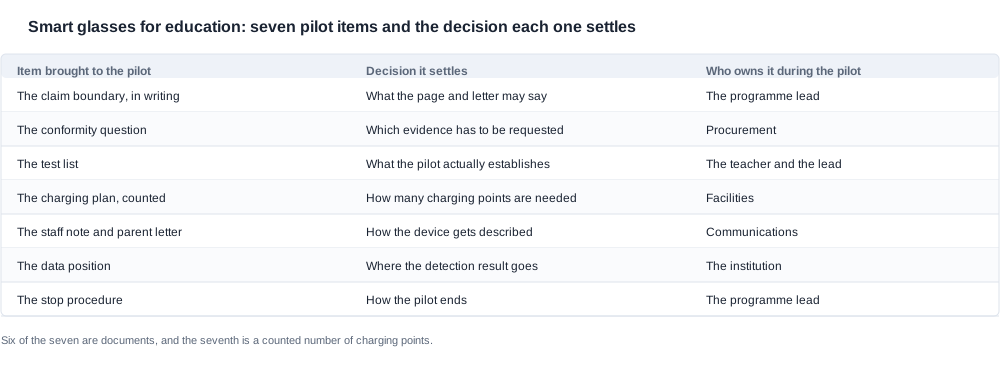
The seven items, and what each one actually contains
- The claim boundary, in writing. One page, signed by the person who owns the programme, listing what the device does and what it does not do: a published posture-and-distance indication, a lens-type electronic atomiser with a clear-versus-fogged state, magnetic charging, a charge ceiling of two hours or less, and roughly twenty hours of rated use. And listing what is excluded: no vision claim, no efficacy claim, no conformity status, no application behaviour. This page is the source for the staff note, the parent letter and the pilot report, so that three documents written at three different times cannot contradict each other. The education pros and cons article sets out the case for and against in full. 2. A written conformity question. One page, addressed to the supplier, asking which requirements apply in the named market, who holds the evidence, and how it reaches the importer. It is the one question a pilot has to answer before it can become a rollout, and the answer takes longer than the pilot, which is precisely why it is sent first. The framework a market applies to children's products is at children's product compliance. 3. The test list. What the pilot will actually establish, written before it starts: the notification path, the charging routine and its owner, the indication behaviour as a teacher would observe it, the data position in practice, and the claim as a teacher would state it to a parent. Five items, no more. The education buying checklist is the selection counterpart, and the education how to choose the right model article is the model decision. 4. The charging plan, with the hardware counted. Docks, locations, the owner of the nightly charge by role, and the fallback when a charge is missed. 5. The staff briefing note and the parent letter. One side each, in plain language, both written from the claim boundary. 6. 7. A way to stop. A pilot that cannot be ended cleanly becomes a rollout by inertia. The education warranty and returns article is the policy view, and the education what to expect article is the realistic version of the first term.
Who the buyer is, and what the pilot has to produce
The reader is a programme manager, a procurement lead or a brand buyer supplying an institution, a training provider or a district. The decision in front of them is not whether the device works in a classroom — a demonstration settles that. The decision is whether the institution can run the pilot without creating a problem it cannot close, and then decide on a rollout with something other than a feeling.
The fear behind that decision is institutional rather than technical. A pilot that has produced a claim the documentation cannot support, or that has not answered the conformity question, becomes a rollout by inertia, because the devices have been bought, the teachers have been trained and the parent letter has already gone out. By that point the cost of stopping is higher than the cost of continuing, which is how institutions end up defending something they did not choose.
That is why the list is a list of documents rather than a list of equipment. Documents are what a pilot produces. Equipment is what a pilot consumes.

The three children's models, read as a procurement constraint
The catalogue publishes three children's models and no others in this tier, and the published rows are narrower than the marketing language around them usually is.
The A05 and the A06 are published with identical rows: a 40 mAh cell, a charge ceiling of two hours or less, roughly twenty hours of rated use, and magnetic charging. Both pages show a lens-type electronic atomiser with a clear-versus-fogged lens state, and a posture-and-distance indication that distinguishes a correct posture and distance from an incorrect one. Neither page publishes a Bluetooth version, a frame weight, a frame size or any efficacy figure. The catalogue prints nothing that separates the two designations, and we will not infer a difference from the naming.
The A07 publishes a 70 mAh cell, the same charge ceiling of two hours or less, the same roughly twenty hours of rated use, magnetic charging and Bluetooth V5.4. It publishes no atomiser row and no posture-and-distance indication. On its own terms it is an audio model with a larger cell and a published radio version.
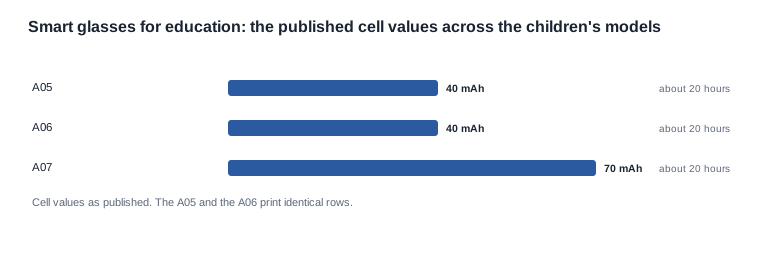
Read as a procurement constraint, that gives a shortlist of one or two models rather than three. A classroom that wants the detection function has one functional choice and two identical designations to choose between. A classroom that wants audio and a radio has one model and a smaller cell to accept. And no classroom in this range gets a camera, because none of the three children's models has a camera row — which is also why a detection claim on a children's device has to be a claim about a published indication rather than a claim about a recording.
The position we will not take. The catalogue product names for these models are children's smart protection glasses and children's smart audio glasses, and they are catalogue names. We publish no claim about what any of these products does for a child's vision, because we hold no evidence for one, and because the requirements behind such a claim have not been assessed for this range. The published rows are what a buyer can order from; the posture-and-distance indication is a published feature, not a clinical or educational outcome. The compliance framework that a market applies to children's products is collected at children's product compliance.
What the identical rows on the A05 and the A06 mean for the order. Two designations with the same published specification is unusual enough to be worth a note, because it changes what the buyer should do. A support pack that treats them as interchangeable will be wrong the first time a family asks about a unit whose designation says A06, and there is no published row for anyone to fall back on. So the designation has to be recorded per device rather than per class, it has to appear on the model card that goes into the household, and it has to appear on the paperwork. The alternative — one designation for the order and one for the shelf — creates an inventory that cannot be reconciled at the end of the pilot, and an unreconciled inventory is the reason a pilot cannot be closed cleanly.
The charging plan, counted per classroom
This is the item that gets missed and it is the one with a number attached. A magnetic interface and a charge ceiling of two hours or less, against roughly twenty hours of rated use, means each device is charged nightly by an adult, at a fixed place, on a dock that has to be somewhere specific.
A class of twenty is twenty charging points. A year group of six classes is a hundred and twenty. A pilot across four sites is four hundred and eighty, plus the cable, plus the power, plus the shelf. None of that appears on a product quotation, and it is the single largest number in the whole programme. A school that has not counted the charging points will find out in week one, and it will find out from the teachers rather than from the buyer, which is the worst way to find out.
The counted plan needs four things written down. The number of docks, at one per device rather than one per teacher. The location, because a dock that lives in a drawer is a dock that does not get used. The owner of the nightly charge, named by role. And the fallback when it is missed, because a missed charge in the middle of a lesson is a visible failure in front of a class, and the recovery has to be a decision somebody can make quickly rather than a question to escalate.
The charging sequence itself is at charging guide for the education models, and the runtime rows are at battery life.
One procurement detail belongs in the same paragraph. A magnetic interface means the dock is part of the order rather than a cable, and the dock is a specific object that has to be sourced for the exact model — which is a second line on the purchase order rather than an accessory that arrives in the box. The catalogue publishes the charging interface for all three children's models and publishes no dock identifier, so the buyer should ask for the dock as a separate line with its own quantity, and should count the docks against the device count rather than against the teacher count. A device that has to be shared between two children is also a device that has to be charged twice as often.

The people side: the staff note, the parent letter and the data position
Three of the seven items are about people, and they are the ones that decide whether a pilot is allowed to continue.
The staff note. One side, in plain language, saying what the device does and what it does not do. The teacher is the person who will be asked the question in front of a child, and the teacher should not have to improvise the answer. The education training article is the staff-facing version to work from.
The parent letter. One side, from the same claim boundary as the staff note, so the two cannot drift apart. That single requirement does most of the work: two documents written from one boundary cannot contradict each other, and the failure mode in this category is a staff note and a parent letter written by different people on different days. The education support resources article is the material to build both from.
The data position. Where the detection result goes, who sees it, what is retained, and what happens when a parent declines. This is the item most likely to be missing from a pilot brief and the one most likely to be raised by a parent in week one. It cannot be answered from the catalogue, because the catalogue publishes no application or firmware row for these three models, so the behaviour of the published indication is a question for the supplier in writing rather than an assumption. The claim has to be written down before the pilot starts, not negotiated during it.
Three sub-questions belong inside that position, and the third is the one institutions forget. Where the result goes, and whether it leaves the institution at all. Who inside the institution can see it — a teacher, an administrator, a parent — and what they can do with it. And what the family does when it declines: whether the device still functions as an audio model, whether it pairs, and whether anything about the purchase changes. That last question determines whether declining is a real choice, and a programme that cannot answer it does not have a data position; it has a data procedure with an unanswerable case in it.
The documentation discipline matters here more than anywhere else in the category. The staff note, the parent letter and the pilot report are three audiences for one set of facts, and the failure mode is not a false statement in any of them — it is a drift between them, where a teacher describes a feature the parent letter does not mention and the parent letter mentions a limitation the teacher was never told about. One source document and three renderings of it is the only arrangement that survives a term.


Where an education pilot goes wrong
The claim is written after the devices arrive. The symptom is a staff note drafted in a hurry in week one and a parent letter drafted from it, neither of which matches the catalogue. The prevention is to write the boundary first and get it signed.
The conformity question is left to the rollout. The symptom is a pilot that has run for a term and cannot be scaled because nobody knows which requirements apply or who holds the evidence. The prevention is to ask it in writing, once per market, before the pilot starts — not because the answer is likely to be negative, but because the answer takes time.
The charging points are counted per device instead of per class. The symptom is a week-one failure reported by teachers. The prevention is the counted plan with a named owner.
The pilot has no exit. A pilot that cannot be ended cleanly becomes a rollout by inertia, because stopping it costs more than continuing it. The prevention is a stop procedure written in advance, with a date, and a reason either way. The education warranty and returns article is the policy view.
The test list was never written. The symptom is a pilot that ends with impressions from six teachers and no record of what was established, so the rollout decision is made on anecdotes. The prevention is the written test list, which is also what the education buying checklist is built from.
A spare battery was ordered as an accessory. No hot-swap arrangement is published for any model, so a spare cell is a second device rather than an accessory, and a spare device has to be counted, charged, tracked and returned.
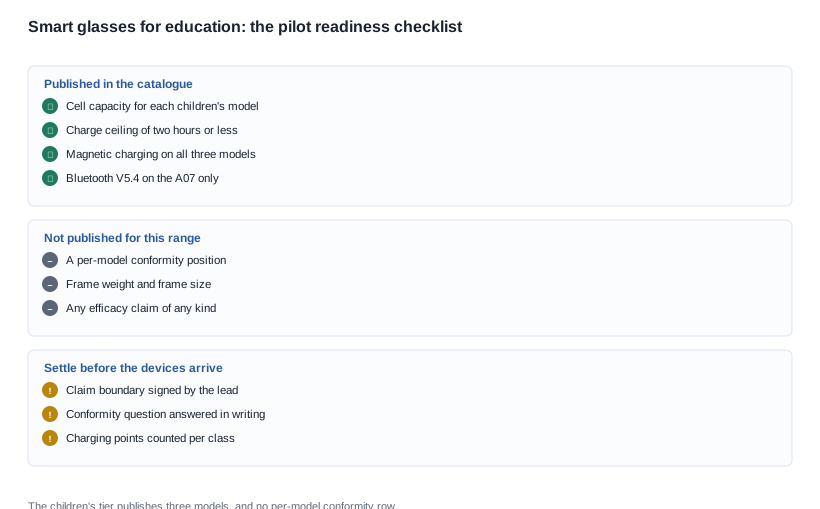
The two questions a pilot cannot fix afterwards, and what the order can still move
The two items that cannot be recovered are the claim boundary and the conformity question, and they are the two that are usually deferred because neither of them produces anything visible. The claim boundary produces no demonstration and the conformity question produces no device; both produce a document, and documents are easy to postpone in a programme whose visible progress is measured in working devices.
The commercial terms that remain open are ordinary and worth naming. Minimum order quantity tiers, and whether two models can share a purchase order. The pilot quantity against the rollout quantity, which is where most of the room sits because it is the supplier's risk rather than the institution's. Whether the supplier supplies the quick-start card and reviews the parent letter artwork before it is printed, which on a device with a published indication is worth more than it sounds. And a split first run into two deliveries against a staged payment, which suits a pilot that has to report to a committee before the rollout is approved.
Two of those deserve a sentence each, because they are the ones a buyer in this category forgets. The pilot quantity is the only lever that protects the institution from its own timetable: a pilot bought at the rollout quantity is a rollout that has already been paid for, and the committee that was supposed to approve it has no leverage left. The quick-start card is the document that makes the charging routine work, because the routine is the one thing the institution cannot delegate — it happens at a household, at a time nobody chooses, and a card that shows the designated adult what to do and what not to do is worth more than any feature on the device.
Settled by the product rather than by the relationship: the cell configuration and therefore the rated-use ceiling, the charging interface and therefore the charging plan, the published indication and the published atomiser rows, and the cost and lead time of conformity testing. A mould charge is a one-time cost that belongs in a separate quoted line rather than folded into the unit price. The commercial structure of a first order is at pricing and the clause language is at contract terms.
Our position. We publish the children's model specifications — the 40 mAh cell on the A05 and the A06, the 70 mAh cell on the A07, the charge ceiling of two hours or less, the roughly twenty hours of rated use, the magnetic charging interface, the Bluetooth V5.4 on the A07, and the published detection and atomiser rows on the two protection models. We do not publish the per-model conformity position, the application and firmware behaviour, a frame weight, a frame size, or any efficacy claim, and we will not present a company-level page as per-model coverage.
If you tell us the institution type, the class size and the market, we will say which of the seven is the one that will decide the pilot. The education what to expect article is the realistic version of the first term, the education pros and cons article sets out the case for and against in full, and the kids range lists the published figures.
Related reading
- The model decision — how to choose the right model for education
- The selection counterpart — education buying checklist
- The compliance framework — children's product compliance
- The range we publish — kids smart glasses
Tell us the institution type, the class size and the market, and we will say which of the seven items decides the pilot.


