
Smart glasses for kids parenting is a category where the product price is the smallest number in the budget and the least unpredictable one. The published range for children is three models: the A05 and the A06, which publish identical parameters, and the A07, which publishes a different feature set. No certification is published for any of the three, no age grade is published, no weight and no ingress position are published, and the catalogue publishes no charging case row for any of them. That silence is the whole budget argument. A budget built on the unit price alone is a budget with an unknown line in it, and the unknown line is the one that decides whether the channel's margin survives its first quarter.
Smart glasses for kids parenting: for the buyer who budgets past unit price
Start with the conclusion, because it is counter-intuitive for anyone used to hardware budgets. For a parents channel entering this category with three models and one or two destination markets, the unit price is a small share of the total cost of putting the range on sale, and it is the only share the buyer can predict before the first shipment. Everything else — the compliance work, the insert, the returns provision, the support stock — is either unknown at quotation or known only after the first quarter's data arrives. The practical consequence is that a budget for this category should be built as a sequence of named lines with owners, and the first line should be small enough that the others have room.
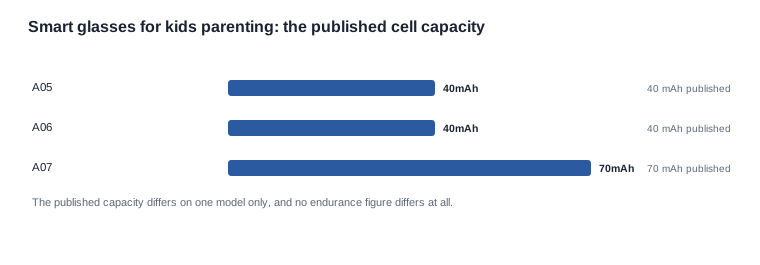
There is a second reason the unit price is the least interesting number here, and it is specific to this product. The published rows for the three children's models are almost identical to each other: a charge time of two hours or less and a rated use of about twenty hours across all three, magnetic charging across all three, and a cell of 40 mAh on the A05 and the A06 against 70 mAh on the A07. There is no published row on which a substantial price difference can be justified, and no published row on which it can be refused. The published record gives a buyer the shape of the decision and very little of the number, which means the price negotiation happens on commercial terms rather than on specifications — and that is a different negotiation, with different tools.
The third point is the one that surprises new channels: the majority of the risk in this category is not in the hardware and not in the price, it is in what the channel says about the hardware. Every claim the channel publishes that the supplier has not published converts directly into a returns provision, a listing correction, or a compliance file that has to be opened after the fact. In this range the published record supports a short list of statements, and the budget line that matters most is the one that funds getting every statement in the listing matched to that list.
There is a fourth structural feature of this budget that is worth naming early, because it changes what a margin calculation can honestly claim. The three published children's models share the same charge ceiling and the same rated use, so there is no published row on which a price tier can be justified by performance. A channel that builds its margin on the assumption that the higher-priced model is worth more per unit is relying on a claim the published record does not carry, and the difference between the two models has to be established from something else — the confirmed difference between the A05 and the A06, the radio and the feature set on the A07, or the market position the channel has built for itself. Which means the commercial case for the second model is a case the channel has to make, not one it can read off a table.
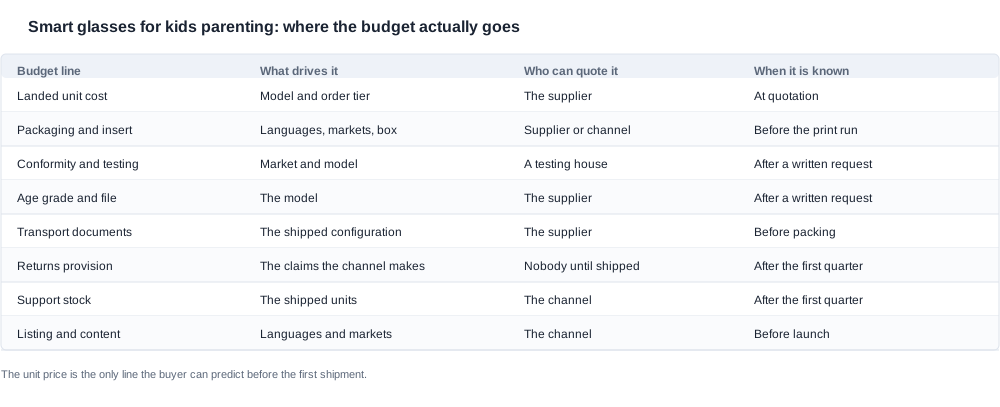
| Budget line | What drives it | Who can quote it | When it becomes known |
|---|---|---|---|
| Landed unit cost | The model and the order tier | The supplier | At quotation |
| Packaging, insert and artwork | Languages, markets, box format | The supplier or the channel | Before the first print run |
| Conformity and testing | The market and the model | A testing house | After a written request |
| Age grade and technical file | The model | The supplier | After a written request |
| Transport documentation | The configuration being shipped | The supplier | Before the shipment is packed |
| Returns provision | The claims the channel makes | Nobody, until it ships | After the first quarter |
| Support and replacement stock | The shipped units | The channel | After the first quarter |
| Listing and content work | Languages and markets | The channel | Before launch |
The one line that is never quoted and always paid. Almost no quotation in this category includes the cost of establishing conformity for the destination market, because the catalogue publishes no certification for any model and no age grade, so nobody has priced the work of finding out what is required. The buyer therefore receives a unit price that looks complete and a compliance obligation that has not been costed by either side. The budget line for it has to be created deliberately, and the order to create it in is before the first purchase order is placed, not after the first shipment is held.

The three published children's models and what separates them
The published range is short enough to be quoted in full, which means the budget conversation can start from facts rather than from a shortlist somebody assembled.
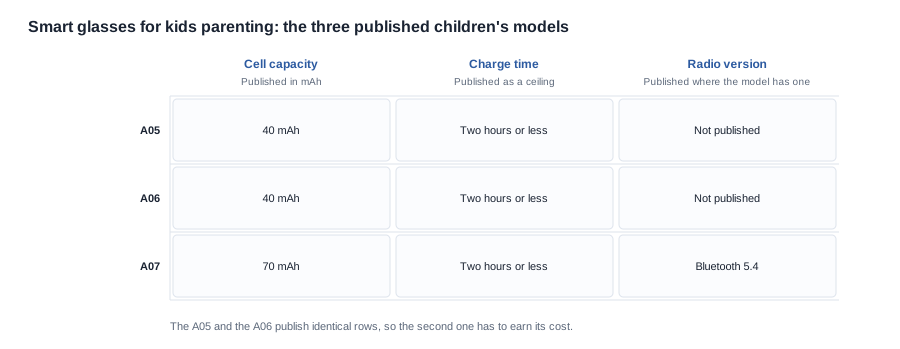
The A05 and the A06 publish identical parameters, and the difference between them is not confirmed. For budget purposes this is not a small point. Two models with identical published rows means two conformity files, two inserts, two sets of support copy, two listings and two sets of returns data, all describing the same thing. The financial question is therefore not "which model is better" but "does the second model earn its keep", and the answer has to be produced by the supplier in writing, because the published record cannot produce it. A channel that consolidates to one model and holds the other as an alternate has one set of costs; a channel that lists both has two, and the second set is a fixed cost spread over the same sales.
The A07 is a different product rather than a better one. It publishes a larger cell and a radio version, and it publishes no fogging arrangement and no posture or distance detection. Two consequences follow for the budget. The first is that the A07 has a different accessory and insert set from the A05 and the A06, so it is a separate artwork and compliance line rather than a variant. The second is that a connected product attracts a different set of questions from a market authority and from a parent, and those questions have to be answered in writing even where the published record is silent — the catalogue publishes no application row and no firmware row for any model in the range, so a budget that assumes a connected-product answer will exist is a budget with a gap in it.
What the published rows cannot tell the budget. The frame material, the lens material, the coating, the hinge specification, the weight, the ingress position, the charging case status, the storage behaviour, the operating temperature range and the cycle life rating are not published for any of the three. So a budget that assumes a certain defect rate, a certain accessory replacement rate or a certain unit price band for a specific configuration is assuming something the published record does not support, and the assumption should be labelled as one so that it can be corrected when the real figure arrives.

The compliance line that no quotation will include
This is the line that most often turns a profitable first order into an unprofitable second one, and it exists because the published record for these three models is empty on the questions a market actually asks.
What has to be established. The destination market has a set of requirements for a product of this type, and the catalogue names none of them for any model. The channel therefore has to establish, per model and per market: the applicable product standard and any age grading requirement; whether a third-party test is required, and whether the test is per model, per configuration or per batch; the technical file the standard expects to exist; the certificate or declaration that results; the labelling and packaging requirements; and the registration or listing step, if the market has one. Each of those has a cost and a lead time, and the lead times are longer than a typical launch schedule.
Why the quotation misses it. The supplier's quotation is built on what the supplier publishes, and what the supplier publishes for these three models contains no certification reference at all — the catalogue text names no CE, FCC or RoHS, and there is no per-model certification row. The company-level export certification page in the catalogue is an image page whose content is not extractable text, so it cannot be read across as evidence for a model. A buyer asking "are these certified" receives either a reassurance or a request for more information, and neither is a priced line in a quotation.
The configuration trap. The requirement is usually per configuration, and the configuration a channel ships is not always the configuration that was tested. A shipping case, a different lens, a different package format or a firmware variant can each move the goods into a different conformity position from the sample that was assessed. In this range the camera models show how easily that happens: five publish a charging case capacity, two publish a case without a capacity, three publish no case row at all and one has no charging-case row. The children's models publish no case row for any of the three, which is an unpublished row rather than a stated absence, so a channel that adds a case to the box is adding a configuration nobody has assessed.
The age grade is the line that stalls first. No age grade is published for any of the three models, and age grading is usually the first question a market authority asks about a product in this category. It is also the item most often left out of a budget because it feels like a label rather than a programme. It is not a label: it requires a decision about the product's design, a technical file, sometimes testing, and a document that the packaging and the listing then have to match.
What to put in the request, and what to budget. The document list per model per market should name the standard, the test requirement, the file, the certificate or declaration, the labelling, and the registration step, with a place to record the answer, the date and the cost. What the supplier can absorb and what cannot is a commercial question with a clear answer: the supplier may already hold a file for a model, in which case the channel's compliance cost is close to zero, and where they do not, the cost and the lead time are real and have to be carried by somebody. The route for the request list is at the certification checklist, the child-product route is at child product compliance, and the market-by-market entry points are at the EU route, the UK route and the US route.

The returns provision is a budget line, not a cost
A returns provision is money set aside at the point of sale for units that come back. In a category where the published record is thin and the channel's own copy is the most likely source of a return reason, this line is not a rounding error, and it is the line that moves the most between the first quarter and the second.
The driver is the claim, not the hardware. The published rows describe a device that charges within a stated ceiling and delivers a rated use of about twenty hours, with a behaviour prompt on two of the three models. None of that is a defective device. A return in this category is much more likely to be a parent who read something the listing said, acted on it, and did not get it. Which means the size of the provision is set by the accuracy of the copy rather than by the quality of the product, and a channel that has not yet tested its copy is budgeting blind.
Three specific provisions to set. The first is for units returned against a claim the channel has removed — the wording fix is cheap, but the units already in the returns queue are not, and the provision for a wording problem is sized by the number of units in flight when the wording is corrected. The second is for units returned against a behaviour the channel described and the product does not produce, which is the case that a range consolidation fixes and that a first order does not. The third is for the accessories — the cleaning item and the magnetic dock are consumed or lost, and the replacement rate for a magnetic dock is a channel metric that only exists once the units are in homes.
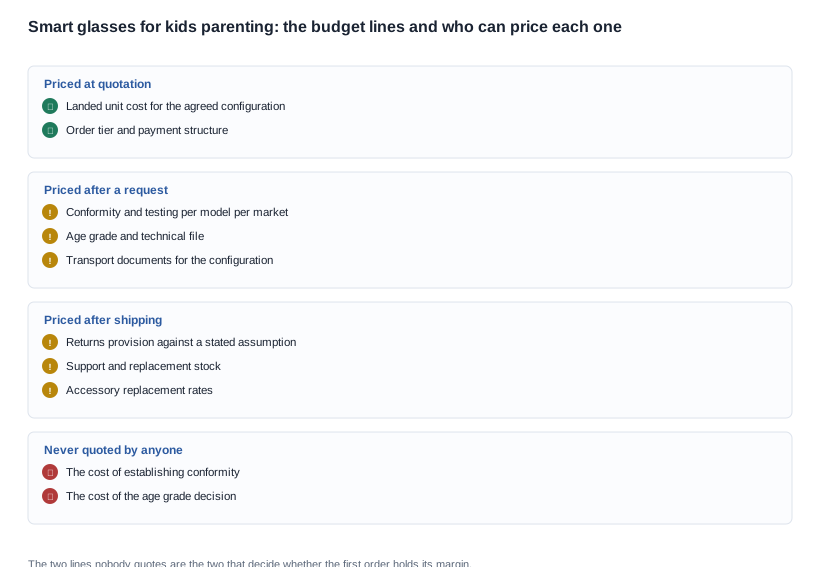
How to set it without inventing a rate. Do not start from a percentage. Start from the number of units in the first shipment and the published rows, and write the provision as a stated assumption with a date on it, for example a first shipment of a stated size with a provision covering a stated share of that shipment at a stated unit cost. Then replace the assumption with the actual returns breakdown at the end of the first quarter, split by reason. The split is the useful output: returns against a claim, returns against a missing accessory, returns against a defect and returns against a change of mind are four different budget problems, and a single blended rate hides all four. The total cost of ownership for a device of this type is therefore not a number to guess at in advance but a number to measure in the first quarter and re-price from.

Building the budget as a channel owner
The sequence below is the one that works when the published record is as thin as it is for these three models.
- Fix the range first. One model or two, decided in writing, with the published rows attached. The A05 and the A06 publish identical parameters, and the difference between them is not confirmed, so the range decision is a cost decision before it is a product decision. The model pages are at the A05, the A06 and the A07.
- Build the compliance line per model per market, and price it before the purchase order. This is the step that stalls a launch if it is deferred, because the lead time belongs to a testing house rather than to the supplier's production schedule.
- Cost the insert and the artwork as a one-off per version. The insert is where the claims are made, and a claim that has to be removed later is a reprint. The accessory and insert decision is set out at accessories for a parents channel.
- Set the returns provision as a stated assumption with a date. Sized on the first shipment, replaced by the first-quarter returns breakdown split by reason.
- Hold the support stock at a share of the first order rather than a forecast. The published endurance is a rating without a test condition, so the replacement rate is a measured figure and not a derivable one.
- Re-price the whole budget at the end of the first quarter. The compliance line becomes an actual cost, the returns provision becomes an actual rate, the accessory rates become actual rates, and the unit price can be renegotiated against a real order history. The commercial pages for that step are pricing, payment terms and minimum order quantity.
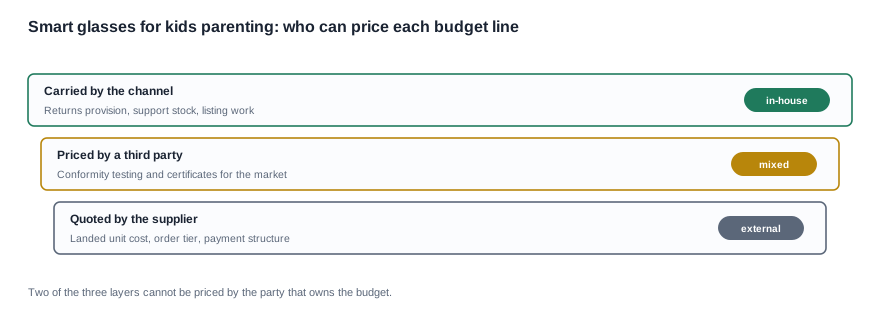
What we will and will not do on a budget. We publish the rows that exist for these three models — the cell capacity, the charge time as a ceiling, the rated use, the magnetic charging interface, the published feature set, and the Bluetooth 5.4 on the A07. We will quote a configuration, an order tier and the commercial structure against it, and we will say plainly which figures in a buyer’s budget depend on a compliance file that does not exist yet. We do not publish a certification, an age grade, a charging case, a weight or an ingress position for these three models, and we will not estimate the cost of obtaining any of them on the buyer’s behalf. What we will do is take the market, the channel, the models you intend to list and the budget lines you have drafted, and return the rows that can be quoted, the lines that need a written supplier position before they can be priced, and the lines that have to be carried as assumptions until the first shipment produces real figures. The product family is at kids smart glasses and the scenario entry point is smart glasses for parenting.
Related reading
- How the scenario opens — smart glasses for parenting
- The model family — kids smart glasses
- The claim boundary — child product compliance
- The errors to avoid — beginner mistakes
Send us the market, the models and the budget lines you have drafted, and we will separate the ones we can quote from the ones that have to be carried as assumptions.


