Smart glasses for outdoor use are bought as a season, not as a device, and the published position in this range is stronger on serviceability than on endurance. Seven catalogue entries are relevant to an outdoor channel, and between them they publish two detachable inner frames, detachable or slim temples on two further rows, a remote photo capture feature on two models, an ingress marking on exactly two, and a colour count on exactly one. What none of them publishes is the operating temperature range, the drop performance, the lens material, the coating, the frame weight or any third-party ingress report. For a buyer, that combination points at one conclusion: the outdoor decision is about how a damaged unit is handled and how a season is restocked, and endurance is a secondary question.
Smart glasses for outdoor: the published asset is serviceability, not endurance
The buyer in this scenario and what is actually being decided. The reader is a brand buyer, a channel buyer or a merchandiser assembling an outdoor assortment for a seasonal window. The decision is not which model is the most rugged. It is which models go into the assortment, how a damaged unit is replaced, what the listing may claim about weather, and how the season's replenishment is planned against a supplier's lead time. The risk that costs the most is the ordinary one: a season of stock that cannot be reordered in time because the lead time was negotiated against a calendar rather than against the season.
Why this range reads differently from an indoor one. Outdoor selling has two properties the catalogue rows describe only partly. The environment is hostile in ways that are not published — temperature, dust, impact, water beyond splash — so the buyer's diligence has to move from specification to sample and to written statements from the factory. And the commercial cycle is seasonal, which means a colour count published on one model and absent on the others is not a minor detail; it is the difference between a replenishable assortment and a single-run assortment.

Which published features survive an outdoor season, and which do not
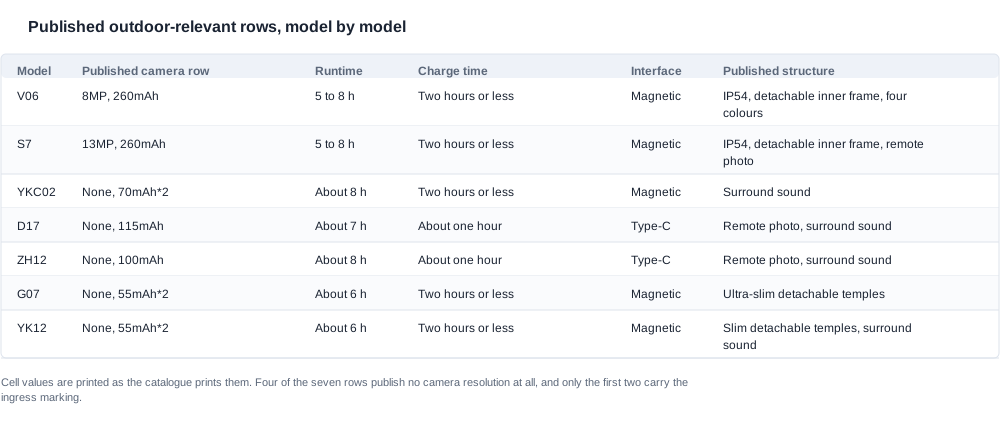
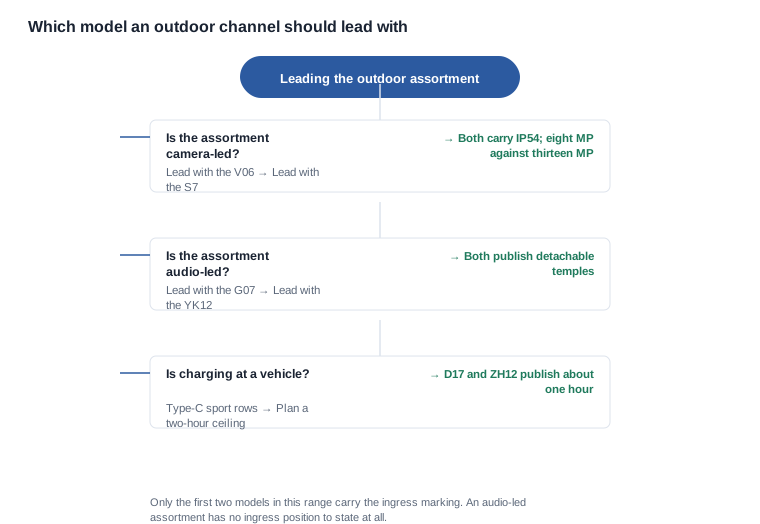
Two models in this range publish a camera resolution, and they are the same two that carry the ingress marking. The V06 publishes 8 megapixels, a 260 mAh cell, a rated use band of 5 to 8 hours, magnetic charging and a detachable inner frame, alongside four colours. The S7 publishes 13 megapixels, the same 260 mAh cell, the same band, magnetic charging and a detachable inner frame. Both are catalogued with the sport designation and both carry the IP54 marking. That pairing matters commercially: the two models that can survive splash are the two models that carry a camera, which means a camera-led outdoor assortment and an audio-led outdoor assortment do not have the same ingress story.
Three audio-oriented rows publish no resolution at all. The YKC02 publishes Bluetooth 5.4, 70mAh2, about eight hours, magnetic charging and surround sound. The D17 publishes Bluetooth 5.4, 115mAh, about seven hours, Type-C charging at about one hour, remote photo capture and surround sound. The ZH12 publishes Bluetooth 5.4, 100mAh, about eight hours, Type-C charging at about one hour, remote photo capture and surround sound. The G07 and the YK12 publish Bluetooth 5.4, 55mAh2, about six hours and magnetic charging, with the G07 publishing ultra-slim detachable temples and the YK12 publishing slim detachable temples alongside surround sound. None of these five rows publishes an ingress marking, a camera resolution or a frame weight.
The detachable inner frame is the most valuable published structural feature in the range. On the V06 and the S7 it converts a damaged product into a replaced part. For an outdoor channel this is worth more than a resolution tier, because a resolution tier has nothing behind it in this range — no sensor model, no field of view, no video specification — while a detachable frame is a fact on the catalogue page that a buyer can put into a spare-parts plan and a buyer can cost. A channel that has not asked whether spare inner frames can be ordered has quietly decided to replace whole devices instead, and that decision sits in the after-sales line of the business case rather than in the product line.
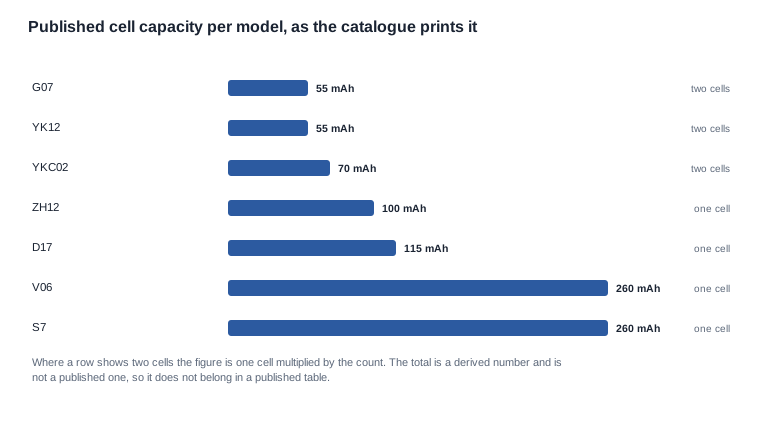
The cell architecture varies more than the tier names suggest. Two of the audio rows publish a doubled cell at 55mAh2, the YKC02 publishes 70mAh2, and the D17 and the ZH12 publish a single cell of 115 mAh and 100 mAh. The camera rows publish single cells of 220 mAh to 290 mAh. Where a row publishes two cells, the figure is one cell multiplied by the count; the total is a derived number and is not a published one, so it does not belong in a published specification table. It does belong in a buyer-side total-cost comparison, where the derived figure should be marked as derived.
Two rows charge in about an hour, and that is the fastest published turnaround in the range. The D17 and the ZH12 publish a charge time of about one hour against a ceiling of two hours or less on every other row. For an outdoor channel that charges at a vehicle rather than at a wall socket, that difference is the difference between a usable half day and a usable full day, and it is a reason to give the Type-C sport rows a place in the assortment even in a camera-led range. It is also a reason not to overstate it: about one hour on two rows is not a charging speed the range can claim in general.
The ingress position: two models carry it, and the rest carry nothing
The marking is on the V06 and the S7, and nowhere else. The IP54 marking appears on exactly two catalogue entries, and both of them are camera models. The second digit is a splash-protection level and the first is a dust-protection level; neither covers immersion, and neither covers sustained rain. This is the fact an outdoor listing gets wrong most often, because the sport designation is printed on five rows in this range while the marking is printed on two of them. A listing that says the sport range is IP54 is wrong on three models out of five, and it is the kind of wrong that a customer in heavy rain will find.
No third-party report is published behind the marking. There is no testing body named, no report number and no test standard cited for the IP54 on the V06 or the S7. A buyer whose customer requires a documented rating has to request a report, and that request has a lead time and a cost that belong in the season plan rather than in the launch week. The digit reading is at IP ratings and the wording the listing should use is at what the second digit means.
The audio rows have no ingress position at all, so the listing says nothing. For the YK12 and the G07, the ZH12 and the D17, and the YKC02 there is no marking to describe and therefore no weather wording available. This is not a weakness to work around with softer language; it is a limitation to state plainly or to solve by supplying a different model. A buyer who wants a splash-positioned audio SKU has to source a different model or accept that the listing will not mention water.
What the environment rows say, which is nothing. The operating temperature range, the drop performance, the impact behaviour and the dust tolerance are not published for any entry. For an outdoor channel those are the four questions a professional buyer asks before anything else, and all four have to be answered by a written statement from the factory rather than by a catalogue row. A statement that says "not tested below zero" is a usable answer; a catalogue that stays silent is not.

Seasonality, colour count and the replenishment risk
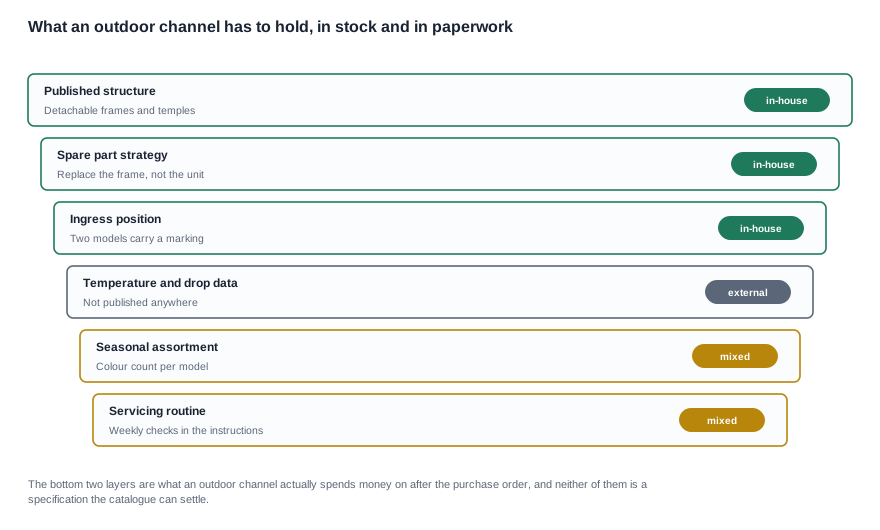
The colour count is published on one model and the season is built on it. The V06 publishes four colours, and the other six relevant entries publish no colour count at all. A retail assortment therefore has to be designed around a single model's colour set, or it has to be designed as a one-colour assortment across the rest. That is a materially different supply chain from a channel that can reorder a colourway mid-season, and it should be settled before the artwork is drawn rather than after the first run is on the water.
The lead time has to be negotiated against a season, not a calendar. A supplier quoting four to six weeks against a calendar means something entirely different when the buying window closes in three weeks and the season opens in eleven. The commercial question worth asking is whether the production slot can be reserved and what the cost of a missed slot is, and the lead time page is where the structure sits. The MOQ question is the same question from the other side: a minimum order quantity that is comfortable for a year-round channel is a serious constraint for a seasonal one.
The servicing routine is a channel cost and it belongs in the box. Contacts collect salt, lenses collect grit, and a frame that has been knocked takes a knock in the structure rather than the finish. Nothing in the catalogue characterises any of those surfaces, so the only defensible instruction is a supplied one: a weekly check of the contacts, the lens and the frame, with a dry cloth, written into the insert rather than left to a listing line. The outdoor maintenance guide is the short version, and the servicing routine is a cheaper return-rate lever than any specification the buyer could ask for.
The two surprises a first outdoor season usually produces. The first is that the detachable inner frame is harder to replace than it looks — the part may exist, the order route and the lead time may not, and the question has to be asked before the season rather than in the middle of it. The second is that the two rows with the fastest published charge time are the two rows with no camera resolution, so a buyer who wants both properties is sourcing a configuration the catalogue does not describe.
The shortlist criteria for an outdoor assortment, and the order to apply them
The order of the criteria decides whether the shortlist is useful, because two of them can remove a model before its price is looked at.
- Does the assortment need a splash-positioned SKU? If it does, the choice narrows to the V06 and the S7, because they are the only entries in the range that carry the marking.
- Does the assortment need a camera? If it does, the assortment draws on the full camera tier rather than on the seven rows above, and the resolution class becomes the differentiator: 8 megapixels on the V06 and the MT5, the CY05 and the V03, the V03 Pro and the MT6, and the CY03 and the KY06, and 13 megapixels on the S7, the L1 Pro and the L2 Utral.
- Does the assortment need a detachable structure? The V06 and the S7 publish detachable inner frames; the G07 and the YK12 publish detachable or slim temples. The repair economics differ from the comfort economics, and the buyer should be clear which one is buying.
- Can the channel recharge in the field? If yes, the D17 and the ZH12 publish about one hour against a ceiling of two hours or less elsewhere, which is the difference between half a day and a full day of use away from a socket.
- Can the assortment be reordered inside the season? If not, the colour count and the lead time dominate the decision and the assortment has to be designed around the four colours the V06 publishes.
- Only then does the unit price tier come into the comparison. It is the criterion that matters least, because in this range the price difference between two configurations is usually smaller than the difference between one configuration with a spare-part route and one without.
A buyer who knows how to choose between two suppliers' outdoor quotations is really asking whether the supplier will answer the environment questions in writing. The one who does has settled the hard half, and the price tier that follows is the easy half.

What to demand in writing before an outdoor configuration is ordered

- Confirm the model designation on the unit against the paperwork. The designation is what makes a loss traceable and what makes a spare-part request answerable.
- Ask for the ingress position in writing for that exact model, with its scope, and ask whether a test report exists behind the marking.
- Ask for the operating temperature range and the drop position. Neither is published, and both are the first questions a professional outdoor buyer asks.
- Check the frame structure on the sample part by part. Which piece detaches, how it is held, how it is replaced and whether the replacement is a catalogue item or a bespoke one.
- Establish the spare part route and its lead time. A spare-part answer without a lead time is not a spare-part answer.
- Agree the servicing routine and put it in the box insert. A routine nobody is told about is a routine nobody performs.
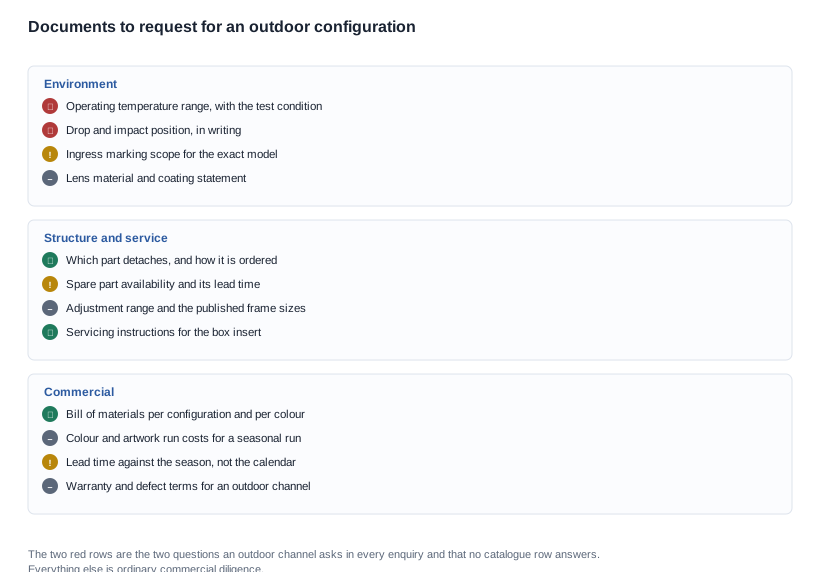
The documents to request before a deposit. The environment statement, the ingress position, the lens material and coating, the detachable-part schedule with the spare-part lead time, the adjustment range and published frame sizes, the servicing instructions for the insert, the bill of materials per configuration and per colour, the colour and artwork run costs for a seasonal run, the lead time against the season, and the warranty and defect terms. The clause language is at contract terms and the commercial structure is at pricing. The outdoor selection guide is the version of the selection step to use before a shortlist, and the size question is where the adjustment question starts, because nothing about the frame sizing is published for these models.
Where the commercial room sits. The colour and artwork change between runs is cheap; the same change after the print run is not. The consumable and insert contents are per-unit costs that decide the servicing routine's effectiveness. Whether the channel can split a season order into two deliveries against a staged payment is often the difference between a full season and a partial one. The pilot tranche of an order is where the margin opens, because that is the risk the factory carries rather than the buyer.
Where an outdoor channel fails, and what the first season measures
A weather claim that outruns the marking. The marking covers splash protection on two models. The claim covers immersion on all of them, and the customer in a downpour is the one who tests it.
A range described as IP54 across the board. Five rows in this range carry the sport designation and two carry the marking. The gap between those two numbers is the gap between a defensible listing and a challenge.
A season ordered against a calendar lead time. The reorder window is what matters, and it has to be negotiated before the run, not assumed from a quotation.
A broken unit written off as a broken device. Without a spare-part route established, a damaged inner frame becomes a device replacement, and the cost lands in a line nobody budgeted.
A servicing routine that exists only on the product page. A weekly check that is not in the insert does not happen, and the returns arrive in the second month of the season.
A listing that quotes a weight. The only published weight in the whole catalogue is 158 g for the MT6, which is a camera model with a foldable case rather than an outdoor model, and it is the whole unit including its battery and camera and excluding the case. Every other model in the range has no published weight at all.
What the first season has to measure. Three ratios from the returns desk: how many returns were impact damage, how many were water, and how many were a battery that would not charge after being left in a vehicle. The third of those is the one that changes the channel's design, because a battery that fails after heat in a vehicle is a charging-model problem rather than a product problem, and it is solved with the case rows and the charging routine rather than with a different model.
A narrow proposition, and we will not widen it
Stated plainly: the honest outdoor proposition is a narrow set of things done well, with a published structure that helps a channel repair rather than replace, and we will not widen it. We publish the charge times, the interfaces, the rated use figures and the cell capacities, the resolution class where one is published, the detachable inner frames on the V06 and the S7, the ultra-slim detachable temples on the G07, the slim temples on the YK12, the colour count on the V06, the IP54 marking on the V06 and the S7 and the remote photo capture on the D17 and the ZH12.
What we do not publish, and will not estimate: the frame weight beyond the single 158 g whole-unit figure for the MT6, the operating temperature range, the drop and impact performance, the lens material, the coating, the field of view, the video specification, the frame rate, the low-light behaviour, the runtime test condition, and any third-party ingress report. We will not say waterproof, we will not extend the IP54 marking to the YKC02, the D17 or the ZH12, and we will not state that any model holds CE, FCC or RoHS certification, because the catalogue text names none of them and carries no per-model certification row.
What we will do: take the environment, the season window, the price band and the volume, and tell you which configurations exist, which published rows apply to them, which structure can carry a spare-part strategy, and which claims the listing can make without overreaching. The product families are at sport smart glasses and AI camera glasses, the scenario entry point is smart glasses for outdoor, and the worked example of the same channel is at the outdoor case study.
Season window and price band
Send the environment, the season window, the models you are comparing, the price band and the volume, and we will return the published rows that cover them, the structural features that support a spare-part strategy, the claims the listing can carry, and the questions that have to be settled in writing before a purchase order. The materials and adjustment position is at materials and ergonomics, and the terms for a sample order are at sample policy.
Related reading
- The point where the scenario starts — smart glasses for outdoor
- The product family set — sport smart glasses and AI camera glasses
- The ingress scope — IP ratings
- The rows we can confirm — battery life
Tell us the environment, the season window and the models, and we will return the published rows that cover them and the structure that supports a spare-part strategy.