Smart glasses for security: the four published rows that the season moves
Season does not change the specification. It changes which published row binds. A security deployment that works through a mild spring can be quietly wrong in three separate ways by August, and each of the three failures is a procurement failure rather than a device failure. The heat of the exposed post puts the charging plan under pressure. The cold of the winter night changes what the published runtime is actually worth. The rain season turns the ingress question from a formality into the only question that matters. And the autumn surge changes the order date rather than the hardware at all. A buyer who treats the seasonal review as a device process will spend the summer discovering that the plan was wrong; a buyer who treats it as a row-binding task will spend an afternoon finding out.
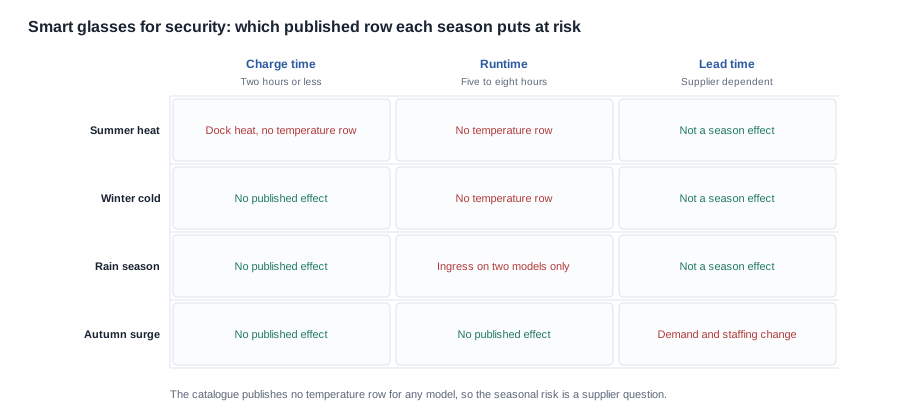
The conclusion, stated before the detail. Four published rows carry almost all of the seasonal risk, and they are the same four rows in every deployment: the charge time, the ingress marking, the rated runtime, and the lead time. The catalogue publishes a temperature-dependent behaviour for no model in the range, so a seasonal review cannot be answered by reading the catalogue — it can only be answered by attaching a written question to each affected row. And the size of the affected population is knowable in advance, which means a buyer can price the risk of a season before it arrives rather than after. The practical rule is: for each season, name the row it binds, count the models that are exposed on that row, and put a question on the count before the order.
Who this is written for. The buyer or operations planner who owns an annual ordering cycle for a security deployment, and who has to explain to a finance function why a device order placed in a particular month is not a device order at all. That reader's problem is rarely the specification. It is the date.

Heat, and the charging interface that has to survive it
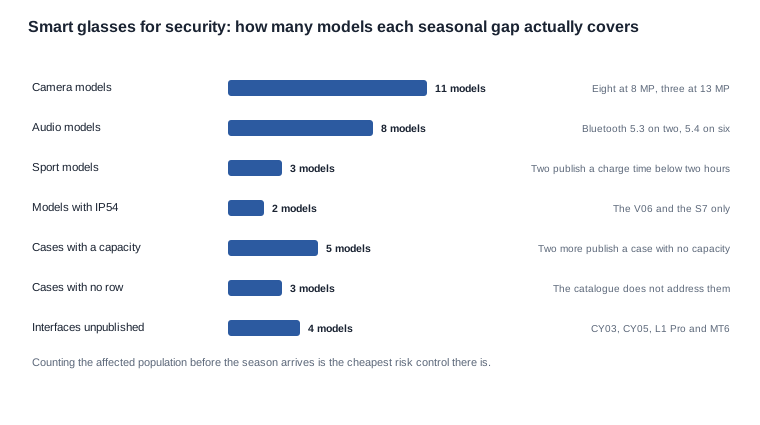
The published charge time for the camera group is a ceiling of two hours or less on every one of the eleven models, and the same ceiling holds across the eight audio models and the YKC02. Only the D17 and the ZH12 publish about one hour. In a mild climate that number is a logistics convenience. In a hot summer, it becomes the constraint that decides whether the deployment's charging plan works, because the number the catalogue publishes is a charge time measured under a condition the catalogue does not publish.
What the heat actually changes
Three things, in order of how easily they are missed. The contact. A magnetic charging model depends on a correctly aligned contact free of debris at every location, and the failure mode of a hot, dusty environment is a contact with debris on it. The catalogue publishes no operating temperature range, no thermal behaviour and no cycle life rating, so a buyer cannot rule the risk out — and the operational answer is cheap: the contact-cleaning consumable is already a line on the base's order, and the specification should state a cleaning interval per device per week rather than "as required". The dock. A magnetic model needs a charging point at every location, and a dock in an exposed or hot position is an installed asset with a thermal question attached. The model choice. A Type C model with a cable does not depend on a contact alignment, which is a genuine argument for it in a hot site — and a genuine argument that has to be made deliberately rather than by accident.
The cost of not deciding
The failure is administrative rather than dramatic: a rising rate of "will not charge" reports at the base, which are attributed to the hardware, which produces a supplier claim that the supplier will answer with the published charge-time row. The row is not wrong. It is simply not an answer to the question the site is asking. The way to avoid the loop is to ask the supplier, in writing and in advance, what the charge time is at the temperature and humidity the site actually runs — and to record the answer as the acceptance criterion for the charging plan rather than the catalogue figure.
The seasonal mitigation that costs almost nothing
Three items, all of them consumable or procedural rather than capital. State the cleaning interval per device per week against the summer rate rather than the annual average. Put one spare charging point per site in the spares inventory, so a failed contact does not take a vehicle out of service. And put the summer charge question into the supplier question list before the order, with a requested figure and a requested test condition. The published rows are at battery life and the charging plan is at charging solutions.
The cost comparison a hot site forces, which is not a unit price comparison. In a site where the charging interface matters, the two configurations are not comparable at the unit price because they commit the buyer to different recurring and capital lines. A magnetic configuration commits the buyer to a charging point at every location, plus a spare charging point in the spares inventory, plus the labour to place, power, protect and maintain each of them, and it exposes the buyer to the contact and dock questions above. A Type C configuration commits the buyer to a cable per device per location, replaced at the base, plus a recurring consumable line that scales with the fleet size, and it removes the contact-alignment failure mode from the summer risk entirely. The right way to compare them is the total cost of one device over one year: the unit price, the share of the charging hardware allocated to it, the replacement rate of the cable, the consumable rate, and the administrative cost of the interface the buyer chose. A buyer who runs that arithmetic for the site's actual summer conditions will frequently find that the configuration with the higher unit price has the lower total cost, and will have the evidence to defend the choice. The terms are at pricing and the agreement language is at contract terms.
Cold, and the runtime ceiling that the night shift inherits
The runtime row is published for every camera model — five to eight hours on the V03 and the V03 Pro, and the V06 and the S7, six to eight hours on the KY06 and the MT5, and about seven hours on the MT6 and the L2 Utral, and the CY05 and the L1 Pro, and the CY03 — and for every audio model, where it runs between about six and about eight hours. What is published nowhere is the condition under which that runtime was measured. A winter night patrol in an exposed post is the condition where that missing information becomes expensive, because the operator is further from a base at the coldest hours and the runtime row is the only number that decides whether the shift closes without a gap.
Why the night shift inherits the problem rather than creating it
The mistake is to treat the winter issue as a new requirement. It is not. The published runtime is a single number that the deployment applies across all twenty-four hours of the year, and the winter shift is simply the shift where the gap between that number and the site reality is widest. A deployment that sized the spare pool on the annual average has sized it on a condition that exists for three months and is invisible in the other nine. The seasonal correction is not a new model and not a new policy — it is a re-sizing of the spare pool and the recharge interval for the months where the condition bites.
The two decisions the cold season forces
Recharge interval. The base has to plan for the possibility that a device is not returned to a charging point during a long night shift. That is a spare-pool sizing decision, and the spare pool is a cost the buyer owns rather than a specification the supplier publishes. Model selection for the night post. The camera models with the shortest published run times are the ones with the lowest published cell capacity, so the night post and the endurance post are not the same purchase. A site with a twelve-hour night shift and a four-hour day shift may reasonably run two different models, and that is a shortlist decision that only becomes visible when somebody reviews the roster against the runtime row.
What to ask about cold, in the order that saves time
Ask what the published runtime is measured at, and under what temperature and activity. Ask whether there is a published figure for cold conditions, and if not, ask for a supplier statement of the tested range. Ask what the standby draw is, because a device left on a desk between patrols is a standby question and no standby figure is published for any model. Ask whether the device can be configured to reduce the sampling or recording rate, because that is the only lever a buyer has over a runtime ceiling that the catalogue does not tie to a condition.

Rain, and what the ingress marking settles and does not
The ingress position in this catalogue is unusually clear and unusually narrow, and the discipline is to say both halves out loud. Two models carry an IP54 marking: the V06 and the S7. Both are sport camera models, both publish a removable inner frame, and both use magnetic charging with a 260 mAh cell. No other model in the camera group, the audio group or the sport group carries any ingress marking at all.
What IP54 covers, in words a deployment sheet can use
A dust protection level and protection against splashing water. That is the published meaning, and a deployment sheet should say exactly that and no more. It does not cover immersion. It does not cover a sustained downpour. It does not cover a jet of water from a pressure hose, and it does not cover a vehicle wash bay, which is where a surprising number of devices in this category are actually rinsed. And no test report behind the marking is published, so the marking can be stated as a catalogue attribute and nothing at all can be built on top of it.
The arithmetic of the rain season
The buyer who plans for rain should count, before the season arrives, how many models in the shortlist carry a marking and how many do not. In a camera shortlist of eleven models, two carry the marking and nine do not. In a shortlist that includes the audio group, none do. That ratio decides the commercial shape of the answer. The options are to restrict the shortlist to the two marked models, to ask the supplier for a written ingress position on every other model in the shortlist, or to design the deployment so that the unmarked models are not the ones exposed — which is a scheduling decision that belongs to the site and is sometimes cheaper than either alternative. The digit reading is at IP ratings and the deeper treatment is at advanced IP considerations.
What the rain season actually costs
Two things, one obvious and one not. The obvious one is the risk of a device failing during the wettest part of the shift, which is the risk the ingress question exists to address. The less obvious one is the cost of the question itself: for every unmarked model, a written supplier request, a response time, and a decision. A buyer who counts that cost early will often find that restricting the shortlist to the marked models is cheaper than documenting nine separate positions — and that is a legitimate outcome, not a failure of due diligence.
How to write the ingress position into the agreement
Once the buyer has decided how the ingress question is being answered, the answer has to live somewhere that survives the order, and the purchase order is usually the wrong place for it. Three clauses do the work. The specification clause names the exact model, the exact configuration and the exact marking claimed for it, so that "IP54" attaches to a model rather than to a category. The evidence clause requires the supplier to state what test report or test standard stands behind the marking, and what the marking does not cover, in writing — because a marking with no stated boundary is a claim with no scope. The remedy clause states what happens if the device is used in conditions outside the stated boundary: whether it is a warranty matter, an operational matter, or neither, and who decides. A buyer who has all three clauses can put the device in a wet site with a defined expectation. A buyer who has only the marking has a hope. The wider compliance position, including what the catalogue does and does not publish about export certification, is set out in the certification checklist at the certification checklist.

Putting the season into the purchase order
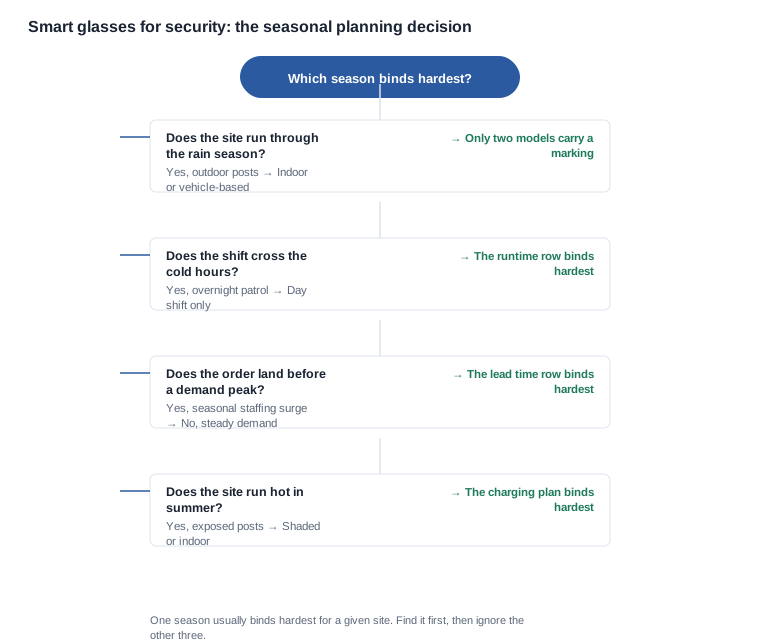
A seasonal review that does not end in a date and a number is a document, not a plan. The output of this stage has to be an order date, a configuration, and a set of questions with a deadline. Here is the sequence that produces it.
- List the seasons the site actually runs, with the months attached, and mark which posts run through each one. A site with three indoor posts and one exposed post has one outdoor season, not four.
- Match each season to the row it binds. Heat binds the charge-time row, cold binds the runtime row, rain binds the ingress row, and a demand peak binds the lead-time row.
- Count the exposed models for each row, using the published structure of the range, before the season arrives.
- Turn the temperature and ingress gaps into written questions, with a requested figure and a requested test condition, and a deadline that precedes the order date.
- Fix the recharge plan against the shortest break of the year, not the average break. The published charge-time ceiling of two hours or less, and the about-one-hour figure on the D17 and the ZH12, are the two numbers this step uses.
- Place the order against the demand peak, not the budget year. The lead time is a supplier figure and the catalogue publishes none, so it has to be obtained — the way it is handled is at lead time and the commercial structure of the order is at pricing.

The staffing dimension, which is not a device question at all. A seasonal surge brings temporary staff into the deployment, and temporary staff change three things that a device specification cannot see: the handover volume at the issue point, the number of people who need to be trained on the kit and the recording policy, and the loss rate, because a device issued to a person who leaves in six weeks has a different return profile from one issued to a permanent officer. The quarterly count that closes the season is the count of devices issued and not returned, and a site that has never counted cannot tell a seasonal return rate from a permanent loss rate. The handover procedure is at how to pack smart glasses for security, and the loss exposure is discussed at warranty and returns planning.
The limit we place on seasonal planning
We publish the rows a seasonal review is built on and we will not add a figure to any of them. That means the charge time as a ceiling of two hours or less, with about one hour published for the D17 and the ZH12 alone; the rated run times per model; the charging interface per model, including the four camera models whose interface row is not published; the cell capacities and cell counts; the IP54 marking on the V06 and the S7, stated as a catalogue attribute with nothing built on top of it; the charging-case capacity where the catalogue publishes one; the Bluetooth version on the audio models; and the count and composition of the three groups — eleven camera models, eight audio models and three sport models.
We do not publish an operating temperature range, a thermal behaviour, a cycle life rating, a low-temperature performance figure, a humidity specification, a test report behind the ingress marking, a lead time, or a capacity figure. We will not write that a device is tested to IP54, because no test report is published behind that marking, and we will not extend the marking to any model that does not carry it. We make no medical, hearing-aid or corrective-lens claim for any product in the range.
What we will do is take a described site with its seasons, its shift pattern, its exposure and its demand pattern, and return the published rows that apply, the questions the seasonal review has to put to the supplier, the count of models exposed on each row, and the order date that the pattern implies. The product families are at AI camera glasses and Bluetooth audio glasses, the scenario entry point is smart glasses for security, and the model-to-job matching that the seasonal review feeds into is at security product recommendations.
Related reading
- The charging plan the season has to fit — charging solutions
- The order date the season implies — lead time
- The failures the seasonal review is meant to prevent — troubleshooting before deployment
- The loss exposure a seasonal surge creates — warranty and returns planning
Describe the site, its seasons, its shift pattern and its demand peak, and we will return the rows at risk, the models exposed and the order date they imply.