Smart glasses for security work are an evidence chain, and the chain is where the buyer has to do the work rather than read a specification. A recording that cannot be retrieved, cannot be tied to a moment and cannot be tied to a unit is not evidence, and none of those three properties is published for any model in the range. What is published is a camera tier of eleven rows with two resolution classes, cell capacities from 220 mAh to 290 mAh, rated use figures from 5 to 8 hours, charging interfaces on seven of the eleven, and case capacities on five. Everything else a security deployment depends on — the retrieval path, the time-stamping method, the unit attribution, the field of view, the video format, the frame rate, the low-light behaviour — has to be established on a sample before the purchase order, and that is the entire argument of this article.
Smart glasses for security: the product is an evidence chain, not a camera
Who is buying in this scenario and what is being decided. The reader is a security equipment buyer, a solutions integrator, a channel buyer or a brand owner building a hardware-plus-service package. The decision is which camera entry goes into the package, what the case configuration is for the shift length, what the acceptance criteria will say, and what the support arrangement looks like for a device that thirty people are using and none of them chose. The risk that costs the most is a package that is sold as evidence and cannot produce evidence, because that failure surfaces at the moment it matters rather than at the moment it is bought.
How to choose between two camera quotations in this category. Start from the chain rather than from the resolution figure, because the chain decides whether the product can be used for the purpose at all and the resolution figure does not. Two quotations that carry the same resolution class can sit at very different places on the evidence chain, and the difference between them shows up in the retrieval time, the time-stamping method and the attribution scheme rather than in anything on the specification page. The second decision is the shift length, because it decides the case configuration and the case configuration decides the freight file. Only after those two decisions is the resolution class worth comparing, and even then it is worth comparing as a tier rather than as a quality ranking.
The published position for the camera tier, in one paragraph. Eleven entries carry a camera: the MT5 and the V03 Pro, the MT6 and the KY06, the CY05 and the V06, the L1 Pro and the L2 Utral, the S7 and the CY03, and the V03. Eight publish 8 megapixels and three publish 13 megapixels. The cells run from 220 mAh to 290 mAh, with the MT6 at 265 mAh. The rated use figures run from 5 to 8 hours on the 220 mAh and 260 mAh rows and about 7 hours on the 290 mAh rows. The charging interface is published on seven of the eleven and absent from four — the L1 Pro, the MT6 and the CY03, and the CY05, which publish a case capacity and nothing about how the device itself is charged. The IP54 marking appears on two entries only: the V06 and the S7.
The four properties that turn a recording into evidence
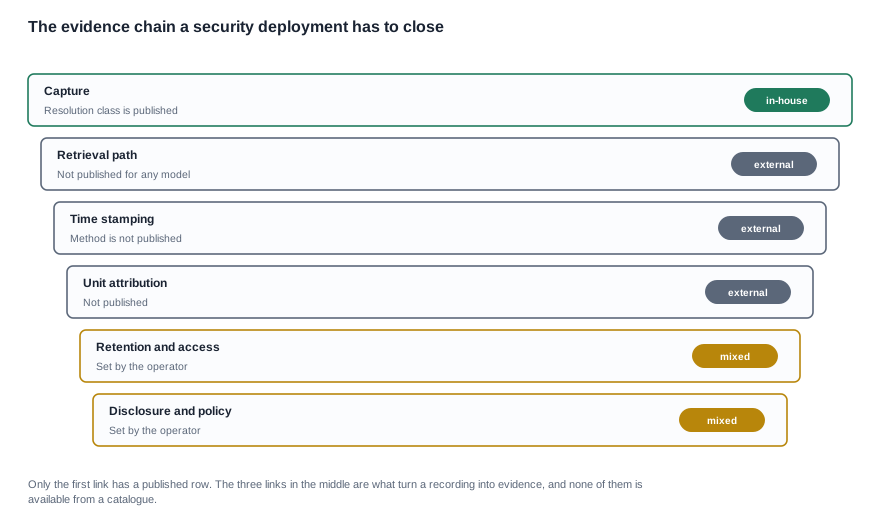
Retrieval. How a file leaves the device, how long that takes, and whether the device overwrites anything before the file is retrieved. Storage capacity, file format and overwrite behaviour are published for no model in the range. The operational consequence is severe in this scenario and mild in most others: an overwritten file in a security deployment is not a lost video, it is a missing piece of an incident. The rule that follows is the only defensible one — retrieve on a schedule, and write the schedule into the shift procedure rather than into a listing.
Time stamping. How a file is tied to a moment, and whether the stamp comes from the device, from the phone or from the platform it is uploaded into. The method is not published. A security package that promises a time stamp is promising a method the buyer has not seen, and the method is the difference between a record and an allegation.
Attribution. How a file is tied to a specific unit and a specific operator. The catalogue publishes the model designation for each entry and nothing about how a designation is carried into a file name, an index or a log. That is the piece the buyer has to design, and it is a design task rather than a specification request: a batch and unit numbering scheme that survives the transfer into the evidence system. The traceability question is covered at product traceability.
Retention and disclosure. Where the file is kept, for how long, and who may see it. This is the operator's decision rather than the manufacturer's, and it belongs in the same document as the recording policy. For a camera product sold in the European Union the regulatory frame is the General Product Safety Regulation (EU) 2023/988 and, for the radio element, the Radio Equipment Directive (EU) 2014/53/EU; the GPSR and red directive pages set out the route, and the data side is at GDPR and smart cameras.
The resolution class is not a legibility claim, and the distinction decides the shortlist. Eight of the eleven camera rows publish 8 megapixels and three publish 13 megapixels — the L1 Pro, the L2 Utral and the S7. A resolution class tells a buyer how many pixels the sensor produces. It does not tell the buyer what a corridor at night looks like on the resulting file, because the field of view, the video format, the frame rate and the low-light behaviour are all unpublished. A buyer who shortlists on 13 megapixels and discovers the frame is too narrow for the corridor has bought the wrong product, and the only way to find out is a sample in the actual environment.
The one structural feature with direct security value is remote photo capture. The S7, the D17 and the ZH12 publish it. It matters for a deployment where the operator should not have to reach for the temple to trigger a capture, and it is a published fact rather than a claimed capability. It is also worth noting where it is not published: ten of the eleven camera rows carry no such row, and two of the three models that do publish it — the D17 and the ZH12 — publish no camera resolution at all.
The case decision is a shift-length decision and a transit-file decision
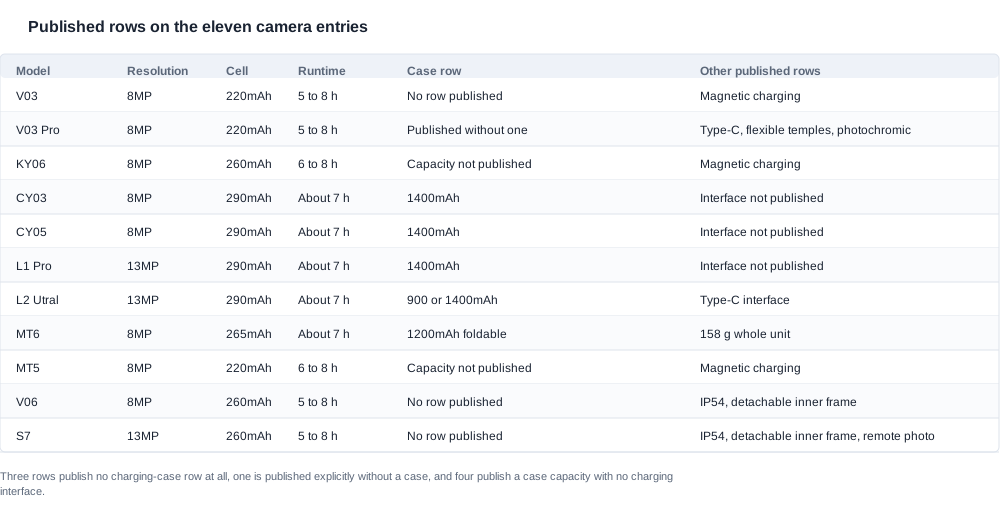
The case row has three different answers across the eleven camera entries, and a buyer who assumes one is wrong on most of them. The CY03, the CY05 and the L1 Pro publish a 1400 mAh case. The L2 Utral publishes 900 mAh or 1400 mAh as a configuration choice. The MT6 publishes a 1200 mAh foldable case. The KY06 and the MT5 are delivered with a case whose capacity is not published. The catalogue publishes no charging-case row at all for the V06 and the S7, and the V03 and the V03 Pro, and a buyer who wants to know what is in the carton for those four has to ask the supplier. Those are three states — capacity published, capacity not published, and no row at all — and only the first two are specifications, while the third is a question rather than an answer.
For a security shift, the case is a shift-length decision. A camera workload is the heaviest published load, and the rated use figures of 5 to 8 hours sit below a full shift on the 220 mAh and 260 mAh rows, while the 290 mAh rows publish about 7 hours. A row with a published 1400 mAh case extends the working window; a row with no published case row does not extend anything and may not recharge at all during a shift. That makes the case configuration part of the model selection rather than an accessory line, and it is the point at which the shortlist usually has to change.
The case is also a second lithium cell with a transit file. A charging case that ships with the configuration is a second battery that has to be declared, and the requirements are set out at battery transport. For a security package the interaction between the case, the shift length and the transit paperwork is real: the case that makes the shift work is the case that changes the freight file. A buyer should ask for the battery transport documentation for the configuration including the case, and ask for it before the order rather than at the border.
The MT6 is the only row with a published weight, and it is a whole-unit figure. The catalogue publishes 158 g for the MT6, and that figure covers the glasses including their 265 mAh battery and camera and excluding the foldable case; the weight of the case itself is not published. It is the only weight in the catalogue, it belongs to one model, and no other camera row has one. A package that quotes a weight for a different model is quoting a number that does not exist.
The ingress position is a marking on two rows. The V06 and the S7 carry an IP54 marking with no third-party report published behind it, and the YKC02, the D17 and the ZH12 do not carry it at all. A security package that is sold for use outside therefore has two models with a marking and nine without. If a client requires a documented rating, that is a report request with a lead time, and the scope of the marking is at IP ratings.
What a security fleet has to prove on a sample

The script below is the difference between a demonstration and an acceptance test. Each step produces a written result, and each result becomes a line in the incoming inspection criteria that the first shipment is measured against.
- Record a known scene with a known clock in frame. The clock gives the tester something to compare against, and the scene gives the tester something to judge legibility against. Record it in the darkest area of the actual shift, not in a corridor near the office.
- Retrieve the file and time the transfer. The transfer time is the number that decides the retrieval schedule, and the schedule is what protects the evidence.
- Check the file name against the unit designation. If the two do not correspond, the attribution scheme has to be designed before the fleet ships, not after.
- Test in the darkest area of the actual shift. The low-light behaviour is unpublished, so this observation is the only measurement available.
- Run one full shift on the sample and log the failures. Not a demonstration run of twenty minutes. A full shift finds the charge point, the handling point and the point where the unit is set down.
- Write every result into the acceptance criteria. A result that is not written into the acceptance criteria is an opinion rather than a test, and it will be re-argued at the first dispute.
The compatibility test is a separate piece of work. Fourteen entries in the catalogue publish a Bluetooth version and none of the eleven camera rows is among them, and no verified device list is published for any model. So for a fleet, the pairing behaviour against the phones the team actually carries has to be tested directly, on the issued devices rather than on the buyer's own. The method is at the Bluetooth testing guide and the radio position is at Bluetooth connectivity.
The test script for the security deployment itself is at how to test smart glasses for security, and the vocabulary the package will be sold in is at the security glossary.
What to demand in writing before a security configuration is ordered
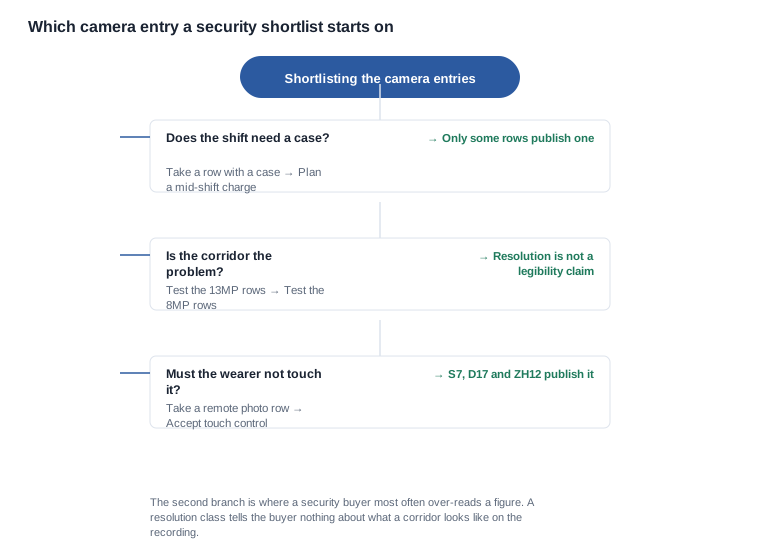
The shortlist questions, in the order they narrow the range. The first three decide which rows survive; the rest is diligence on the survivors.
- What is the shift length, and does the configuration include a case? This decides whether a 1400 mAh case row is required, and it decides the transit file at the same time.
- Is the environment dark or narrow? A corridor at night is a field of view and a low-light question, not a resolution question, and the answer to it is a sample rather than a figure.
- Must the operator avoid touching the temple? If so, the remote photo capture rows are the shortlist: the S7, the D17 and the ZH12.
- How is a file retrieved, and how long does it take? The question with the biggest effect on the shift procedure, and the one with no published answer.
- How is a file time-stamped, and how is it tied to a unit? Two questions that decide whether the package can produce evidence.
- What is the radio behaviour against the issued phones? Because no camera row publishes a radio version.
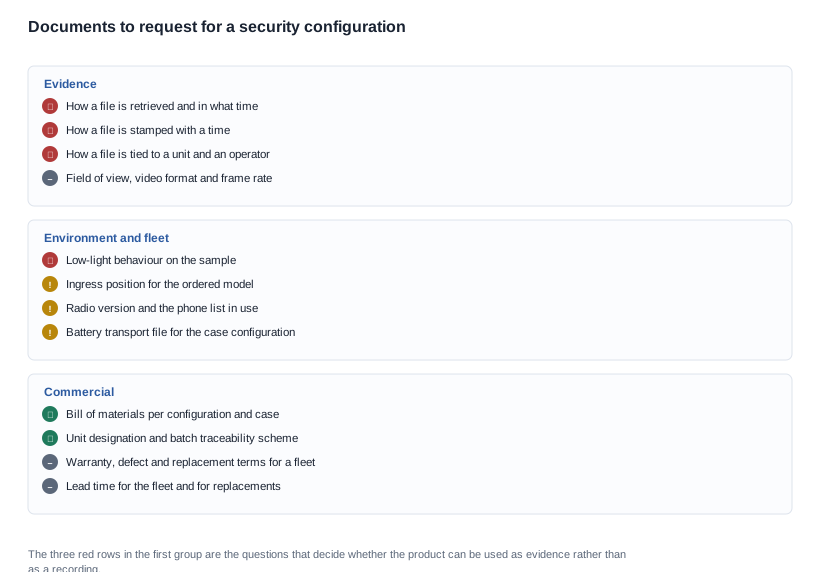
The documents to request before a deposit. The retrieval and transfer statement, the time-stamping and attribution statement, the field of view, video format and frame rate figures, the low-light observation from the sample, the ingress position, the radio version and the phone list, the battery transport file for the case configuration, the bill of materials per configuration and case, the unit designation and batch traceability scheme, and the warranty, defect and replacement terms for a fleet. The procedures are at sample policy and supplier verification, and the commercial structure is at pricing and MOQ.
The commercial terms that move. Minimum order quantity tiers, and whether two configurations with different cases can share a purchase order. Whether the case is bundled or ordered separately, because the freight weight and the transit file change with it. The unit price tier for a pilot and for the fleet, and the share of units taken at the pilot tier. Whether a first run can be split against a staged payment. The replacement terms, which for a fleet are a service level rather than a warranty line: how a failed unit is swapped, how quickly, and whether the replacement carries the same designation scheme. The clause language is at contract terms, and the factory-side diligence behind a package like this is at factory audit and quality consistency.
Where a security deployment fails, and what the first shift measures
A package sold as evidence before the chain is tested. The device records; the chain does the rest; the chain is not published. This is the single most expensive failure in the scenario, and it is entirely avoidable with a script.
A case configuration chosen for price rather than for the shift. A 1400 mAh case and a 900 mAh case are different shift lengths, and the shorter one loses the recording at the point where the recording mattered.
A deployment that assumed a radio version. No camera row publishes one, so the compatibility work lands in the deployment week if it was not scheduled earlier.
A support arrangement written after the first shift. Thirty people using a device they did not choose will produce questions, and the questions come from the people the package is supposed to be protecting. The material to have ready is at the security support resources article.
An ingress claim across the whole range. Two of eleven camera rows carry the marking. A package that implies otherwise has a documentation gap in it, and a client-side audit will find it.
A batch and designation scheme decided after the fleet shipped. Attribution is easier to design before than to retrofit, and retrofitting it means re-indexing the evidence that has already been collected.
What the first shift has to measure. Four numbers, and all four are internal rather than customer-facing: how many files were retrieved before the device overwrote anything, how many files could not be tied to a unit, how many files could not be time-stamped, and how many charge failures happened during the shift. The first two decide whether the retrieval schedule and the attribution scheme need to change. The fourth decides whether the case configuration is right. None of them can be found in a catalogue, and all four can be collected on a single shift.
Where the published rows and the need diverge
The boundary we hold: security is the segment where the gap between the published specification and the operational need is widest, and the correct response is a test script rather than a longer feature list. We publish the resolution class and the cell capacities on the eleven camera entries, the charge times of two hours or less on the camera entries and about one hour on the D17 and the ZH12, the rated use figures, the charging interface on the seven camera rows that carry one, the case capacities where they are published, the remote photo capture on the S7, the D17 and the ZH12, the detachable inner frames on the V06 and the S7, the flexible temples and photochromic lenses on the V03 Pro, the single 158 g whole-unit weight for the MT6, and the IP54 marking on the V06 and the S7.
What we do not publish, and will not estimate: the field of view, the video format, the frame rate, the storage capacity, the file format, the overwrite behaviour, the low-light behaviour, the time-stamping method, the unit attribution scheme, the audio capture behaviour, the per-model weight beyond the MT6 figure, and any ingress test report. We will not state that any model is tested to IP54 beyond the two rows that carry the marking, and we will not state that any model holds CE, FCC or RoHS certification, because the catalogue text names none of them and carries no per-model certification row.
What we will do: take the shift length, the environment, the fleet size, the phone fleet and the destination market, and tell you which camera entries exist, which published rows apply, which chain properties have to be established on a sample, and which criteria the first shipment should be measured against. The camera tier is at AI camera glasses, the sport tier at sport smart glasses, and the selection step is at the security product recommendations.
Fleet size and the phones in use
Send the shift length, the environment, the fleet size, the phone models in use and the destination market, and we will return the configurations that exist, the published rows that cover them, the chain properties that have to be tested, and the acceptance criteria the first shipment should be measured against. The framing that matters for a package like this is at consumer versus industrial.
Related reading
- Where the scenario starts — smart glasses for security
- The product tier — AI camera glasses
- The camera position — camera and imaging
- The compliance route — GPSR and red directive
Tell us the shift length, the environment and the fleet size, and we will return the configurations that exist and the chain properties that have to be tested.