What to expect to know about smart glasses for travel is a short list of corrections, and six of them are identical in every market a travel channel sells into. A traveller arrives with a set of assumptions that no catalogue row supports: that one charge covers the week, that the assistant answers in a tunnel, that the frame shrugs off rain, that the photographs come out steady, that the audio cannot reach the next table, and that a recording always announces itself. Each of those assumptions is a returns liability, and each of them is settled in the listing copy rather than in the hardware. This article is written so that a brand buyer, a channel buyer or an e-commerce merchandiser can set the six expectations correctly before the first purchase order, using only the rows our catalogue actually publishes.
What to expect to know about smart glasses for travel before a purchase order
The decision sitting in front of the reader. You have a travel channel, or you are about to open one, and the product question has been settled at a high level: people buy glasses on a trip and use them in bursts. What has not been settled is the commercial detail that decides whether the channel works — what ships in the box, what the listing is allowed to say, which evidence sits behind each claim, and how much of the per-unit cost is carried by accessories that nobody costed. The fear behind that decision is not technical. It is a first shipment that comes back with returns whose reasons are all correct and none of which the listing warned about. The way to handle that decision is to set the criteria before the order, not to interpret the returns afterwards, and the criteria are the published rows plus the questions this article lists.
Why a travel channel is priced differently from a commute or an office channel
Travel selling has three properties that move the numbers. The purchase is made once, often in an airport or a duty-free environment where the buyer cannot try the product and cannot ask a question afterwards. The usage pattern is intermittent, so the product sits in a bag between bursts rather than on a desk, which makes the charge routine the product's real endurance. And the return window is short relative to the first trip, so the first bad experience has time to become a public review. A supplier who publishes a rated runtime and nothing else leaves all three of those properties undocumented, and the buyer absorbs them as returns. Any total-cost model that treats a travel unit the way it treats an office unit will be wrong at the accessory line and at the copy line, and those are the two lines that decide the sell-through.
The twenty-eight published entries, and the traveller's next question
Twenty-eight entries are published. Twenty of them carry AI in the product designation; the eight that do not are the AR entry, the three children's entries, the three sport entries and the bone-conduction entry. The published electrical rows are the cell capacity, the rated runtime, the charge time and, for twenty-four of the twenty-eight, the charging interface. The camera rows add a resolution class: 8 megapixels on eight models and 13 megapixels on three. The cases are published for seven of the eleven camera models, in three different ways. Beyond those rows, the catalogue publishes a small number of structural features — a detachable inner frame on the V06 and the S7, remote photo capture on the D17 and the ZH12, a detachable temple on the G07 and a slim temple on the YK12, four colours on the V06. Everything a traveller would ask about next — the frame weight, the field of view, the video format, the frame rate, the lens material, the coating, the acoustic figures, the storage behaviour, the ingress test report and any per-model certificate — is not published, which means every one of those items is a question to put to the supplier rather than a row to quote.
The six corrections a travel channel has to make in the copy
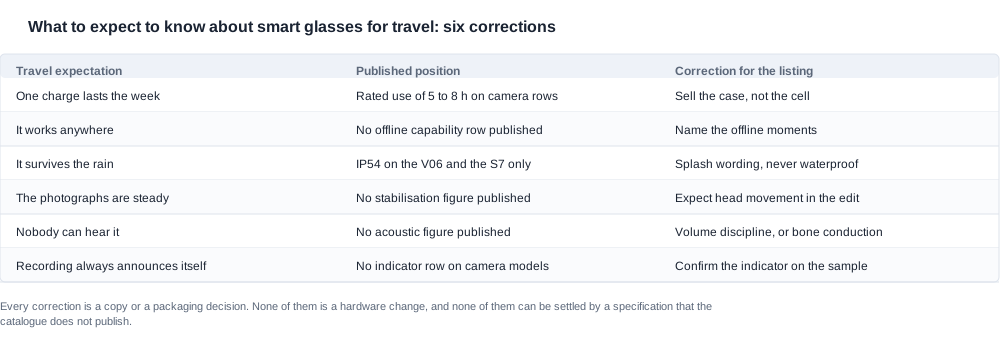
Each of the six corrections below is a decision about wording or packaging. None of them requires a different product, and each of them can be made in an afternoon by a buyer who has the published rows in front of them.
| Expectation a traveller brings | What the catalogue publishes | What the listing has to say |
|---|---|---|
| One charge lasts the week | Rated use of 5 to 8 h across the camera rows | Sell the case, not the cell |
| It works anywhere | No offline capability row on any entry | Name the offline moments |
| It survives rain | IP54 on the V06 and the S7 only | Splash wording, never waterproof |
| The photographs are steady | No stabilisation figure on any entry | Expect head movement in the edit |
| Nobody can hear the audio | No acoustic figure on any entry | Volume discipline, or bone conduction |
| Recording always announces itself | No indicator row on the camera models | Confirm the indicator on the sample |
Endurance, connectivity and water are the three that come back as returns
The endurance claim is a band, and a camera workload sits at the bottom of it. The published rated use figures are 5 to 8 hours on the V06, the V03 and the V03 Pro, and the S7, 6 to 8 hours on the KY06 and the MT5, about 7 hours on the CY05 and the L1 Pro, the CY03 and the L2 Utral, and the MT6, about 6 to 8 hours across the audio rows and about 7 to 8 hours across the sport rows. No figure carries the test condition, so a buyer cannot state whether the camera was running, what the volume was, or how far the radio was from the phone. A listing that says "all day battery" is making a claim the catalogue does not support for any entry. A listing that says "rated use of 5 to 8 hours depending on configuration" is making one it does.
The connectivity claim has no published row to sit on. Twenty of the twenty-eight entries carry AI in the product name, and for none of them does the catalogue publish the feature list, the language coverage, the latency, or whether the processing happens on the device or somewhere else. That single omission is the reason a traveller in a tunnel, a basement car park or a rural market finds the assistant unavailable, and it is not a defect. It is an unstated dependency. The correction is one sentence in the listing and one line in the pre-trip card: the assistant and the translation need a connection, and there are moments when there is none.
The water claim is the one that reaches a regulator. The IP54 marking appears on exactly two catalogue entries, the V06 and the S7. The second digit is a splash-protection level and the first is a dust-protection level; neither covers immersion, and neither covers sustained rain. The YKC02, the D17 and the ZH12 are the other three sport entries and none of them carries the marking, so "our sport range is IP54" is false on three of five models. The marketing claim is not permitted to say waterproof, and the listing copy has to use the marking's own scope.
Photographs, leakage and the recording indicator are the three nobody warns about
A worn camera moves with the head, and nothing in the catalogue says otherwise. There is no stabilisation figure, no video resolution, no frame rate and no low-light figure on any entry. A traveller who expects a still frame will get a moving one, and the moving one arrives as a soft-image complaint. The correction is in the copy: first-person footage is recorded from the head, and the buyer should decide whether that footage is the product's selling point or an inconvenience before the channel is built around it.
Open-ear audio leaks, and the leak grows with the volume. Driver size, frequency response, microphone pickup distance and the leakage figure itself are not published for any entry in the range, which means the buyer cannot state a sound level in a listing and cannot tell a customer what the device will be like in a quiet carriage. The correction is procedural rather than descriptive: the audio models in this range are open-ear, and the bone-conduction entry is the only design in the catalogue that produces no sound in the room at all.
The recording indicator is the one feature a traveller takes for granted. The AR entry publishes an indicator light with button control. The camera entries publish no indicator row, and the question of whether recording is always visible is not answered for any of the eleven camera models. On a travel channel this matters more than in most scenarios, because a traveller is frequently in a space where recording is regulated and where being asked to explain a hidden microphone is a real cost. The correction is to verify the indicator on the sample unit and to write the answer into the listing, rather than to assume either outcome.
Cases, cells and the two-hour ceiling behind the endurance claim
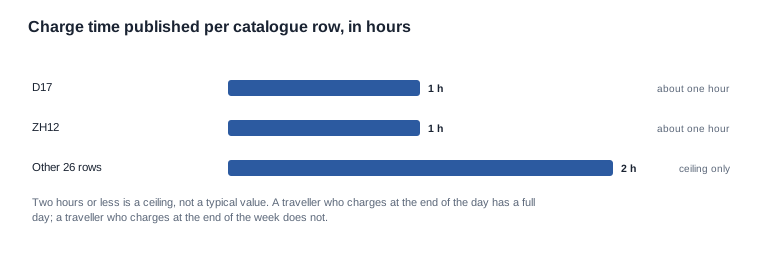
The charge time in this catalogue is a ceiling, and only two rows beat it. Twenty-six of the twenty-eight entries publish a charge time of two hours or less; the D17 and the ZH12 publish about one hour. Two hours or less permits exactly two hours, which is a different assertion from a charge that finishes in under two hours, and the difference matters for the traveller who charges in a hotel room between an afternoon flight and an evening one. A travel buyer who writes "charges in under two hours" in the listing has made a claim that the catalogue does not support on twenty-six rows, and a buyer who writes "a charge time of two hours or less" has written the truth.
The case, not the cell, is what extends a travel programme. The case capacities published for the camera models are 1400 mAh on the CY03, the CY05 and the L1 Pro, 900 mAh or 1400 mAh as a configuration choice on the L2 Utral, and 1200 mAh on the MT6's foldable case. The KY06 and the MT5 are listed with a case whose capacity is not published. The catalogue publishes no charging-case row at all for the V03, the V03 Pro, the V06 or the S7. That is three different answers to the same question, and a buyer who writes "includes a charging case" in a listing has to know which of the three applies to the SKU being listed, with the four that carry no row needing an answer before the copy is written.
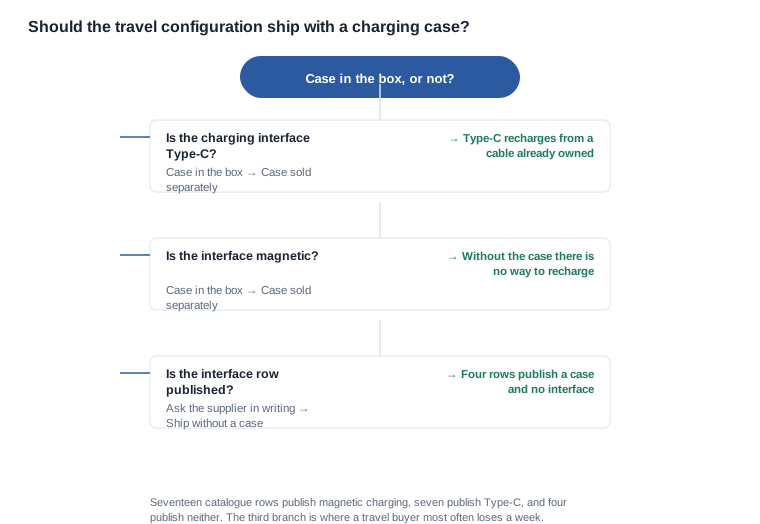
The interface decides whether the case is optional or compulsory. Seventeen entries publish magnetic charging, seven publish Type-C, and four — the MT6 and the L1 Pro, and the CY05 and the CY03 — publish a case capacity and no interface row at all. On a Type-C configuration a traveller can recharge from a cable that is already in the bag, which makes the case an accessory rather than a component. On a magnetic configuration the case is the only way to recharge, so a configuration without one is a configuration that returns to the buyer at the end of a trip. The four rows with no published interface are the trap: a travel buyer who assumes magnetic charging for them will ship a product whose recharge path has never been stated, and the discovery arrives in a review.
A case in the box is a second lithium cell, and that is a transport file. The battery transport requirements apply to the case exactly as they apply to the device. A travel channel that ships a case in the box is shipping a second battery with a declared capacity, which changes the freight paperwork, the air-freight limits and the transit file for that configuration. The commercial question and the compliance question are the same question here, and they are cheaper to settle at the quotation stage than at the border.
What the listing may claim, and the paperwork behind each claim
Ingress: the marking and the report are different objects. The IP54 marking on the V06 and the S7 is a catalogue attribute. No third-party test report number is published behind it, no testing body is named, and no test standard is cited. A buyer who needs a documented rating has to request a report, and a report request has a lead time and a cost that belong in the programme plan rather than in the launch week. The digit reading is at IP ratings, and the scope wording that the listing should use is at what the second digit means.
Certification: the catalogue text contains no reference to CE, FCC or RoHS at all. The catalogue carries a company-level export certification page whose content is images rather than text, and the catalogue text itself names none of these marks. There is no per-model certification row anywhere, and there is no record of a certificate number for any of the twenty-eight entries. A travel buyer who needs CE, FCC or RoHS evidence for the destination market is therefore asking a supplier for material that has to come from the factory's documentation file, and the certification checklist page sets out how to ask for it and how to check the result.
The claims that have no published row at all. Nothing in the catalogue supports a weight statement — the single published weight is 158 g for the MT6, which is the whole unit including its battery and camera and excluding the foldable case, and it is a camera model rather than a travel model. Nothing supports a field of view, a video format, a frame rate, a lens material, a coating, a drop rating, an operating temperature range or an acoustic figure. On a travel channel those omissions converge in one place: the traveller's own body and the airport and the weather. A buyer who needs any of them has to ask for them per model, in writing, and record the answer in the product file.
What the travel-specific copy can say. The published rows support a copy that names the model, the resolution class where it applies, the cell capacity, the rated use as a band, the charge time as a ceiling, the charging interface, the case capacity where one is published, and the structural features where they are published. They support a copy that says the marking covers splash protection on the two models that carry it. They do not support a copy that says waterproof, that says all-day battery, that says invisible, that says noise cancelling, or that says the assistant works without a connection.

Verifying a travel configuration on a single sample unit

The verification work for a travel configuration is short and repeatable, and the point of doing it on one sample unit is that it converts every open question into a line in a file that the second order can reuse.
- Put the exact configuration in writing. Model, colour, case or no case, interface, and the destination market. A sample that differs from the ordered SKU in any of those is a different product, and the most common discovery in this category is that the sample carried a case the order did not.
- Ask for the runtime with its condition. The figure exists on every row; the condition does not. The question to put is what was running during the measurement, at what volume, and at what radio distance, and the answer is worth more than the figure.
- Ask for the interface in writing for that SKU. Especially for the four rows that publish none, and especially if the marketing copy has already promised magnetic charging.
- Time one full session on the sample. From the state a traveller would actually start in, with the camera running if the configuration has one. Write the number into the pre-trip card, because the traveller's memory of a five-hour day is not a specification.
- Check the indicator behaviour with the camera running. Ask the traveller to be able to see whether a recording is in progress, on the unit in the hand, and record the answer in the listing.
- Ask for the certificate file for the destination market. Per model, with numbers that can be checked in the issuing body's public register, not a brochure page.
- Record the answers in the purchase order file. The sample cost, the sample lead time and the terms for that file are at sample policy.
The shortlist of questions to ask before you order
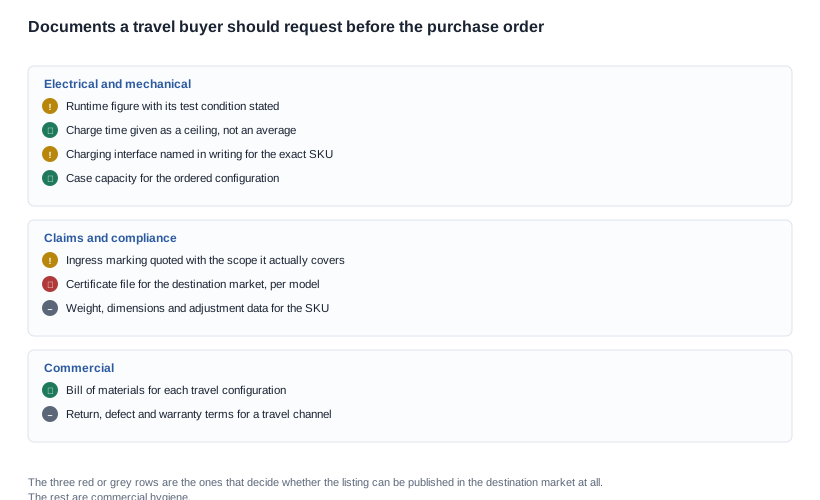
A buyer who wants to know how to choose between two travel configurations should start from what is published rather than from what is promised, and then put the remainder in writing. The red flags are consistent across this category and they are worth naming before the quotation arrives, because each of them is a question that turns out to be expensive later.
- Which model is being quoted, and which configuration of that model? The configuration question carries the case, the interface and the colour, and it is where most of the confusion in this category starts.
- Is the charging interface published for that row, and if it is not, what is it? Four camera rows publish a case capacity and no interface, and a travel unit with no stated recharge path is a return waiting to happen.
- What condition was the runtime measured in? The figure is published on every row and the condition on none, so this question is the difference between a usable claim and an unusable one.
- Is the ingress marking the one the catalogue prints, and does the copy match its scope? Two entries carry the marking and the scope is splash protection, not immersion.
- Which certificates exist for the model, with numbers that can be checked? The catalogue text names none of the standard marks and carries no per-model certification row, so the answer has to come from the factory's file.
- What is the total cost of the configuration as it ships? The accessory and the freight weight are the lines most often missed, and they are the lines that decide the price point of the channel.
- What are the trade-offs between the case in the box and the case sold separately? The choice changes the price point, the artwork, the freight weight and the transit file together, which makes it a four-way decision rather than a packaging one.
The documents that have to exist before a deposit. The bill of materials per travel configuration, with the case specification; the battery transport file for that configuration; the runtime figures with their conditions; the interface statement; the ingress position in writing; the per-model weight; the model designation table; the certificate register; and the agreed incoming inspection criteria. The clause language for these is at contract terms and the commercial structure of a first order is at pricing. A travel channel that puts the accessory decision and the certificate request in the same negotiation gets both; a channel that treats the accessory as a packaging detail and the certificate as an afterthought gets neither on time.
Where travel programmes fail, and what the first shipment measures
A case included where the interface does not need one. It adds a second lithium cell to declare, an object to lose and a price point to the SKU, and the traveller who wants the second session will buy the case separately at a price that suits both sides.
A listing that promises a charge the interface cannot deliver. On the four rows with no published interface, this is a real possibility rather than a theoretical one, and it surfaces on the second day of a trip.
A waterproof claim on an insert. The marking covers splash protection on two entries; the claim covers immersion on all of them. A traveller in heavy rain is the customer who tests it, and the review that follows names the brand.
A card that promises the assistant works everywhere. The dependency is real and the correction costs one sentence. The failure is not the offline moment; it is the review that says the feature is broken.
An accessory bill of materials inherited from a competitor. Every inherited line is a per-unit cost that was never justified by this configuration and this interface, and it is a bill of materials the factory cannot quote cleanly.
A return rate that nobody attributes. The first shipment is the cheapest measurement in the category. The question is narrow and answerable: of the units that came back, how many were returned for battery, for water, for a soft image, or for a feature that did not work, and how many of those returns had the corresponding sentence in the listing. That ratio decides the copy for the second year, and it is cheaper than any survey.
The commercial room in a travel programme. The case configuration, the consumable and card quantities, the artwork, the minimum order quantity tiers, whether two models can share one purchase order, and the split of a first run against a staged payment are all negotiable. The cell configuration, the interface, the certification cost and lead time, and the tooling amortised across the first order are not — they are quoted as separate lines rather than folded into the unit price. The pricing and MOQ pages set out the structure, and the payment terms page covers the staging.
A worked example. Take a hypothetical European travel retailer planning two SKUs under one brand: an audio model at a lower price point and a camera model with the 1400 mAh case at a higher one. The interface decision comes first and settles the packaging. Taking the Type-C route, where the catalogue publishes Type-C on the D12 and the L2 Utral, the D11 and the V03 Pro, and the D17 and the ZH12, the camera model takes the case as a separately priced accessory rather than a box item, and the audio model ships without one. The second decision is the claim set: the copy names the model, the rated use band, the charge time as a ceiling, the interface, and the ingress scope only where the V06 or the S7 is concerned, and it says nothing about waterproof, all-day endurance or offline assistance. The third decision is the documentation, and the certificate file for the destination market is the item that has to be settled before the order rather than after it, because it is the only one on the list with a lead time nobody controls. The outcome is two price points from one platform, a per-unit cost that is visible and small, and a first shipment that produces a return reason breakdown instead of a guess.
The travel rows, without industry averages
Concretely, we publish the rows a buyer can order from and we will not fill the gaps with industry averages. For the travel-relevant part of the range that means the resolution class, the cell capacities from 40 mAh to 290 mAh, the charge times of two hours or less with about one hour on the D17 and the ZH12, the rated use figures between five and eight hours, the charging interface on the twenty-four entries that carry one, the case capacities where they are published, and the structural features the catalogue names — the detachable inner frame on the V06 and the S7, the remote photo capture on the D17 and the ZH12, the detachable temples on the G07 and the slim temples on the YK12, and the four colours on the V06.
What we do not publish, and will not estimate: the frame material, the lens material, the coating, the hinge specification, the per-model unit weight beyond the single 158 g whole-unit figure for the MT6, the field of view, the video specification, the frame rate, the low-light behaviour, the storage behaviour, the acoustic figures, the runtime test condition, the cycle life rating and the operating temperature range. We will also not state that a product is tested to IP54, because no test report is published behind that marking, and we will not extend the marking to the YKC02, the D17 or the ZH12, which do not carry it. We will not claim CE, FCC or RoHS conformity for any model, because the catalogue names none of them and carries no per-model certification row.
What we will do: take the model, the configuration, the destination market and the price band, and tell you which published rows apply, which accessory configuration exists, which claims the listing can make without overreaching, and which documents have to be settled in writing before a purchase order. The product families are at sport smart glasses and AI camera glasses, the charging decisions are at charging solutions, and the scenario entry point is smart glasses for travel.
Configuration, market and price band
Send the model, the configuration, the destination market, the price band and the volume, and we will return the published rows that cover it, the accessory configuration that exists for it, the claim set the listing can carry, and the documents that have to be settled before the order. The seasonal side of the same channel is at travel seasonal considerations, and the briefing material a buyer hands to a traveller is at how to train for travel.
Related reading
- The entry point for this scenario — smart glasses for travel
- Which product families exist — sport smart glasses and AI camera glasses
- The published specifications — battery life and charging solutions
- The transit file — battery transport
Tell us the model, the configuration and the market, and we will return the published rows that cover it and the claims the listing can carry.