

Lead time reaches your margin in two separate places, and the second one is invisible until the finance team asks. The first is obvious: a schedule that runs long pushes the sale, and a sale that happens after its window has less value than the same sale inside it. The second is the cost of carrying the order — the money spent at the deposit and not recovered until the stock sells, which is a working capital cost that grows with every week the programme takes.
The arithmetic is straightforward once it is written down, and it changes decisions. The quantity that produces the lowest unit price is frequently not the quantity that produces the best return, because a larger first order buys a better price tier and locks more capital for longer. In a category where unit prices and minimum order quantities are not published and are confirmed per enquiry, the buyer has to build that arithmetic from the numbers the supplier does provide — the tier boundaries, the payment structure and the quoted durations.
Three conclusions follow, and they are the substance of this page. First, compare suppliers on landed cost and cycle length rather than on unit price. Second, treat the schedule as a priced input rather than as a constraint to be suffered. Third, work out which of the two — a longer schedule at a lower price or a shorter one at a higher price — is cheaper, because in most programmes the answer is not the obvious one.
Smart glasses lead time: a cost of capital, not a delay
The usual way to describe a long lead time is as a delay, and delays are frustrating rather than expensive. The commercial description is more useful: a long lead time extends the period between paying for goods and receiving revenue for them, and that period is a balance-sheet item.
Three mechanisms make the extension costly.
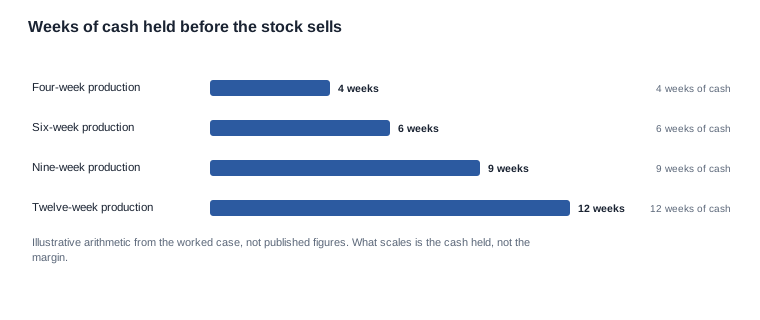
Working capital. The money committed at the deposit, plus the balance paid before despatch, sits as inventory until the channel sells the units. Each extra week in the cycle is another week of that balance. For a business that turns its stock four times a year, a cycle that grows by four weeks reduces the effective turns by roughly a fifth, and the working capital needed for the same revenue grows to match. This is the mechanism most often described as "the cash flow problem", and it is a lead-time problem.
Stock cover. Because the arrival date is uncertain, a buyer hedges by ordering more than the immediate demand requires, or by ordering earlier. The extra units are a cost of the schedule's uncertainty rather than of the product, and they carry a carrying cost, a storage cost and a risk of becoming slow-moving stock.
Price-tier decay. A tier is usually a band of quantities with a validity condition attached. When a programme takes longer, the sell-through rate changes, and the quantity that justified the tier may no longer be the quantity the programme needs to reach it in time. The tier discount is therefore a function of the cycle, not only of the order.
The reverse also holds, and it is the reason this page is worth reading before the order rather than after: a shorter schedule does not only reduce these costs. It converts working capital into revenue sooner, reduces the stock cover that has to be bought as insurance, and keeps a price tier valid for the period it was quoted for.
The two places a schedule shows up in the margin
In the unit. A longer schedule gives the buyer less negotiating room on price, because a supplier knows the buyer's alternative — waiting — is expensive. A buyer with a launch date that cannot move has no leverage on the unit price, and the price is set by the date rather than by the market.
In the total. A shorter schedule has a cost attached to it, and it is not always visible in the quotation. Expedited freight is paid per shipment. A split delivery carries a second booking, a second duty and a second clearance. A larger first order buys a better tier and increases the cycle. This is where the trade-off has to be made explicitly rather than absorbed.

The arithmetic to run before you accept a price tier
The calculation is not complicated, and it can be done with three numbers from the supplier and two from the finance team.
Number one: the tier boundaries. Ask for the quantity bands and the price at each. A quotation without its band is not a price, and the arithmetic below is impossible without it. In this category the tier is also tied to the configuration, because a published configuration and a made-to-order one are different commercial objects.
Number two: the quoted durations. Both the production window and the documentation route, stated separately rather than blended. The blended figure is useless for this calculation because the blended figure is what the buyer is being asked to accept without seeing the chain.
Number three: the payment structure. The deposit percentage, the event that triggers the balance, and the credit period offered. These three determine when the cash leaves and when it comes back.
Number four: the cost of capital. The annual rate the business applies to its own money. This is a finance input, not a supplier input, and it is the number that converts weeks into money.
Number five: the price the channel will hold. The price at which the product sells, which is what the total has to be measured against.

The calculation, in order
Convert the quoted price into a landed cost. Add freight for the consignment that will actually be used, the destination duty and clearance, the inspection, and the one-off tooling and certification charges that the first order carries. A tier comparison made on the unit price alone is comparing two incomplete figures.
Multiply the landed cost by the order value. That is the money committed.
Measure how long it is committed. From the deposit to the sale. If the sale date is unknown, use the channel's planning assumption rather than an optimistic one, because the optimistic version is exactly what turns a margin forecast into a margin disappointment.
Apply the cost of capital for that period. This is the number that turns the schedule into margin, and it is usually small per order and large across a year. It is also the number that justifies paying a premium for a shorter schedule: the premium has to be compared with the capital cost of the extra weeks, not with the unit price.
Subtract the channel margin you intend to hold. What is left is what the programme contributes, and it is the figure that has to be compared against a second quotation on the same basis.
The number that is usually wrong
In most of these calculations the error is in the period rather than in the rate. Buyers tend to use the production window and forget the transit, the clearance and the receiving, and they use the deposit date rather than the balance date as the start of the committed period.
Both errors bias the result in the same direction: they make the cycle look shorter than it is, which makes the schedule look cheaper than it is. The correction is procedural rather than analytical — put the deposit, the balance, the despatch, the arrival and the sale on one calendar, and read the periods off it rather than out of the quotation.
Where margin leaks between the quotation and the shelf
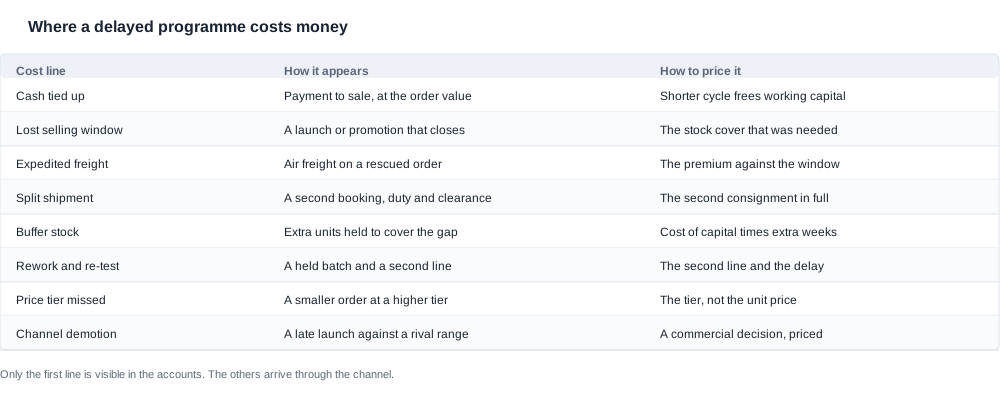
Seven places account for most of the difference between a quoted margin and a realised one, and none of them is the unit price.
A tier that the quantity does not reach. The quote was built for a band; the order landed below it, or above it in a way that changed the price. The comparison has to be made at the quantity actually ordered.
Freight that was assumed consolidated. A first order frequently travels alone. The difference is not a percentage, it is a multiple.
A split delivery. A second consignment means a second booking, a second duty, a second clearance and a second receiving operation, and each of those is a cost with no offsetting saving.
Buffer stock held against the schedule. The units bought as insurance against an uncertain arrival are units that must eventually be sold, and if the launch is late they are sold later or at a discount.
Rework and re-test. A held batch consumes schedule time that has already been paid for, and the second line is a second line.
A missed selling window. The programme arrives after the promotional period it was built for. This is the largest of the seven when it happens and the hardest to recover from, because it affects the price the channel will accept afterwards as well as the volume.
A price tier that decayed while the programme ran. The quantity that justified the discount was a forecast of sell-through, and a slow start changes the forecast.
The trade-off, stated honestly
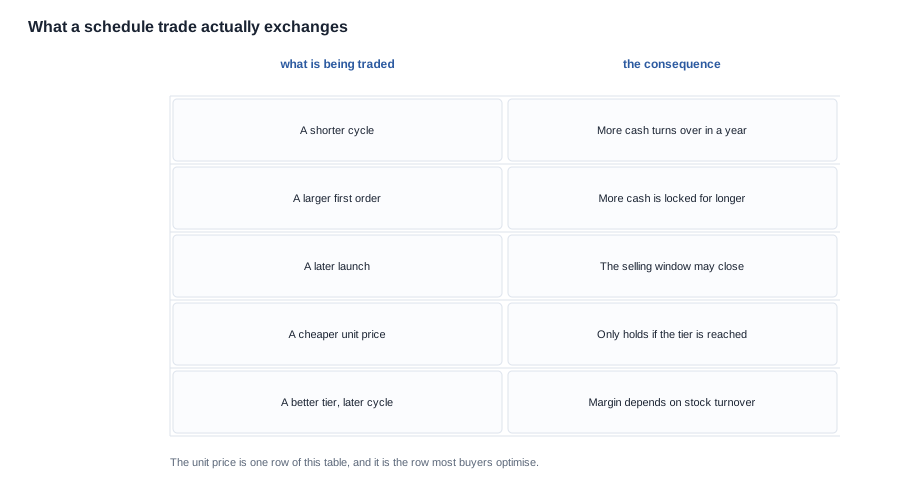
The obvious negotiation is between a shorter schedule at a higher price and a longer schedule at a lower price. It is worth making that comparison explicitly, because the unit price is not the right axis to compare them on.
The comparison is: the price premium for the shorter schedule, against the capital cost of the extra weeks plus the value at risk in the window that the longer schedule might miss. The second side is usually larger than the first when the window is fixed — a launch that closes — and usually smaller when the date has slack. That is why the same two quotations can produce different answers for two buyers, and why the right comparison depends on how fixed the launch date is.

Trading schedule against price: what each side of the deal costs
Not everything on the schedule can be bought. A buyer can pay for a reserved slot, for expedited freight, for a split delivery and for a faster documentation route; a buyer cannot pay for a laboratory's queue or a sub-supplier's material schedule. The distinction matters because the purchasable items are the expensive ones, and the unpurchasable ones are the ones that decide the date.
What is worth paying for
A reserved slot with a date. It converts a factory's discretion into a commitment, and it is usually cheap because it costs the factory flexibility rather than money.
A shorter documentation route. Where the market's route can be opened in parallel rather than after, the saving is weeks and costs nothing; where a faster laboratory is needed, it costs money and is worth comparing against the window.
Freight, when the window is fixed. Expedited freight is a rational purchase when the margin on the stock is larger than the freight premium and the window is genuinely closed. It is a poor purchase when the date still has slack, because it buys days the programme did not need.
What is not worth paying for
A smaller first order to shorten the schedule. It does not shorten it. It may make it longer, because a small order can neither consolidate nor batch with other work sharing the same components.
A price concession that depends on a schedule the buyer cannot hold. The discount is not real if the programme cannot consume the quantity in the window it was priced for.
Buffer stock bought instead of a date. It moves the inventory risk from the supplier to the buyer without reducing the schedule risk, and it usually costs more than the freight premium it replaces.
The questions to ask when the schedule is the negotiation
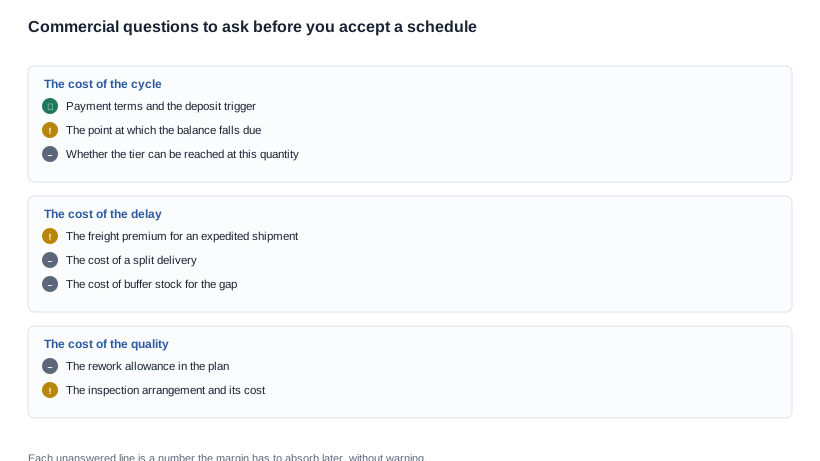
- What are the tier boundaries, and what is the price at each?
- Which durations are quoted separately — production, documentation, transit?
- Is the freight assumption based on a consolidated shipment?
- What is the deposit structure, and what event triggers the balance?
- What does the schedule assume if the consignment ships alone?
- Is the quoted duration to dispatch or to delivery?
Each of these has a short answer, and each one changes the margin arithmetic rather than the unit price.

A margin case worked through
The case below is an invented scenario used to reason through the arithmetic. No customer, order or shipment is described; the model, the quantity, the durations, the cost of capital and the channel price are assumed, so that the calculation can be followed step by step. The figures in this section are arithmetic from those assumptions and are not published data.
The assumptions. A first order for a camera model into one European market. Two quotations, both from a single supplier's published tier structure. Quotation one offers a shorter production window at a higher unit price; quotation two offers a longer window at a lower unit price. The cost of capital is set by the buyer's own finance function. The channel price is fixed, because the market it is sold into does not move for a buyer's schedule.
Step one, the landed cost. Both quotations are converted to a landed cost: freight at the single-consignment rate, the destination duty, the clearance fee and the inspection. The freight assumption is the same for both, so it does not decide the comparison, but it changes the absolute number and would decide it in a programme where one supplier assumed consolidation and the other did not.
Step two, the committed period. The deposit, the balance trigger, the despatch, the arrival and the sale are placed on one calendar for each quotation. The periods differ by the difference between the two quoted windows, and the longer one also carries a later arrival relative to the launch requirement.
Step three, the capital cost. The committed value is multiplied by the cost of capital for the committed period. The shorter schedule produces a lower figure here, and it is the first place in the calculation where the schedule has a price.
Step four, the window. The launch requirement sits at a fixed date. Under the longer schedule the stock arrives after it, so the sale moves into a later period at the same channel price, and the inventory has to be carried for longer before it converts. This is the second place where the schedule has a price, and it is the larger of the two.
Step five, the comparison. The price premium of the shorter schedule is set against the capital cost plus the carrying cost of the longer one. In this case the premium is recoverable, and the decision is to take the shorter schedule. Had the launch date had four weeks of slack, the same two quotations would have produced the opposite answer.
Step six, the order size. The same calculation is then run at the next quantity band, because a tier that requires more units also requires more capital and more sell-through time. The band that maximises unit margin is not the band that maximises the return on the capital committed, and the two are separated by exactly the arithmetic above.
What the case demonstrates
The conclusion is not that a shorter schedule is always better. It is that the schedule has a price, the price can be calculated, and the calculation should be done before the order rather than reconstructed afterwards from an invoice.
The same case also shows why the tier structure matters more than the unit price. Two bands, two different capital positions, and a difference in the return that is larger than the difference between the two suppliers' quotes in many programmes.
What we can and cannot put a number on
Concretely, we publish the specification and we do not publish the commercial terms, because a price without a configuration and a quantity is not a price and a lead time without a range is not a date.
What we publish is the specification that the margin calculation is built on: the twenty-eight models and their rows — the battery capacity and rated use for each, the charging time for every model, the charging method for the twenty-four where it is stated, the Bluetooth version for the fourteen where it appears, the case capacity for the five models where it is published, and the ingress rating on the two models that carry one. The configuration choice is itself a margin decision, because a published configuration carries a different commercial treatment from a made-to-order one.
What we do not publish: unit prices, price tiers, minimum order quantities, tooling charges, certification fees, production lead times and production capacity. Each depends on a configuration, a quantity and a market, and a single published figure for any of them would be the blended number this page argues against.
What we will do is take a model, a quantity, a destination and a required date and tell you which configurations exist, which published rows the commercial case has to be built around, and how the schedule interacts with the quantity you intend to order. We will also tell you plainly when a date cannot be met, and we will say so before you commit rather than after you have planned around it.
The longer view of the schedule is at the lead time section, the payment structure is at payment terms, the shorter schedule is examined at how to increase it, and the cost side of the same argument is at MOQ and hidden costs.
The action to take now. Ask for the tier boundaries, the separate durations and the payment structure in one message, then run the five numbers above against your own cost of capital. The result is usually a clearer answer than the price comparison, and it takes an afternoon.
Related reading
- Lead time section — the schedule behind the arithmetic
- Payment terms — when the cash actually moves
- How to increase the lead time window — the schedule lever
- MOQ and hidden costs — the cost side of the same trade


