

A buyer who wants a microphone standard to test against will find that the standardised measures are mostly component-level ones and that the measures which decide customer experience are not standardised at all. That gap is not a defect in the standards; it is that the standards describe a component, and the thing buyers are deciding on is a system in use.
So smart glasses microphone quality smart glasses industry standards is best understood as a map of which rows have a reference method and which rows you have to define yourself. For a sourcing team the map is more useful than any individual standard, because it tells you which citations in a supplier's documentation are worth chasing and which rows in your own purchase order are doing all the work.
Smart glasses microphone quality: mapping rows rather than listing standards
The reason a microphone standard is hard to find for this category is that the category is a system and the standards are for parts. A capsule can be characterised on a bench, under a defined reference, to a repeatable figure. A pair of glasses with a capsule, a port, a frame, a firmware chain and a radio cannot be characterised by the same method, because the frame is not a controlled variable and the firmware is not fixed. There is no reference method for the thing the customer buys, and the absence is structural rather than a gap in the documents.
What this means for the buyer is that a standards-driven approach has to be split in two. The component rows can be checked against a published method, and asking for the method is entirely reasonable, because the method is what makes the figure comparable. The system rows cannot be checked against anything, and a buyer who cites a component standard in the purchase order for a system row has created a contract that no supplier can satisfy, because the two are measuring different things.
What this also means for how a supplier responds. A supplier who is working to a good documentation habit will answer a component question with a method and a caveat about the assembly. A supplier who is quoting a competitor's listing will answer with a number. The difference shows up in the second exchange, and it is worth running the second exchange before the sample order rather than after it, because the quality of the answer is a reasonable proxy for the quality of the programme.
And what it means for cost. A buyer who has defined the system rows does not need a laboratory. A buyer who has not will eventually need one, because a system row that nobody defined will be settled by whoever complains loudest, and in a channel that is a returns manager. The protocol is a piece of work that costs a day and an afternoon; a dispute about a returns trend costs a quarter.
The four rows that have a reference method, and why they are rarely the ones you are shown
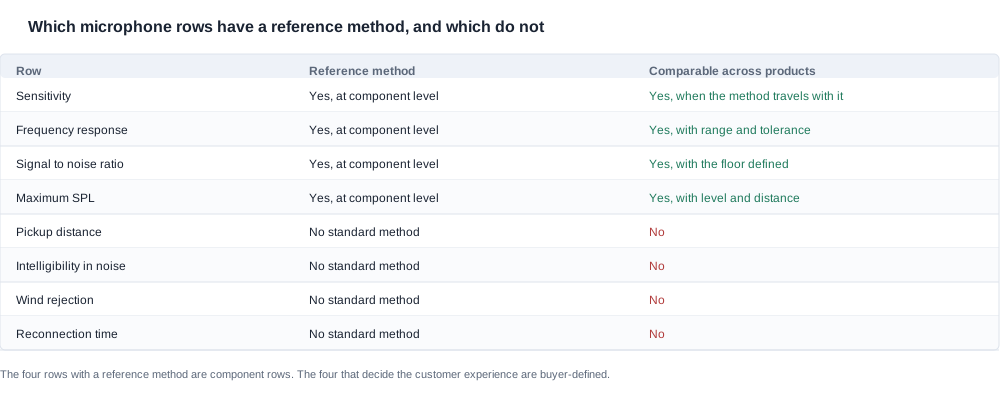
Sensitivity, frequency response and signal-to-noise ratio are standardised at the component level. There are reference methods, and two microphones measured to the same method are comparable. Maximum SPL is the most genuinely standardised of these, because it describes the microphone's behaviour at a defined input level with a defined distance.
The catch is that comparability depends entirely on the method being stated. A sensitivity figure without a reference and a weighting tells you nothing, and this is why suppliers quote pickup distances rather than sensitivity figures: the standardised number is harder to quote loosely.
Why these four rows are the ones you will rarely be shown. Three reasons, and each of them is worth understanding because it explains what a supplier is doing when they decline the question. First, the rows describe a capsule in a fixture, and the product in front of you is an assembly with a port, a frame, a distance and a moving head, so the component figure is real but not about the product. Second, the rows are the ones a supplier most often does not hold for the finished assembly, because characterising an assembly is more work than characterising a part and is only worthwhile if the result is going to be used. Third, and most usefully for a buyer, the rows are rarely decisive for the purchase, which means that a supplier declining them is not necessarily concealing a weakness.
The practical instruction that comes out of this. When a supplier offers a component figure, ask for the method and then ask for the same measurement on the finished unit. The first request tells you whether the number is real. The second tells you whether it is about your product. Suppliers that hold the second will treat the question as routine. Suppliers that hold only the first will explain that the assembly changes the result, and that explanation is itself the answer you need.
The two figures most often confused with each other. Sensitivity and signal-to-noise ratio are quoted interchangeably in this category, and they answer different questions. Sensitivity is the output produced for a given input level. Signal-to-noise is the relationship between that output and the noise floor. A supplier asked for sensitivity and who answers with a ratio has answered a different question, usually because the ratio is easier to compute and easier to present well. Asking which one was measured, and against which reference, settles it in one line.
What no reference method will do for you. Even a fully documented capsule figure does not describe the open-ear acoustic path, which is a property of the frame and of the distance from the mouth. It is worth stating that plainly in a specification, because a buyer who has collected four good component numbers and then expects a customer-grade result is making the same category error in reverse: the standards are real, and they are about something else.
The four rows with no standard, and the components each one is built from
Pickup distance. There is no standardised method that produces a comparable number. A figure quoted without an input level describes the test, not the microphone. This is the row most often compared across suppliers and the least comparable.
Intelligibility in noise. The measure that determines whether a product works for a customer on a call, and entirely buyer-defined. There is no reference protocol; there is your protocol, and it has to be the same one every time you compare.
The components of it are yours to choose: source material (a news bulletin is better than speech you improvised), source level, source distance, background type and level, and where the recording microphone sits.
Wind rejection. No standard, and it should not be treated as one. Wind performance depends on the airflow condition, the microphone position relative to the airflow, and the test's own geometry. A figure quoted without those is not comparable to anything.
Reconnection time. Entirely buyer-defined. This is the measure that predicts daily satisfaction and it appears in no specification, which is why this category generates more support contacts about pairing than about anything else.
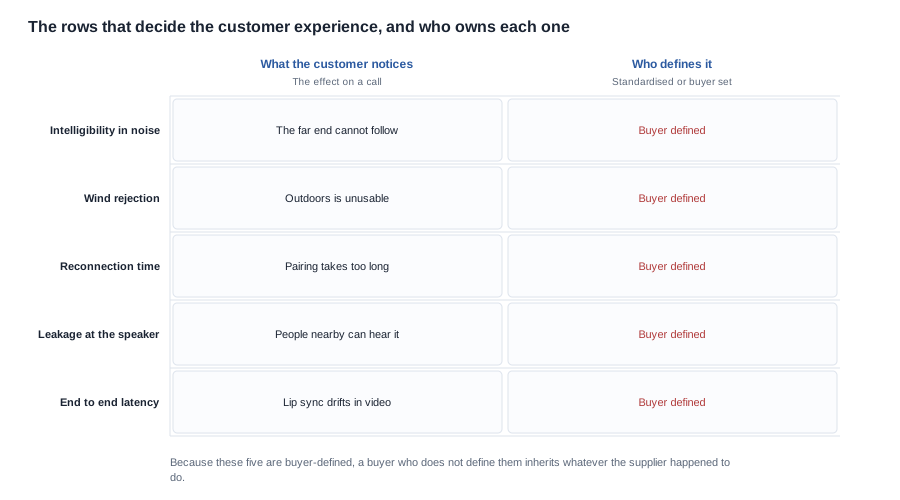
The two more that are worth adding to the list. Leakage at the speaker, which is what a colleague hears and which appears on no sheet in this category, and end-to-end latency, which is what produces lip-sync drift in video and which is invisible in a component specification. Both are buyer-defined for the same reason as the other four: no reference method produces a comparable number for a system in a frame.
The consequence of the gap, stated commercially. When five of the nine rows that decide the customer experience are buyer-defined, then a buyer who does not define them inherits whatever the supplier happened to do, and the supplier's answer is a function of what was easy to tune rather than what the channel needed. A buyer who does define them gets a product that matches the environment it was developed for, at a price that includes the development. The gap is not a reason to distrust suppliers. It is a reason to stop expecting a standard to do the work that only a specification can do.
Writing a protocol that survives a second supplier and a second year
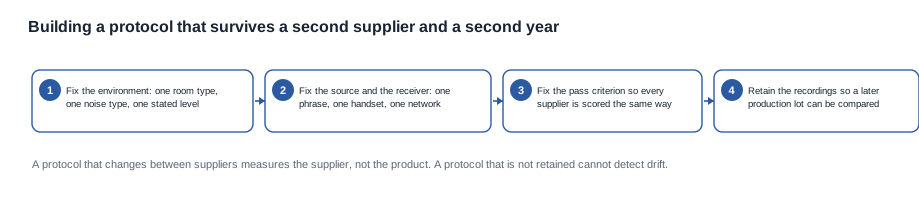
A protocol is only worth writing if it will still be running when a second supplier is being compared and when the second production lot arrives. That imposes four requirements, and each of them corresponds to a decision that is cheap now and expensive later.
Specify the method, not the number. Where a supplier gives you a microphone figure, ask what the input reference was, what the weighting was, what the environment was, and whether it came from a production unit or a sample. Those answers differ enormously between suppliers and most of the difference is rigour. The buyer who asks for the method has to keep it, and the protocol is the place to keep it.
Define your own protocol for the behavioural rows. Three measures, fixed and repeatable: three-metre intelligibility with a stated source, a real-network call, and wind with a stated airflow. Run them on every sample and every delivery. The point of fixing three is that three is enough to detect a change and few enough to run on a receiving day.
Keep the recordings. Not just the result — the audio. It becomes the reference against which drift between production lots is detected, which is a failure mode no specification will tell you about. A score without the recording can be re-scored differently by the next person who reviews it, and a recording cannot.
Record the configuration with the recording. The unit, the firmware version, the lot and the date, on the file itself rather than in a spreadsheet that will be separated from it. Drift is only detectable if the earlier and the later result are comparable, and two results recorded a year apart are comparable only if the thing that changed between them was the product rather than the method. A supplier that asks what fields the buyer wants on the protocol form is asking a reasonable question, and a buyer that answers it precisely is protecting itself against a dispute it cannot otherwise settle.
Keep the protocol in the order the test is run. The order in which the conditions are applied is itself part of the method, because a device that has been in a cold room behaves differently from one that has been on a desk for an hour, and a protocol that records the order of the tests is a protocol that can be repeated next year by a different person in a different building.
Score against a criterion, not against an impression. The pass condition should be written before the first unit is tested, and it should be the kind of condition a second person would apply the same way. A score of "mostly intelligible" is not a criterion. A score of "the scripted phrase is repeated correctly by three of three listeners at three metres in a 65 dB office" is a criterion, and it is arguable only about the listener, not about the rule.
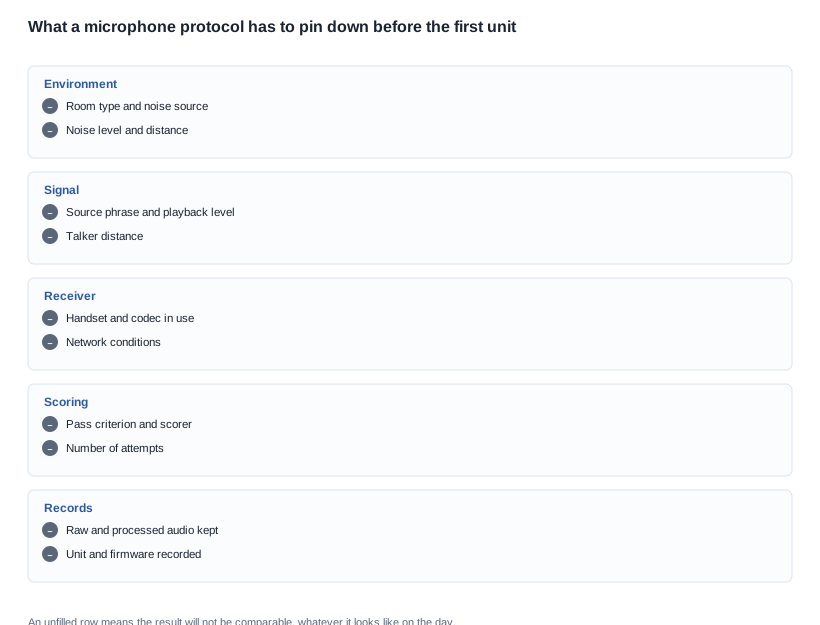
What the protocol must not contain. It must not contain a condition that changes between suppliers, which is the most common way a protocol becomes incomparable without anybody noticing. It must not contain a condition that only the buyer's first tester could reproduce, because that condition becomes the product and not the rule. And it must not contain a condition whose pass mark was set after the first result was seen, because at that point the protocol measures the expectation rather than the product.
What to cite in the contract when no standard obliges a supplier
The most useful legal point in this category is that a standard nobody is obliged to meet has no contractual force, while a criterion written into the purchase order does. A buyer who writes "the device shall meet the applicable microphone standard" has written something that is probably not resolvable, because there is no applicable microphone standard for the system. A buyer who writes the environment, the source, the distance, the scorer and the pass condition has written something that is.
The clauses that make a criterion binding. State the test in the same order every time: environment first, then source, then distance, then the receiving device, then the pass condition, then the number of attempts. Attach the protocol as a numbered schedule referenced by the order, so that a change to it is a change to the order and not a matter of memory. Name who runs it: the supplier on production units, the buyer on its own units, or both on their own respective units, with the recordings shared. State the consequence: a lot that fails the schedule is a lot the buyer may refuse, and the cost of re-delivery sits with the supplier.
The document requests that go with the criteria. The sample order cost and terms, the number of units at each quantity band, the lead time for a configuration change, the tooling position, the incoming inspection criteria the supplier is willing to be held to, the golden sample retention terms, and the model list the conformity file covers. Each of these is a commercial term that a microphone discussion usually omits, and each of them is where a project quietly loses margin.
What is negotiable and what is not. The number of units used for the protocol, whether the supplier runs it on production units or on engineering samples, whether the recordings are supplied, the sample order quantity, the price tier at which the sample cost is waived, the number of pilot units taken before a run order, the payment schedule against a split delivery, and the per-shipment application of the inspection criteria are all negotiated. The component configuration, the pass condition once written, the acceptance consequences, the conformity file coverage and the lead time for a hardware change are not, and a supplier who offers to negotiate them should be asked why.
The trap in the contract clause. The most common drafting error in this category is to write an acceptance criterion that the supplier can satisfy by changing the product. If the criterion is intelligibility at three metres and the supplier can change the gain profile to meet it, the criterion is a development instruction rather than an acceptance test, and it should be labelled as one. A criterion that survives a product change is an acceptance test; a criterion that does not is a requirement, and it belongs in the requirement section where its development cost can be seen.
The catalogue position on standardised microphone measurement
It is worth being precise: we publish no microphone measurement of any kind for any model — no sensitivity, no frequency response, no signal-to-noise ratio, no pickup distance, no suppression description, no leakage figure and no latency figure — and we will not estimate any of them.
That is a narrower position than a buyer may expect from a factory, and we would rather state the reason than the fact alone. The reason is that a measurement we have not taken on the assembled product, in a stated environment, with a stated method, is not a measurement; it is an estimate, and an estimate in a specification column is indistinguishable from a measurement until someone tries to reproduce it. When an estimate reaches a distributor's technical team or a marketplace, the consequence lands on us and on the buyer's channel.
We would rather a buyer ran a fixed protocol on a sample than trusted a figure whose method they had never seen. Where you send samples we will run the protocol with you and report what we hear, including the rows where the result is worse than the expectation, because a row that is worse than expected before the order is a design constraint and the same row after the order is a returns line.
The published rows that do exist. The audio family names across the range are open-ear acoustic structure, directional audio and intelligent noise reduction. The electrical rows are published and verifiable: Bluetooth 5.3 on the K01 and the K02, Bluetooth 5.4 on the YK12 and LC-105-2, the D12 and the G07, and the D11 and the LC-105-1; cell configurations of 55 mAh by two, 90 mAh by two and 100 mAh; charge times of two hours or less on every one of them; runtimes of roughly six to eight hours; and magnetic or Type-C charging depending on the model. The sport models publish the same rows on Bluetooth 5.4, with 70 mAh by two on the YKC02, 115 mAh on the D17 and 100 mAh on the ZH12, and the D17 and the ZH12 at roughly one hour to charge. The G07 and the YK12, which carry the slim or detachable temple, are the two that publish roughly six hours on the 55 mAh by two configuration, and the rest of that group publish roughly eight. None of those rows is a microphone row, and the distinction matters when a buyer writes a specification.
What we can do instead of publishing a number. Send us the models, the environments, the target markets and the quantities, and we will tell you which of the nine rows above is decisive for your programme, which are component rows you can check with a method request, which are system rows you will have to define yourself, and what the protocol should contain. The design context is at noise control and microphone pickup, the terminology is at the microphone glossary, the request list is at microphone specifications to request, and the open-ear framework is at open ear audio technology.
Related reading
- Microphone quality buying checklist — the rows to request when no standard obliges a supplier to publish them.
- Open ear audio technology — the acoustic framework the microphone rows sit inside.
- Noise control and microphone pickup — the pillar, for what the standards in this article do and do not settle.
Send samples and we will run a fixed protocol with you and report what we hear.


