

The V03 and the L2 Utral differ on battery and charging in three ways that matter operationally: the frame cell is 220 mAh against 290 mAh, the charging interface is magnetic against Type-C, and the stated endurance is a 5 to 8 hour range against a single figure of roughly 7 hours. On paper they resemble the same product at two price points. In a warehouse they are two different cable strategies, two different case stories and one shared question: neither catalogue page states the condition under which the endurance was measured.
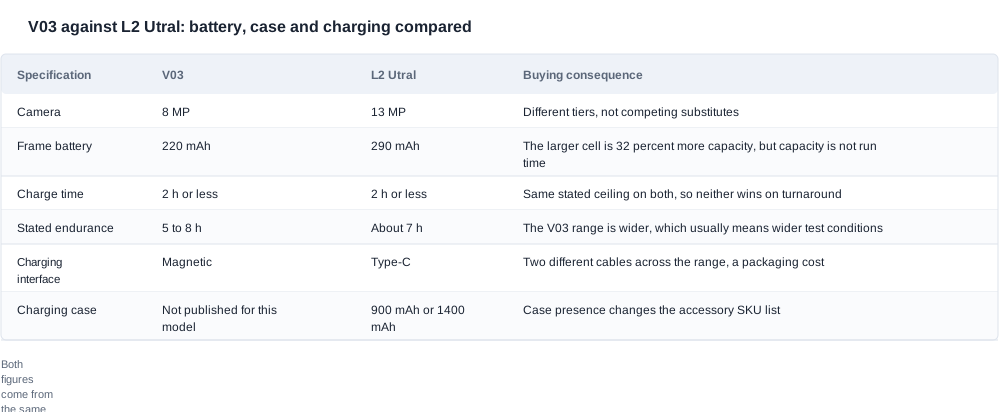
That framing matters because the three differences belong to different categories, and none of them is a performance difference in the sense a buyer usually means. The cell is a component fact. The interface is a design decision with a long tail. The endurance figure is a measurement whose method is not published. Treating all three as "battery" is how a comparison ends up arguing about the wrong number.
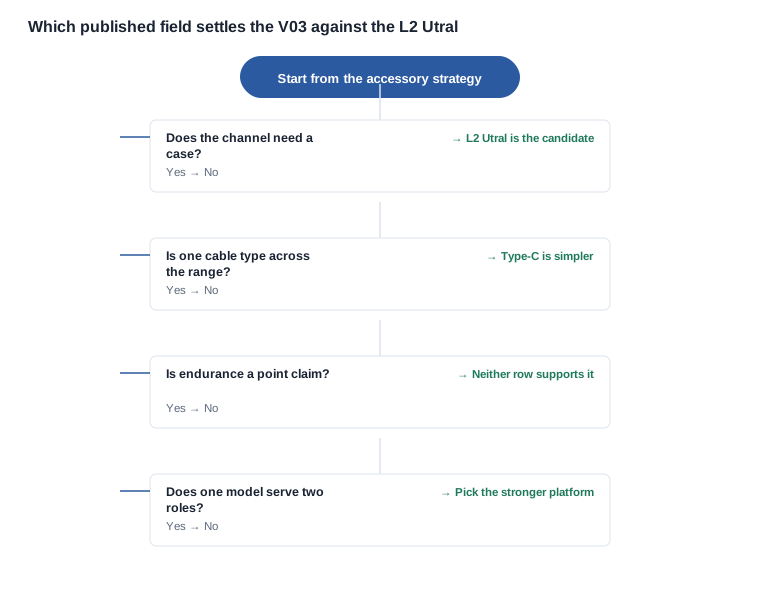
There is a fourth difference that the two catalogue rows imply rather than state, and it is the one with the longest tail of all: the accessory strategy. One model needs a proprietary pad that must be stocked forever, and the other can be shipped with a cable most customers already own. That is not a battery difference and it is not a specification difference; it is a supply chain difference, and over a multi-year range it frequently costs more than the cell gap ever saved.
Reading the two rows that decide the order, starting with V03 capacity
Capacity is not runtime. The L2 Utral carries 32 percent more cell capacity than the V03. That is a real difference and it is worth something in a product where the camera is running continuously, but it is not a runtime difference on its own, because runtime is the product of capacity, the radio duty cycle, the processor load and the screen or indicator behaviour. A 290 mAh cell that spends more time on Bluetooth reconnection is worse in the field than a 220 mAh cell that sleeps efficiently.
The duty cycle itself is where the two models could plausibly diverge, and it is precisely the field neither row publishes. A firmware branch that keeps the radio continuously paired, one that reconnects aggressively after idle, and one that sleeps between captures will produce three different runtimes from the same cell. Two models on the same platform with the same firmware behave similarly; two models on different platforms with different firmware branches do not, and the catalogue gives a buyer no way to tell which pair these are.
A practical consequence follows for anyone writing product copy from these two rows. A capacity figure is safe to publish because it describes a component; a runtime figure derived from it is not, because the derivation assumes a duty cycle nobody has published. If the channel needs an endurance claim, the only defensible source is a measurement taken under a stated condition on a sample order, not an extrapolation from the cell.
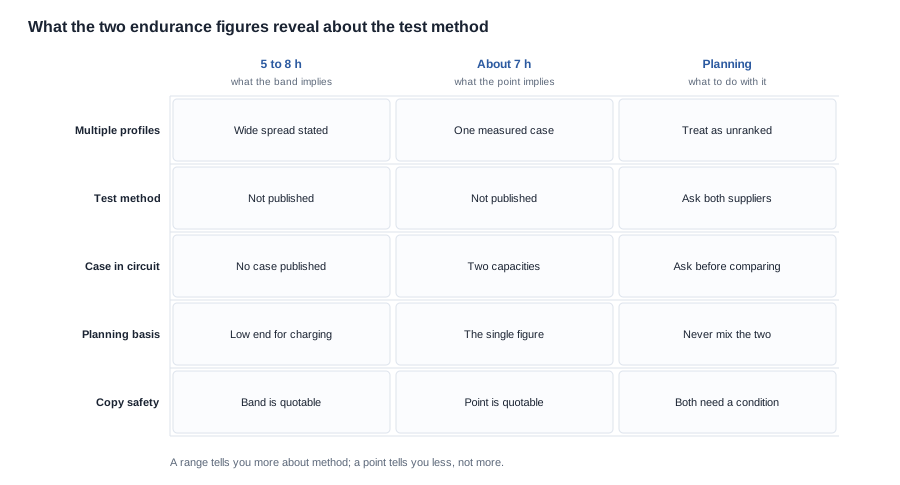
The endurance range is a clue, not a number. A published 5 to 8 hours is a statement that the result depends on conditions the catalogue did not name. A published roughly 7 hours is a statement of a single measured case. For a buyer building a specification, the first is more informative, because the range tells you the supplier ran more than one profile. For a buyer building a product page, the second is easier to write, and easier to defend until a customer complains.
The two statements also have different failure modes when they reach a customer. A band that a customer fails to reproduce produces a complaint about the lower end, which is the number the catalogue already conceded. A single figure that a customer fails to reproduce produces a complaint about the only number anyone published, which is a harder position to defend because there is no second figure to point at. That asymmetry is worth remembering when a channel partner asks which model is easier to describe in a listing.
The range also carries a second signal that buyers rarely extract from it. A five-to-eight-hour band spans sixty percent of its own upper bound, which is a wide spread for a single product and implies that the low end is a real operating condition rather than a laboratory artefact. A buyer who plans around the low end will over-provision charging; a buyer who plans around the midpoint will under-provision it roughly one time in three. Which of those two errors is acceptable is a programme decision, not a specification decision, and it should be made deliberately rather than by default.
The default is usually the midpoint, and the midpoint is the option that fails most often in both directions. Planning around it produces a programme that runs short of charge on the heavy days and carries unnecessary spare capacity on the light ones. Planning around the low end is safe and expensive; planning around the high end is cheap and unsafe. For a giveaway or a bundle, where usage is unpredictable and short, the low end is almost always the right planning basis. For a hero product sold to a user who films continuously, the high end is closer to reality and the case becomes the compensating accessory rather than an optional extra.

Charging: the difference you will feel first
There is one more consideration before the interface decision is made, and it is a scheduling one rather than a technical one. Interface changes are effectively permanent for a given model, because the connector is part of the tooling rather than part of the firmware. A buyer who expects to change the interface later is not describing a plan; they are describing a new model with the same name. Deciding the interface early is therefore cheaper than deciding it thoroughly, because a thorough decision reached late still requires new tooling.
The V03 charges magnetically. The L2 Utral frame charges over Type-C. These are not interchangeable decisions and they propagate into everything downstream of the box.
A magnetic frame needs a magnetic pad or cable in the box, needs a shelf-stable contact, and puts a failure mode into the field: a pad that has been in a bag for a month and a customer who cannot find the charging orientation. A Type-C frame needs a standard cable, which is the single most commonly owned cable in the world, which lowers the accessory cost and removes the orientation problem entirely.
The accessory difference is larger than it first appears, because it is a recurring cost rather than a one-off. A Type-C programme can often ship without a cable at all, or with a generic cable bought at volume, because the customer almost certainly already owns a compatible one. A magnetic programme cannot: the pad is specific to the product, so it is a permanent accessory line, a permanent packaging component and a permanent replacement-sale opportunity. Whether that is a cost or an opportunity depends entirely on the channel, and it is a question worth asking before the accessory list is locked rather than after.
The second-order effects run in both directions. Magnetic charging is easier to demonstrate in a store and harder to explain in a manual, because there is no orientation to describe and therefore nothing for a customer to get wrong — until the contact is dirty. Type-C is harder to demonstrate and trivial to explain. Neither is better; they fail differently, and the failure mode should be matched to the channel's support model rather than to the engineering preference of whoever designed the product.
A buyer who has both models in one range can use that difference deliberately instead of treating it as an accident. Put the Type-C model where the customer already owns cables and the magnetic model where the demonstration matters more than the accessory cost. That produces a range with two interfaces deliberately placed, a support model that matches each placement, and a defensible answer when a channel partner asks why the two products are packed differently.
The L2 Utral also comes with a charging case in two capacities, 900 mAh and 1400 mAh. The V03's case is not published for this model. If you are building a retail proposition where the case is the reason the customer keeps the product in a bag, that difference matters more than the cell capacity inside the frame. Our charging case options breakdown sets out what a case adds to a landed cost.
There is also a landed-cost consequence that the unit price does not show. A case adds a second cell to the shipment, and a second cell can affect the classification of the whole consignment, the documentation the destination market requires, and in some cases the route the shipment can legally take. None of that is visible in a per-unit comparison, and all of it is cheaper to establish during the quotation than after the container has been booked.
That case choice is itself a decision rather than a detail. Two published capacities mean two carton sizes, two packing configurations and potentially two accessory SKUs, and a range that carries both alongside a magnetic product is now managing three box variants. Buyers who take the 1400 mAh option for a hero product and the 900 mAh for a secondary SKU should write that down before artwork, because it determines the packaging set the supplier has to hold.
The practical sequence for a range carrying both is therefore short. Choose the interface first, because it determines the accessory supply chain and cannot be changed without re-tooling. Choose the case configuration second, because it determines the carton set. Choose the carton set third, because it determines what the packaging team has to hold. Only then does the unit price comparison become meaningful, because by then both sides are quoting the same box.
Where the two models sit against each other commercially
| Decision point | V03 | L2 Utral | Which way to lean |
|---|---|---|---|
| Resolution positioning | 8 MP | 13 MP | The L2 Utral, if your listing leads on camera quality |
| Frame cell | 220 mAh | 290 mAh | The L2 Utral, if the camera runs constantly |
| Stated endurance | 5 to 8 h | About 7 h | The V03, because the range implies multiple test profiles |
| Frame charging | Magnetic | Type-C | The L2 Utral for a universal-cable retail box |
| Case | Not published for this model | 900 mAh or 1400 mAh | The L2 Utral, if the case is part of the product story |
| Documented camera sensor | Not published | Not published | Neither; you must ask |
| Frame weight | Not published | Not published | Neither; you must ask |
Read as a table, this is a comparison with one clear winner in four rows and no usable answer in three. That is an unusually honest shape for a competitive comparison, and it is worth resisting the urge to fill the last three rows with estimates. A row that reads "neither, you must ask" is a row that tells the buyer exactly what work remains, and a row filled with an inferred number tells the buyer nothing except that somebody guessed.
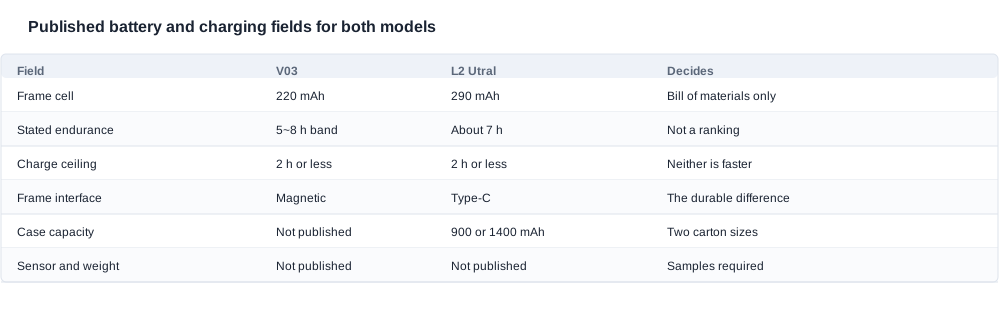
The two "neither" rows also share a consequence. Because neither model publishes a sensor or a weight, the imaging gap and the physical gap are both unassessable from the catalogue, which means the only two differences a customer could actually complain about later — picture quality and how the unit feels — are the two the published rows cannot rank. The two rows also answer one question cleanly, and it is the question buyers ask most often. On charging, the L2 Utral is the more flexible model: a standard interface, a published case in two capacities, and an accessory list that can be assembled from parts most suppliers already hold. The V03 is the cheaper box with one object in it and one interface to explain. Neither is the better product; they are different supply chains, and the right one is decided by what the channel already stocks.
That is the strongest argument for ordering samples of both rather than for choosing on the sheet.
The questions this comparison cannot settle
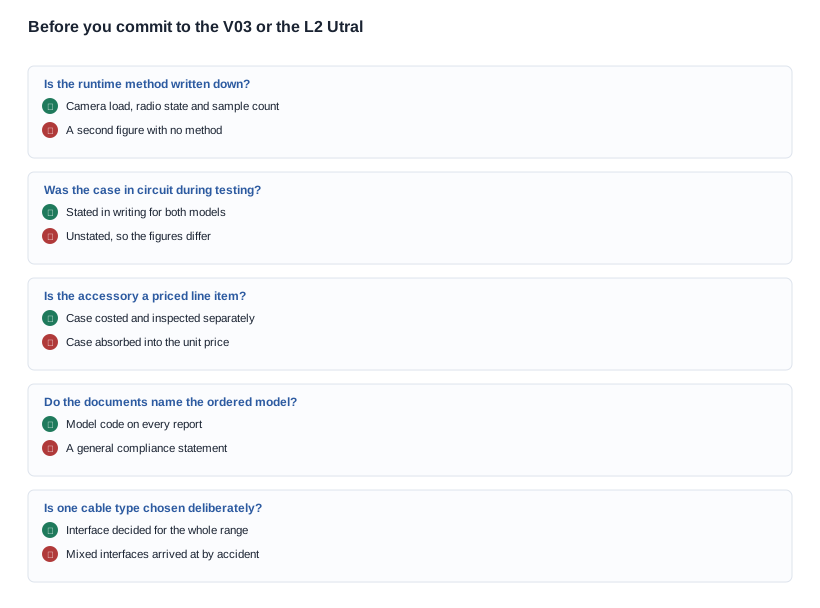
There is a version of the endurance question that has no good answer, and it is worth naming before a buyer spends a week on it. If the two suppliers return different test methods and neither is willing to re-run the measurement under the other's method, there is no procedure that makes the published figures comparable. The buyer's options at that point are to accept the lower figure as the planning basis, to run both methods on samples in-house, or to drop the endurance claim from the copy altogether. The third option is the one most often chosen and the one most often regretted, because endurance is the claim customers look for first.
Neither model publishes a sensor model, a field of view, a video format, an ingress rating or a frame weight. That is not an oversight in the comparison; it is the state of the source, and it applies identically to both sides. Until you have a sensor model and a field of view, the 13 MP versus 8 MP line is a marketing difference rather than an imaging difference.
The second gap is the endurance condition. Ask each supplier the same question in the same words: what was the camera doing during the measurement, was the Bluetooth link active, and was the measurement taken on a single sample or averaged across units. If the two answers differ, the headline figures are not comparable and you should plan against the lower one.
A third question is worth adding to that list, and it is the one most often skipped. Ask whether the case was in circuit during the endurance measurement. A case that participates in charging changes the effective endurance materially, and a runtime figure produced with the case attached describes a different product from the same model with the case unused. Because the V03 does not publish a case at all, the same question applied to both models may well produce two different experimental setups, which would mean the two figures describe different systems.
A fourth question belongs on the list for the same reason: what the charging accessory actually is, and what it costs as a line item. The magnetic pad is specific to this product and must be bought, packed and replaced. A generic cable is not. Two suppliers quoting the same unit price can therefore be quoting genuinely different boxes, and the only way to see that is to ask for the accessory as a named line rather than assuming it is included.
Two further questions belong on the same list because they determine whether either model can be ordered at all: the ingress position for the destination market, and the certification evidence naming the ordered model. Neither is specific to this pair, and both are cheaper to ask now than to discover after artwork approval.

The judgement behind this comparison, and what to do with it
We do not treat the capacity gap between these two models as a performance gap. The published numbers describe hardware, not outcomes, and the gap closes or reverses depending on the firmware behaviour that neither catalogue page describes. Our position is that the interface difference is the more durable commercial difference: Type-C and magnetic are different supply chains, different accessory lists and different customer expectations, and that choice will still be correct in two years when the cell difference has been forgotten.
Our V03 specification sheet sets out the full published row for that model if you want the same detail for the entry-level side of the comparison, and the charging case options breakdown covers the case decision in more depth than a single row of a table can.
One thing this comparison deliberately does not do is produce a winner. The two models are separated by an interface decision and a case decision, and both of those are programme decisions that depend on what the channel already stocks and what the customer owns on day one. A page that named a winner would be making the buyer's decision for them using information the catalogue does not contain, which is the failure mode this whole category of page is prone to.
If both models will sit in your range, treat them as a two-SKU charging strategy rather than a two-SKU spec strategy. Pick one magnetic and one Type-C, or pick two Type-C, but do not let the choice be accidental. Then fix the case configuration per SKU so your packaging team is not holding three versions of the same carton.
How to evaluate the two answers that come back is a documentation test, and the same test works whether the supplier is a factory or a distributor. The supplier who returns a written test method, states whether the case was in circuit, names the ordered model on every document, and quotes the case as a priced line item has given you something you can put in a purchase order. Red flags are narrow: a second runtime figure offered without the method, a compliance statement naming neither model, and a case capacity that changes between the quotation and the purchase order.
Before you commit, the shortlist should be written down with the deciding axis attached to each model — interface, case, endurance, or programme role — so that the choice survives the arrival of a third model eighteen months later.
Related reading
- The same interface question for the other camera models — V03 smart glasses charging options
- What the case changes about the order — AI camera glasses shipping weight
- Choosing across the whole camera range — AI camera glasses which model to pick
Tell us the models you are comparing, the destination market and the expected volume, and we will tell you which configurations exist and which details are still unpublished.


