

The V06 entry in the catalogue publishes a specification and nothing that can be turned into a price. What it publishes is short enough to recite: eight megapixels of camera class, a cell of 260 milliampere-hour, a charge that completes in two hours or less, an endurance band of five to eight hours, a magnetic contact rather than a cable, four descriptive rows, and four colour names. No currency is attached to any of them, and no commercial term — minimum order quantity, lead time, warranty, tooling, packaging, accessory pricing — appears anywhere in the published record.
The phrase "value for money" is used in this article in a narrow and practical sense. It means three things: the published rows that decide what a unit physically is, the commercial lines that are blank, and the questions that convert each blank line into something a supplier can answer in writing. It is not used to rank this model against another, because the published record supports no such ranking and we publish no prices for any model in the range.
That distinction is not a way of dodging the commercial question. It is the answer to it. A quotation can only be compared once the configuration behind it is fixed, and for this model the configuration is not fixed anywhere in the documentation: the carton contents are undetermined, the colour set is not defined, the accessory set is not defined, the packed weight is not published, and the compliance scope is not documented. Any comparison made before those are settled is a comparison of two descriptions rather than of two products.
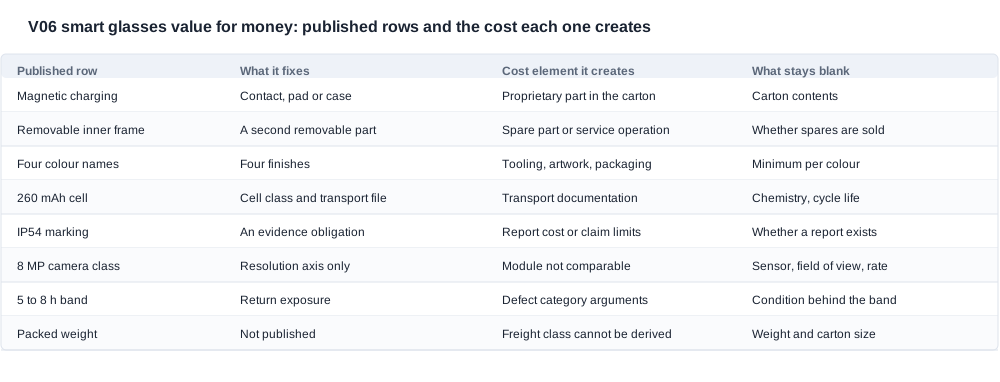
V06 smart glasses value for money: what the published rows make comparable
The published rows for this model are unusually good at one thing and silent on everything else. They are good at describing the assembly, and silent about the commercial terms. That is why they are worth reading as a cost structure rather than as a feature list: each published row creates a cost element that a competing quotation may or may not contain, and the presence or absence of that element changes what the two quotations are actually comparing.
Magnetic charging creates a proprietary part. The charging method is published as magnetic, which means the product needs a contact, a pad or a case, and none of those is a cable the customer already owns. Three of the camera models in the range carry no charging-case line in their published rows at all, and this model is one of them, so the carton contents are not specified in the published material. A case that is in the carton is a line item; a case that is sold separately is a different product with a different attachment rate; a case that does not exist for this model is a third. Until the carton is defined, two quotations for "the V06" are not comparable.
The removable inner frame creates a second part with its own economics. The row publishes that the inner frame comes out. It does not publish how many are supplied, whether a replacement can be ordered on its own, or whether the part is user-replaceable or service-only. Each of those answers creates a commercial line: a spare-part catalogue with its own minimum quantity, or a service operation with a turnaround and a cost per unit. A quotation that includes spare frames and one that does not are not two prices for the same thing.
Four colour names create four production configurations. The four are orange, white ice blue, black and black ice blue, and each of them is a finish with its own tooling question, its own artwork, its own packaging configuration and, quite possibly, its own minimum order quantity. A quotation that covers one colour and a quotation that covers four are not two prices for the same thing either, and neither is a quotation that covers four in total against one that covers four per colour.
The 260 milliampere-hour cell creates a documentation and transport obligation. The capacity is published and it is a real number, but nothing else about the cell is — no chemistry, no cycle life, no weight of the cell itself. What the figure does determine is the transport file, because battery transport documentation is written from the cell record rather than from the product record.
The IP54 ingress marking creates an evidence cost rather than a component cost. The marking appears in the feature rows of this model and no report reference is published with it. Producing the report has a cost and a lead time; not having it has a different cost, because it constrains what may be printed on a carton, on a product page and in a listing. Either way, a quotation that has a report behind it and a quotation that does not are quotations for different commercial propositions.
The eight-megapixel camera class constrains what can be compared about the camera module. The catalogue publishes the resolution class and nothing beyond it. There is no sensor model, no field of view, no frame rate and no video format. That means the camera module cannot be compared against another product's camera module on published data, and it means a quotation line for "the camera" cannot be verified by reading the specification. The camera detail is set out in the camera imaging material.
The five-to-eight-hour band creates a return exposure. A band published without a condition decides how a return is argued about. If the condition behind the lower end of the band excludes continuous camera use, then the expectation a customer forms from the listing and the experience on the unit diverge, and that divergence lands in a warranty claim. The published band is discussed in the V06 battery life record.
Two further points belong to the cost structure rather than to the specification, and both are useful to a buyer planning a comparison.
First, the catalogue publishes no real photograph, no video and no test report for any of the twenty-eight models in the range, this one included. That has a direct cost consequence: the finish expectation a customer forms cannot be formed from the catalogue, so the sample order is where the finish is first seen, and any change of expectation after the sample stage becomes a change of plan rather than a change of product.
Second, the specification rows cannot be used to infer a packed weight. The only published weight anywhere in the catalogue belongs to a different model — 158 grams for the MT6 glasses body, a figure that excludes the folding charging case that model carries — and a weight published for a different product cannot serve as a stand-in for this one. The freight class of a V06 consignment is therefore not computable from the documentation, and any landed-cost arithmetic that assumes a packed weight is an assumption rather than a calculation.

The cost elements that are published, and the ones that are blank
It is worth being exact about which side of the line each item sits on, because the two sides behave differently and conflating them is where a comparison goes wrong.
What is published. The specification rows and the colour names. Concretely: a camera class of eight megapixels, a cell of 260 milliampere-hour, a charge that completes in two hours or less, a rated endurance band of five to eight hours, magnetic charging, four descriptive rows, an IP54 ingress marking among them, and four colour names. These are the rows a specification file can be built from and the rows a quote can be checked against for consistency.
What is blank. Every commercial line. The catalogue publishes no unit price and no price range for this model, and it publishes no minimum order quantity, no delivery schedule, no warranty term, no tooling charge, no artwork charge, no packaging cost, no accessory price, no certification documentation charge, no payment terms and no freight basis. The commercial terms for this model are negotiated, and the published record contains nothing to negotiate against.
The blanks are not all equal, and a buyer who treats them as one undifferentiated list will spend effort in the wrong places. They fall into three groups.
The blanks that decide the shape of the order. The minimum order quantity and the question of whether it applies per colour or to the total is the most consequential of them, because it determines whether a four-colour range is one order or four. The lead time comes next, and the specific question to ask is where it is measured from — deposit, artwork approval, sample confirmation or order entry — because two suppliers quoting the same number from different starting points are quoting different products. The sample order quantity and the sample cost come third, because the sample is the only stage at which several of the published blanks can be closed at all.
The blanks that decide what the customer receives. The carton contents, the accessory set and the packaging specification all sit here. Since no charging-case line is published for this model, whether a case, a pad or a contact lead is supplied is a specification the buyer has to write and the supplier has to confirm. Whether spare inner frames can be bought separately determines whether the business is in the parts business or the service business. The colour scope question — which parts a published colour name covers — determines how many packaging configurations the range actually contains.
The blanks that decide what the shipment and the paperwork look like. The packed weight is not published, so the freight class cannot be derived. The warranty categories and their duration are not published, so the acceptance criteria have nothing to attach to. The compliance scope is not published per model, so the cost of obtaining the documentation is unknown. Payment terms and the delivery term are not published, so two quotations with different terms are not comparing the same obligation.
There is one more blank worth isolating, because it is easy to assume it is filled and it is not: the camera. The catalogue publishes the resolution class, so a buyer looking for "the camera specification" may believe the question is answered. It is answered only in part. The sensor model, the field of view, the frame rate, the video format, the storage capacity and the overwrite behaviour are all unpublished, and each of them is a line a buyer would want in a quotation for a product whose main feature is capture.

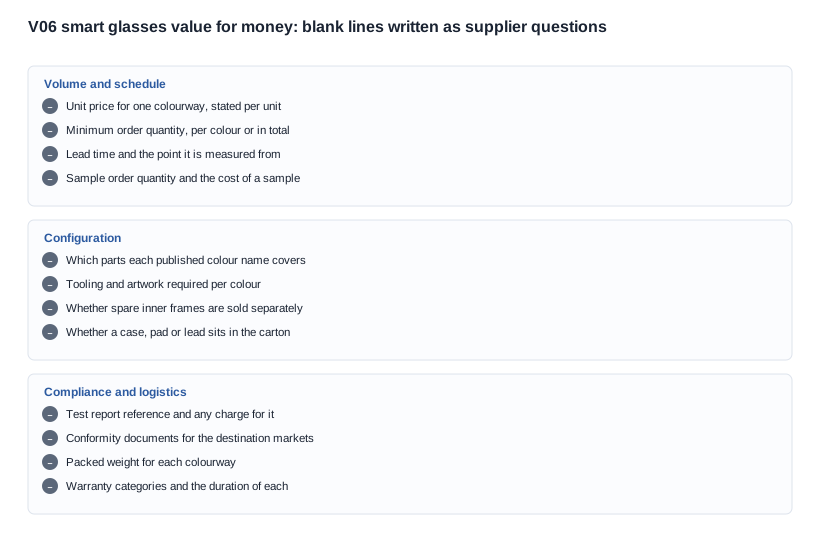
The blank lines, written as questions for a supplier
The useful form for a blank line is a question that has an answer of a certain shape. A request for "the price" produces a number without a basis. A request for "the unit price for one colourway, including the carton contents listed below, excluding any accessory sold separately" produces a number that can be compared with another number of the same kind.
On volume and schedule. What is the unit price for a single colourway, and what does it assume about the order quantity? Is the minimum order quantity per colour or across the range? What is the lead time, and what event starts the clock? What is the sample order quantity, what does a sample cost, and how long does a sample take to arrive? What are the payment terms and the delivery term?
On configuration. Which parts does each published colour name cover — the shell only, or the inner frame and the temple as well? Does any colour require separate tooling, and what does that tooling cost? What artwork is needed per colour, and what is the minimum quantity for it? Can a spare inner frame be bought separately, and what is its minimum quantity? Is a charging case, a pad or a contact lead included in the carton, and what is the part reference for whichever it is?
On the compliance file. Does a test report exist for the IP54 marking, what is its reference, and does producing a copy carry a charge? Which conformity documents can be provided for this model and for the destination markets, and what do they cost? Is the charge for the documentation the same for every colour?
On logistics and warranty. What is the packed weight per colourway, and is it measured with or without the accessories? What is the packed size? What are the warranty categories, what does each cover, and how long does each run? What defect remedies apply at incoming inspection?
Two things about the form of the request matter as much as the content. The first is that all of it should arrive in one document — a specification schedule, a price schedule and a compliance list — so that the blanks are visible as blanks instead of distributed across a series of replies, and so that a disagreement later is about the document rather than about what somebody said. The second is that the answers should be recorded against the rows they came from, because a row with a number attached to it and a row without one are the two halves of a due-diligence file, and only the second half tells you what still has to be closed.
Putting two quotes on the same footing
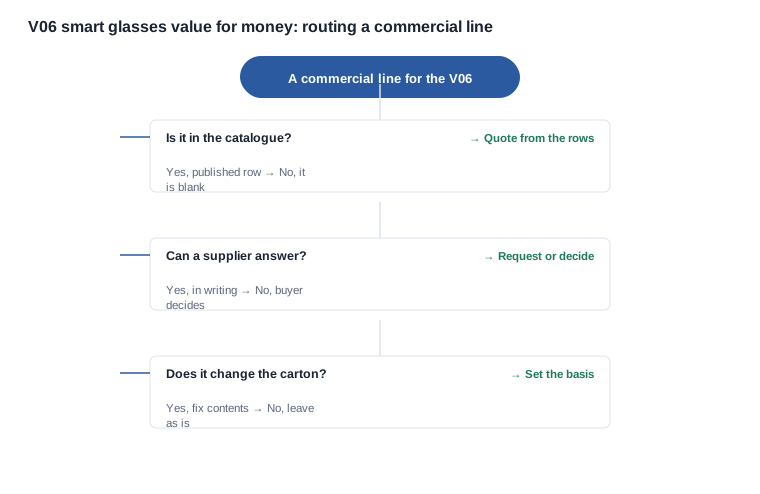
Two quotations for this model are not comparable on arrival, because the configuration behind each of them is undefined in the published material. The work of making them comparable is not analytical; it is a matter of fixing what each quotation is about, and then holding both to the same fixed description.
Step one is to define the configuration once, in writing. For each quotation, state which colourways it covers, what the carton contains, which accessories are included, which markets it is priced for and what compliance scope is assumed. This is the description that both quotations have to satisfy before any number is read. It is also the description a purchase order has to carry, and the description an incoming inspection will be measured against, so writing it once saves it being written three times.
Step two is to make both quotations answer the same questions, in the same order. The line list above is that order. The value is not that the questions are clever; it is that the answer to each one has the same shape in both documents, so a difference between them is a difference about the product rather than a difference about what each party assumed.
Step three is to normalise the basis of each commercial line before comparing anything. The lines that most often are not on the same basis are these.
- Unit price. A price for one colourway is not a price for the range. A price that includes the charging accessory is not a price without it. A price with the tooling charge amortised over one production run is not a price with it shown separately.
- Minimum order quantity. A total minimum and a per-colour minimum are different commitments, and a supplier who quotes a total minimum is describing a smaller program than a supplier who quotes a per-colour minimum for the same colour set.
- Tooling and artwork. A one-time charge spread across the planned volume and a one-time charge shown as a line are the same money until the volume changes, and the volume is exactly what the other lines are trying to establish.
- Lead time. The number only means something next to the event it is measured from.
- Warranty. Categories and durations rather than a single term, because a warranty without categories cannot be applied to a defect.
- Logistics. The same packed-weight assumption, the same carton, the same delivery term.
Step four is to attribute every difference. Once the two quotations describe the same thing, each remaining difference should be attributable to a named line — the accessory set, the colour coverage, the compliance scope, the volume assumption, the payment terms. A difference that cannot be attributed is not a price difference at all; it is a difference in what was quoted, and it has to be closed before the two numbers are placed next to each other.
How to judge whether two quotations can be compared yet. Three checks are worth running before any number is read, and they are cheap compared with a comparison that has to be withdrawn. The first is a configuration check: can each quotation be restated as a colour set, a carton content list and an accessory set? If either cannot, the two documents are describing different things and the comparison has to wait. The second is a basis check: do both sets of lines use the same unit, the same minimum basis, the same lead time start point and the same warranty structure? The third is an attribution check: can every difference be traced to a named line rather than to an unstated assumption on one side? These three checks are the criteria a shortlist should be built on, and a buyer who wants a red-flag list for the file will find that a quotation missing the configuration statement is the first item on it.
Step five is to re-quote when the configuration changes. A quotation is valid for a configuration. If the colour set changes after the quote, or the carton contents change, or a destination market is added, the quotation is no longer the same object and it should be issued again rather than adjusted in an email.
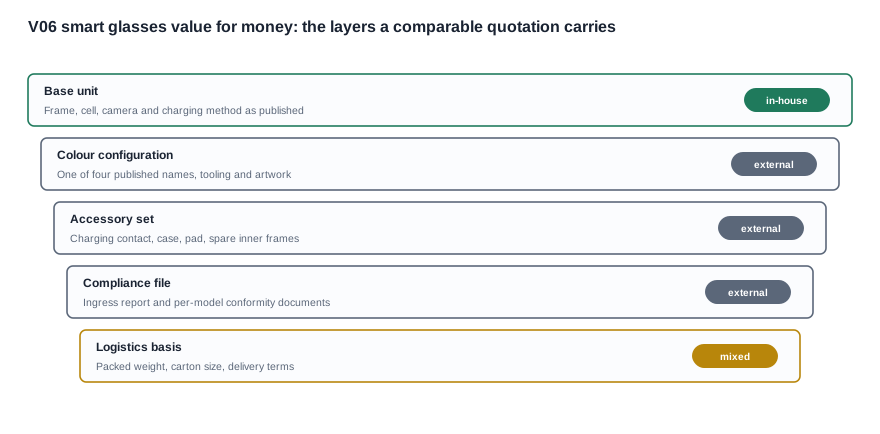

What we will and will not state on this model is narrow, and we would rather say where the line sits than let it be assumed. We publish the specification rows and the four colour names for the V06 and no price for any model in the range. We do not convert the endurance band into a working day, we do not print the ingress marking on a carton as a tested rating, and we will not give out a size, a weight, a case capacity, a certificate number or anything else the record does not contain. A commercial comparison for this model is built from a configuration and a document, not from a figure read off a product page.
What this leaves a procurement team with is a file rather than an opinion. The published rows tell you what the product is; the blank lines tell you what has to be requested; and the request, once answered in one document, gives two quotations that describe the same thing and can be set against each other without a judgement being made in the gap. The published gaps for this model are set out in full in the V06 limitations record, the fit question behind the inner frame is covered in the who needs the V06 note, the certification position across the platform is in the certification coverage material, and the tier alongside this one is covered in the S7 and V06 battery comparison. We publish the specification rows for this model and no price for any model in the range, and the commercial terms for this model are set out in a quotation against a configuration rather than read from a list.


