

An MSDS is a safety data sheet: a structured document that describes the hazards of a material, how to handle it, what to do in an emergency, and how it must be transported and disposed of. It is produced by the manufacturer of the material, it follows a fixed section order, and it is written for people who work with the material rather than for the person who ends up owning the finished product. That last point is where most confusion in this category starts, because a smart glasses buyer is not usually handling a bare lithium cell — and yet the paperwork follows the cell through the chain.
The practical answer to the question a buyer actually asks is that the document follows the battery, not the device. A device that ships with a lithium cell inside it travels with that cell's documentation, and the freight forwarder, the carrier and the receiving warehouse will all ask for it in one form or another, usually at booking rather than at delivery. Which form they ask for depends on what they need it for, and the practical difficulty is that three different documents are routinely called similar things.
This article explains what the document contains, why the same material appears under several names, when a shipment genuinely requires one, what the catalogue publishes about the batteries in this range, and what to request from a supplier so that the paperwork arrives before the goods do.
What is an MSDS, and which battery it covers
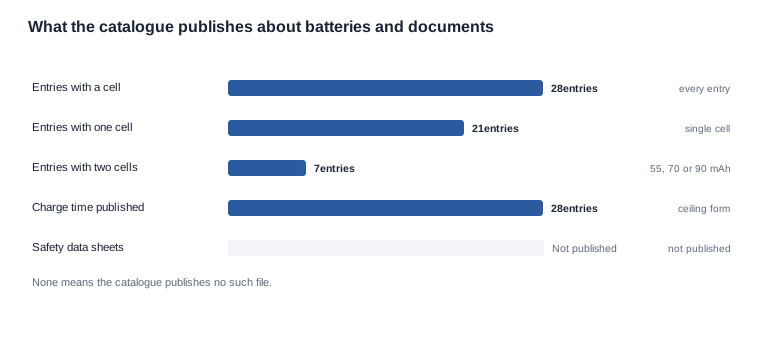
The document is issued for a specific material in a specific form, which means it maps to a cell rather than to a product. For this range the cell values are published for all 28 entries, and they are not uniform: 220, 260, 265 and 290 milliamp-hours across the camera entries, 90 milliamp-hours in a pair on the K01 and the K02, 55 milliamp-hours in a pair on the LC-105 pair, the G07 and the YK12, 70 milliamp-hours in a pair on the YKC02, a single 100 milliamp-hour cell on the D11 and the D12, and 40, 70, 115, 100 and 200 milliamp-hour cells elsewhere. Twenty-one entries carry a single cell and seven carry two.
Two consequences follow. The first is that a supplier may be holding several cell types at once, in which case there is more than one document and the request has to name the cell rather than the product. The second is that the number of cells in a package is a fact that affects how a shipment is classified and documented, so it is a question to ask rather than an assumption to make.
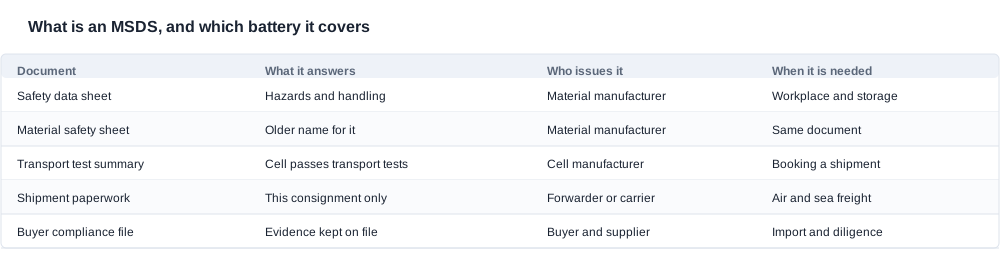
The scope of the document is also worth stating plainly, because it is narrower than buyers sometimes expect. A safety data sheet describes hazards, handling, storage, emergency response, disposal and transport requirements for a material. It is not a quality certificate, it does not guarantee conformity with a product standard, and it says nothing about the finished device the cell goes into. A buyer who has a safety data sheet in the file has not satisfied any certification requirement, and a buyer who has certification evidence has not satisfied the documentation request that a carrier makes.

What the document contains
A safety data sheet follows a standard section order, and the sections are worth knowing because a buyer receiving one can check whether the document is complete for its purpose without reading it line by line.
The opening sections identify the material and the supplier and give emergency contact details — which is the section a forwarding agent or a warehouse checks first. The hazard identification section states the hazards and any classification applied to the material. The composition section names the ingredients and their proportions, which for a battery is the cell chemistry and the electrolyte.
The handling and storage section covers what may and may not be done with the cell, which for a lithium cell includes the temperature and mechanical conditions that must be avoided. The fire-fighting section states the extinguishing medium, which is a specific recommendation rather than a general one. The exposure controls and personal protection section covers what a worker needs. The first-aid measures section covers what to do after contact, ingestion or inhalation.
The later sections cover the technical parameters, the toxicological and ecological information, the disposal considerations, and finally the transport information — the section that carries the classification, the UN number where one applies, the packing group and the handling instructions for the mode of transport. That last section is what connects the document to a shipment, and it is the section that a freight forwarder will actually work from.
What the catalogue publishes about all of this is nothing. There is no safety data sheet, no material safety data sheet, no transport information section, no chemistry, no cell manufacturer and no cell test report anywhere in the range's published material.
The composition section is the one a buyer should read first, because it answers the question a cell document is normally requested for: what is actually inside. For a battery it gives the chemistry and the electrolyte, and that information is what determines the transport classification and the storage conditions. A document that lists a supplier's product range without giving a composition is not a cell document, and a buyer who files one of those has a document that will not survive the carrier's second question. This is the most common form of the problem, because the file tends to be indexed under the supplier's name rather than under the cell model.
The charging-case configuration deserves a second look for the same reason. Five camera entries publish a charging-case capacity, and a case with a published capacity implies a battery inside the case, so a consignment that includes cases can involve more than one cell type. A buyer who assumes the product and its accessories share one cell type is likely to be wrong, and the correction is cheap if it is made in the request rather than at the loading dock.
Why the same material has several names
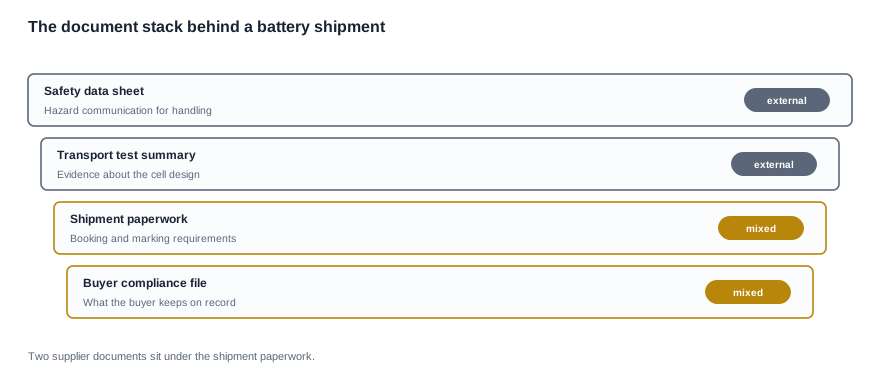
Three documents get conflated, and each answers a different question.
The safety data sheet is the hazard communication document. It is issued by the manufacturer of the material, it is formatted to the standard section order, and its purpose is to let somebody handle, store and transport the material safely. The older term "material safety data sheet" refers to the same document in its earlier form, and the two names are still used interchangeably in commercial practice even where the standard has moved on.
The lithium battery transport test summary is evidence about the cell design. It records the results of the tests in the manual of tests and criteria that a cell or battery has to pass before it can be offered for transport — the tests covering altitude simulation, thermal cycling, vibration, shock, external short circuit, overcharge and forced discharge, among others. It is a document about a specific cell model, and it is what a forwarder asks for when a shipment contains lithium cells.
The shipping paperwork is the document the carrier or the forwarder produces for a particular consignment, drawing on the other two. It describes the consignment, its classification, its packing and its handling.
The practical rule follows from that: a buyer asking for "the MSDS" may receive any of them, and a buyer who needs two things has to ask for two. Asking for the safety data sheet and the transport test summary for the cell used in a specific entry is a precise request that gets precise answers; asking for the MSDS gets whichever document the supplier considers to be that.

When a shipment actually requires one
The requirement is not created by owning a device; it is created by moving cells across a border or through a dangerous-goods process. In practice the document is requested in four situations, and they arrive at different points in a buyer's timeline.
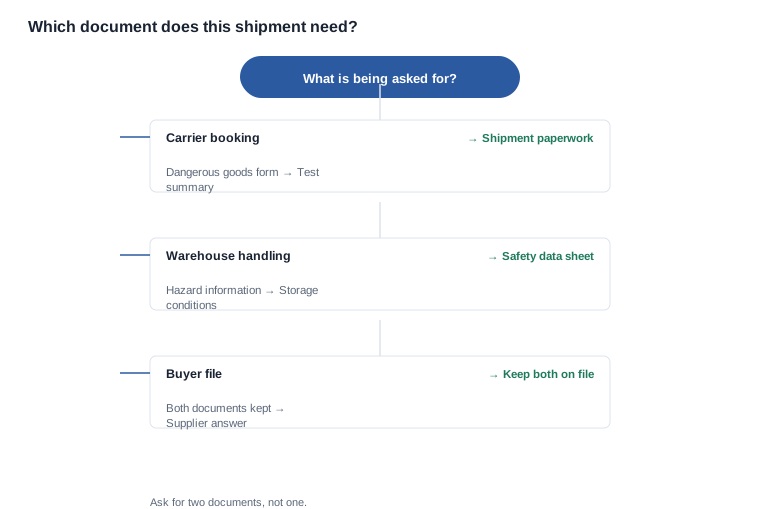
At booking, by the carrier or the freight forwarder. For air and sea freight, a consignment containing lithium cells needs documentation before it is accepted, and the forwarder will ask for the test summary and, depending on the arrangement, the safety data sheet. This is the moment when a missing document stops a shipment rather than delaying it, and it is the point at which a buyer discovers whether the supplier's documentation exists at all.
At the warehouse, on receipt. A distribution centre handling lithium cells commonly requires the safety data sheet before goods are put away, for the purposes of its own handling rules and for the training of its staff. The requirement comes from the handling operation rather than from the transport, and it applies to a shipment that arrived without any transport issue.
For workplace handling. A business that holds cells has its own obligations around hazard communication, storage and training, and the safety data sheet is the document that supports them. This applies to a buyer who stocks samples or spares as well as to one who stocks finished product.
For the buyer's own compliance file. A buyer that imports into the European Union needs to be able to show what is inside the product it sells, and a battery document is one part of that file. It is also the document that answers the questions a buyer's own customers will ask in due diligence.
One point of order matters in all four situations: the request should name the cell, not the device. A supplier with several cell types in the range cannot send one document for the range, and a buyer who receives a single document for a product with two different cell types has received a document for one of them.

What the catalogue publishes about its batteries
The range's published battery material is genuinely useful for planning and genuinely insufficient for compliance, and the distinction is worth keeping sharp.
Published: a cell value for every entry, in the catalogue's own form, which for the seven two-cell entries appears as a value multiplied by two; a charge time for every entry, with twenty-six of them published as a ceiling of two hours or less and the D17 and the ZH12 as about an hour; a charging method on twenty-four entries, with magnetic on seventeen and Type-C on seven; and the charging-case configuration, which tells a buyer whether a case travels with the product at all.
Not published: the cell chemistry, the cell manufacturer, the cell model designation, the energy content in watt-hours, the safety data sheet, the transport test summary, any test report number, the transport classification, the UN number, and any statement about which cell a given entry uses. The energy content in particular is a derived value rather than a published one, and it is derived from the capacity and the cell voltage, which is why it has to come from the cell supplier rather than from a capacity row.
The practical consequence is that a buyer can use the catalogue to work out which cell types are in play across a product line — which is genuinely valuable, because it tells a buyer that a multi-model shipment may contain several cell types and that the document request has to be per cell — and cannot use it to prepare the compliance or transport paperwork at all. A buyer who has planned a launch around the catalogue's battery rows has planned the logistics but not the documentation, and the two are booked together in practice.
There is a second reason the cell values matter commercially, and it is the one that catches buyers out. A buyer comparing two entries on capacity is comparing published figures, and the published figures use the catalogue's own notation, which for the two-cell entries is a value multiplied by a cell count. Using a bare total in a specification risks it being read later as a single published cell value, which is a different statement and occasionally a wrong one.
Questions that get the right document into the paperwork
- Which cell or cells are fitted to each entry we are ordering, and what is the cell model designation? The catalogue publishes the capacity value and the cell count, and the designation has to come from the supplier.
- Can you provide the safety data sheet and the lithium battery transport test summary for each cell type in our order, and in what format? Two documents, named precisely, rather than one document called an MSDS.
- What are the transport classification, the UN number where one applies, and the packing instruction for air and for sea? These determine what the forwarder can accept and how the consignment has to be packed.
- What is the cell's energy content in watt-hours, and what is the cell chemistry? Both are needed for transport paperwork and neither appears in the published material.
- Which battery marks appear on the product and on the packaging, and who applies them? The marking requirement sits with the party responsible for the consignment, and getting it wrong stops a shipment.
- Are there any handling, storage or temperature conditions for these cells that affect how we may hold stock? This is the section that matters for a buyer running a warehouse.
- What does the documentation set look like for a new cell type, and how long does it take to produce? The catalogue publishes no lead time for anything, so the answer has to be given in writing and built into the launch plan.
- Which document does your forwarder ask for, and in which format? The fastest route to the right paperwork is usually to ask the party that will demand it.
A buyer who holds samples, spare units or returned goods has the same exposure as a buyer who holds stock, and the obligation arrives earlier than a shipment does. The disposal section is the one most often skipped, and it is the one that creates a long-tail obligation: it states how the cell has to be handled at the end of its life, which for a lithium cell usually means removal by a qualified facility rather than general waste. A buyer who has never read that section and then disposes of a batch of units has taken a decision without the information needed to take it.
Building a battery document request that gets answered
The difference between a request that returns a usable document set and one that returns a folder of unrelated paperwork is mostly in how it is written. Four habits make the difference.
Name the documents rather than the category. "The MSDS" is ambiguous between a safety data sheet and a transport test summary, and a supplier answering that question will pick the one it has. Asking for the safety data sheet and the lithium battery transport test summary for a named cell gets two specific documents.
Name the cell rather than the entry. The catalogue publishes a cell value and a cell count for every entry, which identifies the cell type, and the request should carry that value and count forward so the supplier knows which of its cell documents is needed.
Ask for the document's own identifiers. Issue date, revision, the supplier's emergency contact, the document language, and the cell designation are what make a document auditable later. A test summary has an identity of its own that is not a certification number, and having it recorded in the buyer's register is what lets a later shipment be matched to the right paperwork.
Keep a register. One line per document — cell type, entry, document name, date, holder — is enough to answer an audit question or a repeat shipment without searching a mailbox, and it is the difference between a compliance file and a collection of attachments.
There is one timing point that belongs with all of this, and it is the reason to send the request at sample stage rather than after the bulk order. The catalogue publishes no lead time for producing compliance documents, so the response time is unknown until it is asked for, and a shipment that arrives with its paperwork still outstanding is held rather than delayed. Sending the request while the samples are in evaluation costs a short delay and removes an unknown from the launch plan.
The commercial case for doing this early is simple arithmetic: a consignment held at the port, refused by a warehouse or re-booked because a document is missing costs far more than a document request that goes out with the sample order. The buyer who has asked early is also the buyer whose customers' due diligence questions get answered from a file rather than from a supplier.
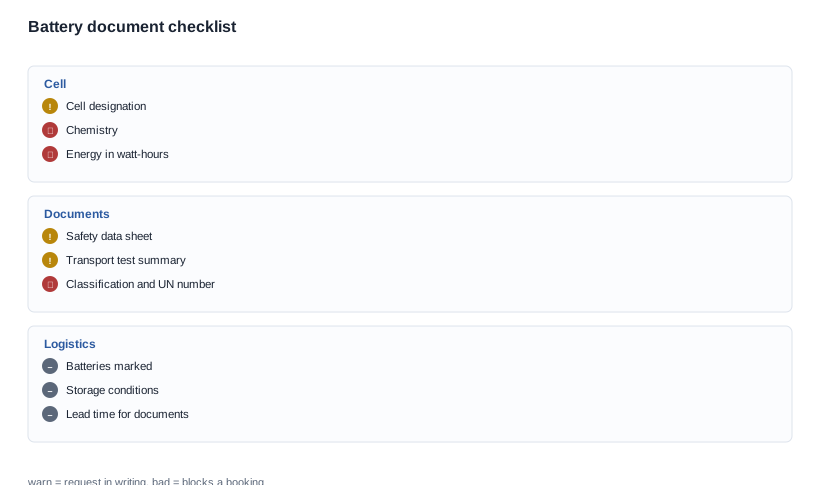
A buyer who has these eight answers has a documentation pack before the goods are built, and the shipment conversation becomes a check rather than an escalation. A buyer who has not has a conversation with a carrier at booking, and the delay lands on the launch rather than on the paperwork.
On this document, our position is that the catalogue publishes none of it, and that is a deliberate boundary rather than an omission to be filled in later. We do not publish a safety data sheet, a transport test summary, a cell chemistry, a cell designation or a watt-hour figure for any of the 28 entries, because the cell is selected at production time and the documentation belongs to the cell supplier rather than to the finished-product range. What the catalogue does publish is the cell value and the cell count for every entry, which is enough for a buyer to know how many cell types a multi-model order involves, and it is the first question in any request for battery paperwork.
Related reading
- The transport document that is not the same thing — UN 38.3 explained
- How the two transport documents differ — UN 38.3 and IEC 62133
- Whether a sea shipment needs it — UN 38.3 for sea freight
- How the cells in this range are configured — mAh explained
The document follows the cell, not the device — name the cell, ask for both papers, and collect them before the goods are built.


